
Home » Providers » Recent Articles:

History Repeats: Revisiting Dr. John Malone’s Big Cable “B-Movie” Treatment of Jefferson City, Mo.

Phillip Dampier November 14, 2013 Charter Spectrum, Competition, Consumer News, Editorial & Site News, History, Liberty/UPC, Public Policy & Gov't, Video Comments Off on History Repeats: Revisiting Dr. John Malone’s Big Cable “B-Movie” Treatment of Jefferson City, Mo.

tciAs Dr. John Malone positions his pieces on the cable industry’s chess board to win back the title of King of Big Cable, it is important to consider history.

Malone’s growing interest in a combined Charter-Time Warner Cable, under his effective control, is the first step towards re-envisioning Tele-Communications, Inc. (TCI) — America’s largest cable operator in the 1980s and early 1990s. Although most of the original TCI Cable systems are now owned by Comcast, Malone’s notorious way of doing business may soon affect millions of Charter and Time Warner Cable subscribers in the not-too-distant future.

[flv]http://www.phillipdampier.com/video/Senate Hearings Alan Garner Jeff City MO 3-90.flv[/flv]

How bad was life with TCI as your local cable company? Listen to Alan Garner, then-City Attorney for Jefferson City, Mo., who testified before Congress in March, 1990 about the uniquely abusive, allegedly criminal behavior of out of control TCI executives. (5:04)

[flv]http://www.phillipdampier.com/video/Senate Hearings Danforth Alan Garner Jeff City MO 3-90.flv[/flv]

Sen. Daniel Inouye (D-Hawaii) was so stunned by the events in Jefferson City, he first asked if TCI’s threats were documented and on learning they were the basis of $35 million in court-ordered damages, the chairman of the Senate Commerce Committee remarked, “you got thugs around there.” Under detailed questioning by Sen. John Danforth (R-Mo.) Garner talks about the “B-Movie” threats from TCI executives who warned city officials “we know where you live,” constant rate hikes, take-what-we-give-you service, and the fact TCI was willing to rip down cable lines and leave the city without cable service if they were denied a franchise renewal. (14:12)

[flv]http://www.phillipdampier.com/video/Senate Hearings Burns Alan Garner Jeff City MO 3-90.flv[/flv]

A befuddled Sen. Conrad Burns (R-Mont.) asked Garner why the city would still want to stay involved in the cable franchise process after the city’s horror story. Garner explained cable operators use public property to wire service to customers. Without local oversight, Garner believed TCI would still be scattering cable lines across neighbors’ backyards, across sidewalks, and draped over fences. TCI had a unique way of managing local service complaints, according to Garner. It threw service orders into a random cardboard box and let cable repair crews fish them out one by one. The ones furthest back in the box were the oldest, and the least likely to ever be chosen. TCI only listened to city officials when they had some oversight and enforcement powers. (3:13)
Idaho Wireless ISP Offers Unlimited 4G LTE “Family-Friendly” Internet Access Free for the First Year

Phillip Dampier November 13, 2013 Broadband Speed, Competition, Consumer News, Rural Broadband, Syringa Wireless, Video, Wireless Broadband Comments Off on Idaho Wireless ISP Offers Unlimited 4G LTE “Family-Friendly” Internet Access Free for the First Year

Screen Shot 2013-10-18 at 2.48.37 PMAn independent cell phone provider in Idaho has found a unique niche to innovate beyond offering traditional cell phone service by launching unlimited 20Mbps home broadband Internet access over its wireless 4G LTE network.
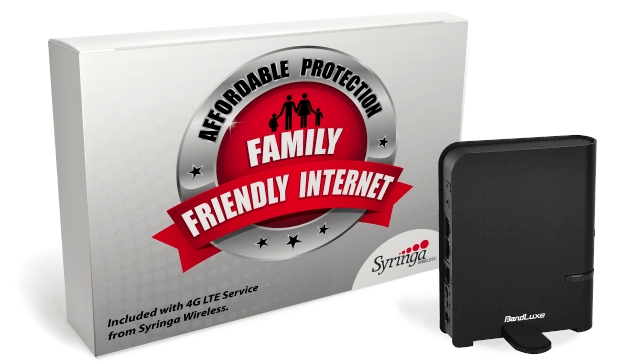
Syringa Wireless of Pocatello has launched a pilot LTE home fixed broadband trial that comes free for the first year if customers agree to buy the necessary equipment — a $300 wireless router. The service promises up to 20Mbps service, which represents a major improvement in communities where broadband speeds consistently rank among the slowest in the nation.

The pilot trial is open to residents in Rexburg, Ammon, Blackfoot, Chubbuck, Pocatello, Rupert, Burley, and Filer — all in Idaho. The company encourages those interested to sign up for the trial before the end of November.

Another innovation from Syringa is the company’s free “Family-Friendly Internet” option for residential, church, and business customers. It filters the Internet to block adult websites and claims not to slow down Internet connections.

syringaSyringa’s fixed wireless broadband puts the company in a stronger position for a Wireless Internet Service Provider (WISP), because it is able to also market traditional cell phone service for its rural customer base. Syringa still sells unlimited smartphone data plans and has a roaming agreement with a major national carrier for cell phone users traveling outside of Syringa’s home service area.

Many independent cell phone providers are struggling to survive because they are unable to sell the most popular new smartphones until they have been available at larger carriers for several months. A fixed wireless broadband service may diversify Syringa sufficiently to withstand any challenges from larger operators.

Founded in 2006, Syringa Wireless is Idaho’s only fully integrated wireless provider, offering cell phone service including data, text messaging, and shared minutes, with preset and unlimited options. Both local and national plans are available, with and without contract. The company also has custom plans for business users and offers service at local stores in southern and eastern Idaho.

[flv]http://www.phillipdampier.com/video/KPVI Pocatello Syringa Wireless Family Friendly Internet 11-8-13.mp4[/flv]

KPVI in Pocatello talks with Scott Dike, general manager of Syringa Wireless, about the company’s new fixed wireless broadband service for Idaho. (4:44)

Verizon Admits Congestion Problems for Its LTE 4G Network in NYC, San Francisco, and Chicago

Phillip Dampier November 13, 2013 Broadband "Shortage", Broadband Speed, Consumer News, Public Policy & Gov't, Verizon, Wireless Broadband Comments Off on Verizon Admits Congestion Problems for Its LTE 4G Network in NYC, San Francisco, and Chicago

They are coming.

Verizon Wireless quietly admitted Tuesday its much-vaunted LTE network is suffering speed slowdowns so serious, some customers in New York, Chicago, and San Francisco are being randomly kicked off Verizon’s 4G network to slower 3G service until congestion eases.

Fran Shammo, Verizon’s chief financial officer, volunteered that online video was the likely culprit and he was surprised by usage growth well in excess of what Verizon predicted.

Current estimates from the company suggest Verizon’s LTE customers are responsible for 64% of all data traffic on Verizon’s wireless network nationwide. But in large cities, Shammo said traffic numbers are much higher.

Shammo

Shammo

“There are certain pockets where we’re absolutely going to experience that down tick from the LTE network to 3G because of capacity constraints,” Shammo admitted.

The sudden revelation Verizon now has insufficient capacity for its LTE service is a significant reversal for Shammo, who has repeatedly told investors Verizon has enough wireless spectrum for the next 4-5 years.

In May 2013, Shammo told investors attending the JPMorgan Global Technology, Media and Telecom Conference:

As I have said before, our spectrum position right now is very good, with the AWS transaction that we completed with the cable carriers last year, with the sale of the spectrum that we are doing with AT&T later this year, obviously giving that spectrum to someone who can utilize it better than we can at this point in time. So I think our holdings are exactly where we need to be. And I have said before we really don’t need spectrum for the next four to five years, with the way that we deployed CDMA and how we will utilize that spectrum from our CDMA deployment over to the 4G network as we need it.

Later that same month, Shammo confidently repeated his assertion Verizon was all set for spectrum at Barclays Global Technology, Media and Telecommunications Conference:

Well, we have — from where we sit today, we have a very good spectrum portfolio which is why we went after the AWS spectrum, which is really going to be used for our capacity of LTE. The 700 megahertz that we have contiguous across the United States is used for the coverage piece. So we’re in pretty good shape for the next four to five years, even with reallocating our 3G spectrum over to our 4G network. […] And we think, look, we think that there will be enough spectrum there. We think that technology change — I mean, people are already talking about LTE advanced. Well, LTE advanced is nothing more than creating a bit more speed on the network. But really LTE advances around being able to utilize the spectrum much more efficiently within the network.

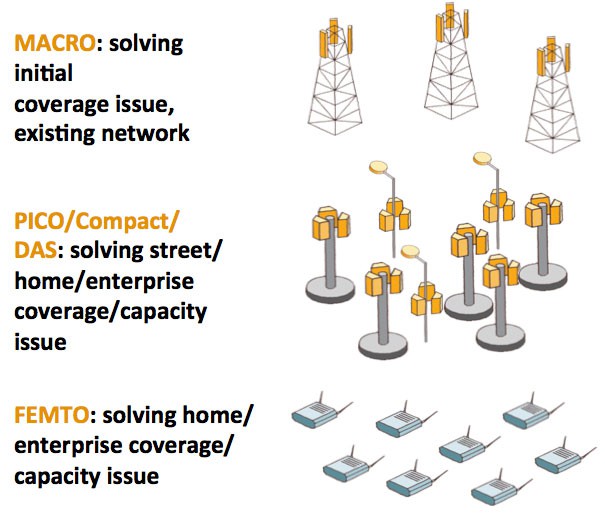
Carriers can boost coverage with additional traditional cell towers, street level picocells, or in-building femtocells.

Carriers can boost coverage with more cell towers, street level picocells, or in-building femtocells.

Some critics suggest Verizon is ginning up a spectrum crisis as new FCC chairman Tom Wheeler begins to look at the current state of wireless spectrum and competition in the wireless industry. They also point to the fact Verizon has so much unused, warehoused spectrum, it has tried to sell the excess off to third parties.

“We have A band [unused spectrum] in our pocket today that we put for auction a year and a half ago and we did not get what we thought it was worth,” Shammo said yesterday. “We brought it back into the portfolio. But we can use that as a trade for some different spectrum. We put it up for auction so obviously it was on the block [and was] never taken off the block. But obviously it is not for fire sale. If a transaction makes sense then we will execute the transaction. If it doesn’t, then we will deploy it.”

In the short-term, Shammo promised customers the congestion issues were already being dealt with by “lighting up” acquired AWS spectrum formerly owned by cable operators, and adding data systems and small cell-type antennas in high congestion areas.

Shammo added that since Verizon was finished expanding its wireless network out to new, unserved areas, future investments would be directed at improving service within current coverage areas.

“I think by year-end you’re going to see us [concentrate] all of our CapEx around densification and then you will start to see us talk about things like VoLTE (Voice over LTE) and multicast (video) and some of these LTE advanced technologies that will come in the next year,” said Shammo.

Verizon Declares Cord Cutting ‘Real’; Under 30 Crowd Doesn’t Care About Linear TV

cablecordCord-cutting is a real, measurable phenomena and is especially common among those under 30 who don’t care about traditional cable television service.


Those are the views of Verizon’s chief financial officer Fran Shammo, speaking this week at the Wells Fargo 2013 Tech, Media & Telecom Conference in New York.

Shammo told investors Verizon FiOS subscriber numbers showed the company has an excellent position in the broadband market because it is the only national provider other than Google offering fiber-to-the-home service.

Verizon TV customers are regularly encouraged to upgrade to 50Mbps Quantum service with a push of a button on their remote control.

Verizon TV customers are regularly encouraged to upgrade to 50Mbps Quantum service with a push of a button on their remote control.

“Broadband is absolutely key,” said Shammo. “Most of our customers are taking our 50Mbps [FiOS Quantum] or higher speed and part of that is because you need that speed inside the home [to support] your wireless devices that run off of Wi-Fi. If you’re running hot water with five people, you are eventually going to slow down the hot water and it is going to run cold. The same thing happens when you are running five wireless devices over your Wi-Fi network.”

Shammo said as more online video becomes available people will gradually shift more of their viewing time away from traditional television.

“We’re also seeing fewer people taking [our cable television] product,” said Shammo. “They really want the broadband speed and if you look at the demographics, those 30 and below don’t care if they have linear TV. They are looking at getting their content through other means.”

Shammo said he doesn’t necessarily have a problem with that because heavy online viewing will stimulate upgrades to faster Verizon FiOS Internet speeds.

“We invested in FiOS for broadband and for television and we think we have a superior product,” said Shammo. “But we’re smart enough to realize that the ecosystem will eventually change and people are bringing content in over-the-top. We want to make sure we have the fastest — the best broadband […] and we believe we have the best linear TV product but we know that over the top video is going to become more popular.”

U.S. Cable Broadband Market Saturated; Low-Income Customer Growth Opportunities Remain

Phillip Dampier November 12, 2013 Broadband Speed, Comcast/Xfinity, Competition Comments Off on U.S. Cable Broadband Market Saturated; Low-Income Customer Growth Opportunities Remain
Moffett

Moffett

Wall Street is worried the cable industry will not be able to report major subscriber gains going forward because just about every middle/upper-income customer that wants broadband within cable’s footprint already has the service from either the phone or cable company.

Cable analyst Craig Moffett from MoffettNathanson Research predicts singing up the last 20% of Americans who don’t subscribe to broadband service will be challenging. As of today, 73% have the service, up 2.5% from last year. An increasingly anemic growth rate is a sign the marketplace is getting saturated, with only low-income Americans underrepresented, primarily because they can’t afford the asking price. Most of the rest don’t own or want computers or Internet access or live in a rural area where the service is unavailable.

Under these circumstances, it is no surprise broadband providers are reporting lower new customer gains. Time Warner Cable and Cablevision actually lost broadband customers in the third quarter, mostly to Verizon FiOS. For the last five years, the cable industry has picked up most of its broadband customers from phone companies offering only DSL service.

“To be sure cable is still taking share [from telco DSL] but it is doing so at a much more modest pace,” Moffett said.

The industry’s best chance for new subscriber growth appears to be bundling computers or tablets with an entry-level broadband offering targeting the poor.

Although cable companies are not supplying free PCs just yet, many are introducing relatively slow, budget-priced broadband tiers to attract lower-income subscribers.

Time Warner Cable introduced a $14.95 2/1Mbps broadband tier this month the company hopes will attract price-sensitive customers, especially those now subscribed to low-speed DSL.

Comcast has Internet Essentials, a $10 slow speed broadband service for families with children enrolled in the federal student lunch program. It is also rolling out a “prepaid Internet service” directly targeting low-income customers. Prepaid customers pay $69.95 for an activation kit containing a DOCSIS 3 modem and a month of broadband service. Renewals are priced at $15 for a week or $45 for a month for 3Mbps service with a 768kbps upload rate.

Most other cable providers offer entry-level broadband speeds, but usually only as a retention tool. Even if the industry custom-targets low-speed tiers to low-income homes, many customers may never make it past the cable industry’s credit check procedure. Comcast’s prepaid offering avoids that problem.

Search This Site:

Contributions:

Recent Comments:

Your Account:

Stop the Cap!