Home » Wireless Broadband » Recent Articles:

South Carolina: America’s Broadband ‘Corridor of Shame’

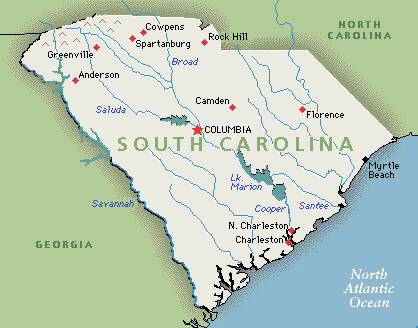
In the fall of 2009, South Carolina’s Budget and Control Board approved a fire-sale deal that leased out 95 percent of the state’s public wireless broadband spectrum to two private companies in a 30-year contract valued at $143 million, with the promise South Carolina would enjoy better broadband as a result.

Two years later, South Carolina’s broadband standing has been called “a Corridor of Shame” according to one provider that is trying to expand service while Clearwire and DigitalBridge — the contract winners, sit on their respective hands.

Both companies secured access to the statewide Educational Broadband Service spectrum they get to control with near-exclusivity for less than $5 million annually — around $1 a year for every South Carolinian that could eventually be served with improved broadband.  But nobody is getting service from either provider, indefinitely.

Columbia’s Free-Times notes neither company has concrete plans to bring broadband to anyone in South Carolina.  Clearwire, now in financial trouble, provides no service in the state and DigitalBridge refused to comment for the newspaper’s story.  Free-Times reporter Corey Hutchins could not find anyone able to provide any definitive information about either company’s short or long-term plans to hold up their end of the bargain.

Khush Tata, chief information officer for the S.C. Technical College System suspects one might not even exist.  So long as these two companies maintain a lock on the spectrum, nobody else can deliver the wireless service either.

“I haven’t seen any big cohesive strategy since [the leasing] at all,” Tata told the newspaper. “I think that it’s still based on market and business viability for each provider so they’re sort of on their own. Each provider, they invest based on their return on investment, which is good for their business, but as a state there isn’t any overall planning or approach — and I think the leasing of spectrum provided the largest overall strategy opportunity, which is a pity that it hasn’t panned out yet.”

Don’t tell that to industry-connected Connected Nation, whose South Carolina chapter claims the state is doing better than most providing broadband service.  The group has published maps, based entirely on data provided by the state’s phone and cable companies, that suggest most residents not only get the service, but have a choice in providers.

“That’s just plain bull,” says Stop the Cap! reader Jeff Lodge, who lives outside of Columbia.  Not only does the local cable company pass him by, but there is no DSL either.  He relies on an unlimited wireless data plan from AT&T and does most of his web browsing during breaks at work.

No Plans

“I live in a community of 22,000 people and only those along the main streets in this community have access to broadband,” he says. “The cable company doesn’t go far off the beaten path, and the here-and-there DSL some get is dreadful.”

Even Connect South Carolina acknowledges broadband speeds in the state are often woefully behind others in the region.  Many well-populated census tracts have no wired broadband at all.

With the pervasive lack of broadband, incumbent providers have been heavily lobbying the state to keep others off their spartan turf — pushing for the same type of legislation effectively banning community broadband networks that North Carolina passed earlier this year.

“It’s Time Warner Cable and AT&T… again, that are behind most of this effort, and those two companies treat South Carolina like a forgotten bastard child now,” Lodge says. “Can you imagine the arrogance of big cable and phone companies to keep competition away even when they, themselves, won’t compete?”

No Comment

One company trying to make a difference: GlobalCo and their partner On-Time-Communications.  A review of the under-developed website of the latter suggests neither entity is well-positioned or backed to deliver broadband without significant financial assistance.  But at least they recognize the problem.

“In South Carolina there’s 10 counties that made [the FCC’s report on broadband unavailability] and the majority of them come out of what’s commonly referred to as the ‘Corridor of Shame’,” Ronnie Wyche, GlobalCo’s vice president of sales told Free-Times.

None of this comes as a surprise to Brett Bursey, director of the South Carolina Progressive Network, who opposed the spectrum sell-off.

“The bargain basement lease of the nation’s only statewide broadband system was a theft from, and insult to, the taxpayers who built and own the system,” Bursey told the paper. “The system is not being developed by the companies who won the lease and the Legislature is ideologically opposed to public ownership.”

Sprint Customers’ Treatment of 4G WiMAX: So Unimpressive They Shut It Off to Save Battery Life

Sprint’s 4G experience has been nothing to write home about for a number of their customers, who are increasingly disabling the service to save on battery life.

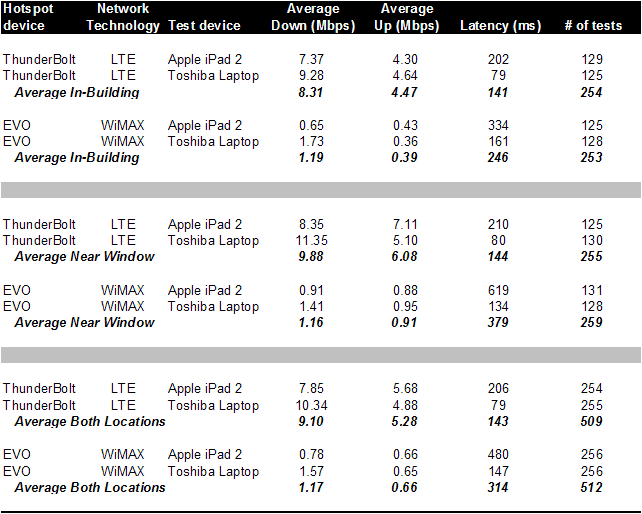
Speed tests of Sprint’s 4G WiMAX experience show increasingly unimpressive results, as the network grows exponentially more crowded with customers trying to capitalize on the higher speeds 4G is supposed to deliver.  The result?  BTIG Research in April found, after exhaustive testing, the average Sprint 4G customer was now getting around 1/1Mbps service from a network that promised to deliver speeds many times that.

This isn't even a contest. (Source: BTIG Research)

Now an increasing number of customers are simply switching the 4G service off completely to extend battery life.

Doug Mahoney, a contributing editor for TechZone360, says he has about given up on WiMAX:

WiMAX tends to stay turned off so I run 3G and there’s no big differences in the convenience of reading email or using simple apps like Twitter and Foursquare.  With more public places starting to offer free WiFi, the case for WiMAX — or LTE — on a smart phone starts to grow weaker between the extra cost and the battery life issue.

Mahoney complains Sprint’s 4G network is simply not robust enough to support consistent speeds and access.  In suburban Washington, he compares Sprint’s 4G coverage to an open air tree, with spotty service scattered across the region.  As a result, his 4G phone spends a lot of time desperately-seeking-signal — a process that accelerates battery depletion.

Given Sprint’s WiMAX “tax” of an additional $10 a month for the service, Mahoney isn’t so certain he’d pay it again on a future Sprint phone.

Are the same speed reductions in store on Verizon’s currently-lightning-fast LTE 4G network few customers use right now?  Perhaps, but Verizon’s brand may force the company to make sure coverage is much stronger than what Sprint customers currently tolerate:

LTE has the same power consumption issues as WiMAX. I suspect Verizon will have better, more ubiquitous LTE coverage just due to the characteristics of the 700 MHz spectrum and physics involved, so I should have faster broadband available in more places rather than the abstract green tree coverage map.

Cricket Drives Away Mobile Broadband Customers With Internet Overcharging Scheme

Phillip Dampier August 4, 2011 Audio, Broadband Speed, Competition, Cricket, Data Caps, Wireless Broadband Comments Off on Cricket Drives Away Mobile Broadband Customers With Internet Overcharging Scheme

Leap Wireless is trying to save face on less-than-impressive second quarter financial results showing the company is losing its mobile broadband customers who are increasingly weary of Cricket’s price increases and speed throttles.

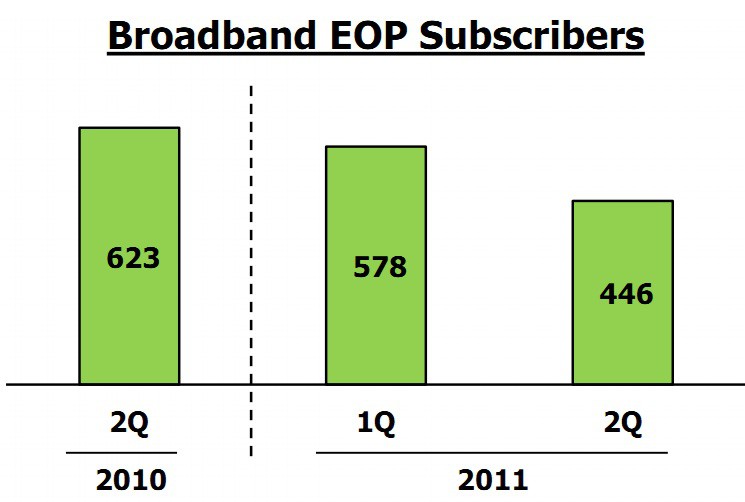
The company lost at least 132,000 broadband customers since the first quarter, mostly due to price increases, reduced usage allowances and “network management” practices, which reduce speeds to near dial-up for customers who are deemed to be “using too much.”

“On broadband, we tightened our focus to more profitable customers while shedding less profitable ones,” said Leap Wireless CEO Douglas Hutcheson.

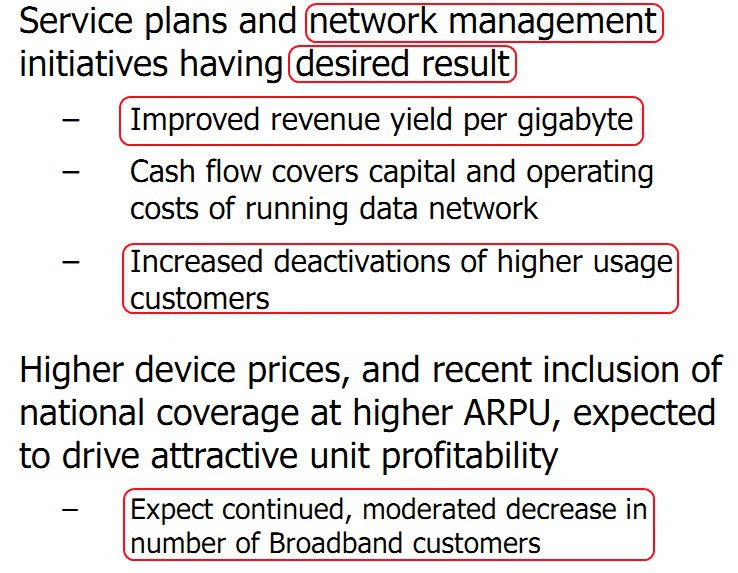
Internet Overcharging Facts of Life: What 'Network Management' tools are really used for. (Courtesy: Cricket's Second Quarter Results Investor Presentation)

Cricket recently announced increased pricing on their usage limited plans: $45/month for 2.5GB, $55/month for 5GB, or $65/month for 7.5GB.

With a less-than-robust regional 3G network and higher pricing, broadband customers have decided to take their business elsewhere, despite the company’s recently announced expanded data roaming agreement with Sprint.

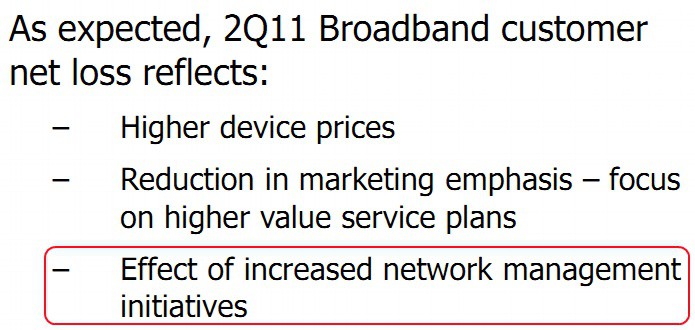
Cricket acknowledges their “increased network management initiatives” are partly to blame for the loss, but the company also says increased prices for mobile broadband devices, which used to be available for free after rebate, are also responsible.  Cricket’s least expensive mobile broadband modem now runs just under $90.

Company officials told investors the losses “were expected,” and that the company has been trying to make up the difference with higher value smartphone data plans.  Mobile broadband customers tend to consume more data than smartphone users, so the company’s emphasis on smartphone data users, who use less, will deliver increased revenue at a reduced cost.

Cricket’s CEO explains the company’s renewed focus on keeping highly-profitable mobile broadband customers while effectively getting rid of “heavy users” who have been targeted with aggressive speed throttling over the past year, and now face higher prices for lower usage allowances. Also explored: Cricket’s future 4G LTE network buildout.  August 3, 2011.  (4 minutes)
You must remain on this page to hear the clip, or you can download the clip and listen later.

Cricket's declining mobile broadband business

In fact, the company’s presentation to investors credits network management tools for driving away “higher usage customers,” allowing Cricket to reap the benefit of “improved revenue yield per gigabyte.”  In short, that means Cricket profits handsomely from data plans they hope customers will only occasionally use.

One of Cricket’s biggest product priorities this year is pitching its Muve Music service, bundled into an all-inclusive $55 wireless prepaid phone plan.  It gives Muve phone customers unlimited access to an enormous downloadable music library accessed on the phone.  Since the service does not allow customers to transfer the music to other devices, record companies are happy to participate.

The biggest downside for some is that the Muve phone becomes your music player — a phone many customers consider a work in progress.  Some critics have labeled the service a “total fail” because of sound quality and DRM restrictions. But since the service is already bundled into the wireless plan at no additional cost, more than 100,000 customers are using it, downloading at least 130 million songs since it was first introduced in January.

Muve Music is another way Cricket is trying to differentiate itself from other wireless providers, and the company may try to expand the Muve Music service to much-more-profitable smartphones in the near future. Cricket hopes to begin selling no-contract smartphones at prices below $100 by Christmas.

Cricket executives answer questions from Wall Street about how the company intends to deal with a decline in mobile broadband customers, and explains their use of network speed throttles. Cricket plans to “follow industry trends” and experiment with “session-based” throttles sometime next year. These allow customers to pay an extra charge to temporarily remove the speed throttle when they need additional bandwidth. It’s just one more source of lucrative revenue from conjured up network management schemes.  August 3, 2011.  (4 minutes)
You must remain on this page to hear the clip, or you can download the clip and listen later.

Cricket is also planning further expansion of its ‘welfare wireless’ plan — a Universal Service Fund-backed home phone replacement for customers receiving public assistance.  The Lifeline USF subsidy is designed to provide affordable home telephone service to the most income-challenged among us.  Many landline providers charge around $1 a month for the service (before fees), and then charge for every call made.

Cricket’s implementation of this subsidy could draw some controversy because it delivers a $13.50 monthly discount off -any- of their rate plans.  That means qualified customers could pay just over $40 a month for a high end smartphone service plan, subsidized by every telephone ratepayer in the country.

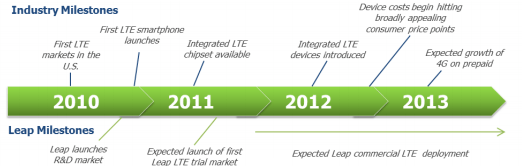
Cricket also plans to launch LTE 4G service starting in early 2012.

Cricket plans to introduce 4G LTE service in 2012.

Nice Try: Media Sells Rural Massachusetts Residents on Fiber Broadband They Won’t Get

For the past two years, we’ve watched a lot of expansive fiber broadband projects get promoted by local media as broadband nirvana for individual homes and businesses that are either stuck with molasses-slow DSL or no broadband at all. Now, we’ve found another, sold by Springfield, Mass. media as salvation from Verizon’s ‘Don’t Care’ DSL for western Massachusetts.  But will the 1,300 miles of fiber actually reach the homes that need a broadband boost?

[flv width=”640″ height=”380″]http://www.phillipdampier.com/video/WSHM Springfield Broadband in Berkshires 7-26-11.mp4[/flv]

WSHM-TV in Springfield covered the start of MassBroadband 123’s fiber optic project as the solution to rural broadband woes in western Massachusetts.  But most residents won’t actually get to use the new network, at least initially.  (2 minutes)

Last month, Gov. Duval Patrick joined public officials and firefighters at the Sandisfield Fire Department to kick-off construction of the MassBroadband 123 fiber-optic network project to expand broadband access to more than 120 communities in western and north central Massachusetts.
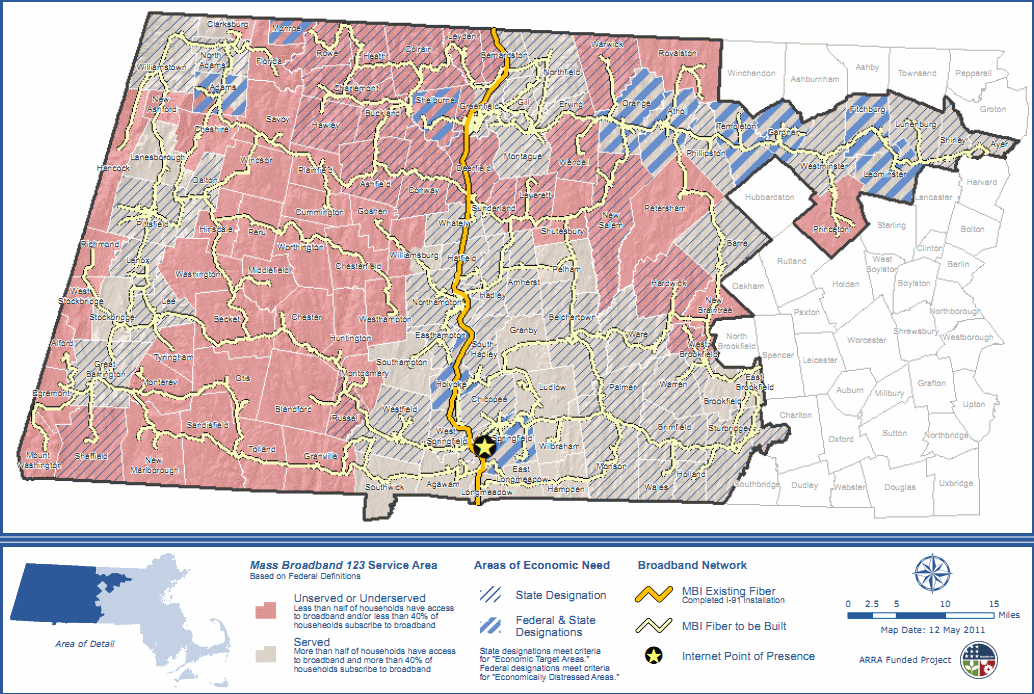
MassBroadband 123 Service Area (click to enlarge)

“For too long, families and businesses in western Massachusetts have lived without reliable and affordable high-speed Internet access,” said Governor Patrick. “Today, as we commence the installation of more than 1,000 miles of fiber-optic cable across the region, we start the critical final step in delivering broadband access to everyone. The digital divide in Massachusetts is about to close.”

Don’t hold your breath.

Don’t get me wrong.  The Massachusetts Broadband Institute means well.  Judith Dumont, the group’s director, is well-aware of the challenges rural Massachusetts has getting 21st century broadband.  She’s helping to oversee the construction of an enormous middle-mile, fiber backbone network that will eventually reach those ten dozen communities.  But much of the funding for the project precludes the possibility of directly wiring that fiber to the people who actually need it.  The incumbent providers’ lobbyists have seen to that, broadly warning it would represent ISP Socialism to allow government money to deliver service to homes and businesses — customers they themselves claim to be committed to serve.  But ask any resident in Sandisfield how well they manage that.

Gov. Patrick splices fiber cable at inauguration ceremony for fiber expansion project. (Courtesy: MBI)

A good part of upgraded broadband on the way in the Berkshires will be provided to government institutions like local government, public safety, schools, and libraries.  There is nothing wrong with that either, but when local media blurs this distinction into belief fiber-fast Internet access is on the way to Mr. & Mrs. Jones living on Maple Street, they do a real disservice to the cause for better broadband.

Dumont optimistically believes that opening the state’s fiber network to incumbent providers on a wholesale basis will dramatically help the pervasive problem of reaching rural customers.  Unfortunately, this has simply not been our observed experience watching these projects develop.  The “last mile” problem doesn’t get solved with the existence of a middle mile network, because providers are rarely willing to invest in the construction costs to wire the unwired.  Political and business matters too often get in the way.

Cable companies frequently boycott participation in these networks, and phone companies like Verizon Wireless -may- utilize them for backhaul connectivity to their cell towers, but don’t expect to see lightning-fast Verizon FiOS fiber to the home service springing up anytime soon in western Massachusetts, even if fiber connectivity is provided just a mile or so up the street.  If they didn’t build it themselves, many providers just are not interested.

“Last mile” is often the most expensive component in a broadband network.  It’s the part of the project that requires digging up streets and yards, stringing cables across phone poles, and literally wiring the inside and outside of individual homes and businesses.  Verizon FiOS works in densely populated areas where large numbers of potential customers are likely to deliver a quick return on investment in the network.  But Wall Street has always disagreed, declaring the capital costs too high to make sense.  AT&T won’t even match Verizon’s commitment, relying instead on fiber-to-the-neighborhood networks that deliver access over a more modern type of DSL, delivered on fiber to copper wire phone lines already in place.  That’s their way of not spending money rebuilding their own last mile network.

Wireless ISPs are expected to take advantage of the state's new middle-mile network.

If any part of the broadband network in rural America needed subsidies, the “last mile” is it.  But Washington routinely delivers the bulk of federal assistance to the construction of middle mile networks and institutional broadband that doesn’t deliver a single connection to a homeowner or business.  That suits incumbent providers just fine, judging from their lack of interest in applying for broadband subsidy funding made available two years ago and their hard lobbying against community broadband networks, or anything else smacking of “competition.”

Thus far, the limited grants that are available for “last mile” projects require substantial matching funds and are often limited to $50,000 — a ridiculously low amount to solve the “last mile” challenge.  Those trying are primarily fixed wireless providers valiantly attempting to serve the areas DSL and cable forgot, but deliver woefully slow speeds at incredibly high prices.  WiSpring, one such Wireless ISP, wants to expand coverage with the help of the new fiber network.  But their top advertised wireless speed for residential customers is 1.5Mbps, and that will set you back $100 a month after a $500 installation charge.  Oh, and their customer agreement limits use to 25GB per month with a $10/GB overlimit fee.  That’s hardly the kind of broadband solution a multi-million dollar fiber network should bring to individual consumers.  It’s as frustrating as filling a pool, one cup of water at a time, with an eye-dropper.

Now imagine if a quarter of the state’s $40 million investment in broadband — $10 million, was spent physically wiring individual homes with fiber broadband.  Would that make a bigger splash in the lives of ordinary consumers than a middle mile network they cannot directly access?  Is construction of a state-of-the-art fiber network a good investment when many of the providers scheduled to use it are Wireless ISPs delivering bandwidth suitable for e-mail and basic web browsing only?

In West Virginia, we learned last month the state is swimming in middle mile stimulus grant money it can’t spend fast enough on behalf of institutions — many who either already have super fast service or can’t afford the Cadillac pricing that represents the ongoing service charges not paid for by grant funds.  Is this a good way to spend tax dollars?

Communities large and small need to think big when it comes to broadband.  Building a middle mile network does not by itself solve the access problem.  It’s a fine start, but absolutely requires a follow-up commitment to solve the last mile problem.  Here are our recommendations:

  1. Demand the federal government eliminate restrictions on the kinds of network projects that can built with stimulus funds, especially those that prohibit investment in last-mile networks;
  2. Don’t believe for a moment large cable and telephone companies will bring better broadband to consumers just because you have a middle mile network.  Historically, they have lobbied hard against last-mile projects they do not own or control, and fund conservative political groups to oppose your community’s right to develop and govern your own broadband future;
  3. If incumbent providers won’t provide the service your community needs, consider exploring the possibility of doing it yourself.  Just as MBI contracts the wholesale part of its service out to a third party to administer, nobody says the village clerk has to be a billing agent for a community broadband service that directly serves your residents;
  4. Involve local citizens in rallying for better broadband instead of sitting around and waiting for the local phone or cable company to provide it.  They won’t.  It’s a simple matter of economics for them – will they get a sufficient return on their investment within five years? If not, you are not getting improved broadband.  That works for them but doesn’t work for your community, and providers have made it clear most of the networks they intend to build are already built.  That leaves a lot of communities behind.
  5. While wireless may be an answer for the most rural or difficult-to-reach homes, it is not a realistic solution for 21st century broadband inside village or town limits.  Wireless networks often lack the capacity to sustain the growing demand for multimedia, high-bandwidth content that is becoming more important for today’s online experience.  When a provider limits usage to 25GB a month, that’s a big problem for any community that will soon find itself stuck in a broadband swamp while the rest of the country passes it by.
  6. The biggest financial challenges seem to come to those who think small about broadband projects.  Don’t rely on yesterday’s technologies for tomorrow’s networks.  Fiber-based broadband will deliver the best bang for the buck and is infinitely upgradable.  That’s why rural phone companies and cooperative telecom providers are constructing fiber networks themselves.

[flv width=”640″ height=”380″]http://www.phillipdampier.com/video/WGBY Springfield The State Were In Judith Dumont 7-11.mp4[/flv]

WGBY-TV in Springfield talked with Judith Dumont about western Massachusetts’ broadband future.  (19 minutes)

AT&T Math: A ‘Heavy User’ Subject to Throttling Uses 4GB and Up

Loyal AT&T customers grandfathered on unlimited data plans are being paid back for their loyalty to the company with the threat of a speed throttle hanging over their heads if they don’t limit the use of their unlimited use plan.

The Washington Post reports, by AT&T’s calculations, anyone using 4GB of usage and up during the month is likely to find their smartphone neutered to near dial-up speed for the rest of the month:

The company said that it will throttle back data use for the top 5 percent of data consumers, who use “twelve times” what its average smartphone data customers use.

A recent Consumer Reports survey found that the average smartphone user on AT&T’s network uses 360 megabytes per month — meaning that only power users will feel the pinch. Using AT&T’s formula, the company’s likely scaling back its network for users who exceed 4 gigabytes per month.

Four gigabytes of usage on a smartphone is a considerable amount, if all you do is browse web pages, read e-mail, and access a handful of apps.  But consumers who increasingly rely on GPS navigation and streaming multimedia content, particularly videos, will find they don’t have to live on their smartphones to put themselves on AT&T’s bad side.  Even devoted attention to video streams from a home security system could consume a considerable amount of data on a usage plan that was supposed to be unlimited.

“It’s a slap in the face to loyal customers who have been with AT&T for a decade or longer,” says Stop the Cap! reader Paul.  “Wireless providers used to operate on rewarding loyalty by letting customers keep their plans intact unless and until they change plans or depart for another provider.  Now AT&T is literally cattle-prodding their most loyal customers who pay $30 a month for an unlimited plan that will now have limits.”

Paul wonders why anyone would want to keep an unlimited plan that will be throttled to punish customers with unusable speeds.

“Clearly, Verizon moving away from unlimited data allowed AT&T to stick it to customers who know they have few places to run,” Paul writes. “This is probably only the beginning.  Why again would we want AT&T to get any bigger than it already is?”

Search This Site:

Contributions:

Recent Comments:

Your Account:

Stop the Cap!