Home » Rural Broadband » Recent Articles:

The Devil Is In The Details: FCC Chairman Julius Genachowski Speaks About Broadband to Consumers

Phillip Dampier

Phillip Dampier

FCC Chairman Julius Genachowski recorded a YouTube video to talk to Americans about the development of a national broadband plan for the United States.

In optimistic, flowery language, Genachowski invited Americans to submit their ideas and suggestions not only regarding broadband, but also the priorities Americans think the FCC should have in the future.

The most important part of the five minute video comes right in the beginning when Genachowski called broadband critical to the nation:

“Broadband is our generation’s major infrastructure challenge. It’s for us what railroads, highways and electricity were to past generations.”

<

p style=”text-align: center;”>

Genachowski would do well to remember America’s experience with all three of these important history lessons.  The broadband plan Genachowski envisions is subject to the same type of intrusive, anti-consumer tactics that wreaked havoc on past generations of consumers.

The railroad industry’s cartel of ownership and control is a familiar tale.  The Rise of Monopolies tells the story:

The need for all of these industries to stay successful was worrisome for railroad owners. To avoid the loss of production in any of these areas, large corporations attempted to stabilize their situations by pooling markets and centralizing management. By combining all of the fields into one conglomeration, the railroads had a new power, as they acquired control of many facets of the new economy. This body now had the ability to “squeeze out competitors, force down prices paid for labor and raw materials, charge customers more and get special favors and treatments from National and State government” (Chalmers). The railroads had all the power, because they controlled all the prices. Since the new residents of the West could not survive without the use of the railroads, they were forced to pay whatever rates the railroad companies set.

With these huge stores of capital, the railroad companies were able to finance political campaigns through whatever and whomever was needed in government. With this control in Washington, there was no way to stop the overwhelming control of this industry over society. The entire nation was subject to the whims of this monopoly.

It took direct government intervention to break up the railroad monopoly and protect consumers and businesses from the abusive practices of a transportation industry that can make or break you based on pricing and service, with little competition.

Public highways became an important asset that still pays off today.  The Eisenhower Administration’s deployment of the interstate highway system, at the size and scope required, would not have been accomplished by the private sector on its own.  Today’s federal highway system is largely self sustaining through the collection of gasoline taxes paid by drivers.

As Americans struggle with several incumbent providers that refuse to provide 21st century broadband technology, with little competition to drive that infrastructure investment, an uneven variety of broadband networks have emerged, from fiber to the home in some areas to an indefinite reliance on aging DSL slow speed technology for millions of rural Americans, or worse, inadequate satellite broadband.

It may be time to consider the same kind of national approach with a publicly owned fiber network private providers of all kinds can use to serve customers with a uniformly high speed, high quality user experience.

Electricity and the development of rural America is another very familiar tale to any rural broadband user.  From TVA: Electricity for All:

Although nearly 90 percent of urban dwellers had electricity by the 1930s, only ten percent of rural dwellers did. Private utility companies, who supplied electric power to most of the nation’s consumers, argued that it was too expensive to string electric lines to isolated rural farmsteads. Anyway, they said, most farmers, were too poor to be able to afford electricity.

The Roosevelt Administration believed that if private enterprise could not supply electric power to the people, then it was the duty of the government to do so. Most of the court cases involving TVA during the 1930s concerned the government’s involvement in the public utilities industry.

In 1935 the Rural Electric Administration (REA) was created to bring electricity to rural areas like the Tennessee Valley.

Many groups opposed the federal government’s involvement in developing and distributing electric power, especially utility companies, who believed that the government was unfairly competing with private enterprise. Some members of Congress who didn’t think the government should interfere with the economy, believed that TVA was a dangerous program that would bring the nation a step closer to socialism. Other people thought that farmers simply did not have the skills needed to manage local electric companies.

Any community wrestling with a municipal broadband project to provide service the private market refused to offer is already acquainted with this familiar story.  So are many rural consumers who are waiting, and waiting, and waiting, for the private market to bring broadband to their communities.  Unfortunately for them, the private market has already written them off as “not profitable enough” to provide service.

The electrification of America did not lead to a socialist takeover of America.  It led to the development and sustainability of rural communities and their local economies.  Agriculture remains one of America’s most important success stories, and without widespread electrification, this story might not have been written.

Scare tactics and horror stories have come whenever a private monopoly or cartel faces the threat of competition, regulation, or a municipal option to provide needed services communities are denied by the private sector.

The fear mongering was there when the railroad monopolies faced investigation and regulation, the “socialism” scare was heard when government attempted to undertake public infrastructure projects of many kinds from highways to utility service, and the same kinds of rhetoric is heard today about “socialist takeovers of the Internet” and “municipal broadband unfairly competes with private providers,” and the logical opposite “the government can’t do anything right.”

Unfortunately, the FCC has a long history of cozy relations with lobbyists who understand how to work within the agency’s nearly-impenetrable bureaucracy.  A review of the broadband plan submissions to the FCC reveals a large  number of them come from lobbying groups and the providers themselves.  Most consumers were left typing comments into a box on the web submission form, with every indication those remarks will be deemed “not serious” by FCC staff.

This time, Chairman Genachowski has to show more than a YouTube video inviting consumers to share their input.  We’d like actual evidence the consumer point of view is actually being taken seriously for a change, and is not simply one tiny noise drowned out in a loud crowd of special interests with profit agendas to protect and public policy to influence.  The FCC already knows what consumers want: widely available, fast, reasonably priced broadband free from Internet Overcharging schemes protected with robust Net Neutrality policies enforced by law.

If the existing providers want to erect roadblocks to competition, oversight, and hell-or-high-water-broadband-deployment, it’s time to break them up and get them out of the way.  That’s broadband we can believe in.
Washington County, NY Considers Spending $40,000 On Broadband Study – Rural Broadband Revisited

Phillip Dampier September 17, 2009 Public Policy & Gov't, Rural Broadband 1 Comment
Washington County, New York

Washington County, New York

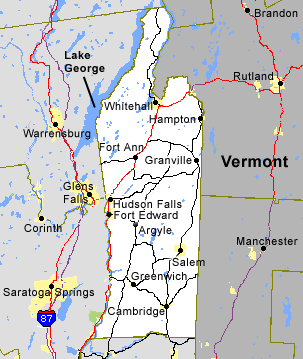
Washington County, one of New York’s many rural counties, sits on the eastern border of the state adjacent to Vermont.  Its 62,000 citizens have access to dial-up, some areas have been wired by Time Warner Cable, and some others have access to Verizon DSL service.  But vast swaths of the county have no choice for broadband at all.  The Washington County Board of Supervisors wants to do something about that and will vote this week on a proposal to spend $40,000 to study how Washington, in cooperation with Warren and Hamilton counties, could benefit from a wireless broadband network being proposed by Plattsburgh (N.Y.)-based CBN Connect.

CBN Connect is a non profit corporation that constructs broadband platforms and networks it resells to commercial providers who will not construct such networks themselves.  CBN Connect’s website states “providers like Time Warner (Cable), Primelink, Westelcom, and others [can use their networks] to reach new customers.”

CBN Connect has plans to develop both fiber optic and wireless networks across New York’s “North Country” in eastern upstate areas.

No details about the type of wireless network under consideration were available.

Readers of The Post Star, which serves the county, had some problems with the country spending $40,000 of taxpayer dollars on the study:

“We are actually thinking of spending $40,000 to fund a private company’s “study?” If CBN wants to sell their services, which I am guessing they will profit on, let them fund whether it is feasable or not. This money can be better spent in other areas of the county, or better yet, don’t spend it at all.” — Whall01

“If there’s a demand (home or business) then the providers (Time Warner Cable, Verizon, CBN Connect) will do their own study (and fund it) to see if it makes sense to them. If they don’t, then they won’t be in business long. Washington county supervisors need to figure out how to cut expenses and overhead, not add to them.” — HFRES

“What a waste — $40,000 for a study to bring broadband to the community? FiOS is the technology that we should be looking into.  Why are our counties always a day late and a dollar short of keeping up with the rest of the world? These counties should be joining together to get Verizon here and bring us FiOS.” — Enoughalready

New Zealand Embarks on National Broadband Plan — Publicly Owned Fiber Network Will Bring Relief to Many

Phillip Dampier September 16, 2009 Broadband Speed, Community Networks, Data Caps, Public Policy & Gov't, Rural Broadband Comments Off on New Zealand Embarks on National Broadband Plan — Publicly Owned Fiber Network Will Bring Relief to Many
Communications and Information Technology Minister Hon. Steven Joyce

Communications and Information Technology Minister Hon. Steven Joyce

New Zealand, long ranked near the bottom of the barrel in broadband according to OECD rankings, will embark on a $1.5 billion (NZD) national broadband initiative, with a publicly-owned fiber network as its hallmark.

The plan, which will give urban and suburban New Zealand residents access to speeds faster than commonly available in the United States, will reach three-quarters of the population within the next ten years.  New Zealand has discarded the “wait around for the private sector” approach, which has left the country with stiflingly slow and heavily capped broadband at high prices.  Instead, it will create an open access fiber optic network on which private providers can compete and offer consumers the speeds they desire.  Communications and Information Technology Minister Steven Joyce issued a statement explaining why the government was getting involved:

Private sector companies have decided, on behalf of their shareholders and as a commercial decision, not to invest in a nationwide network of fibre-to-the-home at this point in time.  The government understands this, and so wishes to assist and work with the private sector in improving the business case for ultra-fast broadband.

The government is also getting involved in order to encourage the provision of widespread open access dark fibre services, which will facilitate the best possible competition outcomes in emerging markets and encourage innovation in wholesale and retail services.

For residents in 33 communities across the country targeted for access to the new network, it cannot come soon enough.  For many of them the most important issue, even beyond speed, is an end to what one Henderson resident called “the current crap called ‘data caps.'”

The speed of the broadband is meaningless compared to the tiny data caps involved.  On the current slow broadband, I use up my 50GB data cap 12-15 days into the month.  Ultra fast broadband would only be useful with no data caps involved, because the existing broadband speed is twice as fast as the cap already,” Lucy in Auckland told the New Zealand Herald.

Rose in Glenfield agrees:

“We have a 20GB data cap that we chew through in about 10-14 days, and then we are stuck on 64kbps or we have to pay another $30 for another 20GB to get through the rest of the month. When are they going to address these kinds of issues,” she asks.

New Zealand has seen the impact of Internet Overcharging schemes for years.  Providers originally introduced ‘data caps’ to reduce the usage on their networks, but have since relied on them, and consumption billing also as a way to collect revenue.  Most residential customers endure usage caps of 20-50GB per month.  After that, some providers dramatically reduce their connections to just above dial-up speed, while others have found new revenue by charging customers $2/GB or more in overlimit penalties and fees.  Some offer additional usage allotments, but at high prices, such as $30 for 20GB of additional usage.

The result has been a dramatically lower adoption of broadband in New Zealand, and many don’t think it’s worth the money.

John Rutter in Howick suggests speed is secondary to dealing with the issue of loathed usage caps.

I like the idea of a ultra-fast broadband investment initiative but I hope Internet service providers like Vodafone, Slingshot, and Orcon will provide unlimited Internet soon. Unlimited Internet should come first, then ultra-fast broadband,” he said.

The government has received public support for its broadband initiative.  The public benefit is a much faster “public highway” on which private providers can offer service to individual customers.  By constructing a fast pipeline publicly that no provider is willing to provide privately, it creates additional value for consumers who find faster, more reliable service, preferably on better terms.

“Already a number of companies have shown interest in the government’s broadband initiative,” Joyce said in a statement. “It’s time to get on with finding the right partners to build these networks.”

The government “is prepared to accept a less than commercial return” from the partners. It aims to hold less than 25 per cent in the partnered investment vehicles and will resist contributions of more than 50 per cent.

For rural New Zealand, the answer generally won’t come from a fiber-based strategy, Joyce says.  Instead, the government estimates $300 million will be needed from public and private sources for a rural broadband plan.  Significant portions of New Zealand are difficult to reach with traditional broadband networks, and many New Zealand residents in even medium sized outlying towns find themselves on long waiting lists for what service is available.

Steve in Wellington told the Herald a lot of towns (like Richmond, Tasman and Rolleston – not just remote areas) have issues where due to lack of exchange space many people cannot get broadband or are on ‘port waiting lists’ waiting for ports to become available. I think the main issue should be ensuring access to broadband full stop. Not just faster for those lucky enough to already have it.”

Rural broadband through wireless is one initiative under consideration.  WiMax technology can deliver fast broadband to rural area, often at faster speeds than traditional telephone company DSL in rural communities.

Throw the Money Away: $350 Million for Broadband Mapping “Ridiculous”

Phillip Dampier September 14, 2009 Broadband Speed, Public Policy & Gov't, Rural Broadband 2 Comments
chickcoop

(Courtesy: Lab squad)

The broadband stimulus package advocated by the Obama Administration may become a feeding frenzy for waste, fraud, and abuse.  That’s the attitude of several public interest groups concerned about how public tax dollars are being used to study, map, construct, and deploy broadband networks to reach the underserved, and those without any broadband service at all.

Now the story has drawn the attention of the Associated Press’ technology reporter Peter Svensson, who along with Joelle Tessler, have written a piece exploring just where American taxpayer dollars are going on broadband mapping.

The $787 billion stimulus bill championed by the Obama administration set aside up to $350 million to create a national broadband map that could guide policies aimed at expanding high-speed Internet access. That $350 million tag struck some people in the telecommunications industry as excessive, compared with existing, smaller efforts. The map won’t even be done in time to help decide where to spend much of the $7.2 billion in stimulus money earmarked for broadband programs.

Svensson and Tessler talked to a variety of industry experts, as well as companies that often find themselves at a major disadvantage when trying to bid for mapping funds and discover the lowest bid for the best work isn’t always the determining factor.

The consensus is that the government is at risk for overspending up to 90% of the money set aside for mapping, and has vastly overestimated the actual costs:

Rory Altman, director at telecommunications consulting firm Altman Vilandrie & Co., which has helped clients map broadband availability in some areas, said $350 million was a “ridiculous” amount of money to spend on a national broadband map.

Even $100 million might be high. The firm could create a national broadband map for $3.5 million, and “would gladly do it for $35 million,” Altman said.

More concerning is the fact that some of the interests that have successfully won mapping contracts are infested with self-interested telecommunications company executives who have a vested interest in steering the findings of the mapping projects, as well as defending common industry practices of withholding data for “customer privacy” and “competitive” reasons.  Allowing the telecommunications industry to provide the raw data (considerably redacted), a practice defended by telecommunications executives sitting on the boards of some mapping firms winning bids, is a recipe for the production of industry-favorable maps.

Public Knowledge, a public interest group, has been particularly critical of broadband mapping strategies, essential to measuring the current availability and very definition of what is broadband service in the United States.  Art Brodsky, communications director of the group, has reported extensively on the issue for months.

Art Brodsky, for Public Knowledge:

It would be a shame if the stimulus mapping/grant program and the broadband plan were considered in isolation, because they are, together, pieces of the same puzzle. Certainly the telephone and cable industries are considering them together, and using the leverage on one to influence the other to reach the inevitable conclusion that no new broadband policies are needed and that everything will be just fine if we leave the companies in control. Ignore our slumping world rankings for broadband. Ignore the lack of choice. Let’s try to connect the dots into a long silver thread.

The first dot is broadband mapping. If the maps show there is no problem with broadband coverage, then there should be no need for legislation, regulation or any other policies that would immediately be branded a “solution in search of a problem” by the telecom industries. Connected Nation plays a key role here, because their maps will be constructed in at least a dozen states, perhaps more, under the broadband stimulus plan.

Unfortunately, the way the stimulus mapping program is going, that piece is falling nicely into place. By agreeing to the telephone and cable industry’s request – some might say caving into the industry’s demand – that broadband speeds not be reported, the National Telecommunications and Information Administration (NTIA) opened the door for all kinds of mischief. In public comments, NTIA officials said such an agreement was necessary to gain the cooperation of the telephone and cable companies. That’s one way to look at it. Another way is that by requiring the carriers to report broadband speeds – even if their reports were inaccurate – at least there would be something on the record that could be corrected, criticized or cited. Without speed data, the value of the program diminishes. Even under the old rules, all the carriers had to show was “advertised” speeds, so the carriers started advertising. The speeds agreed to by NTIA as “broadband” in the first place are relatively slow anyway.

Mark Seifert, oversees the broadband grant and mapping programs at the NTIA defends the spending proposals by the federal government.  Seifert told the AP that since much of the data will come from the providers’ themselves, NTIA plans to “independently verify” the veracity of the data it receives, which he claims could include door-to-door verification with individual residents and other unspecified verification procedures.

Meanwhile, critics of some of the industry-connected broadband mapping efforts say the groundwork may be laid for future challenges by the nation’s largest broadband providers (large telephone and cable companies) who almost uniformly avoided participating in the first round of stimulus grant applications.

Michael Tattersall, founder of the mapping company Stratsoft is concerned.  He told Public Knowledge incomplete or false map data could be used by providers to have other groups’ stimulus applications thrown out.

If the maps show there is more coverage in rural areas than there actually is, then Tattersall said, the “smaller, in-state broadband providers that are applying for funds that will be directly affected by the quality and integrity of state-commissioned broadband maps.” There could be challenges by the larger carriers, which didn’t apply for stimulus funds, to broadband grants from smaller rural, municipal or neighborhood based on already existing Connected Nation maps.

Disqualified applications based on discredited map data could throw the entire stimulus program into doubt, allowing telecommunications lobbyists for the big providers to argue the stimulus program is a failure and needs to be started over, with recommendations those large providers get the bulk of the money.

Indeed, several providers are already concerned with the prospect that stimulus funds could be used to bring competition to their areas — start-ups and projects funded by government money that could eventually directly compete against their existing offerings, designated as too slow or backwards for 21st century broadband.

With providers already trying to downplay expectations for what defines fast, robust broadband, it leaves incumbent providers keeping their communities in a perpetual slow lane in a much better position not to stick out like a sore thumb.  Brodsky again:

In addition to using the maps, telecom carriers are also trying to freeze the idea of advancing broadband into what exists today.

AT&T led the charge on this, in a remarkable filing that would, in essence, freeze broadband where it is now because that’s what the stimulus law directs the FCC to do when it formulates a broadband plan. AT&T said, “In other words, the definition of broadband must comprise services that can practicably be deployed in unserved and underserved areas—and must comprise services that today’s unserved Americans can and will actually adopt.”

Broadband Speed — It’s All About Where You Live & What Provider You Live With

Phillip Dampier August 27, 2009 Broadband Speed, Recent Headlines, Rural Broadband 11 Comments

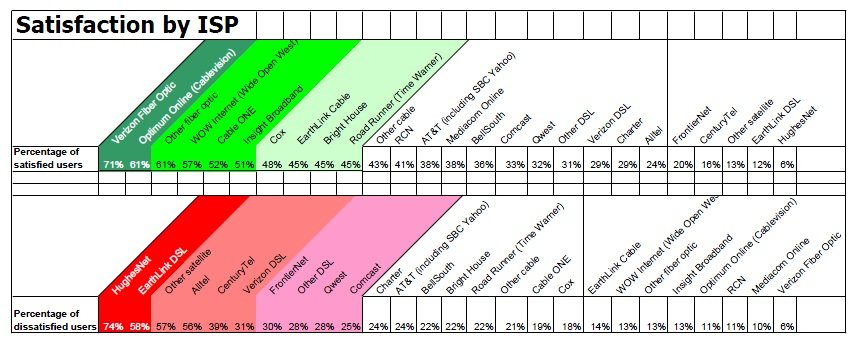
Less than half of Americans surveyed by PC Magazine report they are very satisfied with the broadband speed delivered by their Internet service provider.

PC Magazine released a comprehensive study this month on speed, provider satisfaction, and consumer opinions about the state of broadband in their community.

The publisher sampled more than 17,000 participants, checking their actual broadband speeds, and questioned them about their overall satisfaction with their online access.

The findings indicate consumers live with what provider they can get.  Even lower rated providers scored “satisfactory,” in part because consumers don’t have many choices with which to compare.

ispsatis

Click to enlarge

In the war between coaxial cable modem vs. copper wire DSL technology-of-the-1990s battle, PC Magazine declared the cable industry the winner, consistently delivering faster speeds more reliably than possible with telephone company DSL.  Overall, the average cable speed was “688 Kbps, while the average DSL lets you surf at just 469 Kbps—cable connections, on average, are 47 percent faster.”  Those speed measurements are based on actual web page and content delivery, not on marketed available speed.

In fact, users rated DSL an unsatisfying service, with only 20% of rural and suburban customers very impressed with DSL.  But for many who have no other choice, 50% think it’s good enough.

Or better than nothing.

One DSL provider did extremely well speed-wise in PC Magazine‘s survey, however.  Frontier Communications was rated as the fastest DSL provider in the nation, averaging “real-world” speeds of 724 Kbps, according to the survey.  But even they could only score a 20% customer satisfaction rating, with 30% dissatisfied.

There was one technology that did much, much worse.  Satellite broadband, the last possible choice for many Americans between dial-up and going without, is provided by companies like HughesNet and WildBlue, and they are unmitigated disasters in consumers’ eyes.

Just 6% of Hughes customers were satisfied, with a whopping 74% dissatisfied.  That’s because satellite broadband is extremely slow, averaging just 145 Kbps, heavily capped, and very expensive.  But for some rural Americans who live too far away from their local phone company central office, and will never see cable television, it’s likely their only choice.  Even mobile broadband signals won’t reach many of these consumers.

So what is the good news from all of this?  There is one technology that, hands-down, beats all of the rest — fiber optics to the home.  The nation’s top-rated ISP in PC Magazine’s survey is Verizon FiOS, with 71% satisfied, and just 6% dissatisfied.  Other fiber optic providers, mostly smaller local, regional, or municipal systems, scored 61% satisfaction.  Just one cable company matched that rating – Cablevision’s Optimum Online.

AT&T, with a combination of DSL and their newer U-verse platform, did considerably worse, with 38% satisfied and 24% dissatisfied.

Clearly, subscriber satisfaction comes highest from fiber optic broadband.

Click to enlarge

Click to enlarge

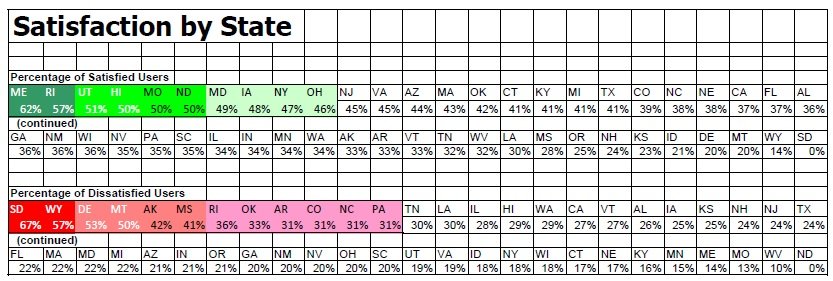
In statewide rankings, it all boils down to where you live.  The more populated states and those with large cities often scored higher than those with lots of wide open rural areas.  The larger the community you live in, the better the chance for fast, quality service.  In states like Wyoming or South Dakota, where more than 57% of customers reported dissatisfaction, it’s more about living with what you’re stuck with.


Search This Site:

Contributions:

Recent Comments:

Your Account:

Stop the Cap!