Home » Rural Broadband » Recent Articles:

Mixed Nuts: Glenn Beck Ties His Boss to ‘Marxist Front Group’ That Isn’t & RedState Strikes Out (Again) on Net Neutrality

glennMaster conspiracy theorist Glenn Beck should have written the last episode of The X Files.  To think I waited nine seasons to find what truth was out there only to have screenwriter Chris Carter rip me off with a chain smoker sitting in a Native American pueblo hearing the date when “they” arrive to begin colonization.  Imagine what Glenn Beck could have conjured up given the same nine years.

The problem with wildly-spun conspiracy theories is that you usually end up tangled in one, and Beck proved when he managed to tie his boss, Rupert Murdoch, into both a ‘Maoist -and- Marxist plot.’

To Beck, Net Neutrality and its supporters come straight out of Marxism. Beck warns “if you sit down and work with these people (Net Neutrality proponent Free Press), you might as well just go out and purchase your own blindfold and cigarette for the firing squad, because I don’t see the difference here.”

Beck slammed a Federal Trade Commission workshop he tied to Free Press, a pro-consumer advocacy group Beck considers Maoist (I didn’t realize they had the power to run government agency workshops — oh wait, they don’t), accusing the whole affair of being a conspiracy to silence free speech.

But here comes the “oops.”  It turns out this very same workshop which ran Tuesday, “From Town Criers to Bloggers: How Will Journalism Survive the Internet Age,” had among its participants none other than News Corporation CEO Rupert Murdoch, who was one of the featured speakers.

Just a few weeks earlier, Beck’s attempt to slam Fox News enemy MSNBC (and its owner NBC) brought a broad indictment against too-similar-sounding messages promoting volunteerism from President Obama and the Entertainment Industry Foundation (EIF), which Beck likened to “living in Mao’s China right now,” noting NBC executive Mitch Metcalf is an “EIF board member.”

How inconvenient for Glenn that Murdoch sits on EIF’s honorary board of governors, and Fox Broadcasting is a participant in the group’s initiatives.

Meanwhile, over on RedState, the blog that bans you for fact-checking their nonsense, writer Neil Stevens just discovered the Obama Administration is working on a National Broadband Plan.  That is like missing a train… that left the platform January 20th, 2009:

I’ve been held underwater by work lately and am just now catching up with this thing called “posting,” so forgive me if this post is light on links and details, but I want to give you all a heads up on what’s coming down the pipe in the Obama/Google administration. The big project after Net Neutrality is supposed to be a National Broadband Plan.

In theory, the idea of a National Broadband Plan is to give faster Internet access to more people. You see, people frequently think America “lags behind” the rest of the world because certain statistics show America to have worse Internet access than other countries. The problem with those statistics is that they don’t account for population density. A country like Japan, South Korea, or the Netherlands has a much denser, more urbanized population, and so it’s easier to run the wires you need to give them all Internet access.

But all a progressive needs is a good crisis, and they’re calling this a crisis. However, one of the proposed fixes is to give third party ISPs access to wires already laid by ISPs to provide service. Do we see how increased access to wires that already exist with service provided, doesn’t give access to people who don’t have access already?

The real motive of Julius Genachowski, Barack Obama, Google, and the rest of the adminstration’s Internet crusaders is to help freeloaders, which is why the Songwriters Guild of America is against Net Neutrality. Anyone who creates things of value on the Internet has something to lose from the Obama plans. Everyone can see this. The terrible problems with the Genachowski/Obama/Google plans are not theoretical.
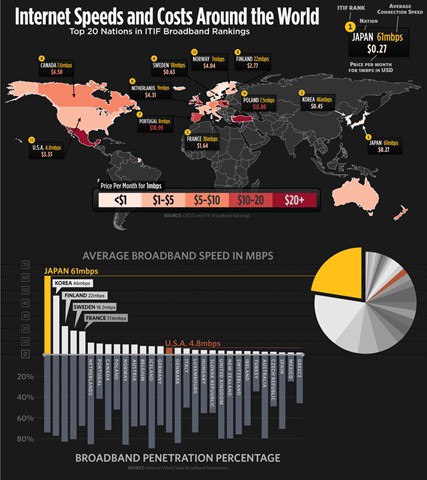
BroadbandWe also forgive Neil for being light on the facts.  It’s not “people” that think America lags behind the rest of the world in Internet access… it’s research that proves it.  Stevens must already be convinced of this, as he debates his own argument, adopting the industry position that tries to explain it all away by comparing population densities between the United States and the Asian nations beating our pants off.  Yes, it is easier to run fiber optics in condominium and apartment-dense areas like Hong Kong.  But the Republic of Korea and Japan have significant non-urban areas as well.

That also doesn’t explain away why Finland, Sweden, and France dramatically outpace us as well.

What all of these countries have in common is a nationally-coordinated public policy that advocates and promotes broadband deployment.  The United States left it up to private providers, who promptly set up a cozy duopoly in most communities and works overtime to keep competition out of their markets.  In many states, they’ve even engineered legislation to ban public broadband initiatives to provide the service they won’t.  The result is an America filled with Internet access “have’s” and “have-not’s” usually defined by income, provider, or location.  This isn’t an issue if you’re lucky enough to have access to FiOS, but is a major problem if your only broadband option is satellite fraudband.

The “open access” provision Stevens is alarmed about is nothing new.

Telephone companies have provided line access to third party DSL providers for at least a decade, and Time Warner Cable allows Earthlink to sell its service over their cable lines as part of an agreement originally dating back to the AOL-Time Warner merger.  You’re excused if you never knew about either arrangement because most consumers don’t.  The fact is, most providers don’t advertise their competition, and when they do, it’s usually because they offer a less worthwhile pricing and speed plan… or in the case of wireless data, a lousy 3G coverage map.

An even better idea for open access is to construct a modern fiber-based network to reach every American and lease it to any provider that wants to reach customers on it.

Providing access to those without broadband service doesn’t come from open access proposals.  Stevens doesn’t realize the second component is Universal Service Fund reform.  The USF, a small fee on phone bills to help underwrite the costs of providing phone service in rural America, has evolved into an often-abused slush fund.  Reforming it to redirect resources into constructing real broadband networks for rural America that can do more than just provide phone lines would help solve the access problem Stevens brings up.

Although the fan club at RedState might represent the “everyone” Stevens claims can see the ‘truth’ about Net Neutrality, they’re not living in an “open access” community themselves.  Just disagree with them and your access magically disappears.

I could write pages and pages about how the American recording industry killed itself through corporate greed, merger-mania, and treating their customer-base like criminals, but Steve Knopper did a much better job in his book Appetite for Self-Destruction, and you can listen to him interviewed at length about the subject courtesy of National Public Radio’s Fresh Air program.

Let me digress for a paragraph.  Independent recording artists who’ve dealt with record labels tell a very different story than the Songwriter’s Guild — their bigger problem is getting paid fairly by the record companies themselves.  Considering the recording industry has been complaining about people stealing their stuff since the days of cassette tape, arguing Net Neutrality represents ‘a pirate’s dream come true’ only exposes the true agenda of some to throttle certain broadband services not to “unclog networks” but to act as a de facto copyright control measure.  That reminds me.  I haven’t thanked Sony enough for foisting the infamous Sony BMG CD copy protection rootkit on us back in 2005.  I’m sure plenty of virus and malware authors who followed their lead probably have.

RedState struck again on Wednesday with another under-informed piece by Neil blasting away at Net Neutrality proponent Google, which is a favorite target of those who oppose Net Neutrality.

Firstly we have the principle of neutrality itself. If Google has its way, carriers like AT&T, Comcast, Verizon, Time Warner, and the rest will not have a say at all in what its users find through their Internet connections. They will not be allowed to set network policies that favor some websites or services over others, no matter how detrimental to the company’s ability to service all its customers.

However, we can see in the case of Studio Briefing that Google is anything but neutral. Studio Briefing has been shut out of all of Google’s services, and has been forcibly removed even from the search, so searching for Studio Briefing would never turn up the company’s webpage. Rather than letting algorithms pick and choose what sites come up, as Google usually claims, somebody human took a step by removing a particular company’s site from the system and sending an email notifying the company of the situation. Imagine Google’s hysterical shrieking had AT&T wiped a Google site off of the map for all users of its services.

Firstly, Neil is unclear about what he is talking about when he suggests providers won’t have a say in what users find through their Internet connections.  Is he upset they might not be able to police criticism of those companies, slow down their competitors, or block blogs?  I’m waiting to hear a justification of how not being able to discriminate against websites will be detrimental to the company’s abilities to “serve its customers.”

As to Neil’s ‘Studio Briefing’ complaint, whether this represents an insidious plot by Google to censor a news aggregation site or dropping a pest site that depends on swiping other people’s content and monetizing it with Google ads is up to the reader to decide.  The folks at Studio Briefing seem more concerned their AdSense account, which lets them earn advertising revenue, was shut off.  The view from the other side can be read here.  Of course, when I tried to Google “Studio Briefing” myself, I had no trouble finding my way there.  That’s hardly being “shut out” and removed from their search engine, because I used that search engine and found my way to the site with just a few mouse clicks.  Even Stevens’ Google attack is linked… by Google.

High Speed Broadband for All (‘All’ is Defined as ‘Chairman of British Telecom’); Neighbors Achieve High Speed Fury

Phillip Dampier November 30, 2009 Public Policy & Gov't, Rural Broadband 2 Comments
Sir Michael Rake

Sir Michael Rake

Hambleden residents who have fought for years to obtain broadband service from British Telecom are boiling mad over their discovery one comparatively recent arrival to the Oxfordshire village near Henley-on-Thames managed to get service shortly after moving in a year ago.  It turns out the “lucky” resident chosen to participate in a very limited trial of so-called “broadband enabling technology” is none other than the chairman of the company providing the service.

Sir Michael Rake managed to obtain the only broadband connection in the rural community as part of what the company called a pilot trial to test out the commercial feasibility of new technology to extend broadband service to more rural locations across Great Britain.

Of course, the “new technology” is reportedly little more than an extender for DSL service that is capable of delivering 1Mbps service on Britain’s aging copper telephone wiring.

The neighbors are furious anyway.

Some have been trying to get broadband service installed for at least five years to no avail.  Hambleden is just one of many rural communities bypassed by BT broadband.

Hambleden is just 35 miles northwest of London

Hambleden is just 35 miles northwest of London

Gary Ashworth, head of Abacus Recruitment told the Daily Telegraph: “It stinks of corruption. The chairman of BT is given preferential treatment over long-serving customers. I run a business and we probably have 1,000 BT lines. Clearly there is preferential treatment if you happen to be the chairman. I think it is a disgrace.”

Ashworth inquired if he could participate in the “BT trial.”  BT promptly said no, saying he’d have to wait until 2010 at the earliest.

“Sir Michael Rake is the only person allowed to participate in the trial in our area. He moved into the village a year ago and surprise, surprise, he has got broadband,” Ashworth complains.

Although Rake can enjoy the benefits of broadband as a trial participant, BT was willing to extend Ashworth broadband service, if he ponied up £68,000 for the installation.

While the chairman of BT browses the web today at his Hambleden estate, the company admits wiring the entire community would not be profitable.

The Daily Mail interviewed Paul Goodman, the Tory MP for Wycombe, who said “the lack of broadband in the Hambleden Valley is a very serious problem for my constituents.”

“Unless all BT staff members are entitled to participate in the trial on exactly the same terms, I think some of my constituents will find this very strange,” he told the Daily Mail.

The government has promised to underwrite broadband expansion into rural areas by 2012 with revenue earned from a 50p surcharge on phone bills.

Telstra Increases Download Quotas, But Australian Broadband Is Still An Overcharger’s Paradise

Glenice Maclellan, Telstra's point person on broadband, has recently discovered Australians don't just want to browse the web and read e-mail on their broadband service.

Glenice Maclellan, Telstra's point person on broadband, has recently discovered Australians don't just want to browse the web and read e-mail on their broadband service.

Telstra, Australia’s largest telecommunications company, has responded to customers leaving their broadband service over its fraudband speeds and paltry usage caps by increasing both, but not nearly enough to change perceptions that Australian providers still serve up slow, overpriced and restrictive service.

Telstra’s CEO David Thodey, who replaced the oft-despised Sol Trujillo, told investors what every Australian contemplating broadband service already knows: “In some parts of the market we’ve gone too far out of line and we need to come back. We must focus on our core business and our customers, this is where we create value for shareholders. At its simplest, the next stage in Telstra’s long-term strategy is to focus on satisfying customers, invest in new capabilities, and drive growth in new businesses.”

Thodey’s approach is to do away with the company’s downright lousy “broadband” service in many rural areas of Australia.  More accurately called “fraudband,” there are still many Australians suffering with Telstra BigPond service that tops out at a ridiculously slow 256kbps.  And because company officials suspect you’ll even use that too much, they slapped a usage cap as low as 200 megabytes on the service, with a war crime overlimit fee of $0.15 per megabyte thereafter.  Your low price?  $27US a month.  For that.  But you can double your allowance to 400 megabytes for a mere $9US more per month.  Grab the bargain.

Effective December 1st, Telstra will move its rural customers to 1996-level broadband service, offering 1.5Mbps minimum to those doing their web surfing over DSL lines.  For those paying $27 a month, they’re increasing your usage allowance to a still-paltry 2 gigabytes per month, and leaving the $0.15/mb overlimit fee in place.  Most DSL customers stuck on these plans will be herded up to the $36 a month plan which is “generous” in comparison with a new download quota of 12 gigabytes per month and no overlimit fee.  Instead, once you hit your limit, they cut your speed to 64kbps for the rest of the month.

Oh but wait, there are some more gotchas:

  • Unless you are bundling your molasses-slow Internet service with a phone line package that brings Telstra at least $81US per month in revenue, add $9 to these plan prices.  You wouldn’t want Telstra management to go home hungry, would you?
  • Uploads are also a part of your usage allowance.
  • Many of their plans lock you in with a 24-month service commitment.  They’ve got you right where they want you.

If you find Telstra’s Oliver Twistian-usage allowances leave you hungry for more, no worries.  Telstra will happily upgrade your service to a higher usage plan, with correspondingly higher prices, by the following day.  That’s good to know if Microsoft obliterated a good part of your usage allowance for the month with critical Windows updates.

Or you could always take your business elsewhere, as many budget conscious Australians have.  Thodey’s fear about out-of-touch broadband pricing is real when considering Telstra’s competitor iiNet offers 4GB (2GB peak/2GB off peak) for just about the same price Telstra charges for its $27 a month/200 megabyte plan.

The company has also recently discovered that Australians want to use their broadband service for more than just web browsing and e-mail.  That’s apparently news to Telstra management, who threw this into their PR push:

“Telstra’s new plans cater for the changing ways Australians use broadband for communications and entertainment at home.  Gone are the days when broadband was used only to check email or internet surf. Australian families now also use broadband to download videos, play online games, or check social networking sites all at the same time”. — Glenice Maclellan, the Acting Group Managing Director of the Consumer division, Telstra

Thanks, Glenice.  The only problem here is that Australians didn’t get to do those things much because of your rationed broadband plans which either overcharged them if they tried, or speed throttled them back to dial-up as a reminder not to be a naughty data hog.

Now, Australians can at least feed at the trough… for a little while.

Telstra offers other plans, which vary on whether you qualify for ADSL 1 service (original DSL) or live in an urban/suburban area upgraded for ADSL 2 or cable modem service.  All prices hereafter are in Australian dollars – $10AUD = $0.91US at time of writing):

New Broadband Pricing for full service fixed phone customers

Monthly MB allowance+

Standard preselect pricing on a 12 month plan ^

Price incl $10

discount on a 24 month plan#,^

Price incl $20 discount with on a 24 month plan and one other eligible Telstra service~,^

Standard preselect pricing on a 12 month plan ^

Price incl $10 discount on a 24 month plan#,^

Price incl $20 discount on a 24 month plan and one other eligible Telstra service~,^

BigPond Turbo

ADSL & Cable

BigPond Elite

ADSL & Cable

2GB (excess usage charged at $0.15MB) $39.95 $29.95 n/a $49.95 $39.95 $29.95
BigPond Liberty 12GB** $59.95 $49.95 $39.95 $69.95 $59.95 $49.95
BigPond Liberty 25GB** $79.95 $69.95 $59.95 $89.95 $79.95 $69.95
BigPond Liberty 50GB** $99.95 $89.95 $79.95 $109.95 $99.95 $89.95
BigPond Liberty 100GB** $119.95 $109.95 $99.95 $129.95 $119.95 $109.95
BigPond Liberty 200GB** $169.95 $159.95 $149.95 $179.95 $169.95 $159.95
**Speeds slowed to 64Kbps after monthly allowance is reached
# Requires Single Bill and combined minimum monthly access fee of at least $59.
~ Other eligible service types are a Telstra mobile, BigPond wireless broadband or FOXTEL from Telstra on a single bill, with a minimum combined monthly access fee of at least $89.
+Unused allowance expires monthly.

Those prices are enough to give North American providers dreams of Money Parties in their heads forever.  Only Time Warner Cable came close with their infamous $150 unlimited usage plan they tried to stick customers with in several cities this past April.

That platinum-deluxe BigPond Liberty 200GB plan bundled with a TV package will cost you more than $4,560US over the life of the 24-month contract.

Australians continue to wait for a National Broadband Network plan that the government says should finally free Australians from a life of being told you have to spend more… a lot more, to save just a little from companies like Telstra.

A spoof on Telstra’s BigPond Internet Support Call Center (1 minute)

Frontier DSL: “Slow, Low Quality, and Priced Significantly Higher Than Verizon” Says Expert Hired By WV Consumer Advocate

One of the promised benefits of permitting the Verizon-Frontier spinoff is that Frontier will bring more and better broadband service to areas Verizon has ignored for years.  The company has been running television ads in West Virginia promoting Frontier’s promised “next generation” of broadband.  But what does that mean?

[flv]http://www.phillipdampier.com/video/Frontier Verizon Deal Advertisement West Virginia.flv[/flv]

Frontier Communications is running this advertisement in West Virginia.

The West Virginia Consumer Advocate Division of the Public Service Commission brought in Trevor R. Roycroft, PhD., former Associate Professor at the J. Warren McClure School of Communication Systems Management, Ohio University, to examine the details behind the marketing and public relations push to promote the deal.

He was not impressed.

After an extensive review of confidential and public documents from Frontier, his conclusion was that Frontier’s DSL service is just plain bad, and for plenty of West Virginians who may only have one choice for broadband in the foreseeable future, being stuck with Frontier’s idea of broadband is particularly bad.

Indeed, Frontier’s idea of what defines “next generation broadband” would be true, if this was the year 1992.

“Frontier has made no commitment regarding improved broadband deployment in West Virginia. Frontier, while achieving higher levels of DSL availability in West Virginia, generally offers its broadband services at higher prices and provides lower quality than those associated with Verizon’s DSL. Frontier’s ability to increase broadband deployment in West Virginia will depend on the condition of the outside plant that it has acquired, which may negatively impact Frontier’s costs of deployment. Furthermore, Frontier must upgrade substantial numbers of customer locations outside of West Virginia, and West Virginia will be competing with this larger priority,” Roycroft writes in his testimony to the West Virginia Public Service Commission.

The infrastructure Frontier utilizes to deliver its broadband service is revealing even to those Frontier customers not directly impacted by this transaction.  Some of the documents Roycroft reviewed laid bare the nonsense the company has used to defend its Acceptable Use Policy language defining an “acceptable amount” of monthly broadband usage at just five gigabytes.  Company officials have said for more than a year that they were concerned about the growth of usage on their network, and its potential to slow service for other customers.  But company documents, included within the scope of Roycroft’s testimony, tell a very different story:

Frontier plans to increase its core backbone from its current level of 10 Gbps to a capacity of 20 Gbps (should the spinoff be approved). With regard to the capacity of its existing backbone, Frontier states:

Frontier expanded the backbone from OC 48 to 10 Gigabit Ethernet during the first half of 2009. Because of this network expansion we do not have peak usage for the past 12 months. No backbone link has peaked above 2.8 Gigabit/second or 28% of the capacity of a link since the augment was completed in 2009.

Thus, Frontier’s current backbone configuration appears to have excess capacity. With the expansion of its backbone network to 20 Gbps, the company’s current data traffic load results in about 14% of capacity being utilized at peak.

Potentially limiting customers to just five gigabytes of usage is so unjustified, in Roycroft’s analysis, its potential imposition on West Virginian customers should be a deal-breaker.

Roycroft ponders whether Frontier will invest enough resources to make sure capacity is not an issue. The only way Frontier’s network will show signs of strain is if the company makes a conscious decision not to sufficiently upgrade their network as they take on millions of new Verizon customers, or they dramatically underestimate the average Verizon customer’s usage.

Roycroft was also asked to evaluate whether Frontier’s claims of 90% broadband availability in its overall service area and 92% in its West Virginia territory rang true.

Roycroft writes that Frontier’s numbers don’t tell the whole story.  In five states, Frontier admits the percentages are notably lower, so no guarantee can be inferred for West Virginia based on Frontier’s talking points.

Frontier’s “Advanced” Broadband Network Is Hardly Advanced and Barely Qualifies As Broadband

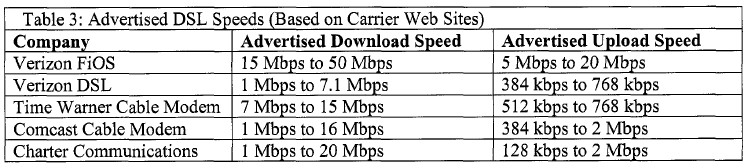
Heavy criticism was leveled at Frontier for its “advanced” broadband service.  Roycroft compared Frontier DSL with several other providers and was unimpressed with the company’s broadband speeds.

Roycroft's table illustrates what's on offer from the competition

Roycroft's table illustrates what's on offer from the competition

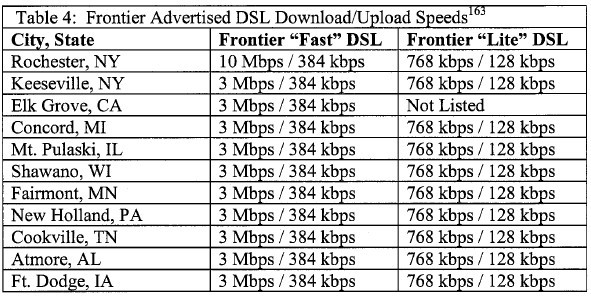
“Frontier’s advertised DSL speeds are generally much lower than those available from Verizon and other carriers. Based on a location-based search of Frontier DSL service offerings, it appears that Frontier’s most prevalent DSL speeds are 3 Mbps and 768 kbps (for download),” Roycroft said.

Frontier's DSL Speeds in Selected Cities

Frontier's DSL Speeds in Selected Cities

Although the expressed upload speed for Rochester should be listed at a higher rate (I managed around 512kbps myself), Roycroft is correct when he says, “it can be seen that outside of Rochester, NY, the DSL speeds associated with Frontier offerings cannot be considered ‘cutting edge.'”

Even while noting Rochester’s potential DSL speeds, real-world speeds are another matter entirely.

[flv width=”640″ height=”405″]http://www.phillipdampier.com/video/Real World Frontier vs Road Runner Speeds.flv[/flv]

One New York customer provided real world evidence of the significant differences in speed offered by Road Runner from Time Warner Cable and Frontier’s DSL (courtesy: 1ComputerSavvyGuy) (1 minute)

Frontier’s DSL offerings in West Virginia are of even lower quality. Frontier indicates that it offers three grades of DSL service in West Virginia:

Up to 256 kbps download/128 kbps upload;
Up to 1 Mbps download/200 kbps upload;
Up to 3 Mbps download/200 kbps upload.

These data transmission speeds, especially upload speeds, are at the very low end of commercial offerings that I have observed.

Comparing Verizon DSL vs. Frontier DSL Pricing & Gotchas, Contracts, and Internet Overcharging Schemes

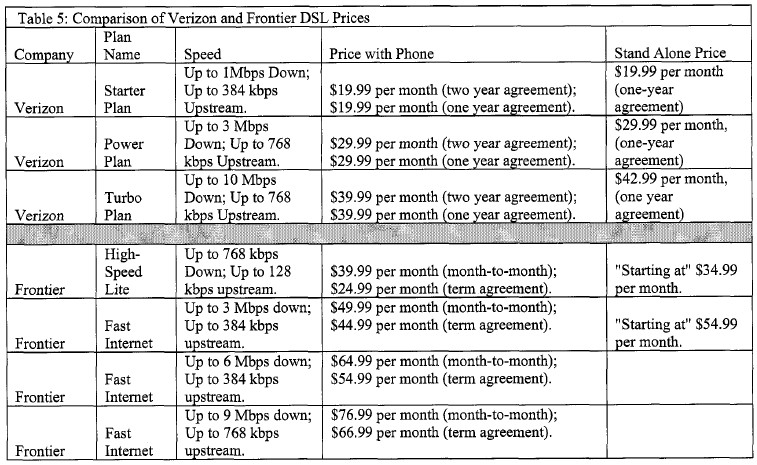
Roycroft’s study found Frontier’s pricing significantly higher than Verizon for DSL service.

Frontier’s DSL prices, either with telephone service, or on a stand-alone basis, are significantly higher than are Verizon’s. For example, the entry-level Frontier plan has a nominal price that is 100% higher than Verizon’s.

However, when considering the per Mbps price, Frontier’s price is 160% higher. It is also notable that Frontier’s upload speeds are also low when compared to Verizon’s.  Consumers are increasingly relying on upload capabilities to share large files, such as videos. Overall, Frontier’s DSL products are low quality.

Comparing Prices

Comparing Prices

Roycroft also gave special attention to Frontier’s infamous 5GB Acceptable Use Policy, which he suggested was a major negative for West Virginia’s online experience.

Frontier indicates that it monitors network usage if “it receives a complaint of slow service or if it discovers that network bandwidth utilization is unusually high in a particular area.

Frontier was asked to identify any action taken against a customer associated with its acceptable use policy and, in response, the company stated that it has not “terminated a customer’s service based on exceeding the 5 GB threshold identified in the AUP.” However, the restriction on usage further raises the relative cost of Frontier’s service. Frontier indicates that consumers may face action by the company if they exceed the usage cap, thus indicating that the prices reflect both speed and volume. Verizon’s DSL service does not include a similar limit.

Frontier’s DSL pricing policies and usage restrictions will represent a significant negative impact on West Virginia consumers, should these policies be implemented in Verizon’s service area in West Virginia.

Even more importantly, Roycroft considered the argument for imposing such Internet Overcharging schemes as unwarranted.

“While DSL provides dedicated bandwidth to the customer in the last mile, DSL subscribers will share network capacity in the ‘middle mile.’ For example, shared data networks will carry consumer traffic from the telephone company central office to an Internet gateway. I believe that Frontier’s policy is more likely to reflect an unwillingness on Frontier’s part to invest in ‘middle mile’ Internet access facilities that would require capacity additions as customer demand increases, and choose to restrict customer usage instead of investing in the capacity needed to meet customer demand,” Roycroft writes.

“Furthermore, Comcast’s download-cap policy includes limits that are dramatically higher than Frontier’s. Comcast’s acceptable use policy identifies 250 gigabytes as the threshold at which Comcast may take action against a customer, which is fifty times the usage associated with Frontier’s policy,” he added.

Roycroft was also concerned about the many ‘gotchas’ that are part of Frontier’s marketing efforts which bring even higher prices to consumers choosing to have DSL service installed.

“To receive the services of Frontier’s technician, the consumer will incur a $134 fee unless the consumer signs up for a term service contract. Even with the term service contract, the customer must pay a $34 fee for the on-site set-up. Furthermore, the technicians that Frontier dispatches to new broadband customers’ homes are also sales agents. Thus, while it may be that these individuals can help with system set-up and the like, they also are part of Frontier’s overall up-selling strategy,” said Roycroft.

Frontier markets a variety of services to customers as part of their promotions and service offerings.  For instance, recent Dell Netbook promotions required customers to sign multi-year contracts for service, with an early termination fee up to $400 if the consumer chooses to cancel service.  Such promotions do not come out of the goodness of Frontier’s heart.  Indeed, such promotions provide even more revenue potential by pitching customers on its “Peace of Mind” services, which include computer technical support, backups, and inside wire maintenance for an additional monthly fee.

Customers don’t even qualify for many Frontier promotions unless they accept a bundled service package combining broadband with traditional phone service and a multi-year service contract.

Roycroft says West Virginia should demand modifications to Frontier’s proposal before it should even consider accepting it.  Among the changes:

  • Frontier should be required to make broadband services available in 100% of its wire centers, and to 90% of its West Virginia customers by the end of 2013. Frontier should expand broadband availability to 100% of its customers by 2015.
  • Frontier should be required to deploy and promote broadband services in West Virginia so that, by the end of 2013, at least 90% of its customers can achieve download speeds of 3 Mbps; 75% of its customers can achieve download speeds of 6 Mbps; and 50% of customers can achieve download speeds of 10 Mbps.
  • To achieve these broadband objectives, Frontier should be required to exceed Verizon’s baseline level of capital investment by at least $117 million during the period ending December 31, 2013, or by an amount sufficient to meet the broadband objectives.
  • Frontier should be required to offer broadband services at prices that do not exceed those currently offered by Verizon for 1 Mbps and 3 Mbps services, i.e., Frontier should offer services at Verizon’s advertised prices for 1 Mbps and 3 Mbps service (respectively, $19.99 per month and $29.99 per month) for a period of 24 months following the merger.
  • Frontier should be prohibited from imposing its broadband “download cap” in West Virginia.
  • Frontier should be required to provide individual written notice to its customers regarding the merger, and should notify customers of any change in services that result from the merger. Changes in billing format should also be clearly explained to customers, both in writing, and through a web-based tutorial.
  • Frontier should be prohibited from migrating any Verizon customer to a Frontier plan that either increases the customer’s rates, diminishes the level of service, or has a materially adverse impact on any of the terms and conditions of the customer’s service. West Virginia customers should experience a rate freeze for a period of 24 months.
  • Frontier should be required to allow former Verizon customers to take a “fresh look” at their purchases, including those customers who have term contracts with Verizon. All early termination charges should be waived for a period of 90 days following the merger, and the long distance PIC charge should also be waived for Verizon long-distance customers who select a long-distance provider other than Frontier.

Wall Street Journal Does Hit Piece on Australia’s National Broadband Plan — Hint, Hint to American Policymakers

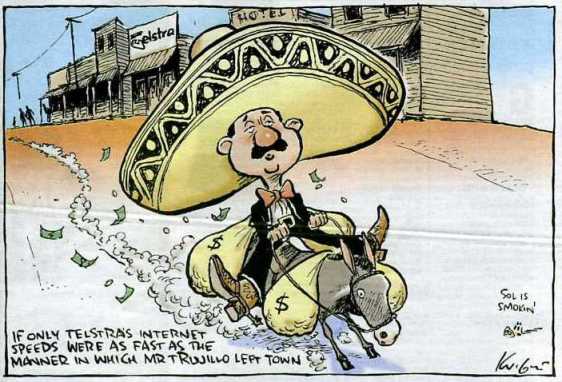
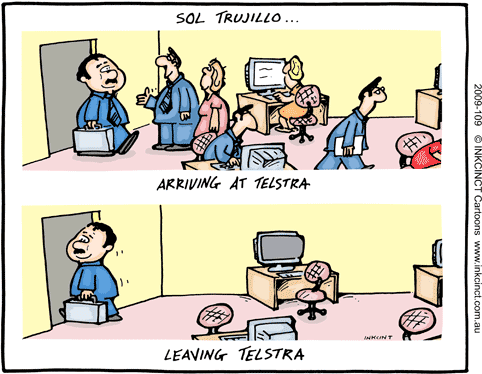
Sol Trujillo, the former head of Telstra, was routinely depicted in the Aussie cartoon press in a sombrero reflecting his Mexican heritage

Sol Trujillo, the former head of Telstra, was routinely depicted in the Aussie cartoon press in a sombrero reflecting his Mexican heritage

Yesterday’s Wall Street Journal Opinion page features a piece of nonsense from Holman Jenkins, Jr., one of the editorial writers for the paper, decrying Australia’s “Broadband Blunder” by not allowing Telstra, the dominant provider, free market means to define problems and create solutions in broadband.  The editorial carries a clear subtext for American policymakers — let the free market do it all and keep government out of it (unless they want to cut some checks with taxpayer money or other subsidies, of course).

Australia lacks America’s bottomless think-tank and K Street resources for publicizing policy differences. Its parliamentary government puts all the policy levers, including a ready resort to secrecy, in the ruling party’s hands. Australia is a small nation, with a small elite that tends to place limits on burn-the-bridges debate.

This may sound ideal to Americans, but the results aren’t always good, says Mr. Burgess. Australia, like America, has its “wingnuts,” he says, but they don’t get a hearing. “There’s no sharpening of issues. Policy ideas aren’t fully vetted.”

The [National Broadband Network] NBN, a tremendously awful idea, is a case in point. The government wants to spend $39 billion to deliver 100 megabits to every household in the next decade, without the slightest idea how it might be done commercially or whether customers, who already can get 21 megabits through wireless in most of the country, would be willing to support NBN’s huge costs.

Trujillo was reviled for increasing his own compensation package while presiding over massive cost-cutting layoffs

Trujillo was reviled for increasing his own compensation package while presiding over massive cost-cutting layoffs

That’s a remarkable bit of news, for both Americans and Australians.  Jenkins comes right out and tells all of corporate America’s best K Street secrets.  Australia doesn’t have the corporate money-astroturf PR-influence machine that frames debates with a corporate point of view.  ‘Burn-the-bridges debate’ is the way Jenkins might characterize it, but burning actual facts and reality for astroturf fiction is more in keeping with reality.  On just about any issue, from energy deregulation to banking reform to last summer’s often-ridiculous health care debate melodrama filled with death panels, hiring a PR firm that can launder corporate-string-pulling-connections guarantees you can lie, distort, and obfuscate anything into something it’s not, in hopes of dispensing with it.  The Net Neutrality as Marxist Plot nonsense emanating from Americans for Prosperity and Glenn Beck is just the latest example of the broadband policy Distact-O-Matic in use.

American wingnuts not only get a hearing, they often get all of the attention, particularly in the television media.  The more outlandish and dramatic the video, the better.  Policy issues are never vetted at all when you start “sharpening of the issues” with accusations Mao Tse-tung is the founding father of Net Neutrality.

Australia’s NBN is hardly an example of government trying to compete with private industry.  In fact, it was the private industry which built the slow, incrementally upgraded, usage capped, and expensive network that misses large portions of the country which drove the government to consider doing what private industry simply refused to do – provide Australians a state of the art broadband platform.  It’s obvious the government doesn’t need to “do it commercially” with large profits and leveraging higher prices in non-competitive markets — they just need to see it gets done and paid for, recognizing Telstra and other providers will not spend the money to build it themselves because they don’t like the long term wait for that investment to be paid back.

Most Australians will also be surprised to learn they can obtain 21Mbps through wireless “in most of the country.”  In fact, reasonably priced broadband in Australia is much slower, and carries a small usage allowance.

Of course, it takes an unwonted faith in government to believe it will deliver the promised digital nirvana on-time, on-budget or at all. In the meantime, Telstra would have no incentive to invest in its own network, so Australia could end up with the worst of possible outcomes: neither a shiny new functioning government network nor an existing Telstra network that keeps pace with technology and customer demand.

Ah, the elusive “incentive to upgrade” reasoning.  The moving target of what represents appropriate incentive (extra fat profits, no competition, keeping costs low by rationing service) may work very nicely for interested shareholders but do little to advance the broadband platform either in Australia or the United States.  This debate is not new.  Decades earlier, power companies argued that rural areas didn’t need electrification because farmers wouldn’t use it (or afford it), or it was simply too expensive to wire for too few customers.  Citizens in both countries will have to impress on their government whether they consider broadband service a nice luxury to have or an essential utility that must be provided, even if it means bypassing the ‘100% free market’ approach that turns up their noses at rural residents or those deemed too poor to afford it.

Just because Jenkins claims Telstra keeps pace with technology and customer demand doesn’t make that reality.  Australians would argue both points, particularly comparing what they get for their money versus what we get in the United States for ours.

The rest of the piece is a glorification of Sol Trujillo, the controversial former head of Telstra, who has been compared with George W. Bush and Karl Rove for his combination of “I am the decider” confidence and Rove’s “take no prisoners” style of defending those decisions.  Jenkins suggests the source of the active dislike of Trujillo was his willingness to go personal in attacking Australian officials in speeches and press accounts.  But many more Australians would find fault with Trujillo’s very generous compensation package and benefits he and his associates earned even while the stock underperformed under his leadership, and with the sluggish, expensive, and capped state of Telstra’s broadband as he left.

Search This Site:

Contributions:

Recent Comments:

Your Account:

Stop the Cap!