Home » Rural Broadband » Recent Articles:

Broadband Stimulus Blockade – FairPoint Bankruptcy Doesn’t Stop Spending to Block Stimulus in Maine

Phillip Dampier February 16, 2010 Broadband Speed, Competition, Editorial & Site News, FairPoint, Public Policy & Gov't, Rural Broadband, Video Comments Off on Broadband Stimulus Blockade – FairPoint Bankruptcy Doesn’t Stop Spending to Block Stimulus in Maine

In Maine, bankrupt FairPoint Communications managed to scrape up enough cash to launch a lobbying effort to get a bill introduced, tailor-written to prohibit stimulus award winners from… helping provide improved broadband service to Maine residents.

Marrache

Incredibly, Sen. Lisa Marrache, D-Waterville, the assistant Senate majority leader, has introduced a bill that would ban the system from using any tuition money to help pay for efforts to expand broadband access. Marrache mouthed FairPoint’s talking points as she suggested poor college students’ tuition money would be diverted for broadband projects. She claimed the bill was introduced because constituents FairPoint’s lobbyists and employees were calling her about it.

The fact Marrache so misunderstood a public-private partnership between the University of Maine, Great Works Internet, and two private investors to improve the Internet “backbone” in Maine should be of grave concern to her constituents. Unless some campaign contributions from FairPoint and its executives make their way to Marrache’s next campaign, voters must be wondering whether the majority leader has a grip on the technology matters before her.

Indeed, the University of Maine explained the “middle mile” improvement program was not going to steal students’ lunch money, but rather dramatically improve broadband capacity for all comers — something FairPoint couldn’t be bothered with while breaking promises to expand broadband service themselves.

Jeff Letourneau, associate director of information technology at UMS, told the Bangor Daily News, “as for tuition subsidizing our broadband efforts, that does not happen and will not happen.”

[flv]http://www.phillipdampier.com/video/WABI Bangor Federal Funding of Maine’s Rural Broadband 12-17-2009.flv[/flv]

WABI-TV in Bangor reported on the announced funding of broadband projects in Maine designed to improve rural broadband service statewide (12-17-2009 — 2 minutes)

Ironically, the network that will be built with the help of the broadband stimulus program will be open to any and all providers, including FairPoint, on a wholesale cost basis. But of course FairPoint would not own and control it, so it’s bad for them, and they’re trying to convince Maine lawmakers it’s bad for Maine residents as well.

Great Works Internet has had a running dispute with FairPoint

But then, FairPoint has had a vendetta of sorts against Great Works Internet for months, trying to overcharge the independent ISP for connectivity it obtained under provisions established in the Communications Act of 1996.

Also running interference for FairPoint is Rep. Stacey Fitts, R-Pittsfield, who serves on the Legislature’s Utilities and Energy Committee. His bill prevents any “undue” competition by UMS with existing broadband providers. In other words, he has written the FairPoint Entrenched Provider of Mediocre Broadband Protection Act. Fitts said he has concerns that the university’s efforts could have unintended consequences on private companies (read that FairPoint) that “already provide access.” It will have directly intended consequences on GWI by further disadvantaging them and potentially sinking their efforts to provide better service in Maine.

“If the university is able to bypass some of the competitive markets, and cherry pick, it could affect the ability to deliver broadband to others,” he said.

Exactly how it affects the ability of FairPoint to deliver what it has failed to demonstrate it is capable of delivering is a question Fitts doesn’t answer.

Fitts

“I know this will cause a lot of discussion in committee,” he told the newspaper. “But we need to have that discussion.”

Maine Public Radio covered the introduction of Rep. Fitts’ bill, and the debate swirling around it. (3 minutes)
You must remain on this page to hear the clip, or you can download the clip and listen later.

Constituents need to have a discussion with him. Unless he wants to be known as the representative from FairPoint, he might want to get out of the way of a project that has a chance of improving broadband in his state, as opposed to the empty promises from a bankrupt provider. If he wants to tie himself to FairPoint’s record of failure, voters can choose someone else to represent them at the earliest possible opportunity.

Those with a need for high speed broadband have tried, and failed, to obtain better service from FairPoint. As Stop the Cap! has reported in exhaustive detail, FairPoint was preoccupied in delivering third world phone service at the time, finally collapsing on the courthouse steps under the weight of its bankruptcy filing.

Bills like these in Maine are further evidence that Congress needs to act on the federal level to pass the Community Broadband Act, which would overturn these kinds of bought-and-paid-for protectionist bills passed in several states. Communities must have the right to bypass companies in the broadband shortage business.

[flv width=”352″ height=”264″]http://www.phillipdampier.com/video/WLBZ Bangor Broadband Stimulus Will Help Maine Health Care 12-2009.flv[/flv]

WLBZ-TV in Bangor showed what broadband brings to Maine’s health care system and other business.  (3 minutes)

[flv]http://www.phillipdampier.com/video/MaineBiz Broadband Special 11-2009.flv[/flv]

MaineBiz Sunday spent nearly an hour going in-depth into broadband challenges in Maine, the problems with FairPoint Communications, the dispute with GWI, and more.  Appearing on the show, which originally aired last November: Fletcher Kittredge CEO of GWI, Phil Lindley of the ConnectMaine Authority, Steve Hand of Know Technology and Rep. Cynthia Dill of District 121 in Cape Elizabeth. (36 minutes)

Coming up…

Comcast Is Allergic to the Word “Free” Except When They Are the Recipient

Broadband Stimulus Blockade – Independent Cable Companies Claim Telephone Companies Unfairly Favored

Phillip Dampier February 16, 2010 Broadband Speed, Competition, Editorial & Site News, Public Policy & Gov't, Rural Broadband Comments Off on Broadband Stimulus Blockade – Independent Cable Companies Claim Telephone Companies Unfairly Favored

It’s not just the big players that are trying to game the broadband stimulus system.

Tiny Pine Telephone Company of Broken Bow, Oklahoma was the only ACA member to secure a $9.5 million stimulus grant

One way to assure the winners and losers of broadband stimulus funding is who gets to write the application rules. The broadband stimulus program includes a scoring system, assigning points of merit to applicants who meet certain criteria. Provide proof of community support, earn a few points. Demonstrate a commitment to serving broadband to the unserved, earn some more points. Offer 21st century broadband speeds of 20Mbps or more, earn a lot more points.

The American Cable Association (ACA), a trade association for smaller independent cable companies, feels the point system has been weighted to favor phone company projects. Both cable and telephone company lobbyists offered their “suggestions” for criteria to be scored. The rural telephone company lobbies won.

Fierce Telecom notes a key criterion is whether the applicant borrowed funds under Title II of the 1936 Rural Electric Act, and it appears that telcos led that charge. Anyone that did borrow the funds under that program got five points so ACA asked the grant makers to reduce the emphasis of that criteria from five to one. Apparently, ACA not only didn’t get their wish, the grant makers upped the points on that issue from five to eight.

With federal funding programs, it’s not uncommon for the rules to be written in such a way that helps politically-connected applicants in the qualification process. ACA was simply outgunned during this round, and after the first round of projects to be funded was announced, only one rural phone company, Pine Telephone, was deemed a winner.

“The American taxpayer will be disappointed to learn that the program was changed to give greater priority to awarding particular segments of the telecommunications industry with broadband funding over equally or better-qualified applicants, including ACA members, that could provide the same broadband service at a lower cost,” ACA President and CEO Matthew Polka said.

Had the reverse been true, the press release from the rural telephone trade association would say the same thing — only the names would have changed.

Coming up…

Sticking it to Frontier Communications — “Just Say No” Applies to America’s ‘Rural Phone Company’ As Well

Broadband Stimulus Blockade – Frontier’s Stimulus Applications Rejected in WV – ‘If Only You Approved Our Deal!’

Phillip Dampier February 16, 2010 Broadband Speed, Competition, Editorial & Site News, Frontier, Public Policy & Gov't, Rural Broadband, Video Comments Off on Broadband Stimulus Blockade – Frontier’s Stimulus Applications Rejected in WV – ‘If Only You Approved Our Deal!’

Frontier's broadband stimulus requests were also shot down when West Virginian cable operators objected

Even companies whose raison d’être these days is to provide better phone and broadband service to rural Americans are being turned down. Frontier Communications, who wants to take control of 617,000 phone lines in West Virginia from Verizon was, in part, promoting rural broadband stimulus funding as a benefit of the deal. After all, a phone company specializing in serving the underserved would stand a better chance of securing broadband stimulus money than a telephone behemoth like Verizon.

Apparently not. The feds turned down their $55 million dollar broadband stimulus application, too.

Frontier applied for two stimulus grants, one to provide fiber optic connections to schools, libraries and health care facilities, the other to fund broadband expansion in West Virginia.

West Virginia’s incumbent cable companies teamed up and just said no.

Opposition piled on from Armstrong Cable Services, Comcast, JetBroadband and Suddenlink urging federal officials to deny Frontier’s applications. They claimed the phone company was trying to secure taxpayer money to provide broadband service in their territories, making the application redundant.

“They had said this was a reason to grant approval, that this would really boost broadband deployment,” Patrick Pearlman, deputy director of the state PSC’s Consumer Advocate Division, which is opposing the Frontier-Verizon sale told the Charleston Gazette. “They went on about how they’re going to get all this money and bring all this, but apparently they couldn’t count on the feds.”

Frontier didn’t blame themselves for the failure, of course. They blamed state officials for holding up their deal with Verizon.

“This is one of the reasons why we have asked this and other commissions to act expeditiously in their review of the proposed transaction,” Daniel McCarthy, Frontier’s chief operating officer told the Gazette.

State regulators should take the rejection as a lesson learned if they believed Frontier’s claims that approving the deal would result in an improved position for broadband stimulus funding. It was not to be. Even small cable companies will pounce on applications that suggest competition might be on the way.

More and more, it appears likely the grand plan for vastly improved broadband will be reduced to funding a handful of showcase rural broadband projects that solve some of the nation’s broadband deficiency woes, but after telecommunications industry and their lobbyist friends are done chewing up the project, plans of expanded broadband providing Americans with better choices at reasonable prices will remain a broadband pipe dream.

[flv]http://www.phillipdampier.com/video/TDS Telecom CEO Announces Broadband Grants for Michigan 12-2009.flv[/flv]

TDS Telecom’s grant for broadband expansion is an example of showcasing hit or miss rural broadband projects.  The company secured $8.6 million to expand broadband Internet services to TDS customers in one Chatham Telephone Company exchange in northern Michigan.  Considering TDS serves largely rural customers in 30 states, winning expansive broadband improvement for all Americans is about as likely as winning the Powerball jackpot. TDS CEO Dave Wittwer explains the stimulus funding to customers in this video. (1 minute)

Ohio Public Utilities Commission Approves Transfer From Verizon to Frontier Communications

Ohio utility regulators today approved the transfer of telephone service from Verizon North to Frontier Communications with some conditions attached.  The transition will make Frontier Communications the state’s second largest telephone company behind AT&T.

Regulators negotiated conditions with Frontier officials that requires the company to:

  • deploy broadband facilities in 85 percent of Verizon’s current Ohio service area by the end of 2013;
  • freeze basic local telephone rates in Frontier’s service territory at current levels until broadband deployment reaches 85 percent;
  • invest in service upgrades in each of the next three years amounting to $50 million in infrastructure improvements;
  • agree to track and report service outages and how Frontier responds to them.

The company has committed to keep on nearly 1,000 Verizon North employees in Ohio.  Opponents expressed concern that pressure to cut costs post-merger would have come at the expense of employees.

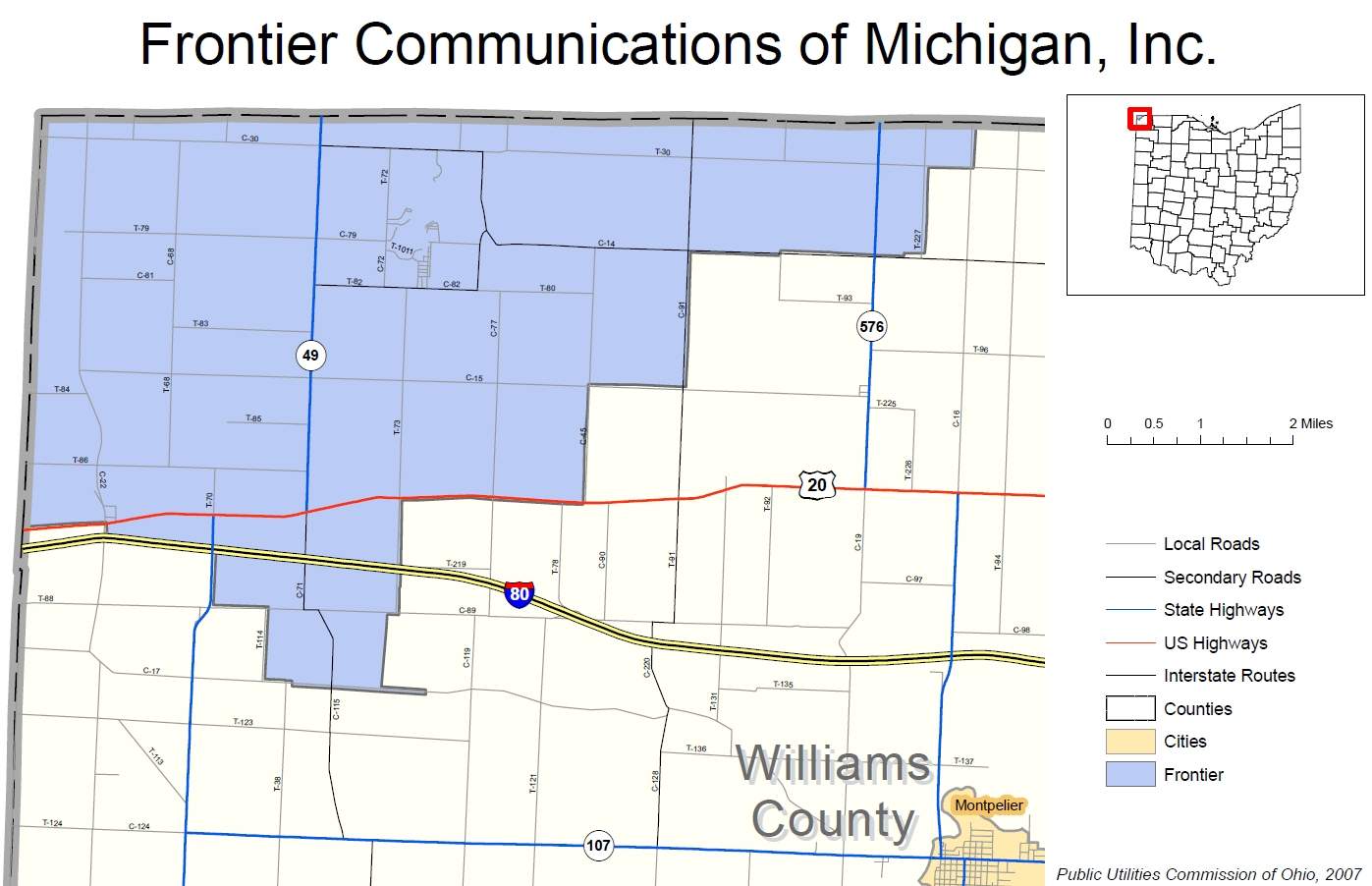
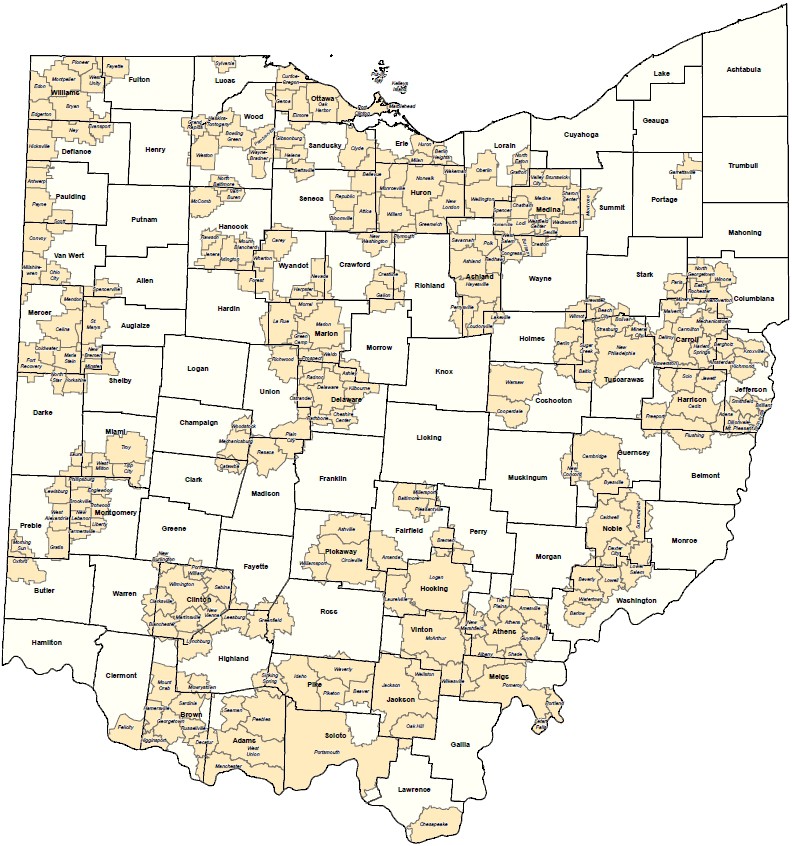
Frontier's current service area in Ohio is a tiny portion of Williams County, serving just 480 residents from an office in Michigan (click to see a color map of the service area)

Ohio residents are largely unfamiliar with Frontier Communications.  Prior to the merger, just 480 residents in a tiny portion of Williams County in northwest Ohio had Frontier telephone service, served by Frontier Communications of Michigan’s office in Osseo, Michigan.

Right now, residents of Billingstown, Cooney, Northwest, and Nettle Lake, Ohio might qualify for Frontier High-Speed Internet Max, advertising “breakthrough speeds at an unbeatable price.”  That is “up to 3Mbps” service starting at $49.99 a month.

Those members of Frontier’s family of customers will now be joined by 435,000 Verizon residential customers in 77 of Ohio’s 88 counties.

The largest portion of Frontier’s new service area will include parts of Champaign, Clark, Clinton, Darke, Miami, Montgomery, Preble, Shelby and Warren counties.

Despite early opposition from Ohio Consumers’ Counsel (OCC), who expressed concerns about the financial viability of the deal and the fulfillment of promised broadband expansion, the vote by the Public Utilities Commission (PUC) was unanimous.  After negotiations with company officials and the OCC and PUC, an agreement to attach conditions to the sale of Verizon’s landlines resulted in a change of heart by the Counsel’s office.

Frontier's new service area, representing territory formerly served by Verizon North (click to enlarge)

Many of Ohio’s former Verizon service areas are served by Verizon”s DSL service, but many rural communities went unserved.  Verizon has made a business decision to direct resources into its fiber to the home service — FiOS, which is only being provided in substantial-sized communities.  With Verizon’s reduction in resources towards rural service areas, Frontier argues the sale will benefit rural residents because they will provide broadband service Verizon never did.  Frontier suggests the viability of its landline business is enhanced by robust broadband deployment as consumers continue to drop traditional phone service.  Broadband gives customers a reason to stay with Frontier, the company believes.

But critics contend Frontier’s broadband is behind-the-times, often providing less than 3Mbps service in many smaller communities.  Frontier also maintains language in its Acceptable Use Policy that expects consumers to limit their broadband use to just 5GB per month, although company officials stress they do not enforce that provision at this time.

Frontier believes broadband deployment will help the company survive the trend away from landline phone service

Frontier relies on traditional, basic ADSL service across its service areas nationwide, but also provides provides some communities with Wi-Fi access for an additional monthly charge.

Similar earlier deals between Verizon and FairPoint Communications, the Carlyle Group, and Verizon’s former telephone directory printing operation (now Idearc Media) have all ended in bankruptcy after months of sub-standard service, billing errors, and broken promises.  Should a similar fate befall Frontier Communications, a trip to Bankruptcy Court could put an end to broadband, pricing, and service commitments made with state officials.

Dealing the Race Card Into the Net Neutrality “Dollar A Holler” Debate

Phillip Dampier February 11, 2010 Astroturf, Broadband "Shortage", Broadband Speed, Competition, Data Caps, Editorial & Site News, Net Neutrality, Online Video, Public Policy & Gov't, Rural Broadband Comments Off on Dealing the Race Card Into the Net Neutrality “Dollar A Holler” Debate

For months now, several groups purporting to represent the interests of minorities have busily been attacking Net Neutrality as beside the point for the poor and unserved consumer who has been left out of the broadband revolution.  To varying degrees, several of these groups have been spouting broadband industry talking points to the Federal Communications Commission, members of Congress, and the public at large.

For them, and the profitable broadband industry they indirectly represent, providing access at affordable prices is much more important than making sure providers don’t lord over the network they provide to customers.

Access vs. Openness

Consumers are perplexed by this either/or proposition.  For us, both issues are vitally important.  In urban, income-challenged areas, affordability is a crucial issue.  In rural areas, access to anything resembling broadband comes before worrying about the price.  For all concerned, making sure the Internet is not subject to corporate content control, either through direct censorship or through the far-more-common practice of pricing and policy controls, is just as important.

Providers have their self-interest on display when they promote broadband expansion — they want to receive the public dollars available from the broadband stimulus package to pay for that expansion.  Of course, every step of the way they have their fingers all over the process, from broadband mapping that protects incumbents from potential competition, defining what constitutes broadband to be as slow and as cheap to provide as possible, to implement usage rationing through Overcharging schemes like usage limits and usage-based billing, and to advocate for public policy that keeps the Money Party of fat profits running as long as possible without oversight.

The entry of minority interest groups into the debate is nothing new.  Groups of all kinds, including many who one would think wouldn’t have an opinion on Net Neutrality, are all part of the discussion.  Debates ensue, statements are fact-checked, back and forth discussion ensues.  What disturbs me is the small handful of groups who are willing to deal the race card when their own views and statements are challenged and they are threatened with losing the argument. Ill-equipped to argue the merits of their case in detail and withstand the scrutiny of fact-checking, some have introduced race into the debate to obfuscate the issues.

While I don’t doubt their sincerity and passion advocating for increased access and affordability, too many of these groups hurt their own case by accepting generous contributions (or advisory board members) from the telecommunications industry.  Consumers who witness the near total alignment of views between these groups their corporate benefactors are right to be concerned.  Many are asking if those views represent true conviction or “a dollar a holler” advocacy.
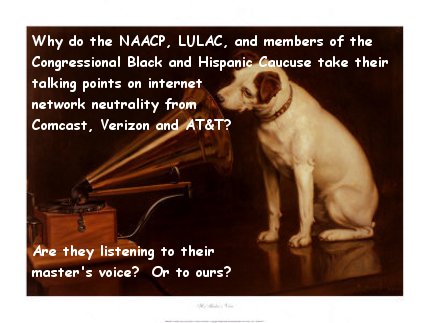
The Black Agenda Report, which created this graphic, ponders the same questions many consumers are asking

As Stop the Cap! documented just a few months ago, Broadband for America is a great example of industry-funded astroturf in action.  Large numbers of groups with no apparent connection to the broadband policy debate have found their way onto the roster of members.  From a cattle association to a Native American group that also has a burning interest in sharing their views about corporate jet landing rights, the one thing in common with virtually every last one of them was a financial contribution and/or board member working for big cable or telephone companies.  Thus far, debating a cattle association has not brought charges of being anti-cow, although I suspect consumers are anti-bull.  Debating the merits of Net Neutrality with Native American groups has not brought charges of anti-Native American bias.

Stop the Cap! itself has been on the receiving end of racial rhetoric offered by one of the anti-Net Neutrality advocates out there, Navarrow Wright.  Wright is a former corporate executive at Black Entertainment Television, and spends his days now as a self-proclaimed social media and branding expert. Last year, after exiting as CEO of Global Grind, a hip hop social network, Wright launched Maximum Leverage Solutions, which claims to be a full service consulting firm specializing in social media strategy and Internet Consulting.

Just a few months later, Wright suddenly discovered a big interest in the concept of Net Neutrality.  While he doesn’t disclose his client list, would it surprise anyone if a telecommunications company hired his services for their own “social media strategy?”

Since last fall, Wright has been generating a mix of provider talking points, Google bashing, and attacking groups that support Net Neutrality.  He’s called supporters of an open Internet “digital elites,” the FCC a player of “dangerous games” by ignoring the anti-Net Neutrality public, Free Press a group that wallows “in crazy claims and race-dividing rhetoric,” and tries to connect support for Net Neutrality as somehow representing opposition to increased broadband adoption.

Challenging and debunking his talking points isn’t difficult — they are precisely the same ones the broadband industry has used for several years now.  We invited Wright to a full, in-depth discussion about the merits of Net Neutrality and broadband adoption.  We even got the discussion started, but that’s exactly where it ended.

Wright is also incredibly defensive about the issue of industry-backed mouthpieces and astroturf efforts in general.  Suggesting Wright’s views are inaccurate brings his resume in response, which I suppose was designed to impress readers with suggestions of his built-in expertise, belied by his silence on these issues prior to last year.  In Wright’s original comment, he took our comments about economically disadvantaged Americans and made it an issue of color:

Our piece:

The letter represents the groups’ concerns that broadband for many in America is simply not available, especially for the economically disadvantaged.  They’ve been swayed by industry propaganda to characterize Net Neutrality as a threat to addressing the digital divide by making service ultimately even more expensive.

His response:

Phil, I know (at least I hope) your intent wasn’t to suggest that people of color have been “swayed by industry propaganda” and aren’t capable of thinking for ourselves on technology issues.

James Rucker, executive director of Color of Change added to the debate in late January, wondering why some civil rights groups are only too willing to support discredited industry talking points and advocate against Net Neutrality.

Rucker discovered the same thing we did.  Challenging these groups to explain their positions brings forth repetitious inch-deep talking points and total silence when a rebuttal is offered.  If pushed, they obfuscate with claims their views are being disrespected, when in reality they are only being fact checked.  Perhaps inconvenient, and even slightly embarrassing, but it’s completely appropriate for consumers to ask whether a conflict of interest exists when a group advocates for the positions of the same industry that is sending them big contributions.

The risk, of course, is to tie an organization’s good name to demonstrably false provider propaganda that some groups are willing to repeat, nearly word for word.

Take for instance Wright’s claim that Net Neutrality will force providers to spend money they would otherwise invest for the benefit of the rural, the downtrodden, and the unserved:

That brings me to the other corporate interests: the Internet service providers. It is the ISPs who must invest in, upgrade, maintain and build out the networks that allow us to receive these cool applications. While I don’t find the network side as sexy as the content side, I do know that we have to have it and ISPs need capital to build and maintain it. So the question remains who is going to pay for maintenance and upgrades to the network if Google gets a free ride? Basic economics tells us that if government requires ISPs to give Google a free ride, there’s only one other place to look for the money: consumers like you and me. What’s more, there are those who want to make it even more unfair by insisting that your big-bandwidth-using neighbor should not have to pay more than you, even if all you want to do is check email and watch some YouTube. Who will all of this hurt the most? Low-income consumers.

The only color that really matters here is green

Wright doesn’t know his American telecom history.  Let’s discuss this fiction:

  1. Bruce Dixon, a writer for the Black Agenda Report says it better than anyone: “Phone companies invented the digital divide more than a century ago as their core business model, preferring to extend service to affluent areas where they could levy premium charges, rather than building networks out to reach everybody.”  The cable television industry “franchise” requirement came as a direct result of cable industry redlining, the practice of wiring wealthy neighborhoods for cable while bypassing urban and rural areas deemed “unprofitable.”  It’s the same story for broadband, and Net Neutrality is beside the point.  The number crunchers look for Return On Investment (ROI) when considering who gets on the right side of the digital divide.  If they can’t make a killing on you, they’re not going to provide you service.  If you can’t afford their asking price, which is increasing regardless of Net Neutrality, why serve you?  Ultimately it is consumers who overpay for these networks, priced well above cost, generating literally billions in profits.  Why ruin a good thing with altruistic broadband expansion at a fire sale price?
  2. Regardless of what Google is doing, providers are seeking new ways to further monetize broadband service, enriching themselves even further.  Prices go up even as the costs to provide the service go down.  The old chestnut about the next door neighbor being a usage piggy is just more of the same “us vs. them” propaganda from providers who want consumers to fight amongst themselves while they run to the bank with the money.  Grandma doesn’t want her broadband service limited either, and she’s way too smart to believe a provider promising dramatic savings for less service from companies that jack up her rates year after year.
  3. The best way to guarantee affordable access to broadband service is to develop a national broadband plan that provides the same kinds of “lifeline” services already available for economically disadvantaged phone customers, legislative policies that force markets open to additional competition, government oversight to ensure providers are required to provide service throughout their respective service areas, and stimulus or Universal Service Fund assistance for projects that assure access to those who simply will never pass ROI tests.  Or we can solve everything by not passing Net Neutrality?  Please.
  4. Google doesn’t have a free ride.  First, consumers -pay- providers for connectivity.  Ultimately, they are the customers — content producers are not.  Nothing prohibits an ISP from offering hosting services to content producers at competitive prices.  If Google, Amazon, Netflix, or Hulu want to host their content on servers owned by Verizon, Comcast, Time Warner, or AT&T, nothing stops them.  Google pays for its own connectivity to the Internet.  Customers pay for accessing it.  Now providers want to get paid again.  It’s like triple-charging for snail mail – you pay for a stamp to mail it, the person you wrote pays to receive it, and the airline that flew the letter cross country has to pay to transport it.

Remember, it’s the content that drives broadband adoption. ISP’s honestly don’t fret as much about traffic as they claim.  They just care whether they can own it, control it, and profit from it.  The evidence to back this up comes from cable and phone companies in a big hurry to stream video content over their TV Everywhere projects.  Nothing consumes bandwidth like online video, yet there they are enthusiastically embracing it.  They have to, because if they don’t control it, it could eventually lead to people dropping their cable TV subscriptions in favor of online viewing.

Wright’s blog promotes another industry favorite — the dreaded phony “exaflood” which threatens to bring chaos and disorder to our online world… unless we totally deregulate broadband and let them do whatever they want to “solve it.”  That’s more of the same.  We’ve seen the results of that for more than a decade now, and the very digital divide that Wright complains about comes as a direct consequence to letting broadband providers serve, or not serve customers as they please at the prices they want.

Wright and other civil rights groups can throw as many race cards as they like against consumers who see right through their corporate-backed agenda.  That’s because consumers know Net Neutrality isn’t an issue of black or white.  The only color that really matters here is green.

Search This Site:

Contributions:

Recent Comments:

Your Account:

Stop the Cap!