Home » Rural Broadband » Recent Articles:

Does Broadband Need More Regulation?

Phillip Dampier March 15, 2010 Astroturf, Competition, Net Neutrality, Public Policy & Gov't, Rural Broadband Comments Off on Does Broadband Need More Regulation?

[flv]http://www.phillipdampier.com/video/CNBC Broadband Regulation 3-2-10 .flv[/flv]

Free Press’ policy director Ben Scott held his own, despite being hopelessly outnumbered, in a business-friendly CNBC ‘Power Lunch’ debate over broadband public policy held earlier this month.  Scott faced Yahoo! CEO Carol Bartz, Larry Clinton from the “Internet Security Alliance,” which receives substantial support — not disclosed by CNBC — from AT&T and Verizon, and CNBC’s clueless Michelle Caruso-Cabrera, who insisted 99 percent of America already subscribes to broadband.  All of the industry talking points were on hand, which isn’t too surprising when they come from industry front groups like the ‘ISA.’ (3/3/2010 — 5 minutes)

New Mexico Rural Broadband Gets Boost from Federal Stimulus Program

Phillip Dampier March 12, 2010 Public Policy & Gov't, Rural Broadband, Video Comments Off on New Mexico Rural Broadband Gets Boost from Federal Stimulus Program

Stimulus funds are helping bridge the digital divide by bringing high speed Internet to rural areas in southeastern New Mexico.

Thursday, Rep. Ben Ray Luján applauded investments in rural broadband in New Mexico made through the American Recovery and Reinvestment Act.

“Broadband technology connects communities, helps businesses grow, and provides students with the opportunity to learn new skills. As we expand broadband technology, we must ensure that our rural communities have access,” said Luján. “It is encouraging that the Recovery Act is making this important investment in broadband technology, especially in our rural and tribal communities.”

Penasco Valley Telecommunications in Artesia has been awarded $10 million in federal stimulus money to string miles of fiber optic cable to rural towns like Hondo, Mayhill and Hope.

The fiber optic cable will be a vital link for the area’s homes, businesses, schools and emergency services.

“It’s important for the rural parts to have access to the Internet, otherwise the digital divide they talk about will just get wider,” said Glenn Lovelace of Penasco Valley Telecommunications.

The project is scheduled for completion some time next year.

Since the American Recovery and Reinvestment Act of 2009 began distributing stimulus funds, it has provided roughly $250 million in funding for projects and programs in New Mexico.

The two New Mexico broadband projects that will receive funding:

Pueblo de San Ildefonso: TewaCom Broadband Initiative (TBI), Phase 1-Upper Rio Grande Valley Project; $632,225 loan and $632,225 grant. The funding will enable the Pueblo to expand service to 2,405 households.

Penasco Valley Telephone Cooperative Inc.: The Penasco Valley Telephone (PVT) Incumbent Local Exchange Carrier (ILEC) Project; $4,818,607 loan and $4,770,660 grant. The funding will provide high-speed broadband to unserved areas in the ILEC territory through fiber and wireless technology.

[flv width=”480″ height=”380″]http://www.phillipdampier.com/video/KOB Albuquerque High-speed cable slated for southeast New Mexico 3-10-10.flv[/flv]

KOB-TV in Albuquerque reports the high speed broadband projects made possible from stimulus funding resemble the kind of public works projects that were common during the Great Depression. (2 minutes)

Frontier-Verizon Deal Wins Approval in Oregon; Consumer Protections Part of Deal to Gain Approval

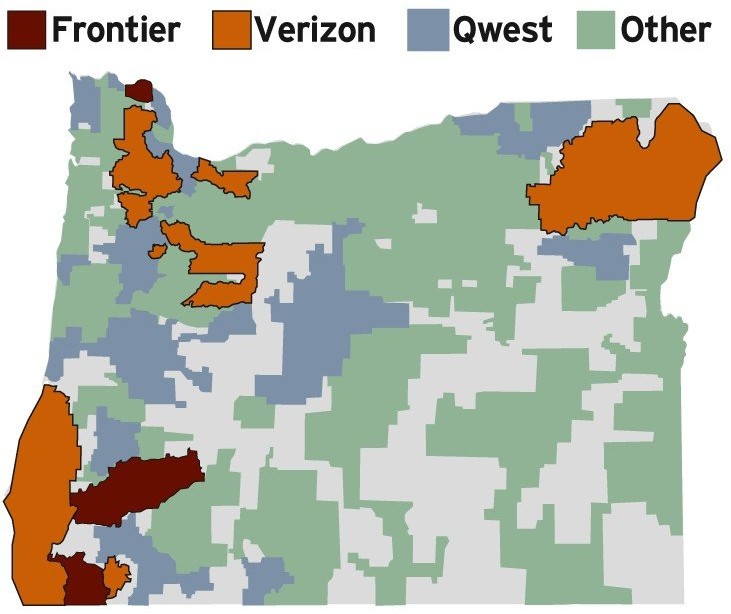
Oregon's telephone company service areas

Frontier Communications has won approval to assume control of telephone lines serving 310,000 Oregonians.

The Oregon Public Utilities Commission Friday unanimously approved the transfer of service from Verizon to Frontier as part of a 14-state transaction.

“First and foremost we want to ensure that customers are not harmed by this transaction.  That’s why we are requiring more than 50 conditions, all aimed at making sure customers are not harmed by this sale,” Chairman Lee Beyer said. “In addition, we are requiring Frontier Communications to spend $25 million on expanding high-speed internet access to its Oregon customers by July 2013.”

In return for approval, Frontier agreed to PUC demands for customer service protections:

  • A commitment that Frontier spend at least $25 million to expand high-speed broadband in Oregon by July 2013;
  • No changes in “commission-regulated” retail service plans for at least three years;
  • Costs of the transition must not be paid by customers in the form of rate increases;
  • 90-day window to change long distance carrier without any fees;
  • An independent audit, paid for by Verizon, to ensure Frontier can handle service for those customers affected by the deal;
  • An opt-out provision letting Oregon’s FiOS subscribers terminate their contracts without penalty if Frontier reduces Internet speeds or drops any of its television channels.

What is missing from Oregon’s agreement?

  • A prohibition of Internet Overcharging schemes like Frontier’s 5 gigabyte “acceptable use” policy that potentially limits customer’s broadband use.  Expanded broadband that customers can only use for basic web browsing and e-mail, without fear of exceeding the limit, indefinitely punishes rural Oregonians with no broadband alternatives;
  • A specific definition of what constitutes “broadband” speeds.  Frontier can continue to deliver the 1-3 Mbps it routinely provides to its less urban service areas.  While better than nothing, Oregon regulators could have used the deal as leverage to win 21st century broadband speeds from Frontier, not yesterday’s ‘barely broadband;’
  • Fines and penalties that will punish a provider that does not invest appropriately in high service standards to provide quality service, and a trigger to permit automatic cancellation of operating certificates should Frontier go bankrupt.

Too many of these deals offer upsides for Wall Street and little benefit to consumers, especially those dependent on their landline phone company for basic communications services.  By forcing requirements that prove costly for a provider to renege on, investors will understand their gains will only happen when they are assured Frontier is doing right by their customers, as well as their shareholders.

Oregon is the sixth state to approve the sale.

Frontier currently serves only 12,000 customers in the state, mostly in southwest Oregon, including the communities of Azalea, Canyonville, Cave Junction, Days Creek, Glendale, Myrtle Creek, O’Brien, Riddle, Selma, and Wolf Creek.

The company’s new customers will come mostly from Washington County, east Multnomah County, and from several pockets of customers in the northwestern part of the state.  Oregon’s largest telephone provider is Qwest Communications, but the state has numerous smaller independent providers as well.

Verizon’s Abdication of Rural Broadband — Plow Money Into Big City FiOS, Ignore or Sell Off Rural Customers

Verizon Communications has made its intentions clear — would-be broadband customers in its service area who are off the FiOS footprint can pound salt.  The Federal Communications Commission issues regular reports on broadband services and their adoption by consumers across the United States.  In the latest report, published this month, customers in Verizon’s current or former service areas who are not being served by Verizon FiOS are behind the broadband 8-ball, waiting for the arrival of DSL service from a company that has diverted most of its time, money, and attention on deploying its fiber-to-the-home service for the big city folks.

One might think the worst DSL availability in the country would be in rural states like Alaska, or territories like Guam, or income-challenged Mississippi.  No, the bottom of the barrel can be found in northern New England and the mid-Atlantic states — largely the current or former domain of Verizon:

Percentage of Residential End-User Premises with Access to High-Speed Services by State
(Connections over 200 kbps in at least one direction)

Maine 73% Sold to FairPoint Communications
Maryland 76%
New Hampshire 63% Sold to FairPoint Communications
New York 79%
Vermont 72% Sold to FairPoint Communications
Virginia 69%
West Virginia 66% Seeks sale to Frontier Communications
Source: FCC High-Speed Services for Internet Access: Table 19

Some might argue that DSL penetration ignores Verizon’s fiber upgrades, but does it?

Providers of High-Speed Connections by Fiber by State as of December 31, 2008
(Connections over 200 kbps in at least one direction)

Maine 8%
Maryland 9%
New Hampshire 10%
New York 21%
Vermont 4%
Virginia 20%
West Virginia 7%
Source: FCC High-Speed Services for Internet Access: Table 20

A survey of the rest of the country calls out Verizon’s inattentiveness to DSL expansion in its remaining service areas not covered by FiOS.

For example: Alabama, Idaho, Montana, and Oklahoma all enjoy 80 percent DSL availability.  Utah and Nevada achieved 90 percent coverage.  Even mountainous Wyoming, the least populous state in the country, provides 78 percent of its state’s customers with the choice of getting DSL service.  Yet New York manages only one point higher among its telephone companies, largely because of enormous service gaps upstate.

What happened?  By 2002 Verizon began to realize their future depended on moving beyond providing landline service.  The company began to divert most of its resources to a grand plan to deliver fiber connections to residences in larger markets in its service areas.  While great news for those who live there, those that don’t discovered they’ve been left behind by Verizon.  Northern New England got flushed by Verizon altogether — sold to the revenue-challenged FairPoint Communications who assumed control of Verizon’s problems and managed to make them worse.

The argument that rural broadband is “too expensive” doesn’t fly when looking at DSL availability in the expansive mountain west or rural desert regions.  Compact states like Vermont, New Hampshire, and Maryland are far easier to wire than North Dakota, New Mexico or even Texas with its large rural areas (87, 87, and 81 percent coverage, respectively).  Verizon simply doesn’t realize the kind of Return on Investment it seeks from FiOS customers — a dollar amount investors want to see.

Of course, that’s the argument Frontier Communications, and FairPoint behind it, made to regulators in sweeping promises to deliver better broadband service.  FairPoint missed its targets and declared bankruptcy.  Frontier is still in the “promises, promises” stage of its deal to take over millions of rural customers currently served by Verizon.


Broadband Stimulus Blockade – ‘Unless We Provide It, You Shouldn’t Get It’ – Incumbent Providers Just Say No

America’s established cable and telephone companies are pulling out every stop to impede the Obama Administration’s broadband stimulus program.

Comcast alone, the nation’s largest cable company, has filed thousands of objections to proposed broadband projects in communities large and small, claiming those projects have the potential of introducing competition in their service areas, whether or not actual broadband service is being provided to residents in those communities.

Most large providers like Time Warner Cable, Comcast, and many national phone companies have steered clear of applying for broadband stimulus money.  They don’t like requirements that could force them to adhere to Net Neutrality provisions, sharing equal access to their networks.  But they don’t want anyone else on their turf getting funding either, and they’re spending enormous amounts of time and money objecting to anything and everything that seeks funding in their respective service areas.

It’s nothing short of a Broadband Blockade, and it is dramatically slowing the government’s ability to pour over thousands of applications.

Settles

Dan Hays, from consulting firm PRTM, told USA Today as a result of the delays, there’s significant doubt as to whether the monies can be awarded before the end of September when the funding authorization expires.

Could that be part of the plan all along?

“They aren’t leading, they aren’t following, and they won’t get out of the way,” said Craig Settles, a municipal broadband expert. “They’re not going to put proposals on the table because they don’t like the rules. Yet they’re not going to cooperate with the entities that are going after the money.”

“There are 11,000 public comments (about the funding applications), and I’m willing to bet that 9,000, at least, were a challenge or protest of one sort or another,” says Settles.

“We’re at a point where it’s the general public’s interest vs. the entrenched incumbents,” Settles added.

When giant telecommunications providers are threatened, they run to lawmakers for special protection, and they’re getting it.

National Public Radio ran this report about the problems awarding broadband stimulus grants. (5 minutes)
You must remain on this page to hear the clip, or you can download the clip and listen later.

Coming next…

FairPoint – Bankrupt And Soaking in Failure – But Still Has Enough for Lobbyists, Attorneys to Fight Broadband Projects On Its Turf

Search This Site:

Contributions:

Recent Comments:

Your Account:

Stop the Cap!