Home » Rural Broadband » Recent Articles:

North Carolina Phone & Cable Companies Decry Municipal Broadband While Living Large on Public Tax Breaks Themselves

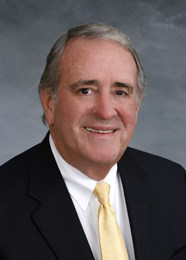
Sen. David Hoyle (D-NC)

Retiring North Carolina state senator David Hoyle wants to save North Carolina cities from themselves.  Proclaiming that “cities are getting into the broadband business with little or no experience and competing with private enterprise who pay the taxes,” Hoyle continues his push to put a stop to municipal broadband projects in North Carolina.

A week after Hoyle and a few allies on the Revenue Laws Study Committee pushed forward a draft bill that would require public referendums that could be triggered even when making basic repairs to community-owned fiber networks, IndyWeek reports Hoyle doesn’t exactly come to the debate with clean hands.

Rebekah Cowell, in a piece called “Hoyle to municipal broadband: Drop Dead,” notes Time Warner Cable’s PAC contributed $6,000 to Hoyle’s final campaign in 2009.

Hoyle told Cowell he is not swayed by Time Warner Cable’s deep involvement in pushing the legislation forward, despite the generous contribution to his campaign coffers.

“The lobbyists don’t influence me,” he said. “I’m in the pocket of the people that provide jobs for this state, and Time Warner Cable employs 8,500 in this state, and I can’t imagine any one that would want to compete with that.”

Time Warner Cable told IndyWeek it doesn’t philosophically oppose municipal broadband projects, and claims Hoyle’s bill would only apply to a city that chooses to take taxpayer money to build a competing network as if it were a private provider. “We just believe that they should have to operate under the same rules as the private provider,” Melissa Buscher, director of media relations at Time Warner Cable told Cowell. “We do believe people in the community should have a say-so in how large amounts of public monies are spent.”

Buscher

Yet the legislation proposed by Hoyle actually impacts projects that receive no public taxpayer dollars.  Under his proposal, any municipal project seeking private bondholders has to endure an endless series of referendums on everything from initial system approval, construction, refinancing debt, extending service, upgrading the network, and even when basic system repairs are needed.

Time Warner Cable’s concern for public tax dollars only seems to extend to their potential competitors.  The cable operator itself gratefully accepted public tax dollars from the state Department of Commerce, the city of Charlotte, and the county of Mecklenburg to construct a $29 million dollar headquarters building in Charlotte.  Even in smaller communities, the cable operator enjoyed benefits from taxpayers who didn’t have a “say-so in how public monies are spent.”  In December, Marble Cliff Village Council approved an economic development agreement with Time Warner Communications including a five-year tax abatement worth $100,000.

North Carolina’s phone companies also benefit from state taxpayers.  As IndyWeek reports:

A 2009 analysis by Democracy North Carolina [shows] two telecommunications companies, AT&T and Embarq, both benefited from tax breaks on the purchases of telephone equipment that costs the state an estimated $31 million annually in lost revenue. In 2008, political action committees for AT&T and Embarq contributed $140,500 and $151,250, respectively, to legislative candidates, statewide candidates and party committees.

Hoyle apparently has no problem with losing that tax revenue.

Hoyle’s claims that municipal broadband projects hurt North Carolina consumers are untrue in cities like Wilson, the only community in North Carolina that successfully avoided a Time Warner Cable rate increase this year.

Time Warner customers in Wilson are benefiting from Greenlight’s competition. According to a December 2009 presentation before the House Select Committee on High Speed Internet Access in Rural and Urban Areas, Time Warner raised its prices for basic service in the Triangle—as much as 52 percent in Cary—but did not impose any rate hike in Wilson. Nor did the company increase prices in Wilson for the digital sports and games tier, while Triangle customers paid 41 percent more.

Cable and broadband consultant Catharine Rice of Action Audits gave the presentation; she advocates for municipalities that want to build their own networks.

The bill could hurt Wilson’s Greenlight service, even though it’s been installed. “The way the legislation is worded, and how I interpret it,” says Ovittore, “is that if the city of Wilson … had a resident who was digging in their yard—let’s say putting a new mailbox in—and accidentally damaged a strand of fiber, before that strand could be repaired the city would have to go through a referendum and vote, spending endless taxpayer dollars.”

A public referendum could also be required if Wilson wanted to connect an additional household to their existing system, Ovittore said.

Hoyle says that of the $30 million to build the network, Wilson used $12 million of it from the utility account. “People there are raising hell about their electricity bill, and it’s just not right,” he said.

Brian Bowman, Wilson’s public affairs manager, said the city borrowed the $28 million on the private market. As for Hoyle’s $12 million figure, Bowman said, much less—only $3.6 million— had been set aside from the electric fund by City Council in 1989; it was re-designated in 1999. “It has always been part of our funding package,” he said. As for the electric bills, Bowman said they were higher earlier this year because of the particularly cold winter, not the cost of the network.

Wilson accomplished its municipal broadband system without spending a nickle of taxpayer money.  Other North Carolina communities considering similar projects would run into overwhelming problems overcoming Hoyle’s telecom-friendly legislation because of its referendum requirements.

Hoyle told IndyWeek he doesn’t see the need for such projects anyway, claiming fast broadband is already universally available across the state.

“I’ve heard that BS, and it’s just not true—period,” he said. “Anybody that needs service has got served in this state and will continue to get served.”

Hoyle’s words sound a lot like those of Time Warner Cable, which also contends broadband availability is not an issue. “Based on a map of the state done in 2009 by Connected Nation, more than 92 percent of homes in North Carolina have broadband available to them,” said Buscher. “A vast majority of those have two wireline providers, some have wireless providers, plus satellite offers broadband to literally every home in the state. This isn’t an availability issue. Anyone who wants Internet service can get it today.”

Those claims are dubious. Chatham County Commissioner Tom Vanderbeck has advocated for rural broadband access since 2006 in an area where pockets still have only dial-up and DSL. Vanderbeck was recently appointed by the General Assembly to serve on the e-NC Authority, which promotes statewide rural broadband. He calls Hoyle’s bill anti-competitive, one that would discriminate against local government.

[…]

“Requiring a vote, when you have deep pockets that can fight it and put up as much money as they want, while making the project sound like a waste of taxpayer dollars—that would be a tragedy,” she adds.

Anyone who proclaims satellite fraudband represents a credible broadband competing alternative should be forced to use it.

Connected Nation, which Buscher relies on for her numbers, has a board dominated by telecommunications company executives, particularly AT&T.  With their private provider-stacked leadership, they can draw the maps anyway they please, particularly in ways that suggest there isn’t a broadband problem in North Carolina… or anywhere else.  Not as long as they are running it.
Liberals Promise Universal Broadband Across Rural Canada – Join Today’s Online Town Hall at 3:30pm EDT

Phillip Dampier May 5, 2010 Broadband Speed, Canada, Data Caps, Editorial & Site News, Net Neutrality, Public Policy & Gov't, Rural Broadband Comments Off on Liberals Promise Universal Broadband Across Rural Canada – Join Today’s Online Town Hall at 3:30pm EDT

(The Liberal Party is sponsoring an online town hall meeting this afternoon at 3:30PM EDT on the issue of expanding broadband in rural Canada.  Why not join in and demand that Michael Ignatieff commit to reforming the Canadian Radio-television and Telecommunications Commission, which has landed Canada in a real broadband mess filled with Net Neutrality violations and Internet Overcharging schemes like usage caps and consumption billing.  The CRTC has been so submissive to Canadian telecom, they might as well be their trade association.

Tell him rural broadband expansion doesn’t do much good if the existing providers, which got Canada into this mess, are still in charge of running it.  Real broadband reform requires a government committed to universal broadband that works for Canadians and doesn’t simply profit from them.  Demand Net Neutrality commitments from the Liberal Party and an end to overcharging schemes.  Universal broadband doesn’t mean much to Canada if Canadians can’t use it without fear of overlimit fees and enormous bills at the end of the month. — Phillip Dampier)

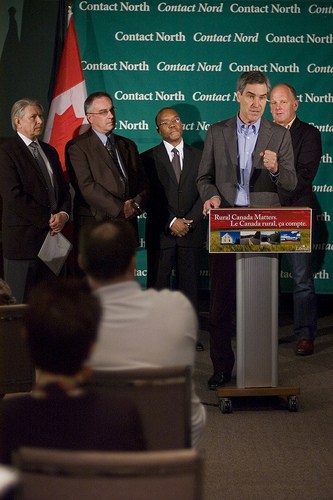
Ignatieff announces the Liberals' rural broadband plan at Contact North in Thunder Bay, Ont.

The Liberal Party of Canada has promised rural Canadians they will not be left behind the digital online revolution, unveiling a promise Tuesday to deliver universal broadband access to all Canadians within three years of taking office.

Michael Ignatieff, Liberal leader made the commitment as part of a series of planks the party introduced under its “Rural Canada Matters” platform to attract support from rural Canadians, who tend to vote Conservative.

“Too many rural communities can’t get access to essential services, because we don’t have the digital infrastructure to deliver them,” said Ignatieff. “That’s why I’m committing a future Liberal government to 100 percent high-speed Internet for every rural, remote and Northern community in our country.”

According to Ignatieff, using proceeds from a 2011 wireless spectrum auction, a Liberal government would invest to achieve an interim target of 100 percent high-speed Internet connectivity of at least 1.5 Mbps. A Liberal government would also seek to set a more ambitious goal for 2017, Canada’s 150th anniversary as a country.

The Liberals blasted the incumbent Conservatives for breaking their promise to deliver rural broadband to Canadians.

In 2006, Canada’s Telecommunications Review Panel recommended the federal government achieve 100% high-speed Internet connectivity by 2010. This goal was not achieved under the Conservative government.  According to the CRTC, in 2009 close to 800,000 Canadian households still did could not access high-speed Internet – or 20% of all rural Canadians. At the turn of the century, Canada ranked second in the world in Internet connectivity, but has now fallen to tenth place.

Ignatieff announced the plan in Thunder Bay, Ontario at an Internet access center run by Contact North.  He characterized the current state of broadband in Canada as threatening the country’s economic competitiveness and quality of life for rural residents.

“While railways and highways were the essential infrastructure of the 20th century, fiber optic lines, satellites and wireless towers, are the digital infrastructure needed to connect our communities and strengthen our economy in the 21st century,” said Liberal Rural Caucus Chair Mark Eyking, “In all regions of Canada, families and businesses depend on access to the Internet and mobile phone coverage.”

New Democratic Party (NDP) MP Bruce Hyer (Thunder Bay-Superior North) praised the Liberal plan.

The Liberal Party is trying to capture an increased share of traditional Conservative Party supporters with a rural-focused agenda

“Obviously, country-wide broadband is a good idea,” Hyer told The Chronicle-Journal newspaper in Thunder Bay. “And there should be virtually no community of any size in Canada, and nowhere along the Trans-Canada, for sure, that we don‘t have high-quality mobile phone access and service. The United States has those things, and we should have them, too.”

But NDP MP John Rafferty (Thunder Bay-Rainy River) told the newspaper he’s heard it all before.

“Liberals have been talking about rural broadband access for a decade now,” he said. “The interesting thing is that he says rural Canada matters. But clearly it hasn’t mattered to Liberals for a long time, or else we would’ve had broadband.  They had a chance to do this. What they’re doing is regurgitating old promises.”

Rafferty said the Liberals first brought it up in 2001, and said then it would cost $4 billion.

“I’m not sure where he comes up with ($500 million).”

Another concern for the Liberal Party plan is the fact it relies entirely on private providers to deliver the service, something they have refused to provide many rural Canadians thus far.  In effect, the government would transfer $500 million dollars earned from large telecommunications companies buying additional spectrum and then hand it all back to those same companies to construct slow speed broadband services they can then profit from.

While many Canadian officials blame Canada’s large rural expanse for the digital divide, others blame Canada’s broadband providers who have engaged in usage-limiting schemes, increased prices, and throttled the speeds of certain broadband services.

Country

Universal Service Target

Target date

US 4 Mbps 2020
UK 2 Mbps 2012
Canada (Liberal Proposal) 1.5 Mbps within 3 years of being elected
South Korea 1 Mbps Currently available
Finland 1 Mbps Currently available
Ireland 1 Mbps 2010
Germany 1 Mbps 2010
France 0.5 Mbps 2010

Analysis: Breaking Down the CenturyTel-Qwest Merger

Today’s merger between CenturyTel (soon to be CenturyLink) and Qwest will combine 10 million Qwest customers and 7 million from CenturyTel into a single company serving 37 states in every region of the country except the northeast and much of California and Nevada.  CenturyLink gains access to Qwest’s highly valued portfolio of services sold to business customers and Qwest gets a partner that can help manage its $11.8 billion debt and help grow the last remaining Baby Bell, formerly known as US West, into a national player capable of withstanding ongoing erosion of landline service.

The deal will impact consumers and businesses, and will challenge regulatory authorities to consider the implications of ongoing consolidation in the traditional telephone service marketplace.  It brings implications for broadband service strategies for both companies, which we’ll explore in greater detail.

Breaking Up Was Too Hard to Do, So Let’s Put It Back Together

Ultimately, the genesis of this, and most of the other big telecom deals that we’ve witnessed over the past few years comes from the 1996 Communications Act, which deregulated large parts of the telecommunications industry and triggered a massive wave of consolidation that is still ongoing.  That legislation was the antithesis of the 1984 court ruling which ultimately led to the breakup of AT&T and the Bell System monopoly in 1984.  When President Clinton signed the 1996 bill into law, it allowed much of the Bell System to eventually recombine into two major entities:

  • AT&T ultimately pieced itself back together with the acquisitions of:

BellSouth — serving the southeastern United States

Ameritech — serving the upper Midwest

SBC/Southwestern Bell — serving Texas and several southern prairie states

Pacific Telesis — serving California and Nevada

  • Verizon became a regional powerhouse by combining:

NYNEX — serving New England and New York

Bell Atlantic — serving mid-Atlantic states

Qwest Tower - Denver

The remaining orphaned Baby Bell was US West, which comprised Mountain Bell serving the Rocky Mountain states, Northwestern Bell which covered the Dakotas, Minnesota, the prairie states not covered by SBC, and Pacific Northwest Bell which managed service for Oregon, Washington, and northern Idaho.  US West was subjected to a hostile takeover in 2000 by an upstart telecommunications company that was laying fiber optic cable in the late 1990s alongside the railways its owner, Philip Anschutz, also happened to own.  Qwest assumed control of US West that summer and rechristened it with its own name.  Owned by a Bell outsider, Qwest has always been the company that didn’t quite fit with the rest.

The company gained respect for its enormous fiber backbone that weaves across many American cities, including several in the northeast.  It is best known for its services to business customers.  On the residential side, the story is less impressive.  The company’s customer service record is spotty and the company has accumulated an enormous amount of legacy debt left over from earlier acquisitions.  Despite the company’s repeated efforts to find a partner, it took until today for it to finally find one.  There are several reasons for this:

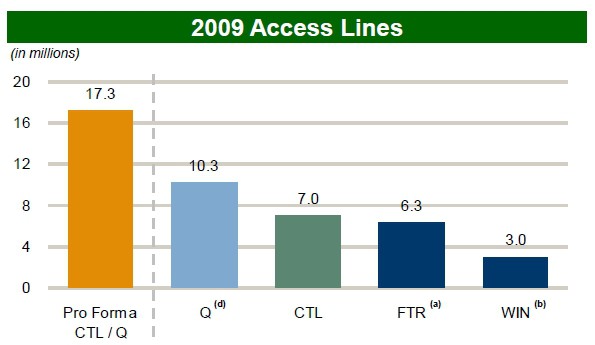
  1. Qwest’s service area is notoriously rural and expensive to serve.  Outside of its corporate headquarters in Denver, the majority of its service area is either mountainous or rural.  Even today, Qwest serves only 10 million residential customers, almost matched by CenturyTel’s own seven million largely rural customers scattered across the country.
  2. Qwest’s history has been littered with financial scandals, starting with a series of deals with disgraced Enron from 1999-2001.  That was followed with charges of fraud and insider trading in 2005.
  3. Qwest does not own its own wireless division and its previous efforts to deliver television service to customers were largely unsuccessful.  That made Qwest’s ability to withstand erosion in its core business – landline phone service, more difficult.
  4. Qwest’s debt is downright frightening for would-be suitors.

Why Does CenturyTel Want to Buy Qwest?

CenturyTel claims such a transaction allows a combined company to become a larger player on the national scene.  By combining Qwest’s good reputation in the business telecommunications sector with combined efforts to deliver broadband products including high speed Internet, the company thinks the combination can’t be beat.  CenturyTel envisions packages of video entertainment, data hosting and managed services, as well as fiber to cell tower connectivity and other high bandwidth services to deliver replacement revenue lost from disconnected landlines.  It also believes it can realize cost savings from the merger and keep the company relevant on a stage dominated by Verizon, AT&T, and a few large cable companies.

But there are other reasons.  For the three super-sized independent phone companies that Americans are growing increasingly familiar with — Frontier Communications, Windstream Communications, and CenturyTel, their business models depend on their ability to constantly engage in deal-making and acquisitions.  All three companies have built their businesses on investors who see their stocks as “investment grade” financial instruments that dependably return a dividend back to shareholders.  As we’ve seen in countless quarterly financial results conference calls, all three companies are preoccupied answering questions from Wall Street about the all-important dividend.  TV personalities like Jim Cramer has specifically recommended these telecom stocks based, in part, on their dividend payout.  If that dividend dramatically shrunk or stopped, the share price for all three stocks would likely plummet.

One of the side effects of companies dependent on dividend payouts is their constant need to be on the lookout for additional merger and acquisition opportunities.  Here’s how it works.  Let’s say CenturyTel’s debt load and reduced revenue, caused by customer defections to cell phones or cable phone service, delivered a bad fiscal quarter for the company.  Cash flow was down, and company officials simply couldn’t keep the dividend payout at the same level as the previous quarter.  Since many people hold CenturyTel stock specifically because of the dividend, a downward turn in that payout could cause some to sell their shares, driving the stock price downwards.

CenturyTel is still digesting a previous merger with EMBARQ, which led it to rechristen the company CenturyLink

One way around this is to seek out a new merger or acquisition target.  By bringing two companies together, preferably one with a healthy cash flow, suddenly the big picture changes.  Your balance sheet now reflects the combined revenue from both companies, which incidentally makes the percentage of debt versus revenue look a lot healthier.  Cash flow immediately improves, especially if you can slash redundant costs.  Come next quarter, that dividend payout is right back up in healthy territory.

Sometimes companies become so preoccupied with their dividend and corresponding stock price, it can lead them to pay out more in dividends than a company earns in revenue.  While that’s great for investors, it is unsustainable in the long run.

Many critics of telecommunications companies employing this strategy claim it’s evidence that a company is biding time and unwilling to invest in innovation for the future.  Some also believe dividend payouts shortchange customers because they can eventually bleed a company’s ability to invest in service improvements, research and development, and capital investments to maintain their network and expand service.

As consolidation continues, the number of new buyout opportunities begins to shrink, and one shudders to think what happens when there is no one else to buy.  How long is this business model sustainable?

Both CenturyTel and Qwest also recognize the impact of ongoing disconnections from landline service, now averaging 10 percent of their customers a year.  Those departing customers are now relying on their cell phones or alternative calling services like cable company “digital phone” service or broadband-based calling from companies like Vonage or Skype.

The one service they hope can stem customer defections is broadband.  Unfortunately, telephone companies are increasingly losing ground against their cable modem competitors, who have an easier time increasing broadband speeds for customers now seeking online video and other high bandwidth applications.

Of course, one of the benefits of being a “rural phone company” is the fact cable competition is often unlikely.  In fact, some of the lowest erosion rates for landline service are in rural communities where the telephone company is the only game in town.  There is plenty of money still to be made offering high priced slow speed DSL service in communities with no cable competitor and spotty wireless broadband that is often slower and usage-limited.

All three of these big independent players are well aware of this, and maintaining a strong position in relatively slow speed DSL service also protects another revenue stream — Universal Service Fund revenue given to rural providers to equalize telephone rates.  CenturyTel recognizes the increasing likelihood much of that money will be diverted to stimulating broadband expansion, something the phone company is more than willing to do if it means preserving their subsidies.

The new combined Qwest-CenturyTel company hopes the merger can help both survive obsolescence.

For Qwest, a debt reduction may make it possible to spend more to deliver fiber-to-the-curb service, similar to AT&T U-verse.  That could increase broadband speeds and prompt them to reconsider their earlier decision to abandon IPTV in the western half of the country.

CenturyTel can continue to offer traditional DSL service with a more incremental upgrade approach in its more rural service areas, but tap into Qwest’s fiber network to reduce backhaul expenses and potentially pick up new business customers by offering Qwest-branded business services.  Company officials strongly hinted that, at least for now, CenturyTel’s existing customers will continue to find the video portion of their “triple play” package delivered by DirecTV satellite service, so no IPTV for them.

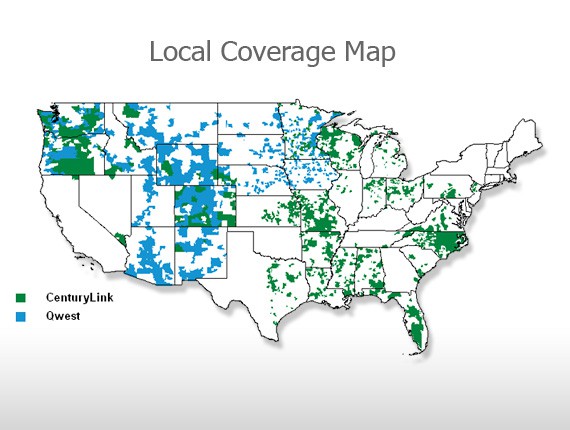
CenturyTel and Qwest's combined local service areas

What Does This Mean for Employees of Both Companies?

Mergers like this always generate great excitement over “cost savings” made possible by the merger.  Much of these savings typically come from employee expenses.  When you hear “cost savings,” think layoffs and pay cuts for all but top management.  Based on past precedent, Qwest employees can anticipate some serious job losses if this transaction closes, especially in the business office.  The combined company will be henceforth known as CenturyLink, with headquarters remaining in Monroe, Louisiana.  That is potentially bad news for Qwest’s employees in Denver.

The transaction is expected to generate annual operating cost savings (which CenturyTel calls “synergies”) of approximately $575 million, which are expected to be fully realized three to five years following closing.  The transaction also is expected to generate annual capital expenditure “synergies” of approximately $50 million within the first two years after close.  That means spending less on infrastructure improvements.

Billing and customer service are traditionally handled by CenturyTel when a company joins the CenturyTel family.  North Carolina customers can attest to that as EMBARQ, an earlier CenturyTel target, finally moves to CenturyTel’s billing system in the coming weeks.

For the sake of pushing the merger through state regulatory agencies, cutbacks in unionized technicians who handle service installations, repairs, and maintain the lines are not expected.  The Communications Workers of America issued a statement today that mildly acknowledged the merger announcement, saying the union “looked forward to serious negotiations with both companies” regarding employment security and assurances of aggressive high speed broadband rollout throughout both companies’ territories.

How the combined CenturyTel-Qwest company stacks up against other independent phone companies. (Q-Qwest, CTL-CenturyTel, FTR-Frontier, WIN-Windstream)

What Does This Mean for Qwest and CenturyTel Customers?

In the short term, nothing.  This merger will take at least a year to complete, assuming regulatory approval in every state where a review is required by state officials.  In 2011, should the merger be approved, Qwest customers can anticipate transition headaches as the Denver-based company winds down operations in favor of CenturyTel.  Billing and customer service will both be impacted.  Long term plans for major projects are likely to be stalled until the merger settles into place.  CenturyTel business customers will eventually see Qwest’s strong business products line become available in many CenturyTel service areas.  Eventually, some larger CenturyTel-served cities may find Qwest’s more advanced DSL service arriving on the scene delivering faster speeds.

Although CenturyTel has hinted it may review whether it’s now large enough to operate its own wireless mobile division, for the near term, expect the partnership to resell Verizon Wireless service to continue.

What is the View of Stop the Cap! on the CenturyTel-Qwest Merger?

Generally speaking, most of the industry consolidation that has been fueled by a deregulatory framework established by the Clinton Administration has not benefited consumers anywhere near the level promised by deregulation advocates.  The three largest independent phone company consolidators — Frontier, Windstream, and CenturyTel are spending more time and resources looking for new acquisitions and schemes to pay out dividends than they are working to enhance service in their respective service areas.  Smaller independent phone companies are deploying fiber to the home networks and answer to the communities where they work and live.  From companies like Frontier, we get Internet Overcharging schemes combined with slow DSL service, tricks and traps from “price protection agreements” that automatically renew, rate increases, and cost cutting.  Windstream plagues some of their customers with extended service outages, and CenturyTel’s promised broadband speeds often don’t deliver.

Unfortunately, bigger is not always better in telecommunications.  While the biggest players like Verizon seek to discard rural American customers, getting one of these three companies instead doesn’t always represent progress.  Our regulators are too often satisfied with basic answers to questions about broadband and service improvements that come with few details and deadlines.  It is just as important to ask what kind of broadband service a company will bring, at what speeds and price, and what usage limits, if any, will accompany the service.

Companies engaged in these mergers hope regulators don’t pin them down to specific service commitments and standards, which could harm the financial windfall these deals bring to a select few.  But they must be the first thing on the table, guaranteeing that customers also get the enjoy the “synergies” these deals are supposed to bring.

Breaking News: CenturyLink to Buy Qwest In All Stock Deal to Impact Customers in 40 States

Phillip Dampier April 22, 2010 CenturyLink, Competition, Consumer News, Rural Broadband Comments Off on Breaking News: CenturyLink to Buy Qwest In All Stock Deal to Impact Customers in 40 States

CenturyTel Inc. agreed Thursday to buy Qwest Communications International, Inc. in an all-stock deal that values the last legacy “Baby Bell” at nearly $10.6 billion, in one of the nation’s largest telecommunications deals.

The merger would dwarf Frontier Communications’ purchase of Verizon landline service and create the nation’s largest independent phone company with operations in 40 states.

Qwest has been off and on the sales block for years, considered the weakest player among the split-up remnants of the old Bell System.  Qwest has fallen well behind AT&T and Verizon in adopting next generation technology to keep landline service relevant in a changing marketplace.  CenturyTel’s business model, like that of Windstream and Frontier, depends on serving rural areas with basic broadband and phone services, without incurring the costs larger providers have in deploying fiber to the home or fiber to the curb networks needed to compete with cable television providers.

Critics contend the consolidation of independent phone companies has left them preoccupied with their stock value and dividend payouts, unwilling to make substantial investments many believe are essential to keep such companies relevant in the long term.  Cell phones continue to eat away at landline service, and the kind of slow speed DSL service available from most of these players cannot compete effectively against cable and fiber broadband service, except in rural communities where customers have just one choice.

We will have additional coverage on this important development shortly.

Whine & Cheese Reception: FairPoint, Others Decry Broadband Stimulus for Bringing Broadband Where They Don’t

Phillip Dampier April 19, 2010 Broadband Speed, Competition, FairPoint, Public Policy & Gov't, Rural Broadband, Windstream, Wireless Broadband Comments Off on Whine & Cheese Reception: FairPoint, Others Decry Broadband Stimulus for Bringing Broadband Where They Don’t

Get out your tiny violins.  Telephone and cable companies that have ignored your neighborhood for years are decrying attempts by the federal government to fund projects that would finally extend broadband service to rural America.  Companies ranging from tiny Eagle Communications in Kansas, to major regional telephone companies like FairPoint Communications and Windstream, are upset that new providers are on the way to deliver broadband service to bypassed homes or communities stuck in their broadband slow lane.

The Associated Press reports coast-to-coast complaints from incumbents who have refused to deliver service or force customers to accept 1-3Mbps speeds indefinitely.

From the Blue Ridge Mountains to the Great Plains, some local phone and cable companies fear they will have to compete with government-subsidized broadband systems, paid for largely with stimulus dollars. If these taxpayer-funded networks siphon off customers with lower prices, private companies warn that they could be less likely to upgrade their own lines, endangering jobs and undermining the goals of the stimulus plan.

That’s rich coming from some providers who threaten to refuse to upgrade lines they’ve never upgraded, endanger employees they’ve long since cut, and threaten their quest for monopoly profits serving rural Americans larger carriers are rapidly abandoning.

Anemic Broadband Is Not in Kansas Anymore

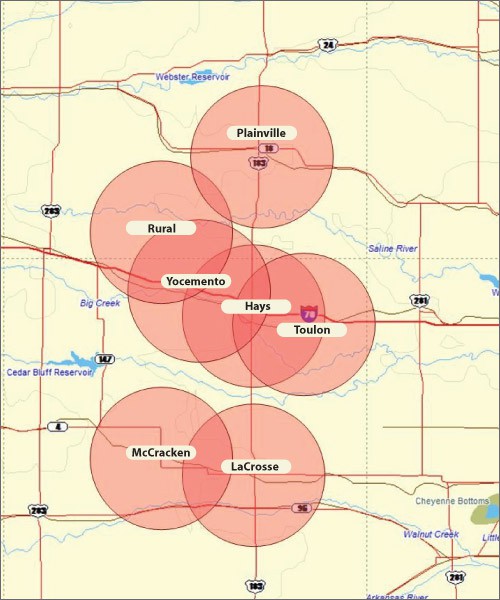
Rural Telephone's Exchange Map (click to enlarge)

Kansas-based Eagle Communications provides cable and wireless broadband service to more than a dozen small towns in the state.  For more populated areas, it’s cable broadband service.  For the rural parts of its service areas, Eagle relegates everyone to a slower speed, more expensive wireless network.

The company is upset to learn about additional expansion forthcoming from Rural Telephone Company, a cooperative which recently won a $101 million stimulus grant to construct a fiber optic system to expand service.  With the grant, the co-op phone company will move beyond its currently constrained DSL broadband network into areas even Eagle’s rural wireless signal won’t reach.

Rural Telephone Company says their broadband grant will provide service “in an area 99.5 percent unserved/underserved and provide a rural infrastructure required for economic stability, education and health care.”

Eagle says it’s unfair competition.

“It is extremely unfair that the government comes in and uses big government money to harm existing private businesses,” Gary Shorman, president of Eagle Communications, told the AP.  “This hurts our company.”

“It’s a little disappointing that companies that aren’t adequately serving these areas are trying to undercut those of us who are trying to step in and get the service where it’s needed,” says Lawrence Strickling, head of the National Telecommunications and Information Administration, the arm of the Commerce Department handing out much of the stimulus money.

The $101 million Kansas project, for instance, will bring connection speeds of up to 1 gigabit to businesses and up to 100 megabits to as many as 23,000 homes. While the network will cover the population center of Hays, where both Rural Telephone and Eagle Communications already offer broadband, that accounts for just eight of the 4,600 square miles to be reached. Much of the area has no broadband at all, says Larry Sevier, Rural Telephone’s chief executive.

The goal is to “close the digital divide between Hays and the outlying areas,” says Jonathan Adelstein, head of the Rural Utilities Service, which awarded the money.

Eagle Communications' Wireless Service Area - Central Region (click to enlarge)

For rural Kansans choosing between Eagle’s wireless service or Rural Telephone’s current maximum 1.5Mbps DSL service for those outside of the Hays city limits, the definition of “high speed service” maxes out at an anemic 3Mbps:

Eagle Communications Wireless Network Pricing – Hays, Kansas

  • Eagle 256/256 $34.95 /per month
  • Eagle 768/512 $37.95 /per month
  • Eagle 1.0/384 $44.95 /per month
  • Eagle 2/512 $54.95 /per month
  • Eagle 3/512 $59.95 /per month

Rural Telephone Company Pricing for Outside the City Limits – Hays, Kansas

  • Rural Telephone’s 1.5Mbps DSL — $29.95 per month
  • Rural Telephone’s 512kbps DSL — $19.95 per month

Gone With the Windstream: Phone Company Says Broadband Stimulus Doesn’t Give a Damn About Their Georgia Business Model

Many of the projects seeking funding don’t actually want to get into the Internet Service Provider business, preferring to construct fiber-based networks available equally to all-comers at wholesale pricing.  Sure they’ll wire government buildings, schools, and libraries as a public service, but their real goal is to make available super high speed networks that incumbent providers haven’t, under the theory a rising tide lifts all boats.  They even invite existing ISP’s to hop on board, buying access to deliver improved service to their existing customers.

But because some providers don’t own or control the infrastructure outright, they’re not interested.

One such project is the North Georgia Network Cooperative, created from a consortium of private business advocates, a state university, and two power company co-ops.

North Georgia sees broadband as a major economic stimulant… if they actually had it.  Large parts of the region don’t, so the Cooperative applied for and won a $33.5 million NTIA grant to construct a 260-mile fiber ring running through 12 counties in the state.  The network will easily deliver connections upwards of 10Gbps for institutions and broadband speeds far faster than incumbent DSL provider Windstream currently provides across the region.

Windstream's biggest promotional push is for its 6Mbps DSL service

Windstream’s DSL packages look better than many other independent phone companies, at least based on their website.  Windstream offers 3, 6, and 12 Mbps DSL packages across northwestern Georgia,  but that doesn’t mean you can actually obtain service at those speeds.  Stop the Cap! reader Frederick, who tipped us off to this story, notes that he can’t obtain more than 1.5Mbps DSL service from his home in Dalton, Georgia because the phone lines in his area won’t support faster speeds.

“I’m actually less than a mile from my area’s central office, but because the phone lines in my area are deteriorated, they had to lock my speed in at 1.5Mbps — anything faster causes the modem to reset,” Frederick writes.  “Windstream does the same thing to my cousin in Lafayette, who was offered 6Mbps service but can only get 3Mbps in reality.”

Frederick says most people in the community don’t really care where the faster broadband comes from — just that it comes.

“If Windstream, who incidentally also applied for government money, could do it there would have never been a need to go around them in the first place,” he says. “Hell, the ironic part is the Cooperative will sell wholesale access to Windstream to use as it sees fit, but because Windstream doesn’t own it they’re pouting, refusing to participate.”

Windstream says it has already invested $5 million in network upgrades covering northern Georgia over the last three years and the Cooperative’s stimulus grant undermines the economics of that investment.  Michael Rhoda, Windstream’s vice president of government affairs told AP Windstream now has to share rural customers with a government-funded competitor.  Windstream wants that funding limited strictly to those areas where broadband service is uneconomic to provide.  To underline that point, the company has applied for $238 million in stimulus funding to reach the “last 11 percent” who don’t have broadband in Windstream’s service areas.

Maine’s Three Ring Binder Project Snaps Shut on FairPoint’s Monopoly Fingers

Maine's Three Ring Binder Project plans to serve most of Maine (click image for additional information)

More often than not, independent efforts to launch improved broadband service in a region come after years of dealing with an intransigent provider comfortable moving at a snail’s pace to improve service.  Financially-troubled FairPoint Communications has been struggling to meet Maine’s broadband needs since the company took over service from Verizon two years ago.  The state government, university, and smaller telecommunications companies decided they could do better — applying for, and winning a $25.4 million dollar grant to construct three fiber rings across the state.

FairPoint insists the project duplicates the company’s own efforts to improve connectivity in Maine and has appealed to lawmakers to stop the project.  But FairPoint recently called a truce when it reached a deal to charge users of the new network a usage fee, with FairPoint getting a large share of the proceeds to expand its own broadband efforts.

[FairPoint’s financial problems have left the company] unable to bring broadband to wide swaths of rural Maine, says Dwight Allison, chief executive of Maine Fiber Co., which was created to build and operate the stimulus-funded network. The project, he says, represents a serious competitive threat to a company that “feels its monopoly is being attacked.”

Of course nothing precludes FairPoint from getting access to the new fiber network at the same wholesale pricing other providers will pay, but the company so far doesn’t seem interested.

Various talking points designed to derail the project are debunked by the Maine Fiber Company:

  • Fiction: It’s government-run broadband.
  • Fact: Three Ring Binder will be owned and operated by Maine Fiber Company, a private company based in Maine. MRC is unaffiliated with any telecom carrier to ensure fair and equal access to the system for all competitors.
  • Fiction: This project will create unfair competition for private providers.
  • Fact: MFC will be a wholesale provider of dark fiber, and its customers will be Internet Service providers, wireless carriers, and telephone companies. MFC will not provide “lit” service in competition with private broadband carriers. MFC is required to provide service on an open access and non-discriminatory basis. All carriers in Maine will be able to use the network to serve their customers in Maine, resulting in robust competition for the benefit of Maine consumers.
  • Fiction: This project duplicates service FairPoint already provides.
  • Fact: Prior to receiving a federal stimulus grant, the project was carefully reviewed by the National Telecommunications Information Agency (NTIA) of the US Department of Commerce to determine whether there was overlap with existing carriers. NTIA determined that TRB would substantially improve access to high-speed Internet access in rural Maine. If material duplication had been discovered, TRB would not have been funded. TRB will offer a mid-mile, dark fiber service that is fundamentally different from what currently exists in rural Maine. In fact, carriers seeking to obtain dark fiber service along the TRB route have routinely been denied access by incumbent fiber providers.

Search This Site:

Contributions:

Recent Comments:

Your Account:

Stop the Cap!