West Liberty, Iowa is home of Liberty Communications
One of the side effects of insatiable telecom industry consolidation is that hard-working, honest, and consumer-friendly providers are swept up by corporate machinery that ends up providing Americans with the least amount of service for the highest possible price. Remarkably, there are still some top-shelf independent providers out there that actually stand with their customers, fighting to bring better broadband service to everyone in their service areas.
A letter to the editor in the West Liberty Index caught my eye. It chastised the Federal Communications Commission for its plans to treat rural Americans as second class broadband citizens with speed goals 25 times slower than those enjoyed by their urban cousins. The FCC, the writer wrote, was simply not going far enough for consumers. What was so remarkable about the letter? It was signed by an Internet Service Provider — Jerry Melick, manager of Liberty Communications.
What would happen if the federal government decided that city roads, bridges and infrastructure should be better-constructed and more efficient than the roads in rural America? What about if the policy-makers determined that urban consumers should be able to get where they are going and get what they need faster than rural consumers? A new government plan intends to make that true of our nation’s information superhighway — the Internet. And, while it is not the highway coming into town, as rural consumers, we should still be very concerned.
[…]
The FCC’s plan will make rural Americans second class citizens in the new broadband world, because it establishes a speed goal for rural areas that is 25 times slower than for urban areas. Shouldn’t rural residents have access to the same broadband services as our larger towns and cities? Despite the construction of our state of the art Fusion network, we still face the challenge of how to bring broadband to our rural customers living outside of the communities of West Branch and West Liberty. Without a National Broadband Plan that supports further investment in rural areas, this will be difficult if not impossible to accomplish.
Melick supports broadband reform efforts at the FCC and changing the Universal Service Fund to provide assistance to companies like his, serving rural eastern Iowa, to build out its fiber to the home Fusion network to nearly every resident in its service area. That’s a refreshing change of pace from the usual rhetoric from AT&T, Frontier, Verizon, and others.
Liberty Communications began service as the independent West Liberty Telephone Company in 1899. It delivered telephone service for more than 100 years until January 2008, when the company announced it was going to construct its own fiber to the home network to provide television, telephone, and broadband service to its customers. The Fusion network would expand later that year to start construction in nearby West Branch, the birthplace of Herbert Hoover, the nation’s 31st president. By April 2009 the fiber network offered a true triple play package of services to customers in both cities. Fusion broadband customers can buy up to 20/2 Mbps service from Liberty. For the rest of its service area, Liberty still relies on DSL service providing up to 3 Mbps, but believes fiber is the future for all of its customers.
The only question remaining is when forward-thinking policies at the FCC will be enacted to help that goal?
“If (Comcast) can’t rape and pillage, it’s probably not a great investment.” — Dr. John Malone, former CEO Tele-Communications, Inc. (TCI Cable)
Susan Crawford
The age of content producers blissfully producing websites and ignoring broadband policy is over.
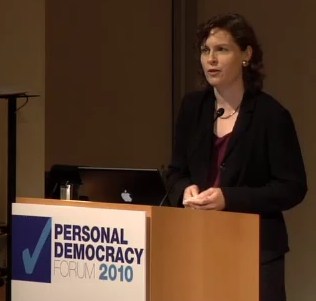
That message comes courtesy of President Barack Obama’s former Special Assistant for Science, Technology, and Innovation Policy, Susan Crawford, who rang warning bells over corporate control of the Internet last week at the Personal Democracy Forum in New York City.
Crawford, now a law professor at the University of Michigan, delivered a presentation arguing that increased corporate dominance over broadband has stalled the Gilded Age of the communications revolution.
Even as broadband becomes an increasingly important component of an American economy in recovery, marketplace concentration and laissez-faire broadband policies have combined to allow a handful of companies to control broadband access, with the potential of limiting access to web services and stalling entrepreneurial online innovation.
Crawford builds her case for a threatened broadband future:
As of 2010, 75-85 percent of the population will have only one choice of provider capable of delivering 50-100Mbps speeds — their local cable company;
Major cable systems have clustered their operations and do not compete with each other;
Verizon has suspended expansion of FiOS, its fiber to the home service, indefinitely;
Comcast, the nation’s largest cable operator with 24 million customers, 16.3 million of which take their broadband service, seeks a merger with NBC-Universal, providing a built-in incentive to limit broadband distribution of video content to non-subscribers who cut cable’s cord.
[flv width=”640″ height=”380″]http://www.phillipdampier.com/video/Susan Crawford at PdF 10 Rethinking Broadband 6-2-2010.flv[/flv]
Watch Susan Crawford’s presentation warning the tech community about the implications of America’s broadband duopoly given free rein. (17 minutes)
Main Entry: un·lim·it·ed
Pronunciation: \-ˈli-mə-təd\
Function: adjective
1: lacking any controls : unrestricted <unlimited access> 2: boundless, infinite <unlimited possibilities> 3: not bounded by exceptions : undefined <the unlimited and unconditional surrender of the enemy — Sir Winston Churchill>
An Alaskan Internet service provider is baffling its broadband customers with a blizzard of BS regarding just how unlimited its “unlimited” service plans really are.
A Stop the Cap! reader in The Last Frontier drops us a note to alert us of yet another provider trying to pull a fast one on its customers.
GCI markets cable-TV, telephone and broadband service in larger communities across many parts of the state. Its broadband service, dubbed “Xtreme,” offer DSL-like speeds at a significant price premium over what users in the lower 48 pay for Internet access.
Since 2007, our reader writes, GCI offered customers a deal. In return for letting the company provide all of your telecommunications needs — cable, phone, and Internet, GCI would provide you with unlimited broadband service. The triple-play package was sold for at least $80 a month, and many customers agreed to the bundled route to avoid GCI’s restrictive, data-capped plans sold to its broadband-only customers.
GCI is now reneging on its end of the deal thanks to a creative redefinition of the word “unlimited.” For the convenience of those who may be English-challenged, Stop the Cap! has provided the Merriam-Webster definition of the word “unlimited” above, which hasn’t changed much since its first use in the 15th century.
Broadband providers like GCI think they are clever enough to change all that.
Much to the chagrin of GCI’s bundled customers, the company unfairly slapped a “Fair Access Policy” on all of its unlimited customers on April 1st. Customers started receiving usage warnings this spring, which came as quite a surprise for an “unlimited” service plan. But the company insists it hasn’t limited its “unlimited” plans at all:
GCI offers some cable modem Internet service plans with “unlimited downloads”, meaning GCI does not bill customers additional fees for usage in a given month.
Actually, that isn’t the meaning of “unlimited” at all, no matter how much the company wishes it was. Again, see the definition above.
In fact, even using GCI’s own definition, nonsensical as it is, it isn’t reality-based either.
Customers who exceed the arbitrary limits GCI determines as “fair,” could be subjected to higher pricing. GCI’s website currently lists the overlimit fee starting at an impenetrable $0.005 per megabyte, which sounds pretty low until you realize it’s $5.00 per gigabyte, which is significantly higher than what most other naughty cappers charge. On slower speed plans, GCI’s overlimit fee is a whopping $0.03 per megabyte — $30 per gigabyte.
What happens when you overuse your GCI unlimited Internet? GCI will contact you to discuss your account and then ask you to agree to either reduce usage or pay additional fees for usage in a given month.
GCI loves to make its limits look mighty big by representing them in megabytes instead of the more commonly used gigabyte measurement. They also include the usual comparisons: over 10,000 web pages, 250,000 e-mails, 1,000 pictures, etc. On the lower speed plans, GCI avoids defining the far-smaller allowances for higher bandwidth services like near-DVD HD video streaming some Alaskan families may want to use during those cold and dark Alaskan winter evenings.
Here are the limits GCI assigns to its “unlimited” service plans:
Plan Name
Usage
Ultimate Xtreme
40,000 MB
Ultimate Xtreme Family
60,000 MB
Ultimate Xtreme Entertainment
80,000 MB
Ultimate Xtreme Power
100,000 MB
That’s usage ranging from 40-100 gigabytes. What this illustrates yet again is that Internet Overcharging schemes are ridiculously arbitrary. A provider in rural Alaska defines “fair” use of its slowest speed “unlimited” broadband tier (3 Mbps/512 Kbps for $45 a month) at 40 gigabytes. Meanwhile, Frontier Communications considers it fair to define its DSL service usage allowance at just 5 gigabytes per month. Comcast says 250 gigabytes a month is fair. AT&T’s wireless smartphone data plan now carries a 2 gigabyte limit AT&T claims is about right.
As is also commonly the case among Internet Overchargers, any unused allowances do not “roll over” to the next month.
GCI considers anyone exceeding these limits engaged in continuous high-volume data transfers, extensive use of streaming video and peer-to-peer file sharing programs, or using an unsecured wireless signal everyone in the neighborhood has hopped on to use. But just backing up your family computer through an online backup service over a month could easily put you over these limits. If a “mutually agreed on” solution cannot be reached to either limit your use or increase your price, GCI will show you the door.
Essentially, GCI hobbles its broadband service plans by imposing limits on services that could challenge some of its other products. For standalone broadband customers, GCI builds in plenty of protection against customers potentially using its Internet service to bypass its cable and phone offerings, despite some recent speed and usage allowance increases. How much online viewing will you feel safe doing on some of these Internet service plans:
Our reader in Alaska thinks the usage limits are unjustified considering GCI’s capacity, and its prices:
GCI has well over 600 Gigabits of capacity across two undersea fiber optic cables.
Since 2007, the only way to get an unlimited download option for the company’s various speed tiers was through its bundled packages. With the new limit on “unlimited” downloads, GCI fraudulently misrepresents its service to Alaskans.
GCI is the poster child for the cable industry’s push for metered billing. I think you’re well aware that cable companies view metered billing as an anti-competitive solution to fend off emerging competition from online content providers like Hulu and Netflix Online. Time Warner backed down when confronted with the possibility of regulation for the entire industry. They will however try again if companies like GCI continue to have success over a long term. This is why it’s imperative that groups like Stop the Cap! fight beyond your region and get regulation passed to bar forced bundling and data transfer limits entirely. Content providers (video services) should be separate entities from network providers (ISPs). It’s the only way to keep rates low and businesses competitive. Thank you for keeping up the good fight.
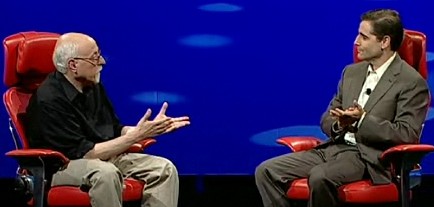
Walt Mossberg (left) discusses the current state of American broadband with FCC Chairman Julius Genachowski (right)
FCC Chairman Julius Genachowki told attendees at the D: All Things Digital conference America scores dead last in a study measuring the rate of change in broadband innovation. American broadband is stuck in neutral while every other ranked nation is moving forward faster in understanding the importance of deploying fast, reliable, and universal broadband. Genachowski directly ties broadband to improving local economies, propelling growth in jobs, and improving education and health care.
Unfortunately the American duopoly most Americans cope with maintains a stranglehold on efforts to bring America literally up to speed with competing nations. Worse, there is no end in sight as long as America relies entirely on incumbent providers to get the job done.
Americans pay some of the highest prices in the world for mediocre broadband, and it’s only getting worse with the introduction of usage limiting schemes like data caps and so-called consumption billing.
Genachowski is attempting to facilitate improved broadband across the United States, but is hampered by private industry undermining the FCC’s authority to help push improvements forward. Recent industry-driven court challenges to the FCC’s authority have led to the agency seeking a different path to regain its regulatory footing.
The FCC chairman sees the biggest challenges coming in wireless broadband, where a spectrum shortage is limiting potential capacity and available bandwidth. Genachowski seeks an accommodation with the nation’s television stations to relinquish UHF spectrum where possible to bolster wireless networks.
Conference host Walt Mossberg challenged Genachowski on why more isn’t getting done and why accepting the current state of the marketplace is acceptable. He also criticized providers for charging high prices for slow service and attacked Comcast for its set top box, claiming if there was an open market for these things, no one would buy it, that it would be the worst thing on the shelf.
[flv width=”512″ height=”308″]http://www.phillipdampier.com/video/All Things Digital Genachowski 6-2-10.flv[/flv]
Excerpts from FCC Chairman Julius Genachowski’s visit with Walt Mossberg at the June 2nd D: All Things Digital conference. (6 minutes)
S1209 would have sailed through the North Carolina Senate 39-5 this afternoon had it not been for Sen. Joe Sam Queen who objected to the third reading of the bill. Senator David Rouzer (R-Johnston, Wayne) also changed his vote from “no” to “yes” which would have ultimately left the count at 40 for and 4 against. After that, the Senate adjourned and will take up the bill once again on Monday. What a job well done… for the cable and phone companies.
Brian Bowman reports that none of the Wake County senators opposed the bill or asked that the moratorium be removed.
Out of the entire North Carolina Senate, there are just four good guys?:
Senator Joe Sam Queen (Haywood, Yancy, Avery, Madison, McDowell, Mitchell) [email protected]
Senator Steve Goss (D-Alexander, Ashe, Watauga, Wilkes) [email protected]
Senator James Forrester (R-Gaston, Iredell, Lincoln) [email protected]
Senator John Snow (D-Cherokee, Clay, Graham, Haywood, Jackson, Macon, Swain, Transylvania) [email protected]
Be sure to send all four of these folks your enormous thanks for doing the right thing. Apparently that is becoming more and more difficult these days.
For those who forgot why this fight matters, here’s a reminder. Watch it.
[flv width=”480″ height=”380″]http://www.phillipdampier.com/video/Martha Abraham, Mars Hill NC.mp4[/flv]
The people in Mars Hill, N.C. cannot afford to forget.
Now let’s talk reality for a moment. I’ve been involved in legislative battles on issues regarding telecommunications policy all the way back to the late 1980s when I was fighting for home satellite dish-owner rights. Back then it was a struggle against big cable, too. It took several tries, but we eventually won that one. Along the way, a lot of the same legislative trickery involved in S1209 reminded me of similar experiences back then. We shouldn’t make the same mistake twice. Let’s take a look:
The revised S1209 establishes a subcommittee to study municipal broadband funding issues while buying the industry a one year reprieve from any other cities or town going their own way. The members on this fact-finding endeavor are specifically defined:
A cable service provider.
A wireless telecommunications service provider.
A local exchange provider that is not a wireless telecommunications service provider.
A local exchange provider that is a wireless telecommunications service provider.
A city that operates a cable system and an electric power system as a public enterprise.
A city that operates a cable system as a public enterprise and does not operate an electric power system as a public enterprise.
A city that is a member of a joint agency established under G.S. 160A-462 for the operation of a cable system as a public enterprise.
The North Carolina League of Municipalities.
Now, can anyone reading tell me who is -not- on the list? Have you guessed?
-You- are missing from this list!
Everyone else is in the back room — cable and phone companies, cities, and a lobbying group representing cities. But not one North Carolina consumer who lives with broadband challenges day in and day out has a place at that table. What do they know anyway?
Brooks Townes in Weaverville doesn’t have a seat at the table, either.
How ironic that everyone holding a seat claims their interests coincide with ordinary citizens like you and I. After all, we’re supposed to be what this fight is all about. Sometimes, our interests will meet. Other times, especially when it comes to legislative strategies, they might not.
An Uncomfortable Revelation Caught On An Open Mike
Thanks to WUNC’s Laura Leslie, you can listen yourself as Senator Clodfelter, not realizing his mike was on, tells Senator Blue, “Now I’ll tell you that the … what I call the crazies who circulate around this issue are not going to like this [S1209 revision with a moratorium], but the municipalities are all on board. They negotiated it, they negotiated it so it’s not possible….” Blue asks Clodfelter how long he’s been talking with the groups representing municipalities. Clodfelter’s response: “We’ve been meeting daily — twice daily, so they’re all on board with this precise text.” The recording ends with Clodfelter presumably tapping his mike. Is this thing on? You bet it is. (June 2, 2010) (50 seconds)
You must remain on this page to hear the clip, or you can download the clip and listen later.
We already know what Senator Clodfelter feels about the people who are appalled at yet another embarrassing year of legislators falling all over themselves to do big cable and phone companies another favor. In his mind, we’re the “crazies” — the indignant citizens fed up with the time, money, and effort not spent building 21st century broadband networks, but instead devising strategies to prevent building them.
Corning has a plant in North Carolina that manufacturers endless miles of fiber optic cable that 40 members of the North Carolina Legislature just said they don’t need. Send it somewhere else.
Those 40 senators just told citizens — who are still using dial-up Internet access in the Appalachians, or who can’t afford the asking price for service in Spring Creek, or who only get excuses from AT&T why certain homes in Alamance County can have broadband, but they cannot — they really don’t care. What AT&T, Time Warner Cable, and Embarq wants is much more important.
[flv width=”480″ height=”380″]http://www.phillipdampier.com/video/Layten Davis Spring Creek NC.mp4[/flv]
…More important than the needs of folks like those in Spring Creek.
So while they propose to hold a debate over the merits of the free market vs. community’s doing-for-themselves when the free market fails them, countless thousands of North Carolina’s residents go without or are still hearing modem tones as they connect at speeds dozens of times slower than everyone else.
With a legislature hellbent on stalling or stopping projects that ameliorate this serious problem, no wonder North Carolina’s broadband rankings are falling fast. In 2007, the Census Bureau ranked North Carolina 35th in broadband adoption. A year later, the state was down to 41st. At least you can be proud you’re not West Virginia, right?
But then again, there are eight more positions to drop, so there is still room to make things even worse.
Now I ask myself, what could have possibly happened to deliver 40 votes into the hands of big cable and phone company interests.
Could it have been the time honored trick of dividing and conquering the opposition? For cities who want to deliver service, the threat of “either/or” seemed particularly effective. Either take our one year moratorium -or- face the ludicrous original legislation that required a community-wide referendum if Mrs. Nickels over on Fairfax Drive needs a new cable installed at her home to get a better picture. Either way, because certain folks didn’t say no way to either choice, it’s a victory party for Time Warner Cable, with no need to BYOB — they’ll provide it themselves. Besides, say the bill’s supporters, we’re offering a chance to hear your voice and views on our stall-tactic fact-finding subcommittee. Senator Clodfelter even thanks you for being reasonable and adult about all this.
AT&T thanks you as well.
Just keep those “crazies” out of the room.
Cable and phone companies get seats, so they can continue to deliver their talking points that don’t actually deliver broadband to any underserved area of North Carolina. Haven’t they said enough already? As Senator Queen asked, where is the broadband service for my communities?
In the end, the fact finding mission (cough) will deliver a watered-down report that will find its way into the nearest recycling bin. The cities’ strong views on municipal broadband will be diluted because they’ll have four competing voices from private industry saying the exact opposite. Besides, after yesterday’s performance in the Senate Finance Committee, does anyone really believe members like Senator Hoyle care what the subcommittee will have to say? He can just make it up as he goes along, just as he did when supposedly quoting the mayor of Salisbury.
After all the years spent watching negotiations over legislation, allow me to share this one piece of advice — collaborate and compromise with interests that seek to bury you at your own risk. Big money interests will call you every name in the book for standing and fighting for your principles (and a few legislators too), but if you make it known it’s time for the other side to start compromising — by actually delivering service and charging a reasonable price for it, there wouldn’t have been a need to engage in this battle in the first place.
That’s why this “crazy” website didn’t back down when Time Warner Cable brought its “new and improved” Internet Overcharging scheme to the table after consumers rebelled against the original plan. The cable company promised a listening tour, to take advice from reasonable consumers, and to modify its plans accordingly. Some folks played the game on their field — debating numbers back and forth about what an appropriate amount of rape and pillaging of our wallets was tolerable. Time Warner changed a few numbers and blessed us with a counteroffer that would have only tripled broadband prices for the same level of service. Couldn’t we be reasonable and take their offer?
We said no and stood by it, even if it meant going down with a fight. By not backing down, we won the battle knowing full well the war wasn’t actually over yet. But you can’t win a battle, much less a war, if you surrender and refuse to fight.
In the end, we were right and they were wrong. We even proved they were never really interested in listening in the first place.
The correct way forward is to remain 100 percent committed to opposing S1209, so long as it stalls, bans, slows, or sets onerous conditions on providing broadband relief. That means calling every senator between now and Monday and then doing the same in the House.
The three words you need to remember are real simple:
Kill this bill.
If you are spending time negotiating over who gets to sit in what chair on the subcommittee, you are not paying attention.
Kill this bill.
If you are trying to split the difference over how long the moratorium is going to last, you do not understand.
Kill this bill.
If you are trying to extract some extra concessions to reduce the rape and pillaging of your citizens, stand up, take a deep breath, go outside, and then tell the first person you see to call their representatives and tell them to:
Kill this bill.
If you are a consumer, you’re probably already upset. In a polite, persuasive, and persistent way, tell your elected officials you understand S1209 has been modified thanks to a compromise, but nobody bothered to compromise with you. You aren’t interested in this bill in any form, and you know that legislator is going to do the right thing and vote no to:
Kill this bill.
If they vote yes, all they’ve managed to kill is your faith in them as your elected representative. That’s something that can be taken care of at the next election.
Maybe people like me are crazy to dare to presume that our elected officials work first and foremost for “we the people” and not for the phone and cable company. Maybe it’s nuts to spend so much time and energy fighting legislation that is so obviously written by and for the industry that cuts a check to the first representative willing to put their name on it and introduce it. We’ve seen the merits of those who tried the same thing last year. Only one of them is no longer with the state legislature, brought down on ethics charges. How surprising. This year’s fight is lead by a retiring senator who will never endure the satisfaction voters might get disconnecting him from the legislature for selling them down Telecom River. That is not too surprising either.
Be Sure to Read Part One: Astroturf Overload — Broadband for America = One Giant Industry Front Group for an important introduction to what this super-sized industry front group is all about. Members of Broadband for America Red: A company or group actively engaging in anti-consumer lobbying, opposes Net Neutrality, supports Internet Overcharging, belongs to […]
Astroturf: One of the underhanded tactics increasingly being used by telecom companies is “Astroturf lobbying” – creating front groups that try to mimic true grassroots, but that are all about corporate money, not citizen power. Astroturf lobbying is hardly a new approach. Senator Lloyd Bentsen is credited with coining the term in the 1980s to […]
Hong Kong remains bullish on broadband. Despite the economic downturn, City Telecom continues to invest millions in constructing one of Hong Kong’s largest fiber optic broadband networks, providing fiber to the home connections to residents. City Telecom’s HK Broadband service relies on an all-fiber optic network, and has been dubbed “the Verizon FiOS of Hong […]
BendBroadband, a small provider serving central Oregon, breathlessly announced the imminent launch of new higher speed broadband service for its customers after completing an upgrade to DOCSIS 3. Along with the launch announcement came a new logo of a sprinting dog the company attaches its new tagline to: “We’re the local dog. We better be […]
Stop the Cap! reader Rick has been educating me about some of the new-found aggression by Shaw Communications, one of western Canada’s largest telecommunications companies, in expanding its business reach across Canada. Woe to those who get in the way. Novus Entertainment is already familiar with this story. As Stop the Cap! reported previously, Shaw […]
The Canadian Radio-television Telecommunications Commission, the Canadian equivalent of the Federal Communications Commission in Washington, may be forced to consider American broadband policy before defining Net Neutrality and its role in Canadian broadband, according to an article published today in The Globe & Mail. [FCC Chairman Julius Genachowski’s] proposal – to codify and enforce some […]
In March 2000, two cable magnates sat down for the cable industry equivalent of My Dinner With Andre. Fine wine, beautiful table linens, an exquisite meal, and a Monopoly board with pieces swapped back and forth representing hundreds of thousands of Canadian consumers. Ted Rogers and Jim Shaw drew a line on the western Ontario […]
Just like FairPoint Communications, the Towering Inferno of phone companies haunting New England, Frontier Communications is making a whole lot of promises to state regulators and consumers, if they’ll only support the deal to transfer ownership of phone service from Verizon to them. This time, Frontier is issuing a self-serving press release touting their investment […]
I see it took all of five minutes for George Ou and his friends at Digital Society to be swayed by the tunnel vision myopia of last week’s latest effort to justify Internet Overcharging schemes. Until recently, I’ve always rationalized my distain for smaller usage caps by ignoring the fact that I’m being subsidized by […]
In 2007, we took our first major trip away from western New York in 20 years and spent two weeks an hour away from Calgary, Alberta. After two weeks in Kananaskis Country, Banff, Calgary, and other spots all over southern Alberta, we came away with the Good, the Bad, and the Ugly: The Good Alberta […]
A federal appeals court in Washington has struck down, for a second time, a rulemaking by the Federal Communications Commission to limit the size of the nation’s largest cable operators to 30% of the nation’s pay television marketplace, calling the rule “arbitrary and capricious.” The 30% rule, designed to keep no single company from controlling […]
Less than half of Americans surveyed by PC Magazine report they are very satisfied with the broadband speed delivered by their Internet service provider. PC Magazine released a comprehensive study this month on speed, provider satisfaction, and consumer opinions about the state of broadband in their community. The publisher sampled more than 17,000 participants, checking […]


 Subscribe
 Melick supports broadband reform efforts at the FCC and changing the Universal Service Fund to provide assistance to companies like his, serving rural eastern Iowa, to build out its fiber to the home Fusion network to nearly every resident in its service area. That’s a refreshing change of pace from the usual rhetoric from AT&T, Frontier, Verizon, and others.