Home » Rural Broadband » Recent Articles:

Call to Action North Carolina: Senator Hoyle Infects Popular House Bill With His Parting Gift to Big Telecom [Corrected]

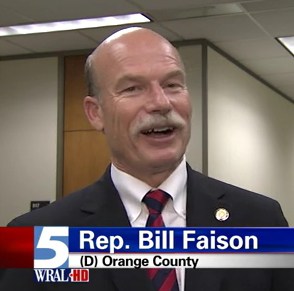
The bill is pending in the House Ways and Means Committee, whose chairman, Rep. Bill Faison, sees the moratorium as an attempt to protect the powerful cable monopoly. Faison, a Democrat who represents Orange and Caswell counties, is meeting Wednesday with representatives of the telecommunications industry and local government leaders to discuss options.

Senator David Hoyle (D-Gaston) couldn’t get his Senate bill the time of day in the North Carolina House, so he attached it to a popular House bill to extend the e-NC Authority — North Carolina’s initiative to promote better broadband.  Now a good bill is infected, like a virus, by Hoyle’s tireless work on behalf of Time Warner Cable.

Hoyle, who has cashed checks from the cable and phone lobbies for years, is proud of sticking it to consumers in his state.

“I want my bill passed. They want their bill passed. So, if they want theirs, they’re going to have to take up mine,” Hoyle told WRAL-TV.

Hoyle, who plans to retire at the end of his term, faces no consequences from Gaston County voters, so he doesn’t care if his bill effectively protects incumbent cable companies who have raised their rates far above the rate of inflation for years.  Hoyle wants a one year moratorium to stop local communities from building their own broadband networks to improve service to residents and deliver lower pricing.

One community that escaped Time Warner’s relentless rate hiking is Wilson, where a municipal broadband project called Greenlight effectively forced a red light on Time Warner’s plans to increase rates in the community earlier this year.  Wilson was the only city we could find in the state where rates remained the same, and residents have Greenlight and city officials to thank for that.

Hoyle and his friends at the cable company are outraged at the thought of North Carolina communities stopping the rate hike gravy train.  After all, less money for Time Warner equals less money for campaign contributions to friendly politicians.

“Do we, as government, want to get in competition with private enterprise and my answer to that is no, and I am passionate about that,” Hoyle said.

If only his constituents could afford to pay him enough to be passionate about their interests.

Rep. Bill Faison, (D-Orange), is among the lawmakers sponsoring the broadband stimulus bill, which was a sure thing until Hoyle got his hands on it.  Faison called Hoyle’s amendments anti-competitive and pro-rate increase, both bad for North Carolina consumers.

“I decide what gets put on the agenda,” Faison told the Charlotte Observer. “It’s unlikely that any bill with a moratorium in it has a chance of getting through the House.”

Hoyle’s strenuous efforts to perform legislative gymnastics on behalf of cable and phone companies have not gone unnoticed by Faison.  He suggested Hoyle’s latest move represented an “interesting political maneuver,” but he doesn’t intend to sit still for it.  Faison and other pro-consumer legislators are meeting this week to consider how to strip Hoyle’s nonsense out of HB1840 and shove it in the nearest trash can.  For comparison purposes, here is the original bill.

Consumers show no love for Time Warner.  Charlotte residents had choice words for their cable company when they learned it was behind the push to stop municipal competition:

Time Warner is about to pay for being jerks to their customers, and it’s high time.

Time Warner cable: I hope they rot. It’s about dang time that municipal governments started providing free broadband to their citizens. The fact that multiple households need their own wireless routers, broadcast on different channels, is a totally inefficient use of technology. Companies like TW Cable want to keep citizens constrained, which runs totally opposite to the promise of the Internet. Find out which boneheads in the Senate are pushing for this and vote them out. They’re clearly more interested in money from the cable companies than in serving their constituents.

For cable to argue unfair competition is laughable when they operate a virtual monopoly.

Instead of fighting this legislation, why doesn’t Time-Warner Cable focus on making its service so reliable and reasonably priced that no city or county will seriously consider managing this themselves? I find it hard to believe any local government could actually run this type of technology more efficiently than a company with TWC’s resources can, but the threat of competition helps keep TWC on their toes. P.S. I lost my TWC signal for 90 minutes this past Sunday right in the middle of the US Open and Brazil-Ivory Coast World Cup game. Nice.

A vote on the House measure is imminent, so North Carolina consumers should be contacting the House Committee members listed below and urge them not to allow any part of Hoyle’s language to remain in HB1840.

[flv width=”576″ height=”344″]http://www.phillipdampier.com/video/WRAL Raleigh NC Broadband Bill Debate 6-28-10.flv[/flv]

WRAL-TV in Raleigh discusses Hoyle’s language and how it ended up in a broadband stimulus request bill.  (2 minutes)

House Ways and Means/Broadband Connectivity Committee

County Name Telephone # E-Mail Party
Mecklenburg Kelly Alexander 919-733-5778 [email protected] Democrat
Nash, Hallifax Angela R. Bryant 919-733-5878 [email protected] Democrat
Rowan Lorene Coates 919-733-5784 [email protected] Democrat
Orange, Caswell Bill Faison 919-715-3019 [email protected] Democrat
Burke, McDowell Mitch Gillespie 919-733-5862 [email protected] Republican
Mecklenburg Jim Gulley 919-733-5800 [email protected] Republican
Haywood, Jackson, Macon, Swain R. Phillip Haire 919-715-3005 [email protected] Democrat
Brunswick, Columbus Dewey L. Hill 919-733-5830 [email protected] Democrat
Catawba Mark K. Hilton 919-733-5988 [email protected] Republican
Franklin, Hallifax, Nash John May 919-733-5860 [email protected] Democrat
Allegheny, Surry Sarah Stevens 919-715-1883 [email protected] Republican
Mecklenburg Thom Tillis 919-733-5828 [email protected] Republican
Edgecomb, Wilson Joe P. Tolson 919-715-3024 [email protected] Democrat
Durham, Person W. A. (Winkie) Wilkins 919-715-0850 [email protected] Democrat

This article contains the following correction since original publication: Our original article did not fully explain the bill to which Sen. Hoyle attached his municipal broadband moratorium. For clarification purposes, that bill is HB1840, legislation to extend the authority of the e-NC Authority. Our original article carried WRAL-TV’s language that said the bill provided for “$5 million in federal stimulus to help provide high-speed Internet access in parts of the state.” While that would be nice, it wasn’t an accurate characterization the bill’s intent.  Our apologies for the error.

New York’s Southern Tier Closer to Securing High Speed Broadband for Rural Residents

Phillip Dampier June 30, 2010 Community Networks, Public Policy & Gov't, Rural Broadband, Video Comments Off on New York’s Southern Tier Closer to Securing High Speed Broadband for Rural Residents

A $24 million federal grant proposal to install 600 miles of fiber optic cable across the southern tier of New York has advanced to the “Due Diligence Phase” of federal review, making it a serious contender for approval.

The application for the “middle mile” project was submitted jointly by the Southern Tier East and Southern Tier Central Planning Development Boards to create a fiber-based backbone to facilitate so-called “last mile” projects which deliver connections directly to consumers and businesses.  If built, the project will make connectivity available to all-comers, from wireless providers trying to reach the most rural homes to cable and telephone-based broadband providers delivering enhanced speeds and service.

The Shequaga Falls, visible from W. Main Street in Montour Falls, exemplifies the terrain of many Southern Tier communities in New York.

Broome, Delaware, Otsego, Chemung, Steuben and Schuyler counties would be served by the fiber network if constructed.

The southern tier of New York, mostly defined as west to Lake Erie and east to Binghamton, is particularly lacking in broadband, in part because of very difficult terrain.  Steep sloping hills rising 1,000 feet or more, created from glacial movements, combine with level hilltops representative of the Appalachian Plateau.  In most of these areas, fields and pastures crown the high points while cropland and communities locate on the level valley floor.  Getting broadband to residents and farms involves winding cables around the hills through communities like Bath, Corning, Elmira, Hornell, Watkins Glen-Montour Falls, and Wayland.  Even larger communities like Binghamton and Ithaca have plenty of landscape to navigate.

Inside immediate town and city centers, broadband is usually provided by Time Warner Cable, Frontier Communications, Verizon, or one of several independent phone companies.  Where 30mph speed limits predominate, broadband is likely available.  Once the speed limit returns to 55mph, service becomes more spotty.

Prior efforts to expand broadband availability included:

  • Public/Private Partnerships: Cooperative efforts to ease the way for private providers to extend service into previously unserved areas.  This had limited success, particularly when sufficient return on investment could not be achieved within a set time frame.  Most private providers will not wire sparsely populated areas because of the time it takes to recoup wiring and pole costs.
  • Aggregation of Demand: This technical-sounding term simply means bringing neighbors together and getting them to jointly commit to sign up for broadband service if a provider will agree to extend service to their neighborhood.  This can achieve success in areas where a provider is assured of getting his initial investment back.  A few of these efforts have even shared or split the financing of some construction costs.  Mike McNamara of Haefele Cable Television, an independent cable provider serving 4,700 residents in rural sections of Tioga County, noted “last mile” access can be expensive, costing about $12,000 for them to extend cable service per mile.

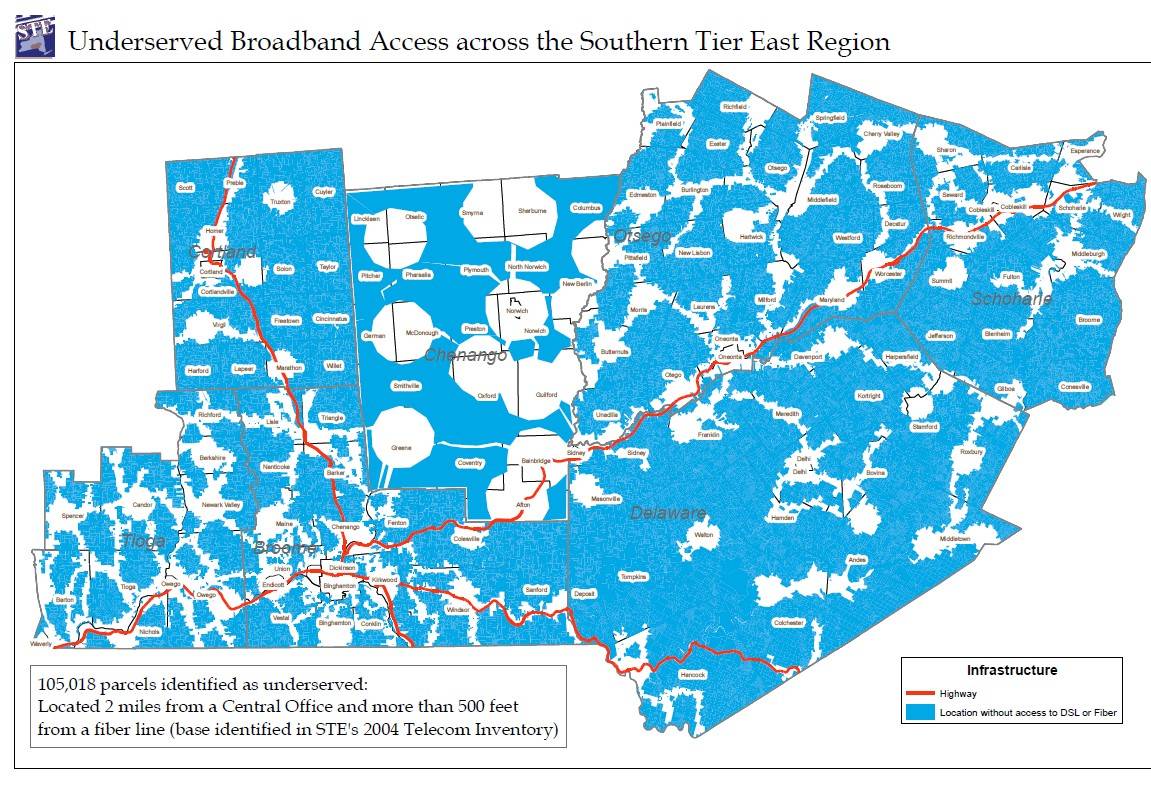
The blue color represents areas in this section of the Southern Tier where no broadband service is available. (click to enlarge)

A decision on the grant is expected by September.

[flv]http://www.phillipdampier.com/video/WETM Elmira One Step Closer to High Speed Broadband Access 6-24-10.flv[/flv]

WETM-TV in Elmira explains the plan to expand broadband service throughout the Southern Tier of New York, if a grant can be awarded.  (1 minute)

Lies, Damned Lies, and Broadband Numbers: Life is Good, Say Broadband Providers; Consumers Disagree

Mehlman

A telecom industry front group acknowledged today American broadband in the last decade has not won any awards for speed or price, but if you just give the industry ten more years of deregulation, there will be more competition than ever to change that.

For the Internet Innovation Alliance’s Bruce Mehlman, the cable and phone companies have done a fine job bringing broadband to Americans, especially considering the industry is only ten years old.  If you leave things the way they are today, the next decade will bring even more competition from phone and cable companies, he promises.

But consumer groups wonder exactly how a duopoly will ever deliver world class service in the next ten years when it has spent the last ten hiking prices on slow speed broadband and now wants to limit or throttle usage.

This afternoon, National Public Radio’s All Things Considered tried to referee the broadband debate, pondering whether America is a world leader in broadband or has just fallen behind Estonia.  Reporter Joel Rose was perplexed to find two widely diverging attitudes about broadband, each with their set of numbers to prove their case.

On one side, consumers and public interest groups like Consumers Union and Free Press who believe deregulation and industry consolidation has created a stagnant broadband duopoly that only innovates how it can get away with charging even higher prices.

On the other, the phone and cable companies, the groups they finance, and their friends on Capitol Hill who believe there isn’t a broadband problem in the United States to begin with and government oversight would ruin a good thing.

Compared with other nations, the United States has continued to see its standing fall in broadband rankings measuring speed, price, adoption rates, and quality.  When East European countries and former Soviet Republics now routinely deliver better broadband service than America’s cable and telephone companies, that story writes itself. Embarrassed industry defenders prefer to confine discussion of America’s broadband success story inside the U.S. borders, discounting comparisons with other countries around the world.

For Rep. Joe “I Apologize to BP” Barton (R-Texas), it’s even more simple than that.  Even questioning the free market is downright silly.

“As everybody knows, if it’s not broke, don’t fix it,” Barton said at a March congressional hearing to discuss broadband matters. “And y’all are trying to fix something that in most cases isn’t broke. Ninety-five percent of America has broadband.”

Industry-financed astroturf and sock puppet groups readily agree, and dismiss industry critics.

Bruce Mehlman, co-chair of the industry-supported Internet Innovation Alliance, which opposes more regulation, acknowledges that the story of broadband in the U.S. is a classic glass-half-full, glass-half-empty predicament. Still, he says he thinks broadband adoption in the U.S. is going pretty well considering broadband has only been available for 10 years.

“For the optimist, you’d say within a decade we’ve seen greater broadband deployment than you saw for cell phones, than for cable TV, than for personal computers,” Mehlman says. “It’s one of the great technology success stories in history.”

Mehlman says Americans don’t need more government intervention to make broadband faster and cheaper. “We haven’t yet and that’s in the first decade,” he says. “In the second decade, the marketplace is only going to be that much more competitive.”

Kelsey

The problems go further than that, however.

Derek Turner, research director for the public interest group Free Press, told NPR broadband rankings tell an important story. “For the providers to try to say that there’s no problem, it’s merely just a smoke screen,” he says.

Providers would prefer to measure their performance against each other instead of comparing themselves with foreign providers now routinely providing better, faster, and cheaper service than what American consumers can find.  They have to, if only because of those pesky international rankings illustrating a wired United States in decline.

Joel Kelsey at Consumers Union tells NPR there is an even bigger question here — what role broadband plays in our lives.

Because 96 percent of Americans can only get broadband from a duopoly — the phone or cable company, the only people truly singing the praises of today’s broadband marketplace are the providers themselves and their shareholders.  Consumers see a bigger problem — high prices, and particularly for rural consumers, slow speeds.

“If you talk to [the] industry,” Kelsey says, “they think of broadband as a private commercial service akin to pay TV or cable TV.”

On the other hand, Kelsey says, “There’s a lot of folks who think it is an essential input into this nation’s economy — an essential infrastructure question.”

National Public Radio reporter Joel Rose dived into the battle over broadband numbers between consumer groups and industry representatives. Is America’s broadband glass half-full or half-empty? (June 28, 2010) (4 minutes)
You must remain on this page to hear the clip, or you can download the clip and listen later.

North Carolina Anti-Municipal Broadband Update – Senator Hoyle Still Up to Tricks

Phillip Dampier June 24, 2010 Community Networks, Editorial & Site News, Public Policy & Gov't, Rural Broadband Comments Off on North Carolina Anti-Municipal Broadband Update – Senator Hoyle Still Up to Tricks

Brian is integrally involved in Greenlight, the highly-recommended municipal fiber to the home broadband service in Wilson, North Carolina

Because of our Internet disruption late this morning and into this afternoon, and the time considerations in the ongoing fight against anti-consumer nonsense from the likes of Senator Hoyle, I am going to re-post an article from Brian Bowman, who is one of the hardest fighters we have for the municipal broadband option in North Carolina.  He has an excellent round-up of the latest events.  We’ll launch another Call to Action shortly once we coordinate our response to this latest attempt to throw North Carolina residents under the bus.

Paper: Muni Broadband Bill Quietly Tucked Into Another Bill

by: Brian Bowman, Save North Carolina Broadband

Okay, I know there’s a lot to keep up with in this ongoing battle, but there’s a new development you need to know about. According to the Greensboro News and Record’s Mark Binker, the municipal broadband moratorium from Senate bill 1209 has been moved to another bill, House bill 1840; apparently to get around a committee that the sponsor, Sen. David Hoyle (D-Gaston), considered unfriendly.

Here’s today’s story, courtesy of the News and Record:

For those watching the municipal broadband moratorium bill (background from me here and from the N+O here) you have another bill to keep track of.

The Senate Rules Committee attached the broadband study and moratorium as constructed in S 1209 and dumped it into H 1840, which has to do with extending E-NC authority.

Sen. David Hoyle (D-NC)

I asked Sen. David Hoyle, chairman of the Rules Committee, why he was sending over a bill that has already passed the Senate.

“I’m sending it over with something the House likes,” Hoyle said. “I can’t get a committee hearing on the broadband.”

Rep. Bill Faison, the House committee chairman holding onto the bill, attended Senate Rules to watch the proceedings but did not comment to the committee.

This is the legislative version of trading paint. If the House fails to concur on H 1840, the measure will be sent to a conference committee. At that point, if no senator signs off on a conference report, the bill goes nowhere. So Hoyle can say, give me a hearing on the muni broadband bill or I lock up you E-NC bill.

“All I’m asking for is a hearing, an up or down vote,” he said. “It’s not fair for someone just to hold my bill and not hear it.”

That collective coffee spit you just heard was Senate Republicans thinking to themselves about all the bills they can’t get heard in their own chamber.

UK Scraps Phone Tax to Fund Rural Broadband

Phillip Dampier June 24, 2010 Community Networks, Public Policy & Gov't, Rural Broadband, Video Comments Off on UK Scraps Phone Tax to Fund Rural Broadband

The License Fee pays for the BBC's television, radio, and online operations, but now the British government wants a portion of it to be directed towards broadband as well.

Britain’s new coalition government announced Wednesday it was scrapping a proposed £6 a year phone tax to help expand rural broadband in the country.

“We need investment in our digital infrastructure,” said George Osborne, the Chancellor of the Exchequer. “But the previous government’s landline duty is an archaic way of achieving this, hitting 30 million households who happen to have a fixed telephone line. I am happy to be able to abolish this new duty before it is even introduced.”

“Instead, we will support private broadband investment, including to rural areas, in part with funding from the digital switchover under-spend within the TV licence fee.”

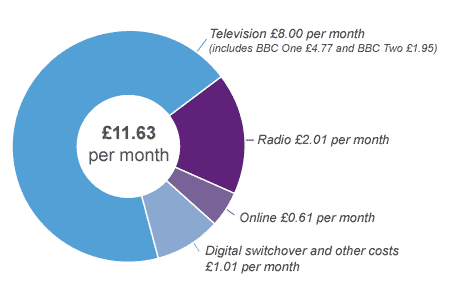
Osborne is referring to the average £11.63 monthly fee British citizens pay to help fund the operations of the BBC’s radio, television and online operations.  A surplus of up to up to £300 million is anticipated to remain after the UK completes its transition to digital television in the next two years.  That money would be diverted to expanding rural broadband under the government plan.

But campaigners for better rural broadband service complain that will not raise nearly enough to provide broadband across the countryside.  The 50p monthly telephone tax proposed by the former Labour government would have raised nearly £1 billion per year.

Charles Trotman, of the Country Land and Business Association, told The Telegraph it will not be enough money to connect all rural areas. He said remote communities risk being left behind in ‘broadband deserts’ unless more is done to help villages set up connections themselves.

Other critics contend the surplus from the digital TV transition may not exist two years from now.  Thus far, mostly rural regions in England have made the transition to digital, costing the government publicity campaign less than expected.

Rather than the tax, Osborne claims the government can spur investment from the private sector by “making regulatory changes to reduce the cost of roll-out.”  He did not specify what those changes might be.

The government claims it is committed to providing up to 2Mbps broadband service across the entire country, but the lack of action in many areas have forced small towns and villages to launch their own municipal broadband services, sometimes funded by residents themselves.

[flv width=”512″ height=”308″]http://www.phillipdampier.com/video/BBC Municipal Broadband 4-2010.flv[/flv]

The BBC covers two British communities doing it themselves — providing enhanced broadband because private providers wouldn’t.  One in Highworth offers free Wi-Fi for up to two hours daily, while in Lyddington residents raised £37,000 to obtain enhanced DSL service.  (5 minutes)

[flv width=”480″ height=”292″]http://www.phillipdampier.com/video/Signal – Connectivity on the move 6-10.mp4[/flv]

Highworth (Swindon) relies on Signal, a high speed WISP/Wi-Fi network that offers up to 20/2 Mbps unlimited access with no Internet Overcharging schemes like usage caps or overage fees for £5.99 per month, or up to two hours daily access for free.  (4 minutes)

Search This Site:

Contributions:

Recent Comments:

Your Account:

Stop the Cap!