Home » Rural Broadband » Recent Articles:

Frontier’s Everyday High Prices for Slow DSL Just Don’t Make Any Sense

Phillip Dampier September 20, 2011 Broadband Speed, Buckeye, Charter Spectrum, Competition, Consumer News, Data Caps, Editorial & Site News, Frontier, Rural Broadband Comments Off on Frontier’s Everyday High Prices for Slow DSL Just Don’t Make Any Sense

Phillip "Frontier DSL is Too Slow and Expensive" Dampier

Frontier Communications occasionally sends me mailers promoting their latest offer for DSL and/or satellite service.  The price on the front of the letter looks good — usually around $20 a month — despite the fact the best Frontier can deliver my area less than one mile from the Rochester, N.Y. city line is 3.1Mbps.  But Frontier’s fine print is infamous for bill padding extra fees, charges, and service commitments that makes the out-the-door price literally higher than Time Warner Cable’s Road Runner service, which actually delivers substantially faster speed at a lower price.

I’m not alone.

Customers in several Frontier service areas are openly wondering why they should do business with the phone company when they are charging more for less service.

In Ohio, Frontier Communications competes in some areas with Buckeye Cablevision.  Frontier sells DSL Internet in northwest Ohio for $29.99 a month.  For that, customers like Inquiry receive 6.2Mbps even though they bought 7.1Mbps service.

“Their [Internet prices] are significantly higher when comparing the other providers in northwest Ohio,” Inquiry writes. “Buckeye Cablevison has 10Mbps service for $24.95/month. And they actually give the customer 10.8Mbps.”

In areas where Frontier often finds itself the only game in town, that price is downright cheap.

Frontier's "High Speed" Fantasies

Nialis in Aliso Viejo, Calif. doesn’t know what Inquiry is complaining about.  He pays $30 a month for 1.5Mbps DSL service from Frontier.

Eric McDaniel from McDavid, Fla. found small relief when he complained about the 2.2Mbps DSL service he was paying $39.99 a month to receive.

“I now pay $29.99, and that is only because I threatened to cancel my service,” McDaniel says. “Now they give me a $10 recurring credit.”

“What are you going to do when they’re the only show in town?”

Even Charter Communications, one of America’s lowest rated cable companies, has prices and service that beats Frontier hands-down.

In some Charter areas like Wausau, Wisc., Frontier DSL comes with a two year service commitment, a $14.99 monthly Wireless Router Fee, and comparatively slow service:

Frontier Communications Pricing - Wisconsin

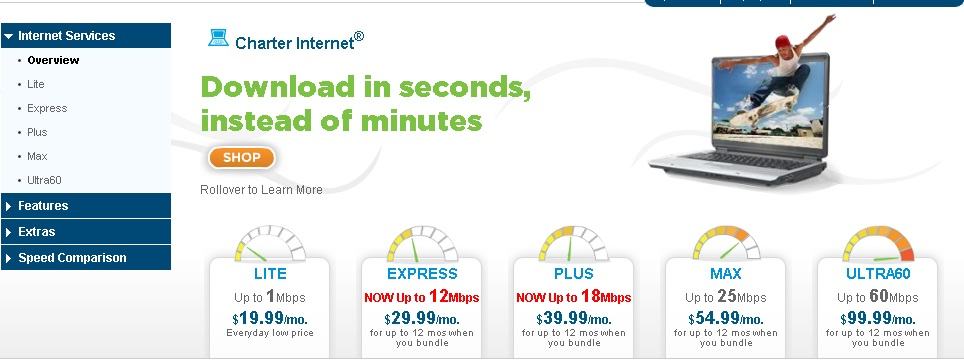
Customers can pay $29.99 a month (before fees) for “up to 3Mbps” DSL service from Frontier or spend $29.99 and get 12Mbps from Charter:

Charter Communications Pricing - Wisconsin

So how does Frontier Communications keep offering service at uncompetitive prices?  They have much greater success in the rural markets they favor, where cable competition rarely exists.  Plus, many consumers may not understand the impact of the speed differences they receive from different providers, tending to blame “the Internet” for slowdowns more than the provider delivering the service.  Some customers may also be attracted to valuable customer promotions that include free netbooks or television sets, and forget about the fine print service commitments that come with the deal.

As dwink9909 from Clintonville, Wisc. shared on the Frontier Broadband Reports forum: “Frontier Communications Inc. is free to charge the maximum the market will bear primarily because they are the only provider in most of the areas they serve. That’s certainly true here in Wisconsin. Six miles south of me you can get dial-up service from two dozen ISPs and broadband via wireless, cable or DSL, but here there is only a single provider for telephone and broadband. We are among the “under-served” millions who are just glad to have high speed Internet at any cost.”

Frontier is only too happy to oblige.

AT&T Tells Customers It Is Abandoning 2G Service: Upgrade Your Phone If You Want to Still Use It

Phillip Dampier September 20, 2011 AT&T, Consumer News, Rural Broadband, Video, Wireless Broadband 2 Comments
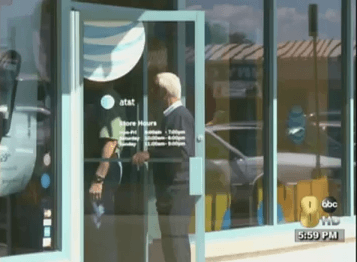
KJCT-TV caught customers lined up literally out the door of this AT&T store in Grand Junction, Colorado.

KJCT-TV caught customers lined up literally out the door of this AT&T store in Grand Junction, Colorado.

AT&T store employees in the Grand Valley of Colorado are using the company’s upgrade of former Alltel service areas to 3G service as an excuse to tell customers they need to buy new cell phones if they continue to want to use their wireless service.

Customers lined up outside AT&T stores in communities like Grand Valley, Colorado on Monday fuming over service problems than began last weekend.

“I had about an half hour wait just to find out I had to buy a new phone and they wouldn’t credit me for it or anything,” customer Josh Simpson told KJCT-TV.

AT&T employees told the television newscast the company is “getting rid of the 2G service in Grand Junction to make room for larger networks.” Employees also said customers were sent a letter informing them about the service change, but customers might have overlooked the e-mail because it looked like spam.

Local employees shrugged their shoulders as customers repeatedly complained about having to foot the bill for brand new phones, often at full price, in order to continue using their service.

“It’s a corporate decision,” one replied.

At issue is AT&T’s adopted network, acquired originally by Verizon Wireless from Alltel but spun away to AT&T as part of an agreement with federal anti-trust officials.  Alltel’s network in the Grand Valley placed more prominence on its legacy 2G EDGE network than AT&T is willing to continue.  AT&T isn’t actually discontinuing the 2G network — it is moving 2G service to less-favorable spectrum it owns in order to make room for improved 3G coverage.  That might work fine in areas less expansive and rugged than western Colorado, but in the Grand Valley, it means many customers will find they no longer have data service at all.

The ongoing tower upgrades have also disrupted cell service generally, and when customers arrive at AT&T’s stores to complain, the employees on hand attempt to upsell them more expensive phones to “fix” the problem.

Customers calling to complain are met with busy signals or general statements from AT&T telling them the changes are for their own good.  But because so many basic cell phones don’t support 3G service, upgrades to phones that do often represent a major unexpected financial hit (and another two year contract and data plan if the phone happens to be a smartphone).

“Alltel served us just fine for many years,” writes our Glade Park reader Tim. “When AT&T eventually showed up, we got everything we never wanted, and this should be a lesson for those who think AT&T will somehow ‘improve’ service at T-Mobile if they acquire them.”

AT&T customer Joan Burns told KJCT AT&T just made up her mind for her.

“I will never again sign a contract with them,” she said. “That’s bull.”

[flv width=”360″ height=”290″]http://www.phillipdampier.com/video/KJCT Grand Junction ATT Customers Forced To Upgrade Cell Phones 9-19-11.mp4[/flv]

KJCT in Grand Junction reports AT&T customers may be noticing a disturbance in their cell phone service, as AT&T employees use it as an opportunity to get customers to upgrade to more expensive phones.  (3 minutes)

Seven States Sue AT&T Over T-Mobile Merger; Seek Protection for Wireless Consumers

Phillip Dampier September 19, 2011 AT&T, Competition, Consumer News, Public Policy & Gov't, Rural Broadband, T-Mobile, Video, Wireless Broadband Comments Off on Seven States Sue AT&T Over T-Mobile Merger; Seek Protection for Wireless Consumers

At least seven states including New York, California, Illinois, Pennsylvania, Washington and Ohio have announced they are joining the Justice Department lawsuit to stop AT&T’s attempted buyout of T-Mobile USA.

The merger has been heavily criticized by consumer groups for its potential to reduce wireless competition and stifle the marketplace with just two dominant carriers — AT&T and Verizon Mobile.  Now several Attorneys General have joined the voices of opposition to the merger.

“This proposed merger would stifle competition in markets that are crucial to New York’s consumers and businesses, while reducing access to low-cost options and the newest broadband-based technologies,” New York Attorney General Eric T. Schneiderman said in a statement.

Washington State Attorney General Rob McKenna said the deal would “result in less competition, fewer choices and higher prices for Washington state consumers.”

“The proposed merger would create highly concentrated markets in Massachusetts and could lead to higher prices and poorer service.” Massachusetts Attorney General Martha Coakley said.

Illinois Attorney General Lisa Madigan said the deal would “substantially lessen competition for mobile wireless telecommunications services in Illinois and across the United States.”

“Blocking this acquisition protects consumers and businesses against fewer choices, higher prices, less innovation, and lower quality service,” Madigan added.

“Our review of the proposed merger between AT&T and T-Mobile has led me to conclude that it would hinder competition and reduce consumer choice,” California Attorney General Kamala D. Harris said. “Enforcement of antitrust law is the responsibility of the Attorney General and is vital to protecting our state’s economic strength and tradition of innovation for the betterment of all Californians.”

Shuler

Although the level of opposition to the transaction continues to grow, AT&T itself claims to remain confident it can push the merger through.

“It is not unusual for state attorneys general to participate in DOJ merger review proceedings or court filings,” AT&T representative Michael Balmoris said.

Several Democratic lawmakers, most of whom receive substantial campaign contributions from AT&T, would seem to underline the company has the support of at least some in Congress.

Rep. Heath Shuler (D-North Carolina), joined 14 Democratic co-signers in a letter sent Thursday to President Barack Obama encouraging him to support the merger deal.

“By settling the proposed merger of AT&T and T-Mobile USA we can put thousands of Americans back to work and promote economic development across the country,” Shuler said. “I urge the President to strongly consider the vast benefits this merger will have on job creation and the economy and quickly resolve any concerns the Administration may have with the proposal.”

Among the co-signers: Rep. John Barrow, Rep. Mike Ross, Rep. Dan Boren, Rep. Dennis Cardoza, Rep. Joe Baca, Rep. Leonard Boswell, Rep. Ben Chandler, Rep. Jim Costa, Rep. Henry Cuellar, Rep. Mike McIntyre, Rep. Mike Michaud, Rep. Collin Peterson, Rep. Loretta Sanchez, and Rep. David Scott.

AT&T currently also has support for their deal from 11 states, many which receive very little service directly from T-Mobile: Alabama, Arkansas, Georgia, Kentucky, Michigan, Mississippi, North Dakota, South Dakota, Utah, West Virginia and Wyoming.

A court hearing is scheduled for Sept. 21 to discuss settlement options.

[flv width=”480″ height=”290″]http://www.phillipdampier.com/video/KFOR Oklahoma City ATT T Mobile Merger 9-19-11.mp4[/flv]

KFOR in Oklahoma City explores the latest developments in the T-Mobile/AT&T merger case.  (2 minutes)

Broadband Life in Idaho: Bears Rubbing Against Towers Knock Out Internet Service

Phillip Dampier September 15, 2011 Broadband Speed, Cable One, CenturyLink, Competition, Data Caps, Editorial & Site News, Public Policy & Gov't, Rural Broadband Comments Off on Broadband Life in Idaho: Bears Rubbing Against Towers Knock Out Internet Service

(Courtesy: Pando Networks)

Bears who fancy a good rub up against wireless Internet transmission towers were blamed for knocking out service for customers in the Potlatch area one day, a problem unique to rural communities who make due with whatever broadband access they can find.

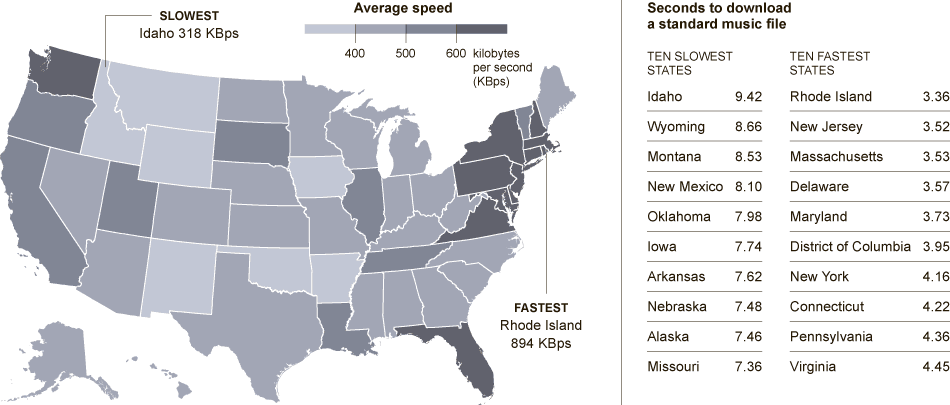
Such is life in rural Idaho, deemed by Pando Networks to be America’s slowest broadband state, with average Internet speeds of just 318kbps.

Stop the Cap! reader Jeff in Pocatello is happy the big city New York Times has noticed Idaho’s online challenges.

“Please take notice of this newspaper article about our online experience here in Idaho,” Jeff writes. “While it underplays the near-total failure of our state legislature to recognize there –is– a broadband problem here, at least the rest of the country will understand just how bad Internet access remains in rural America.”

Jeff should know.  Pando Networks calls Pocatello America’s slowest Internet city.  It’s no surprise why.  Pocatello residents are stuck between a rock — the infamous Internet Overcharging leader Cable ONE (incidentally owned by NY Times‘ rival The Washington Post), and a hard place — Qwest/CenturyLink DSL.

Nobody does Internet Overcharging better than Cable ONE, which baits customers with high speed access and then ruins the deal with an $8 monthly modem rental fee, infamously low usage caps and a two-year contract plan that subscribers call a ripoff.

“Cable ONE never heard of a square deal because they break every consumer rule in the book,” Jeff says. “Although the company pitches speeds up to 50Mbps, they tie it to a two-year contract that only delivers one year at that speed.  After 12 months, they reduce your speed to just 5Mbps for the entire second year, and if you cannot convince the customer service representative to renew and reset your 50Mbps contract for an additional year, there is nothing you can do about it.”

THE Internet Overcharger

Cable ONE has written the book on usage limits.  Customers paying for “blazing fast 50Mbps speed” get to consume a maximum of just 50GB per month (100GB for triple play customers) before overlimit fees of $0.50/GB kick in.  Other Cable ONE plans include daily usage limits of just 3GB, which can make Netflix viewing difficult.

“Cable ONE makes you ration your Internet like satellite providers do, and it’s very irritating because they tease you with fast speeds you literally cannot use unless you are willing to pay a lot more,” Jeff says.

The alternative for most Idahoans is DSL, if Qwest/CenturyLink provides it.  In many areas, they don’t.

“You can be a mile out of Pocatello’s city center and be told there is no DSL, and those that do get it often find it working at 1-3Mbps,” he adds.

In a country now rated 25th in terms of Internet speed, Idaho is comparatively a bottom-rated broadband disaster area.  The state secured 11 federal broadband grants to deliver some level of service in communities across the state, at a cost of $25 million.
The Slow Lane

But ask some local officials about the quality of broadband in Idaho and you find a lot of denial there is even a problem.

The Times got a brusque response to their inquiries about broadband service from the executive director for the Bannock Development Corp., a business development group.  Gynii Gilliam told the newspaper things were just fine, at least for large businesses in cities like Pocatello.

“The last thing I need is a report that says we don’t have the capacity and speed, when I know it exists,” Gilliam said. She noted that Allstate Insurance was opening a $22 million call center in Pocatello and that the Federal Bureau of Investigation has a service center there. “We have not lost any business because of Internet speeds,” she said.

Which proves the old adage that you can have just about anything, for the right price.  The disparity between residential and business broadband — urban and rural — is particularly acute in mountain west states like Idaho.  Verizon was considering rural Wyoming for a multi-billion dollar high speed Internet data center, until it found it could purchase an alternative already up and running elsewhere.  Meanwhile, much of the rest of Wyoming has no Internet, slow speed wireless or DSL, or limited cable broadband in some larger communities.

Even Gilliam admitted her home broadband account was nothing like the service Allstate Insurance was likely getting.

“It feels like it’s moving in slow motion,” she told the Times. “A lot of times I’ll start downloads and not complete them.” She said she was happy as long as she could get e-mail.

But not everyone is satisfied with an Internet experience limited to occasional web browsing and e-mail.
Qwest (now CenturyLink), is Idaho's largest Internet Service Provider.

“With countries like Latvia getting better broadband than we have, it’s only a matter of time before we start to lose even more jobs in the digital economy over this,” Jeff says. “This is one more nail in the coffin for rural economies in the west, which are being asked to compete with bigger cities and eastern states that have much better infrastructure.”

Pando found the northeast and mid-Atlantic states, excepting Maine, New Hampshire, and Vermont, have the best broadband speeds in the country.  The mountain west has the worst.

Rural states like Montana, the Dakotas, eastern Oregon, Idaho, Wyoming, and Utah are the least likely to have widespread access to cable broadband, which can typically offer several times the Internet speed found in smaller communities with DSL service from dominant provider Qwest (now CenturyLink).  CenturyLink claims 92 percent of their customers have some access to broadband, but didn’t say at what speeds or how many customers actually subscribe to the service.

In Idaho, cost remains a factor, so CenturyLink is planning to sell low-income households a discounted DSL package.  Speeds and pricing were not disclosed.

Jeff says the real issue is one of value.

“Some in the Times article blame lack of access, while others claim it’s all about the cost, but it’s really more a question of ‘is it worth paying this much for the service we actually get’,” Jeff says.

“Cable ONE is simply deal-with-it Internet, with usage caps and contract traps that leave customers feeling burned, but their only other choice is Qwest, and they show few signs of caring about delivering fast broadband in this state,” Jeff says.

“I believe CenturyLink Idaho’s vice president and general manager Jim Schmit when he says, ‘We’re in business to make a profit,’ Jeff concludes. “There isn’t a lot of profit in selling Internet service in rural mountain states, so the company simply doesn’t offer it where they won’t make back their investment quickly.”

“The question is, should profit be the only thing driving broadband deployment in the United States?  If you answer ‘yes,’ Idaho is the result.  If you answer ‘no,’ and think it is an essential utility, profit shouldn’t be the only consideration.”

[flv width=”640″ height=”380″]http://www.phillipdampier.com/video/Cable ONE Countdown High Speed Internet.flv[/flv]

Cable ONE’s ad for 50Mbps leaves out a lot, including the 50GB usage cap and two-year contracts that downgrade service to just 5Mbps for the entire second year.  (1 minute)

Shamrock, Okla.: Bankrupt City, Abandoned Police Cars, Padlocked Doors, But Internet Service Prevails

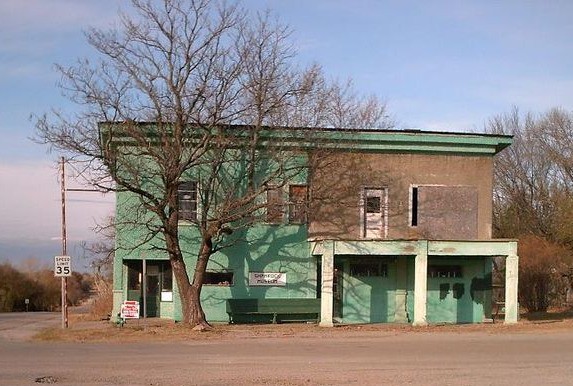
Shamrock Museum

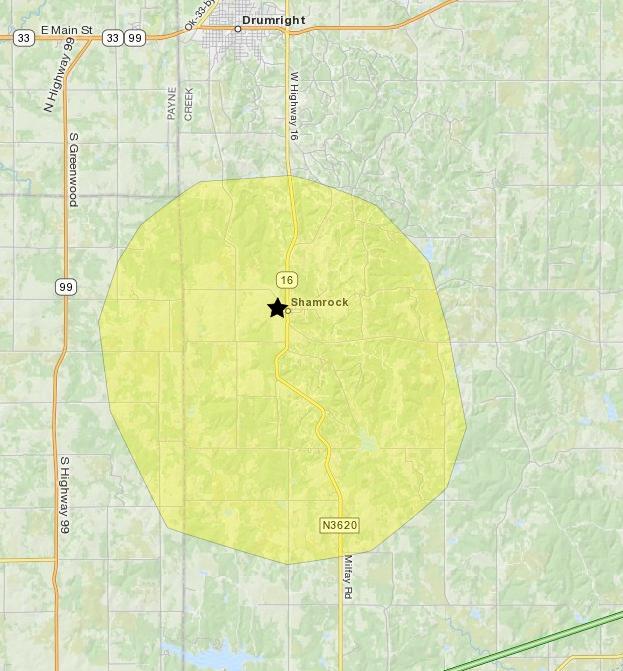
The city of Shamrock, Okla. may not be a city for much longer, facing unincorporation and liquidation of its remaining assets, which include the abandoned police cars that used to earn the city enough ticket revenue to keep the doors open.  But fast (and free at the local community center) Internet prevails (with competition, too) in a city with fewer than 100 remaining citizens.  It’s all thanks to a federal broadband grant and an existing Wireless ISP.

Shamrock’s unlucky predicament comes at the expense of the boom-and-bust oil business that launched dozens of small towns in rural Oklahoma, only to leave them largely abandoned when the oil dried up, or the cost to access it becomes too prohibitive.  Once a community numbering 10,000, Shamrock, located nearly halfway between Oklahoma City and Tulsa, had recently been surviving on revenue earned from writing traffic tickets in infamous speed traps set up along Highway 16.  Shamrock, along with Big Cabin, Caney, Moffett, and Stringtown, became so notorious for their dependence on traffic ticket revenue to keep the towns afloat, at one point the state government publicly designated them “speed trap towns” and banned them from writing tickets on state and federal highways. When Creek County officials learned the city was using non-commissioned officers to write tickets, they shut down the whole operation.

Soon after, residents found the city hall padlocked, with coffee cups still on the desks and police evidence lockers still stuffed with property from active criminal cases (although seized marijuana and beer has since disappeared.)

In fact, the only service now in operation at the city hall, now converted into a “community center,” is Internet access on 10 computers made possible by @Link Services LLC, an Oklahoma City-based Wireless Internet Service Provider (WISP) that provides service in rural areas, with the help of a broadband grant from the U.S. Dept. of Agriculture.

The broadband grant, amounting to $536,000, with matching funds of $134,000 kicked in by @Link, covers the costs of running the community center for two years and extending wireless access with the construction of a new wireless radio tower in Stillwater, which allows the company to reach Shamrock residents.

In addition to providing free access at the former city hall, @Link also sells Internet access to area residents (the only remaining business in town is a diner):

@Home Standard  512 Kbps download  512 Kbps upload $34.95
@Home Advanced  1.5 Mbps  up to 1.5 Mbps $39.95
@Home Premium  3.0 Mbps  up to 1.5 Mbps $46.95
@Home Premium Plus  5.0 Mbps  up to 3.0 Mbps $59.95
@Home Max  6.0 Mbps  up to 6.0 Mbps $74.95

“This is going to be the last place anyone would provide Internet without government funding because there is no chance of turning a profit,” Kerry Conn, chief financial officer of @Link Services told The Oklahoman. “But if you don’t have Internet services, your town is going to die.”

@Link CEO Samual Curtis says their wireless Internet access sells itself.

“Broadband is a very easy sell where there is no broadband,” Curtis told the newspaper.

The only problem with that is Shamrock currently does receive service from another Wireless ISP — OnALot, a service of HDR Internet Services, Inc.  OnALot operates from 70 systems in more than 25 cities and communities across rural Oklahoma.  @Link’s arrival in town, with the assistance of a federal broadband grant, came as a surprise to some Shamrock residents who already had Internet service from OnALot.  Now those customers have two choices — both wireless — for Internet service.  OnALot, the incumbent, is often cheaper, too:

PLAN 12 Month
Contract
Credit or
Debit Card
Monthly Fee For Service
A No Contract No $42.00
B No Contract Yes $37.00
D Yes Yes $33.00

OnALot does not sell traditional speed tiers.  Instead customers share access points rated at speeds of 11 and 54Mbps.  Customers do not actually see anything close to those speeds, because they are theoretical maximums and each access point is shared by several users.  But since many residential customers do not have a firm understanding of what different speed levels represent, it has proven workable for HDR Internet to sell services based on price, not speed.

OnALot does sell dedicated, private wireless circuits to customers who don’t want to share, but they are comparatively expensive:

Speed Equipment Monthly Fee
3.0 / 512 $400.00-$600.00 $200.00
6.0 / 768 $400.00-$600.00 $350.00

OnALot.com operates both standard Line-of-Sight and Near-Line-of-Sight systems on the 80' tall water tower on the west side of Shamrock.

One Oklahoman reader, Bobbi, wondered why @Link received federal grant money to provide Internet service in a community that already had access.

“Why this company didn’t do their homework before they used government money to provide a service to a town that had that service,” Bobbi asked. “Wouldn’t that be a misuse of the grant money?”

Broadband grant funding has come under criticism at times for funding projects that incumbent providers accuse of duplicating services.  A study funded by the National Cable & Telecommunications Association, the cable industry’s top lobbyist, found several instances of grants that would deliver broadband service to areas already served by other providers.

“While it may be too early for a comprehensive assessment of the [government]’s broadband programs, it is not too early to conclude that, at least in some cases, millions of dollars in grants and loans have been made in areas where a significant majority of households already have broadband coverage, and the costs per incremental home passed are therefore far higher than existing evidence suggests should be necessary,” the study says.

Thus far, much of the funding for rural Oklahoma seems to be directed towards wireless Internet access projects, which typically serve sparsely populated areas cable and phone companies have traditionally ignored.

The NCTA’s criticism, in particular, was directed against its would-be competitors.  The lobbying group suggests the price of competition was too high.

Based on the cost of the direct grants and subsidizing the loans, the NCTA study estimated that the cost per incremental home passed would be $30,104 if existing coverage by mobile broadband providers was ignored, and $349,234 if mobile broadband coverage was taken into account.

Wireless ISP operators have told Stop the Cap! many of their projects are self-financed and do not receive government assistance.  Some WISP operators have accused the government of making broadband grants to wireless operators a cumbersome, if not impossible prospect because incumbent telephone companies are often most likely to meet the government’s grant criteria.

For Shamrock residents, one piece of good news: @Link Services and OnALot both have no Internet Overcharging schemes like usage caps.  However, OnALot prohibits the use of peer-to-peer software (torrents) and @Link Services maintains the right to curtail speeds for those who create problems for other users on their shared wireless network.

OnALot’s usage policies are among the most frank (and common sense) we’ve seen, because they are up front with customers about the impact certain traffic can have on their wireless network:

  1. You are paying us to download from the Internet. We do not limit you on that. You can download anything you want 24/7. Games, email, web pages, radio stations, and so on – we don’t care, downloading is what you are paying us for. That said, we would prefer that you do not leave an active game un-attended, or run a radio station continuously, as these eat up bandwidth that others could be using. When you’re done with your game, please turn it off.
  2. We do have restrictions when it comes to uploading TO the Internet. P2P or Peer-to-Peer programs are NOT allowed. These limitations apply primarily to file sharing programs. We do NOT allow music or video sharing programs, bit torrent programs or other programs where outside users can extract files from your computer with or without your express consent. And seriously, do you actually WANT others to have full access to your computer? That’s what you’re giving to file sharing programs! Please call us if you are unsure if the program you are using is a file sharing program.
  3. Yes, you can upload to your favorite website, send big emails, and transfer any size files that are under your control. That’s OK with us – these are intermittent in nature and under your full control. It’s the unattended uploading that sharing programs do that we do not allow.
  4. If your computer has a virus and is “spewing” out onto the Internet, we expect you to have it cleaned. Causing others to become infected is wrong, and we may take steps to disable your Internet connection. We will call you first, explain what is going on and ask that you have your machine cleaned. If you decide not to do this, we will then cut you off until you do.

Search This Site:

Contributions:

Recent Comments:

Your Account:

Stop the Cap!