Home » Issues » Recent Articles:

Goldman Sachs Downgrades Frontier Communications to Neutral — Eroding Revenues Cited

Phillip Dampier June 14, 2010 Data Caps, Frontier, Rural Broadband Comments Off on Goldman Sachs Downgrades Frontier Communications to Neutral — Eroding Revenues Cited

Goldman Sachs has reviewed the implications of Frontier Communications assuming control of millions of Verizon landline customers, and promptly downgraded their stock to a Neutral rating, telling investors the upcoming consolidation will hasten eroding revenues at Frontier.

“Consolidation of the underperforming acquired assets causes an immediate step-up in revenue erosion for FTR (-6.3% in 2010). In addition, the combined company’s initial EBITDA margins will be significantly below those of legacy FTR (pro forma of 48.0% in 2010, 470 bp below legacy FTR).”

Analysts added, “We expect longer term EBITDA margins of 50%-plus, driven by synergy realization (we forecast $450 mn/year by 2013), and moderating revenue declines, as FTR is able to bring a more localized focus to assets that were not a primary focus inside of a much larger Verizon entity. We forecast 2011/2012 FCF of $950 mn/$921 mn, as synergies and margin expansion only partially offset continued (but moderating) revenue erosion.”

In English, that means Frontier will benefit from its larger customer base in reducing expenses on a per-customer basis, and could become a big enough player to realize some benefits from rolling out services to a larger number of customers nationwide, but those benefits will be tempered by the ongoing loss of revenue as customers dump Frontier landlines for wireless and, where available, switch to a cable modem product to get better speeds and consistent service that Frontier DSL does not provide.  Losing that 5 GB monthly usage allowance won’t hurt either.

Frontier is betting a good deal of the company on expanding broadband service in its largely rural service areas, where many Americans are still stuck relying on dial-up or satellite fraudband, the service that promises a broadband experience but doesn’t come close to actually delivering one.

As long as Frontier doesn’t face competition in its markets, it can deliver 1-3 Mbps DSL service for up to $50 a month and bank those profits as a firewall against ongoing loss of landline revenue.  But if new players arrive, such as LTE wireless, WiMax, cable, or municipal fiber, Frontier’s business plan could go awry in a hurry.

Frontier also continues to pin its hopes on its enormous payout of dividends — sometimes exceeding 12 percent.  The stock is currently the best dividend payer in the S&P 500.  With dependable dividends and the ability to throw back free cash to investors, shareholders can’t ask for anything more.  In the first quarter alone, free cash flow amounted to $152 million and the company paid a dividend to shareholders representing 52 percent of that amount.  That’s $152 million Frontier won’t be spending to upgrade their service or have on hand to pay down debt.

For independent legacy landline providers like Frontier, reducing that dividend could spell disaster for the company’s stock price. Even investors understand this, which is why these kinds of cautionary notes are often attached to coverage about the company:

A cautionary note: telecoms companies with large fixed line exposure generally yield high dividends presently because investors do not believe their revenues and income levels are sustainable as people continue to substitute mobile phones for fixed lines.


Lafayette Municipal Fiber Provider Filing Complaint Against Cable Co-Op Over Access

LUS Fiber is a municipally-owned provider competing in Lafayette, Louisiana

Lafayette Utility Systems’ LUS Fiber has filed a formal complaint with the Federal Communications Commission accusing the cable industry co-op of blocking the company from getting the favorable discounts and access to cable networks its competitor Cox Cable receives.

LUS Fiber Director Terry Huval said the blockade against LUS Fiber could ultimately cost the city millions and deny subscribers access to popular cable networks.  Huval accused its rival, Cox Cable, of being behind the repeated denials of membership for the Louisiana municipal cable system.

The municipal provider issued a news release stating that its complaint to the FCC originally was joined by municipal providers in Wilson, N.C., and Chattanooga, Tenn., but the National Cable Television Cooperative has since admitted those systems, while keeping LUS Fiber out.

“The NCTC opened membership to two other municipally-owned telecommunications companies that are very similar to our own Lafayette operation and in the same week refused to admit us on the same terms and conditions,” Huval said. “The only difference among the three systems is that our major cable competitor is NCTC’s largest member as well as a member of NCTC’s board of directors.”

LUS Fiber's primary competitor is Cox Cable

The NCTC is critically important to many medium and small sized cable companies who together collectively bargain access and the best possible volume discounts for hundreds of cable networks and broadcasters.  Those discounts are substantial, considering only Comcast gets larger discounts than the NCTC’s group membership.  NCTC membership also frees members from the tedious one on one negotiations cable systems would otherwise be required to conduct to obtain and maintain agreements with cable programmers.

Keeping LUS Fiber out means the municipal provider could be left charging higher prices than Cox charges for cable-TV in Lafayette.

Federal law appears to be on the side of LUS Fiber as part of the 1992 Cable Act that consumer groups fought for:

It shall be unlawful for a cable operator, a satellite cable programming vendor in which a cable operator has an attributable interest, or a satellite broadcast programming vendor to engage in unfair methods of competition or unfair or deceptive acts or practices, the purpose or effect of which is to hinder significantly or to prevent any multichannel video programming distributor from providing satellite cable programming or satellite broadcast programming to subscribers or consumers.

The NCTC operates a spartan website at nctconline.org

As someone who personally was involved in the passage of that legislation, the ironic part is we were fighting -for- the NCTC back then.  Of course, those days the cooperative was made up of wireless cable providers, utility co-ops, municipal co-ops, and other independent cable systems that were constantly facing outright refusals for access to cable programming or discriminatory pricing.  Satellite dish-owners were also regularly targeted.  NCTC was a friendly group in the early 1990s but has since become dominated with larger corporate cable operators, especially Cox Cable and Charter Communications.

LUS builds a compelling case:

NCTC and its dominant members have not only grown significantly in size and power, but they have become increasingly anti-competitive themselves. They are now undermining Congress’s pro-competitive intent by using denial of membership in NCTC as an anticompetitive device to insulate NCTC’s existing members from competition by new entrants.

Specifically, in 2007 and 2008, NCTC imposed a “moratorium” on new members, claiming that it needed time to review its membership policies. In late 2008, NCTC supposedly lifted the moratorium, posting new application procedures on its website. These procedures, NCTC stated, would ordinarily result in admissions within 60-120 days. LUS promptly applied for membership, furnishing all of the information that NCTC required. In reality, NCTC only lifted the moratorium for private-sector cable operators, including Cox and Charter. For LUS and other municipal cable operators, NCTC’s claim to be open to new memberships turned out to be little more than a deceptive sham.

In short, as of April 2010, despite publishing procedures suggesting that new members would be admitted within 120 days, NCTC had not admitted a single new public communications provider during the year and a half since it supposedly lifted its moratorium.

Without access to programming at competitive prices, no one would consider switching to a municipal provider that charged higher prices than the incumbent.  The NCTC’s increasingly secretive and erratic admission of new municipal members provides ample ammunition for those on the outside looking in to accuse the group of unfair practices.

AT&T’s Latest Oopsy: 114,000 iPad Owners’ E-Mail Addresses Made Public

Phillip Dampier June 14, 2010 AT&T, Consumer News, Editorial & Site News, Video 4 Comments

AT&T has made it a whole lot easier to learn who has bought Apple’s transformative iPad.  An AT&T security lapse permitted a third party to access and obtain the e-mail addresses and individual iPad ID’s of all 114,000 current owners of the device.  That third party, Goatse Security, then promptly handed over the entire list — some 2,000 pages long, to Gawker — who exposed some big name iPad owners last week.

More importantly, several high officials in government and the military were also identified as iPad owners, even as the security lapse could have given access to the exact location of any of them.

In the media and entertainment industries, affected accounts belonged to top executives at the New York Times Company, Dow Jones, Condé Nast, Viacom, Time Warner, News Corporation, HBO and Hearst.

Within the tech industry, accounts were compromised at Google, Amazon, Microsoft and AOL, among others. In finance, accounts belonged to companies from Goldman Sachs to JP Morgan to Citigroup to Morgan Stanley, along with dozens of venture capital and private equity firms.

Some of the movers and shakers exposed (Image: Gawker)

In government, affected accounts included a GMail user who appears to be Rahm Emanuel and staffers in the Senate, House of Representatives, Department of Justice, NASA, Department of Homeland Security, FAA, FCC, and National Institute of Health, among others. Dozens of employees of the federal court system also appeared on the list.

While Gawker considers the implications of a widespread security breach and whether Apple or AT&T is to blame, others are focusing more intently on AT&T’s role in the misadventure.

AT&T e-mailed every iPad owner notification of the security breach only after it became public news:

“On June 7 we learned that unauthorized computer ‘hackers’ maliciously exploited a function designed to make your iPad log-in process faster by pre-populating an AT&T authentication page with the email address you used to register your iPad for 3G service. The self-described hackers wrote software code to randomly generate numbers that mimicked serial numbers of the AT&T SIM card for iPad – called the integrated circuit card identification (ICC-ID) – and repeatedly queried an AT&T web address. When a number generated by the hackers matched an actual ICC-ID, the authentication page log-in screen was returned to the hackers with the email address associated with the ICC-ID already populated on the log-in screen.

The hackers deliberately went to great efforts with a random program to extract possible ICC-IDs and capture customer email addresses. They then put together a list of these emails and distributed it for their own publicity.

As soon as we became aware of this situation, we took swift action to prevent any further unauthorized exposure of customer email addresses. Within hours, AT&T disabled the mechanism that automatically populated the email address. Now, the authentication page log-in screen requires the user to enter both their email address and their password.”

AT&T’s damage control has been one-part victim, two-parts minimize the impact, sprinkled with “attack the messenger” all over the top.

AT&T’s characterization of the security team that exposed the security flaw as malicious hackers brought a swift response from Goatse:

AT&T had plenty of time to inform the public before our disclosure. It was not done. Post-patch, disclosure should be immediate– within the hour. Days afterward is not acceptable.

[…] The potential for this sort of attack and the number of iPad users on the list we saw who were stewards of major public and commercial infrastructure necessitated our public disclosure. People in critical positions have a right to completely understand the scope of vulnerability immediately. Not days or weeks or months after potential intrusion.

In addition AT&T says the person responsible for this went “to great efforts”. I’ll tell you this, the finder of the AT&T email leak spent just over a single hour of labor total (not counting the time the script ran with no human intervention) to scrape the 114,000 emails. If you see this as “great efforts”, so be it.

AT&T’s mistakes just keep on coming, ranging from ongoing billing errors amounting to hundreds of dollars to threatening customers with cease and desist orders just for e-mailing concerns to the company.

[flv width=”640″ height=”500″]http://www.phillipdampier.com/video/Bloomberg Goatse Owens Calls ATT Security Flaw Egregious 6-10-10.flv[/flv]

Bloomberg News ran this interview with a representative from Goatse Security that got a bit over-technical for the average Bloomberg viewer.  (4 minutes)

Ontario County, NY: We Need Fiber So Badly, We Just Did It Ourselves

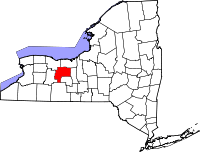
Ontario County, N.Y.

Ontario County, just south and east of Rochester, N.Y., is unleashing the power of fiber optics after private providers turned their noses up at the rapidly-growing Finger Lakes region.

“We just said we need this so badly, we just did it ourselves,” says Ed Hemminger, president and CEO of Axcess Ontario, a non-profit corporation created by the county government to run the $7.5 million dollar project.  Hemminger appeared on this afternoon’s edition of CNBC’s Power Lunch.

The 180-mile fiber optic network now two-thirds complete is expected to be finished by year’s end.  Hospitals and schools are already leasing capacity on the fiber ring.

Axcess Ontario doesn’t actually provide broadband service to businesses and consumers itself.  Instead it leases capacity to all-comers, inviting them to use the fiber ring to enhance their broadband infrastructure.  The company doesn’t provide residential service, for example, but it could enhance another provider’s ability to deliver service.  Right now, the county is contemplating a wireless Internet service for consumers, if they can find a provider.  Frontier Communications could be a likely contender, considering it already provides a Wi-Fi service in downtown Rochester and in portions of suburban towns like Brighton, Pittsford, and Greece.

Hemminger

Hemminger

Ontario County is one of the bright spots in western and central New York’s difficult economy.  Both residential and business growth continues, despite the recession, particularly in communities like Canandaigua, Victor and Geneva.  Having a state-of-the-art fiber ring enhances the area’s ability to attract new businesses and jobs to the Finger Lakes region, often better known for tourism.  At least that is the plan.

“Honestly every company is an Internet company because they all have to use the Internet,” Hemminger claims.

Having the county build the network was the only prospect for getting it done.

“We can have a Return on Investment of 25 years, while the private sector has to recoup its costs in three to four years,” Hemminger says.

Thanks to Stop the Cap! reader Jeff for sending word.

[flv]http://www.phillipdampier.com/video/CNBC Making Broadband Accessible 6-10.10.flv[/flv]

Ed Hemminger discusses the Axcess Ontario fiber ring project in Ontario County, N.Y., on today’s edition of Power Lunch on CNBC.  (2 minutes)

Grand Rapids TV Hands Over Eight Minutes of its Morning Show to Heart AT&T U-verse

Phillip Dampier June 10, 2010 Astroturf, AT&T, Consumer News, Video 2 Comments

AT&T is a paid sponsor of the eightWest program, which may have had something to do with those eight minutes of positive coverage.

Last month, a Rochester, N.Y., morning television news show handed over five minutes of airtime in a thinly-disguised advertisement for local phone company Frontier Communications.

WOOD-TV in Grand Rapids took shilling to a whole new level this morning on its hour-long morning lifestyle program eightWest when it handed over nearly eight minutes to promote AT&T’s U-verse service, infomercial-style.

Essentially handing the microphone over to AT&T area marketing manager Dan Wells, the show’s hosts fell all over themselves talking about how wonderful the service was.  Channel 8’s Terry DeBoer had her original AT&T installation personally supervised by Wells, a service ordinary Grand Rapids consumers probably won’t receive.

As the “Cutting Edge” segment progressed, the station ran a chyron including AT&T’s logo and slogan, “Rethink Possible” as Wells talked about all of the service’s claimed benefits.  DeBoer just thought it was all awesome, gushing this sampler of reactions as a technobeat soundtrack pounded away in the background:

  • “An exciting new adventure in television!”
  • “It really is quite remarkable!”
  • “The super-sized DVR is awesome!”
  • “What are the other services and features that take U-verse to the next level?”
  • “It’s exclusively offered to you by our friends at AT&T.”
  • “Thanks to the power of AT&T and all of their services, you can save money.”

After eight minutes of enthusiasm, there was no time left to inform viewers of a slightly relevant fact only visitors to their website might have noticed: AT&T is a sponsor of the eightWest program.

[flv width=”480″ height=”380″]http://www.phillipdampier.com/video/WOOD Grand Rapids ATT U-Verse 6-10-10.flv[/flv]

Spend eight minutes in AT&T’s marketing Universe on WOOD-TV’s morning lifestyle program, eightWest.  (8 minutes)

Search This Site:

Contributions:

Recent Comments:

Your Account:

Stop the Cap!