Home » Issues » Recent Articles:

Google Launches ‘Google Fiber for Communities’ Website to Advocate for Fiber Broadband

Phillip Dampier July 13, 2010 Broadband Speed, Community Networks, Competition, Editorial & Site News, Google Fiber & Wireless, Public Policy & Gov't, Video Comments Off on Google Launches ‘Google Fiber for Communities’ Website to Advocate for Fiber Broadband

Google today launched a new website which could become a major advocacy center to promote fiber broadband service across America.

Google Fiber for Communities opened with a thank you message for the enormous number of submissions it received for its experimental 1Gbps fiber broadband network.  Google expects to announce the winning application(s) for its experimental  network sometime this year.

But in the meantime, Google also acknowledges what big telecom companies keep trying to downplay and dismiss — “people across the country are hungry for better and faster broadband access.”  That is… better and faster service than their current provider is willing to supply.

The new website provides hints as to its greater purpose:

  1. The name itself.  Notice “communities” is plural.
  2. The site intends to mobilize for fiber networks across the country, starting with lobbying for pending federal legislation that would require installation of fiber conduit as part of federal transportation projects.
  3. The site’s links heavily promotes municipal broadband advocates and organizations, including the National Association of Counties, the National Association of Telecommunications Officers and Advisors, the Fiber to the Home Council, the Baller Herbst Community Broadband Page, the Broadband Properties Municipal Fiber Portal, and Muni Networks.  Outside of the Fiber to the Home Council, which has some big telecom company members and isn’t above advocating for their interests, the rest of the list suggests Google advocates that communities do for themselves what their local phone and cable companies won’t do — deliver world class broadband service at non-duopoly prices.

Stop the Cap! shares many of these goals with Google, as we are strong advocates for community fiber-based broadband, and believe additional competition is highly needed in America’s broadband marketplace to break up an anti-consumer duopoly that delivers slow broadband service (or none at all) at the highest prices companies can get away with.  Thanks to Stop the Cap! reader Jerry here in Rochester for sending word.

<

p style=”text-align: center;”>

Democrats Want More Ambitious Broadband Plan, Call 4/1Mbps Speed Target ‘Second Class’

Senate Appropriations Chairman Daniel K. Inouye - CQ

Inouye

Three senior Democrats on the Senate Commerce Committee have characterized the Federal Communication Commission’s national broadband expansion plans as inadequate — firmly rooting America as second class citizens in a global broadband market.

In three separate letters to FCC Chairman Julius Genachowski, the senators criticized the chairman’s plan for broadband targets set too low, both in vision and in speed.

Genachowski’s plan calls for Americans to have universal access to at least 4/1Mbps service no later than 2020, a goal Genachowski described as “an aggressive target.”

But in a letter obtained by CQ, Senator Daniel Inouye (D-Hawaii) noted that such speed goals were set low in comparison to other countries, many of which are on target to achieve 100Mbps broadband well before 2020.

“What is the FCC’s rationale for a vision that appears to be firmly rooted in the second tier of countries?” Inouye wrote.

Begich CQ

Begich

Senator Mark Begich (D-Alaska) wanted to know how Genachowski settled for 4Mbps download speed, noting that seemed to him to be too modest.

In fact, speed goals in the National Broadband Plan were a major point of contention in the National Broadband Plan, with lobbyists from AT&T and Verizon pushing hard for the lowest possible speed goals.  That is because they are the largest traditional landline providers saddled with aging copper wire networks which provide broadband to most rural Americans through DSL.  Most Americans living outside of major population centers rely on phone company-delivered DSL service typically speed rated at 768kbps-3Mbps.  Because DSL service is distance sensitive, a speed target of just 4Mbps requires a considerably lower investment than a target of 20Mbps or higher.  It is likely 100Mbps service, outlined as a goal for at least 100 million Americans, will first be achieved through fiber and cable networks in large cities, and not from phone company DSL service.

The difficulty for rural Americans to achieve a fair shake in broadband was highlighted by Senator Byron Dorgan (D-North Dakota).  He cited his state’s poor ranking — 42nd in broadband speed, as evidence Americans in rural states suffer with considerably lower quality broadband service.  The FCC’s National Broadband Plan, Dorgan fears, may only recreate the digital divide, only with different levels of speeds.

Senator Byron Dorgan D-North Dakota - CQ

Dorgan

If 100 million Americans can access broadband services at 100Mbps, a rural speed target of 4Mbps will make new, high bandwidth-dependent Internet services just as off-limits to rural America as basic broadband is today in many areas.

Genachowski promised to review broadband speed targets every four years, making adjustments when necessary to be certain rural Americans receive broadband service comparable to urban areas.

But with the wide disparity in speed goals for urban and rural America, that may be impossible in the short term, especially as telecom industry lobbyists continue to pressure Congress for less regulation and no government mandates.

Another Carriage Dispute: AT&T U-verse vs. Rainbow Media’s AMC, We TV, Independent Film Channel

Phillip Dampier July 13, 2010 AT&T, Cablevision (see Altice USA), Consumer News, Video Comments Off on Another Carriage Dispute: AT&T U-verse vs. Rainbow Media’s AMC, We TV, Independent Film Channel

AT&T U-verse customers may have to do without these shows if an agreement cannot be reached with Rainbow Media

AT&T U-verse customers may lose access to three basic cable networks in less than two days if a dispute over how much money AT&T should pay for the networks isn’t settled.

Rainbow Media’s AMC, We TV, and the Independent Film Channel are all threatened with removal from AT&T’s nationwide U-verse lineup as a two week extension of carriage negotiations appears to be going nowhere.

In an ironic “now the shoe is on the other foot” twist, Rainbow Media is a wholly-owned subsidiary of Cablevision Industries — the cable system serving parts of downstate New York, New Jersey and Connecticut.  AT&T is using some of the same language Cablevision used earlier this year in a dispute over fees charged by Scripps’ Food Network and HGTV, as well as Disney-owned WABC-TV in New York.  Rainbow even borrowed a page from Scripps and launched an AT&T protest site, Facebook page and Twitter account.

“AT&T is acting in an aggressive manner that puts their corporate interests ahead of their customers,” AMC said in a statement. “We are negotiating in good faith with AT&T and are hopeful that we can reach an agreement as soon as possible so that our viewers don’t lose out.”

Meanwhile, AT&T is publicly insulting Rainbow’s cable networks.

“Based on aggregate data we obtained from third party industry sources and our own subscribers, some of the Rainbow channels are among the least-watched and most overpriced per viewer compared to other major programming providers,” an AT&T spokeswoman told Deadline. “They’re also trying to force the renegotiation of a contract for one of their other channels that is not yet expired and force us to carry a new channel that wasn’t even formally presented to us until after the recent July 1 contract extension. We want our customers to know that we can’t and won’t give in to unreasonable deals that unfairly disadvantage our customers.”

Despite AT&T’s bravado, Rainbow may have the upper hand with a more aggressive outreach campaign.  AT&T’s website for U-verse has not mentioned the dispute — a potential PR mistake if it wants to argue its position about programming costs.
Rainbow is airing ads on all three of the cable networks involved warning U-verse customers they’ll lose the channels if an agreement isn’t reached by July 14th.
[flv width=”640″ height=”500″]http://www.phillipdampier.com/video/ATT Preparing to Yank AMC 7-12-10.mp4[/flv]
Rainbow Media is informing AT&T’s U-verse customers about the potential loss of networks like AMC from its lineup.  (1 minute)

Thanks to Stop the Cap! reader Marcus for sending news of the dispute our way.

Consumer Reports: Don’t Buy the Flawed iPhone 4

Phillip Dampier July 12, 2010 Consumer News, Editorial & Site News, Video 4 Comments

Bad engineering and all-out deception from Apple’s public relations department have led Consumer Reports to declare the Apple iPhone 4 defective — not recommended for consideration until Apple either fixes the antenna or declares the phone a dud and recalls them.  For those who already made their purchase, the magazine suggests a roll of duct tape may help mask the problem.

[flv width=”320″ height=”200″]http://www.phillipdampier.com/video/Consumer Reports iPhone4 Defect 7-12-10.flv[/flv]

Consumer Reports’ engineers carefully tested Apple’s latest iPhone release and quickly discovered a serious defect in its basic functionality and design. (1 minute)
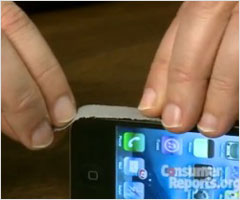
Consumer Reports recommends a well-placed strip of duct tape to resolve Apple's engineering failure

Apple’s deceptive comments claiming that a “software problem” was responsible for the shoddily-engineered antenna has only fueled additional lawsuits against the company for fraud, deception, negligence, concealment, and breach of warranty.  Consumer Reports, which independently tests all of the products it reviews, easily found the iPhone 4 flawed to the point of not functioning in marginal signal areas (something AT&T specializes in providing its customers) just by holding it in your hand.

It’s official. Consumer Reports‘ engineers have just completed testing the iPhone 4, and have confirmed that there is a problem with its reception. When your finger or hand touches a spot on the phone’s lower left side—an easy thing, especially for lefties—the signal can significantly degrade enough to cause you to lose your connection altogether if you’re in an area with a weak signal. Due to this problem, we can’t recommend the iPhone 4.

We reached this conclusion after testing all three of our iPhone 4s (purchased at three separate retailers in the New York area) in the controlled environment of CU’s radio frequency (RF) isolation chamber. In this room, which is impervious to outside radio signals, our test engineers connected the phones to our base-station emulator, a device that simulates carrier cell towers (see video: IPhone 4 Design Defect Confirmed). We also tested several other AT&T phones the same way, including the iPhone 3G S and the Palm Pre. None of those phones had the signal-loss problems of the iPhone 4.

Our findings call into question the recent claim by Apple that the iPhone 4’s signal-strength issues were largely an optical illusion caused by faulty software that “mistakenly displays 2 more bars than it should for a given signal strength.”

No surprise there.  Apple’s claims that a “software problem” was responsible for dropping phone calls and misstating AT&T’s reception quality was accepted primarily by tech bloggers who live or die based on the access they get to Apple’s latest product releases, as well as an army of Apple fans who reflexively defend the company from any criticism, regardless of how well-placed.  Independent tests from Consumer Reports prove the iPhone 4 cannot be relied on to make and receive phone calls while being held, unless you mitigate their design flaw with an external case, or as Consumer Reports suggests, a piece of well-placed, hideously ugly duct tape:

We did, however, find an affordable solution for suffering iPhone 4 users: Cover the antenna gap with a piece of duct tape or another thick, non-conductive material. It may not be pretty, but it works. We also expect that using a case would remedy the problem. We’ll test a few cases this week and report back.

The fact that the magazine issued a “Not Recommended” rating for the phone generated a new round of negative stories in the mainstream media about the company and its latest smartphone.

[flv width=”640″ height=”500″]http://www.phillipdampier.com/video/Bloomberg Apple iPhone Flaw Consumer Reports 7-12-10.flv[/flv]

Bloomberg News ran three news reports today talking about Apple’s strategic problems and also extensively interviewed Michael Gikas, senior electronics editor at Consumer Reports.  He wants Apple to hand out its $30 Bumper case to consumers for free, something Apple has so far refused to do. (11 minutes)

[flv width=”600″ height=”356″]http://www.phillipdampier.com/video/WABC New York Apple iPhone Flawed 7-12-10.flv[/flv]

WABC-TV in New York also ran a significant report this evening about the Consumer Reports findings, and get consumers’ reactions. (2 minutes)


Earthlink Imposes 250GB Usage Limit on Their Customers Getting Service from Comcast

Phillip Dampier July 12, 2010 Comcast/Xfinity, Data Caps, Earthlink 1 Comment

Earthlink, which depends on phone and cable companies to deliver its broadband service, has imposed a monthly usage limit of 250 gigabytes on its customers obtaining service from Comcast.

Customers began receiving postcards in May notifying them about the change in service terms which took effect July 1st.  Earthlink blamed the usage limits solely on Comcast, noting they were dependent on other companies to provide the infrastructure necessary to reach customers:

Comcast and other cable providers provide portions of the network that EarthLink High Speed Cable service uses to deliver broadband Internet access. EarthLink provides the other portions of the network and services like Webmail and the myEarthLink Start Page®.  EarthLink works with its business partners, like Comcast, to manage the network infrastructure.  […]Because Comcast is EarthLink’s business partner in providing the EarthLink Powered by Comcast Service, EarthLink is working closely with Comcast in implementing this Usage Cap.

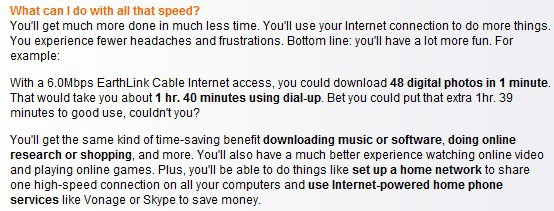
Internet providers routinely sell the benefits of their broadband accounts to better accomplish data-heavy activities like online video using their service, even though in some cases all of that "heavy use" is being used as an excuse to implement usage limits on customers.

In reality, Earthlink offers little more than a handful of its own services to customers.  Most of its network connectivity, billing, and other services are handled by the providing cable or phone company.  Customer support with many technical issues is handled by Earthlink’s own off-shore technical support staff.

Still, Earthlink had offered an alternative to those threatened with Internet Overcharging schemes by Time Warner Cable and Comcast because the company had not adopted those usage limits until Comcast insisted they follow suit.  Presumably with this precedent in place, any other Overcharging schemes imposed by these providers would also impact their respective Earthlink customers.

For those violating the usage limits, enforcement won’t come from Earthlink.  Instead, the provider warns, Comcast will be the entity that comes down on your head.

The vast majority – more than 99% – of customers will not be impacted by the monthly 250 GB Usage Cap. In the event that you exceed more than 250 GB, you may receive a telephone call from Comcast notifying you that you exceeded the 250 GB Usage Cap in the previous month.  The customer service representative on this telephone call  will (i) tell you how much data per month the account has used, (ii) help you identify the source of excessive use, (iii) explain ways to moderate  and reduce your data usage, and (iv) explain the consequences of continuing overusage including termination of the EarthLink Powered By Comcast Service.

Based on Comcast’s past records, the vast majority of customers voluntarily reduce their data usage after this initial call.  However, if after you receive this telephone call from Comcast, you continue to exceed the 250 GB Usage Cap during any month within the six month period after this first telephone call, your EarthLink Powered by Comcast Service may be terminated.  For example, if your account exceeded the Usage Cap in the month of August and Comcast contacted you the first week of September informing you that your account exceeded the 250 GB Usage Cap in August, if your account exceeds the monthly Usage Cap in September, October, November, December, January or February, your EarthLink Powered By Comcast Service may be terminated.   In the event that your EarthLink Powered by Comcast Service is terminated as a result of exceeding the 250 GB monthly Usage Cap, you will have to wait one year from the termination date to be able to subscribe to the EarthLink Powered by Comcast Service again.

[…]Comcast has found that most customers who exceed the Usage Cap during one month change their usage patterns or make other adjustments in their data usage. It is our expectation that only a small fraction of the tiny number of customers whose accounts exceeded the monthly Usage Cap for at least two months during a six month period will have their EarthLink Powered By Comcast Service terminated for one year.

For now, Earthlink customers will have to call the company (888-327-8454) to determine how much data they’ve used during the month as the Comcast data usage meter is apparently only for Comcast customers.

Search This Site:

Contributions:

Recent Comments:

Your Account:

Stop the Cap!