Home » Issues » Recent Articles:

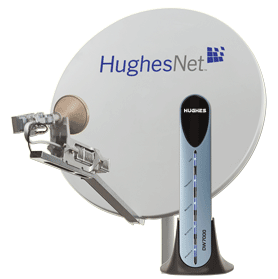
EchoStar Buys Hughes Satellite; Acquires Satellite ‘Fraudband’ Service Rural Americans Loathe

Phillip Dampier February 14, 2011 Broadband Speed, Consumer News, Data Caps, HughesNet, Online Video, Rural Broadband, Video, Wireless Broadband Comments Off on EchoStar Buys Hughes Satellite; Acquires Satellite ‘Fraudband’ Service Rural Americans Loathe

EchoStar Corporation, which makes equipment and provides satellites for Dish Network, today announced it has agreed to buy Hughes Communications, Inc., for about $1.32 billion.

The deal means Dish, the second-largest U.S. satellite television provider, could be one step closer to providing a national data service to its customers.  Hughes operates a “broadband” satellite network, which almost entirely serves rural areas.

Much maligned by its customers, who consider the service’s high prices, low speeds and even lower usage caps “fraudband,” Hughes’ satellite service has been up for sale for some time.

The purchase “brings together the two premier providers of satellite communications services and delivers substantial value to our shareholders,” Pradman Kaul, chief executive officer of Hughes said in the statement.

Satellite television companies have increasingly been at a disadvantage because they cannot sell a true “triple-play” package of television, Internet, and phone service to customers who commonly bundle the three services together.  Instead, Dish and its larger competitor DirecTV have been relying on partnerships with telephone companies who provide phone and Internet service with a satellite television package.

The current generation of satellite broadband services are not well-rated by their customers.  Capacity shortages force providers to place strict limits on usage, which makes the service largely useless for high bandwidth applications — especially video.

The deal is expected to close later this year.

[flv width=”640″ height=”500″]http://www.phillipdampier.com/video/Hughesnet.flv[/flv]

Watch HughesNet’s advertisement promising “blazing fast” speeds in contrast to an actual speed test completed by one of their customers, at a non-peak-usage time.  (2 minutes)

Bell Admits Usage Billing is About Smashing Independent Competition

During the third day of hearings on usage-based billing, Mirko Bibic from Bell admitted that usage-based billing “prevents [other ISPs] from differentiating their offers from our own.”

That remarkable admission is exactly what independent Internet Service Providers have been arguing since the issue of wholesale usage-based billing was first proposed by Canada’s largest broadband supplier.

Independent providers have managed to carve out a niche supplying primarily residential DSL customers with flat rate usage plans, made possible because of wholesale access provisions assured under Canada’s telecommunications regulations.  As Bell, Rogers, Shaw, and Videotron have systematically imposed usage limits on their residential customers (and occasionally lowered them), consumers seeking better value have found it from smaller ISPs that still offer unlimited access.

As Bell frets over its inability to reap retail revenue from customers departing for other providers, the idea of imposing usage-based billing on wholesale accounts ends that revenue erosion once and for all.  As Bell admits, it forces every provider in Canada to charge the same high prices they do for Internet access.

Canada’s telecom regulator, the CRTC, still cannot define what a “heavy user” is, and neither could Bibic.  But with these pricing schemes, now they don’t have to.  Imposing higher prices with vague promises that the resulting revenue will expand Canada’s broadband networks is eerily familiar to what Time Warner promised residents in several major cities, and then didn’t deliver.

In western New York, the cable company promised a new generation of blazing fast speeds on a world class broadband network, as long as customers agreed to pay up to $150 for unlimited residential service per month.  The old price was $50.  But the cable company provided those upgrades in other cities instead — without usage based pricing.  No wonder residents were furious.  After two weeks of protest, Time Warner threw in the towel.

Two years later, the promised upgrades are finally slated to arrive, long after being made available in most large cities in New York State.

Provider-promised bait and switch broadband upgrades merely represent sucker bets, and no one except the provider wins.

If Bell gets its way, there will be no reason for anyone to do business with an independent service provider.  They’ll be forced to charge increased prices, sometimes even higher than Bell itself.

Telecom Dividend Cash Bonanza – Landline Customers Drop, But Stockholder Payouts Rise

Phillip Dampier February 10, 2011 AT&T, Bell (Canada), Frontier, Rural Broadband Comments Off on Telecom Dividend Cash Bonanza – Landline Customers Drop, But Stockholder Payouts Rise

The telephone landline business is hardly a growth industry, as an average of 5-7 percent of customers disconnect their home phone service every quarter, but you wouldn’t know that from the dividends being paid to stockholders.

From AT&T, Bell Canada, Frontier to Qwest — the companies that speak in terms of keeping their customer defection rates down are paying dividends that often exceed earnings.

Among the worst of all — Frontier Communications, whose outsized dividend is expected to reach 75 cents a share.  That, despite the fact analysts predict the phone company will earn only 40 cents a share or so this year.

Where do these phone companies expect to make their money?  Their broadband and wireless divisions.  AT&T and Bell Canada are able to cover landline losses with enhanced profits from their IPTV services like U-verse and Fibe.  Frontier and Qwest expect to survive on providing cheap-to-deploy DSL service in rural areas avoided by cable operators.

Shaw Launches Listening Tour on Internet Overcharging; Will They Hear? Probably Not

Phillip "I've heard this all somewhere before" Dampier

Shaw Communications today suspended its Internet Overcharging scheme as Canada’s firestorm over Internet Overcharging continues.  Western Canada’s largest cable company is taking a page from Time Warner Cable’s 2009 failed playbook and promising a ‘listening tour’ to “hear the views” of their customers on the subject of usage-based billing.

Evidently, the half-million Canadians signing Openmedia’s petition rejecting this kind of pillage pricing out of hand isn’t sufficient, nor are polls showing overwhelming opposition to the end of flat rate usage plans in the country.  So in a bold PR move, Shaw is throwing the doors open to listen to their customers.*

It’s all just wonderful….  Hey, wait a minute.  Is that a speck on my monitor?  What is that spot at the end of the sentence up there?

Uh oh, it’s an asterisk.  I’d better scroll down to find out what that is all about:

|

|

|

|

|

|

|

|

Are you still with me?  We’re on a tour of our own….

|

This part of the tour is brought to you by Shaw.

|

|

|

(*- If you want to be involved in the discussions, which are being held face to face – then you’ll need to email [email protected] to ask for an invite.  Use “Please send me an invitation to attend the Internet usage discussion” as the subject line.)

Oh.  You have to be “invited” to attend.  Because I need permission to speak my mind about Shaw’s overcharging schemes.

Yes folks, it’s all very reminiscent of the Tweeting Trio at TWC back in 2009, who promised us they’d value our feedback, right up until we learned they deleted it, unread.

It’s really quite simple.  The overwhelming majority of Shaw customers are already paying good money for the service they receive today, and they don’t want to pay a penny more.  Shaw is not hurting financially — Internet Overcharging just adds more sugar to the quarterly financial reports.

But Shaw persists in writing replies like this to those writing them on the subject:

Thank you for your interest in voicing your opinion over this controversial topic.

We will be posting a detailed signup form within the next week or so once we get venues arranged. Times will also be posted once venues are established. At this point in time though, only customers like yourself will be invited to attend. Please check back on the 14th of February (Monday) for the posted meeting dates and times. The site to visit will be: http://shaw.ca/Internet/New-Data-Usage/

In its current form, UBB has been put on hold until we can determine the more customer friendly approach to this topic. It will still be rolling out as the objectives are the same – increase overall effectiveness of the network, manage the high users, and improve overall functionality/customer experience with our products. As the current model has caused all kinds of backlash from our customer population, your input as to what would make the process amicable to you would be appreciated.

If you have any other questions or concerns, please don’t hesitate to contact us.

Cheers,

Neil – Rep 7368

eCare Team

Shaw Cablesystems GP

The “customer friendly approach” to Internet Overcharging is not to engage in it.  The “signup form” and meeting dates provide Shaw with a nice list from which to handpick those selected to attend.  What they’ll be treated to is a circus of slides showing why Shaw simply must overcharge Canadians for their Internet service.  There is no surprise why ordinary citizens have caused all kinds of backlash.  These wounds are self-inflicted.

A better idea is to set up an independent debate on the subject, say with representatives from Shaw and Openmedia.ca and let the truth prevail.  Throw the doors open to anyone who wants to attend.  If Shaw wants to really listen, let them hear.

Unfortunately, I fear Shaw is not in a listening mood, otherwise they would scrap their usage based billing schemes and deliver quality service at a fair price, no invitation required.


Stealing the Broadband Revolution with Internet Overcharging: A Report from CBC Radio

Phillip Dampier February 9, 2011 Audio, Canada, Competition, Consumer News, Data Caps, Online Video, Public Policy & Gov't Comments Off on Stealing the Broadband Revolution with Internet Overcharging: A Report from CBC Radio

CBC Radio One: The Current explores Internet Overcharging in Canada:

It’s hard to believe that just eighteen years ago — back in 1993 — we were only beginning to grasp what the Internet could do for us. Today, the Internet is an integral part of the global economy, a powerful political tool, and something many couldn’t imagine living without. That’s partly why the cost of Internet access has been at the centre of a national debate for the past week.

The debate was sparked by the CRTC’s decision to approve what’s known as “usage-based billing.” Then Federal Industry Minister Tony Clement tweeted that Ottawa wouldn’t accept the ruling. And the CRTC is now reviewing its decision and has put out a call to Canadians asking them to weigh in with their opinions.

Today we look at the implications of the different ways of charging for Internet access and we also ask if the Internet should be treated more like a utility or even a human right.

CBC Radio One’s program, The Current explores Canada’s attitude towards usage-based billing and what implications it hold for an increasingly digital society. Steve Anderson from Openmedia.ca joins the program to debate the notion usage-based billing “saves” light users’ money.  (28 minutes)
You must remain on this page to hear the clip, or you can download the clip and listen later.

Search This Site:

Contributions:

Recent Comments:

Your Account:

Stop the Cap!