Home » Issues » Recent Articles:

Comcast’s “Stranglehold on Savannah” — City in Open Revolt Over Shoddy “Don’t Care” Service

Diana Thibodoux documents Comcast's shoddy work in her rented home.

The city of Savannah, Georgia is at the mercy of Comcast Cable, and city officials and local residents are fed up with high bills, the “don’t care” attitude from customer service, and cable and broadband that fails repeatedly, sometimes extending for weeks.

The fervor came to a head in December when city council had accumulated more than 150 complaints from local residents, deciding public hearings were warranted to deal with the city’s dominant cable company, Comcast.

“Comcast Destroyed My House”

Diana Thibodoux called Comcast to deal with a cable issue in her Ardsley Park home and never expected the service call would turn into an expensive nightmare.

Thibodoux says the Comcast technician who showed up decided on his own to rewire the house for cable and began drilling through brick and expensive plaster, stringing easily visible black coaxial cable along outside walls, inside baseboards and up over doors, all in plain sight.

“My house looks like a frat house,” Thibodoux complained to Comcast officials who were on hand to listen to customer complaints at the first of four public “town hall” meetings.

“I’ve never dealt with a company so incompetent,” another local resident said.

[flv width=”640″ height=”500″]http://www.phillipdampier.com/video/WTOC Savannah Ive never dealt with a company so incompetent 2-6-12.mp4[/flv]

WTOC in Savannah shares the horror story of Diana Thibodoux, who says Comcast destroyed her house thanks to an overzealous, incompetent repairman.  (3 minutes)

At least everyone knows she has cable.

Residents used the public sessions to vent about long hold times which can extend to as much as two hours, poor quality service, and what city officials call the predictable outcome of a company that has “a stranglehold” over Savannah’s cable TV market.

“Comcast has treated Savannah like a third world country for years, delivering the best service to the wealthiest neighborhoods while leaving cable lines dangling on the ground in the areas they don’t care about,” said Stop the Cap! reader Jenny Child, who has kept a folder of papers documenting more than a dozen service calls regarding poor Internet service at her small business.

“If it rains in Savannah, and it does so a lot, our Internet goes out,” Child complains. “We have called and called but the technician shows up when it is bright and sunny and shrugs his shoulders and says there is no problem.”

Child and her two employees now handle their online business activities based on local weather forecasts.

“If the man says we’re getting rain today, we handle our Internet things real quick, because as sure as I’ll be in church on Sunday, we won’t have service after the first drops fall from the sky,” she says.

Child keeps calling Comcast when her Internet service drops out, but long hold times to reach the company’s outsourced-to-India customer service department have cut into her business.

“I can’t be sitting here on hold with Comcast for 45 minutes waiting for some representative’s nails to dry so she can pick up the phone and deal with customers,” Child complains. “It’s the biggest cable company ever, and don’t they own NBC? How many people do they have working there that they can’t answer the phone. Maybe everyone else is calling to complain too.”

Comcast’s Business Broadband Blockade Prompts Whining When Potential Competition Shows Up

Hargray is wiring downtown Savannah with fiber broadband to serve long-neglected area businesses

While fielding complaints from more than 50 local residents at a second meeting held to address complaints, Comcast executives questioned whether the city of Savannah was giving favorable treatment to Hargray, a new entrant pushing to bring 21st century broadband into the city of Savannah for businesses Comcast has refused to serve for years.

Comcast complained they didn’t mind competition, but wanted “a level playing field,” a statement that prompted an immediate and angry response from some members of the city council, who blasted the cable company for its attitude.

Aldermen Tony Thomas, John Hall, and Tom Bordeaux all noted Comcast has steadfastly refused to wire many downtown business buildings for cable broadband service, despite years of requests.  Comcast claimed the relatively low number of customers did not justify the cost to expand the service.

Alderman Tony Thomas has championed the ongoing dispute with Comcast Cable on behalf of local residents.

All three could not understand why Comcast had a sudden urgency to complain about unfair treatment when a competitor sought to provide the service they never did.

“If [Comcast] did not want to offer that service previously and someone else is coming in to provide the service, where is the sticking point?” Thomas said.

Bordeaux was more blunt in his remarks intended for Comcast.

“Tell them to sue us,” he said.

In contrast to service from AT&T and Comcast, which often markets 3-6Mbps broadband in Savannah, Hargray’s fiber broadband project will deliver speeds up to 1Gbps, first to business customers. But the company promises it is considering selling to residential customers as well.

Great Deals, But Only for “Selected Neighborhoods”

As Comcast’s bad press has become fodder for the nightly newscasts on several of the city’s television outlets, Comcast literally took to the streets to try and mitigate their public relations nightmare. In the process, they created a new one.

Councilman Tony Thomas is happy Comcast is approaching upset customers and offering them substantial discounts on their cable bill.  But he’s not happy Comcast is only extending those deals to certain customers, not all.

Thomas wants the deals offered to everyone, something that he says is not happening today.
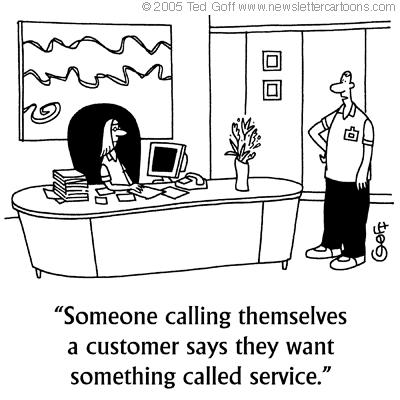
(Courtesy: Ted Goff/newslettercartoons.com)

Andy Macke, Comcast’s Vice President of Communications counters, “All they have to do is call 1-800-COMCAST and they will hear the same deals that the same people are getting from those reps going from door to door.”

“Comcast’s attitude in Savannah is see no evil, hear no evil,” says Jeff White, a Comcast customer who has watched the scuffle. “They don’t even admit there is a problem until it runs on the evening news and city council waves 150 complaints they are getting at the camera — the ones Comcast ignored.”

Macke himself told WJCL-TV, which has covered the dispute with Comcast repeatedly, he was “unaware of the extent of the concerns that our Savannah customers had with us.”

Despite promises to make things right, Alderman Thomas says many complaints are still unresolved.

“We were told that all of those folks had been contacted and that their problems were being worked on. I have since found a few of these people [who] have had no contact whatsoever with Comcast,” Thomas told the TV station.

“Under no circumstances should City Council let the situation with Comcast get pushed under the rug,” one person wrote in the Vox Populi column in the Savannah Morning News. “We the people need help!”

No Help On the Way

Unfortunately for that reader, and other Savannah residents, an attempt by Savannah city officials to attract competing cable service has met with no success and no interest.  Cable operators almost never compete head to head, each respecting the service areas of fellow providers.  Hargray’s interest in Savannah is primarily serving business customers, and the option for municipal service may not be possible much longer if a bill supported by Comcast, SB 313, ever becomes law.

[flv width=”640″ height=”500″]http://www.phillipdampier.com/video/Comcast in Savannah 2-8-12.flv[/flv]

A compilation of news reports from WJCL, WSAV, and WTOC exploring Comcast’s performance problems in the city of Savannah, Georgia.  (15 minutes)
Want to Lure New Digital Economy Businesses to Your Community? You Need 100Mbps Broadband

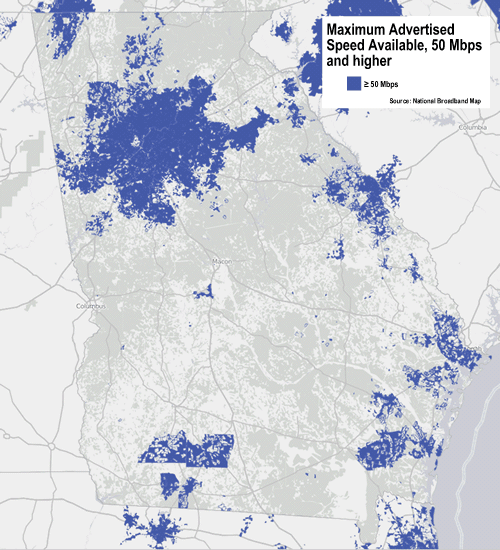
Georgia's broadband map shows just a smattering of 50Mbps broadband. That is half the speed required to attract new businesses, says the IEDC.

Suffering the Great Recession blues?  As communities continue to face the loss of manufacturing, heavy industry, and textile jobs to overseas outsourcing, local economic development specialists have discovered one of the most effective ways to lure new high-tech industry into areas hard-hit with job losses is the availability of cheap, plentiful, and fast broadband.

A survey of economic development officials from around the nation, sponsored by the  International Economic Development Council, showed 77% believe 100Mbps is the minimum speed needed to attract new businesses.  Almost half think even that is no longer fast enough:
  • 42% believe that that 1Gbps is the minimum speed needed to lure new businesses.
  • 35% believe the minimum must be at least 100Mbps.
  • Rural economic developers appear to be well ahead their urban counterparts in the area of planning. 58% of rural respondents either have broadband strategies and tactics worked into their economic development plans or are writing plans with these elements. Only 39% of urban respondents have done the same.
  • 92% see no benefit from the FCC’s minimum broadband standard of 4Mbps, defined largely to suit telephone company DSL service common in rural areas.

Why are rural economies benefiting from better broadband planning? Because in the absence of commercial providers willing to provide the service, an increasing number of small towns and cities are building their own municipal networks to get the job done themselves.  Those networks are routinely superior to the facilities provided by most cable and phone companies serving less populated areas.

Community broadband is working in Wilson and Salisbury, N.C., where a transition from a textile/tobacco-based economy into higher-tech knowledge economy jobs required state-of-the-art broadband as a foundation.  Chattanooga, Tenn.-based EPB Fiber has already attracted dot.com giants like Amazon.com, creating hundreds of millions in local investment and thousands of new jobs.  Why Chattanooga?  Gigabit broadband for just a few hundred dollars a month is just one phone call away.

Relying on commercial providers to build 21st century broadband as a platform for economic transformation has delivered uneven results, especially outside of the largest cities. Large cities traditionally get most of the provider’s time, attention, and upgrades.  Smaller, more out of the way places often see little or nothing.

That is why this year’s latest push in Georgia and South Carolina to tie the hands of communities trying to remake themselves with modern broadband is so risky. While AT&T and the cable companies may position their argument as “protecting consumers,” in fact they are only protecting their own interests, even if it means the next Amazon.com distribution facility or Google data center finds a better home somewhere else.

Updated 3:55pm ET: We added a link to the full report, with appreciation to the author.

How Much Do You Love Time Warner Cable’s New TWC TV iPhone/iPad App?

Phillip Dampier February 8, 2012 Consumer News, Online Video 9 Comments

Time Warner Cable’s new TV App for Apple’s iPhone and certain iOS 4.3-capable iPods has arrived with streaming live cable television for authenticated Time Warner Cable subscribers with a cable-TV and broadband account.

Features on TWC TV™ include:

  • Interactive program guide (IPG) – up to 7 days of listings. View detailed show descriptions including box art. Option to display “HD only” or “favorites only” by creating a favorite channel list.
  • Search – search for programming by title or episode name and filter results by genre
  • Set-top box tuning – tap on a network logo or “watch on TV” button within the program description to tune compatible set-top boxes directly to the channel
  • DVR management – schedule one-time and series recordings on compatible DVRs directly from the interactive program guide. Tap on the “DVR” button to see a list of all upcoming recordings and make changes or cancel recordings
  • Live video streaming of many cable networks

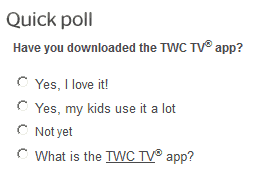
Time Warner wants customers to be so excited, it included a customer poll in its latest newsletter e-mailed to customers, with one notable possible impression left completely off the menu:

You just gotta love it: Time Warner's especially-enthusiastic customer poll can't imagine a possibility that customers might not love their latest app.

Customers who could not find a button to express concerns about the problems they’re experiencing with the app took to the company’s blog instead.  Among the issues raised by subscribers:

  • The app does not work on older generation Apple devices that do not support at least iOS v4.3;
  • Local channels and certain cable networks are not available for streaming;
  • Customers are limited to in-home viewing only;
  • The app does not work on jailbroken devices;
  • Certain Time Warner-provided set top boxes are reportedly not compatible with TWC TV, a problem that usually manifests as no access to the interactive program guide or DVR settings.

The app is available at no charge from the iTunes or Android store.  Android device owners can expect a live streaming-capable version of TWC TV in the near future.

Boxee Goes On Offensive Against Basic Cable Encryption: What a Waste of Money and Energy

Phillip Dampier February 8, 2012 Consumer News, Online Video, Public Policy & Gov't 1 Comment

Boxee, the manufacturer of an Internet-enabled tuner that works like a set top box, has launched an attack against a cable industry plan to encrypt basic cable channels, calling it costly to consumers and the environment:

Amidst flat and declining cable TV subscription numbers, Cable companies are lobbying the FCC to force every cable subscriber to rent cable boxes or cable cards even if they don’t want or need them now.

Currently cable companies must deliver broadcast channels in a way that enables tuners like Boxee Live TV (and the ones in your TV) to display those channels without any extra hardware.

Now the cable companies are asking the FCC to change the rules and turn access off. Their main excuse being that it will reduce the need for the cable guy to drive to your house to disconnect your cable and thus be better for the environment. Considering this ruling would also mean millions more set top boxes and cable cards are manufactured, distributed, and attached to electric outlets (see below for consumption), their argument doesn’t hold water. It’s akin to a cable executive taking a private jet to an FCC meeting, but insisting on having recycled toilet paper on-board to help save the environment.

Boxee

Boxee and other consumer groups oppose the industry’s encryption plan because they say it would deliver no tangible benefits to consumers — just higher cable bills for new equipment that rents for $5-15 a month for each box.  It will also render third-party devices like Boxee, Slingbox, and TiVo almost useless for watching cable television.

Boxee claims cable companies like Time Warner Cable could earn hundreds of millions in new revenue leasing an estimated 10-21 million additional set top boxes to their customers nationwide — more than double the existing number.  Boxee also believes the cable industry is effectively trying stop QAM reception — watching digital cable channels over a television equipped with a basic tuner without a set top box.

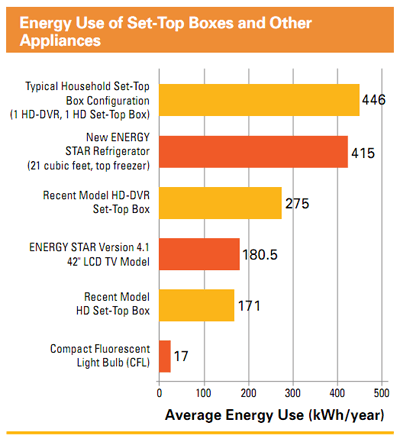
Consumers faced with a choice between a cable company-owned set top box or an independent third-party tuner like Boxee may find few reasons to consider the latter when it also requires the former to work properly. The additional equipment also represents an increase in energy consumption.  Set top box electricity consumption can rival major home appliances, Boxee says.

AT&T U-verse Expansion: It’s Over; AT&T’s Rural Broadband Solution? “We Don’t Have One”

Phillip Dampier February 8, 2012 AT&T, Community Networks, Consumer News, Rural Broadband 21 Comments

AT&T’s vision for 21st century broadband will not extend beyond the 30 million homes that can or will soon be able to access the company’s fiber-to-the-neighborhood service U-verse.

Speaking on an investor’s conference call to discuss 4th quarter earnings results, AT&T CEO Randall Stephenson announced the expansion of its fiber to the neighborhood service is now effectively over.

“Our U-verse build is now largely complete, so we have in place an IP video and broadband platform that reaches 30 million customer locations, which gives us significant headroom now to drive penetration,” Stephenson said.

In practical terms, Stephenson’s announcement means AT&T will continue work on building its U-verse platform in cities where the service is already available, but other areas are unlikely to see an introduction to the service anytime soon.  AT&T President John Stark originally envisioned U-verse for 30 million homes and that vision remains unchanged today.

AT&T’s news for its rural customers is worse.  The company admits it has run out of ideas how to provide rural broadband to its landline customers.

“We have been apprehensive on moving, doing anything on rural access lines because the issue here is, do you have a broadband product for rural America?,” Stephenson said. “And we’ve all been trying to find a broadband solution that was economically viable to get out to rural America and we’re not finding one to be quite candid.”

If you can buy it at any price

Stephenson was hoping LTE 4G wireless service could provide a rural broadband solution, a central theme in AT&T’s lobbying campaign for a buyout of T-Mobile, since abandoned.

“That having been set aside, now we’re looking at rural America and asking, what’s the broadband solution? We don’t have one right now,” Stephenson said.

Stephenson earlier told a July meeting of the National Association of Regulatory Utility Commissioners that DSL, the most common form of broadband in rural America, was “obsolete.”

The two announcements immediately raised questions in South Carolina and Georgia where AT&T and other telecommunications companies are fiercely lobbying for restrictions on community-owned broadband.

Broadband advocates in both states are wondering why the company is spending money trying to stop other broadband projects while not spending on building better broadband service in those areas themselves.

Search This Site:

Contributions:

Recent Comments:

Your Account:

Stop the Cap!