Home » Issues » Recent Articles:

Updated: Time Warner Cable Launches Desktop Streaming Cable TV for ‘Authenticated’ Subscribers

Phillip Dampier February 14, 2012 Consumer News, Online Video 9 Comments

TWC TV for PC (and Mac too!)

Time Warner Cable this morning introduced a “beta version” of Time Warner Cable TV for PC, the latest iteration of the company’s “TV Everywhere” project.

TWC TV requires a current cable television subscription, a Time Warner Cable My Services registration, and a home computer with a current version of Silverlight (if you do not have it, it will likely prompt you to download it).  You do not have to use Time Warner Cable broadband to access the service.

In addition to streaming live TV to the desktop, you can manage DVR listings and remotely change channels on your set top box — the ultimate in laziness if you’ve misplaced the remote control.

We’ve been testing the service here at Stop the Cap! headquarters this afternoon, and so far the service works as described with few glitches.  The channel lineup is similar to the company’s streaming service for Apple’s iPad.  Missing are local channels and cable networks with whom Time Warner has yet to secure streaming agreements.

Video quality could stand some improvement, however.  Netflix and Hulu appear to use higher bit rates than Time Warner is using during its beta test.

Here’s the full list of features:

  1. Live TV – Users scroll the “channel browser” to see a list of available channels with listings displaying network logo, show name, and episode name.
  2. Guide – Up to 7 days of listings data. Option to filter guide display by “favorites only,” “HD only” or ”available to watch on PC.” You can also set channels as favorites from the Guide.
  3. Set-top box tuning – “Watch on TV” button within the program description to tune an MDN/ODN set-top box directly to the channel.
  4. PC tuning – “Watch on PC” button within the program description to tune PC directly to the channel.
  5. DVR management – Schedule one-time and series recordings on MDN/ODN DVRs directly from the Guide’s show pages. Click on the “DVR” tab to see a list of all upcoming recordings and make changes or cancel recordings.
  6. Search – Ability to search the Guide by show title, episode and/or by person.
  7. Settings – Ability to manage Favorite channels, link to set Parental Controls, choose the Device (STB/DVR) to which you are connected for STB/DVR management, and turn on/off Closed Captioning on the website’s video player.

This will work for both PC and Mac. Here are the supported browsers:

  • Internet Explorer 7.0 and up
  • Firefox 4 and up for mac and windows
  • Safari 5 and up for mac and windows
  • Chrome: Latest stable release which is 17

You’ll need to download or possibly upgrade Silverlight to version 4.

(Customers with iGuide set-top boxes and analog video customers cannot tune their TVs using the TWC TV apps or website. Analog customers and those with iGuide and SARA boxes won’t have access to the TV tuning or DVR features, but are offered a basic program guide based on the zip code on their accounts.)

[Updated 9:09am 2/15/12 — Thanks to our readers, we now know “you have to be connected to a Time Warner Cable network connection, with a modem on your account to connect to live TV.”  We stand corrected.]

Comcast Wraps Up ‘Town Hall’ Meetings in Savannah Over Hundreds of Customer Complaints

Phillip Dampier February 14, 2012 Comcast/Xfinity, Consumer News, HissyFitWatch, Public Policy & Gov't, Video Comments Off on Comcast Wraps Up ‘Town Hall’ Meetings in Savannah Over Hundreds of Customer Complaints

[flv width=”640″ height=”380″]http://www.phillipdampier.com/video/WSAV Savannah Final Meeting With Comcast 2-9-12.flv[/flv]

Comcast has concluded the last of four public meetings to address consumer complaints with the quality of the cable company’s products and customer service in Savannah, Ga.

Dozens of customers filled Armstrong Center to complain about billing, hold times, and service issues. Comcast technicians were on hand and literally followed some customers home to address long-standing problems on the spot.

The public meetings came at the urging of Savannah city officials who have received hundreds of complaints about Comcast’s poor performance in the Georgia city. 

“We are committed to continuously improving the services that we offer and the way we deliver the service, said Andrew Macke, vice president of government and community affairs. “There’s ongoing efforts to improve that, but certainly as we value our relationship with the city, we’ll continue to work with them to highlight some of the things that we’re doing but also address some of the common themes.”  (2 minutes)


Comcast’s Discount ‘Internet Essentials’ Off Limits Because of One Late Bill 10 Years Ago

Phillip Dampier February 14, 2012 Comcast/Xfinity, Consumer News, Public Policy & Gov't 3 Comments

A Philadelphia community group is accusing Comcast of keeping its low-income budget Internet program a secret and denying needy families access for the flimsiest excuses.

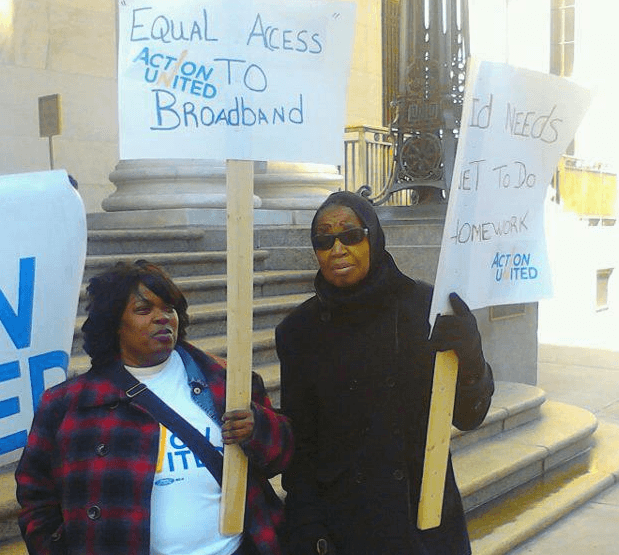
Action United, which fights for low and moderate income Pennsylvanians, dropped off complaints with federal officials in Philadelphia from residents who are upset because they never heard of the discounted Internet access program or were disqualified from applying.

Comcast’s Internet Essentials offers families who qualify for the federal student lunch program access to 1.5Mbps broadband for around $9.95 a month.  But an informal survey by the group found scores of residents who never heard of the program and would have applied if they had known it existed.

The group, which says it has 44,000 members in Philadelphia, Pittsburgh, Harrisburg and Allentown, says it could find only two families among its members that actually qualified to sign up for the service.  Some were disqualified because they didn’t participate in the school lunch program, others because they already have Internet service or had a long-forgotten past due bill.


“I feel as though the Internet service will help my son to progress in math, reading, spelling,” Dawn from North Philadelphia told CBS Philadelphia. But she says Comcast refused to sign her up.

“They told me I had a back bill from 10 years ago, so I was not qualified,” Dawn said.

As Stop the Cap! reported in September, Comcast’s program is effectively designed to reap positive publicity for the cable company while discouraging customers from applying and actually obtaining the service.

Action United protests the digital divide in downtown Philadelphia. (Courtesy: Action United)

Action United says area schools, an obvious place to promote low cost Internet for students, knew nothing about the program.

Comcast counters it sent mailings about Internet Essentials to 4,000 school districts, which covers 30,000 schools.

The group originally planned to protest Wednesday in front of Comcast’s corporate headquarters in Philadelphia to draw attention to the problem.  Earlier today, Action United announced it had reached an agreement to meet with Comcast executives to discuss the program and help cut some of the red tape for families experiencing trouble applying.

Comcast’s decision to offer budget Internet service came as a result of negotiations with the federal government to approve its merger with NBC-Universal. Critics contend Internet Essentials is too restrictive and requires applicants to navigate through a cumbersome qualification process.  After approval, the program only provides discounted service for a period of three years and can be terminated if a family falls past due on their account.

From the byzantine terms and conditions for enrollment in the Comcast Internet Essentials program:

The program is only available to households that (i) are located where Comcast offers Internet service; (ii) have at least one child who receives free school lunches through the National School Lunch Program (the “NSLP”) and as confirmed annually while enrolled in the program; (iii) do not have an overdue Comcast bill or unreturned equipment; and (iv) have not subscribed to any Comcast Internet service within the last ninety (90) days (sections 1(i)-(iv) collectively are defined as “Eligibility Criteria”). This program is not available to households that have children who receive reduced price lunches under the NSLP. The program will accept new customers for three (3) full school years, unless extended at the sole election of Comcast. Comcast reserves the right to establish enrollment periods at the beginning of each academic year in which it accepts new customers that may limit the period of time each year in which you have to enroll in the program.

2. In order to confirm your eligibility for the program, Comcast will need to verify that your children receive free school lunches through the NSLP in the initial enrollment year and each subsequent year you are enrolled in the program. In order to confirm eligibility, participants in the program will be required to provide copies of official documents establishing that a child in the household is currently receive free school lunches through the NSLP. Each year you will be required to reconfirm your household’s current eligibility by providing Comcast or its authorized agent with up-to-date documentation. If you fail to provide documentation proving your eligibility in the program, you will be deemed no longer eligible to participate in the program.

3. You will no longer be eligible to participate in the program if (i) you no longer have at least one child living in your household who receives free school lunches under the NSLP; (ii) you fail to maintain your Comcast account in good standing; (iii) Comcast ceases to provide the Covered Service to your location; or (iv) your account opened under the program is closed. A change in address may result in your account being closed, even if you continue to receive Comcast services at a different address. Program participation also may be terminated if the Covered Service is upgraded, altered or changed by you for any reason. If you are no longer eligible for the program, but continue to receive the Covered Service from Comcast, regular rates, and any other applicable terms and conditions will apply to the Covered Service.

Time Warner Cable Support to Customer: “What Did You Do That Was Wrong?”

Phillip Dampier February 14, 2012 Competition, Consumer News, Video 4 Comments

Time Warner Cable dropped the ball… right on the heads of temporary customers Alice and Dan Beissel, who signed up for service and canceled just ten days later.

The Corpus Christi, Texas couple decided to cancel service from AT&T and give the cable company a try and, according to them, it was trouble right from the start.

The Beissels say the cable service never worked right, with picture outages and other equipment troubles that came and went.  Frustrations mounted when a service call found nothing wrong, until the Time Warner truck pulled out of the driveway and the picture again went blank.

But the final straw was a conversation Dan Beissel had with the company’s customer service support center.

“What did you do that was wrong,” the representative asked Beissel.

Beissel must have thought the answer was ‘signing up for cable service,’ because the family decided to cancel after that call ended.

Now the couple has been forced to turn to KZTV’s Troubleshooter consumer reporter in an effort to collect an overdue refund check for their service.  The station ran into the same kind of frustration the Beissel family did:

We’ve made several calls to Time Warner Cable in an attempt to speak with anyone who can help the couple.

Unfortunately, there is no customer service contact in Corpus Christi.

Time Warner Cable says refund checks are normally processed within four weeks and mailed from a California office.  A local employee working for the cable company in the Corpus Christi area said he would look into the missing refund check.


KZTV in Corpus Christi is helping one family find a missing refund check owed to them by Time Warner Cable.  (2 minutes)

AT&T’s 2GB Speed Trap: “I’m Almost Scared to Use the Phone,” Says Frustrated Customer

An increasing number of wireless data users are getting some tough love courtesy of AT&T.

“Your data use this month places you in the top 5% of users,” the text message reads. “Use Wi-Fi to avoid reduced speeds.”  Our regular reader Earl hopes we’ll keep spreading the word.

AT&T’s speed throttle has now moved beyond the pages of tech blogs and into USA Today, where the newspaper explores the trials and tribulations of wireless data management policies at the nation’s largest wireless companies.

Mike Trang, along with at least 200,000 other AT&T customers, has been caught in AT&T’s wireless speed trap.  The result can be speeds punitively reduced to dial-up for the remainder of a billing cycle, leaving customers on AT&T’s “unlimited use” plan waiting up to two minutes for a single web page to load.

While AT&T tells the newspaper it only throttles the speeds of unlimited customers who use an average of 2GB or more per month to ease congestion (if that), the company’s “congestion problems” seem to disappear when customers switch to a usage-billing plan that charges fees based on different usage allowances:

Trang’s iPhone was throttled just two weeks into his billing cycle, after he’d consumed 2.3 gigabytes of data. He pays $30 per month for “unlimited” data. Meanwhile, Dallas-based AT&T now sells a limited, or “tiered,” plan that provides 3 gigabytes of data for the same price.

Users report that if they call the company to ask or complain about the throttling, AT&T customer support representatives suggest they switch to the limited plan.

“They’re coaxing you toward the tiered plan,” said Gregory Tallman in Hopatcong, N.J. He hasn’t had his iPhone 4S throttled yet, but he’s gotten text-messages from AT&T, warning that he’s approaching the limit. This came after he had used just 1.5 gigabytes of data in that billing cycle.

Many customers who have received the text message warning about their usage now think twice about everything they do with their phone, which may be part of what AT&T intended for its remaining customers grandfathered on a now-discontinued unlimited use plan.

John Cozen, a Web and mobile applications designer in San Diego, told USA Today he’s now “almost scared to use the phone.”

Cozen’s complaints to AT&T have been ignored and now he’s shopping for a new carrier.

AT&T’s warning-and-throttle system is the strictest among America’s largest wireless carriers. When customers exceed AT&T’s arbitrary declaration of being among the “top 5% of users,” their speeds are subject to severe slowdowns until their next bill is issued. This leaves customers who may have needed their phone at the beginning of the month for a business trip or vacation suddenly throttled for weeks because of what AT&T calls “congestion,” even if nobody else is using the cell tower.  Even worse, customers not yet deemed to be offending AT&Ts usage manners, or who pay per gigabyte, can overload a cell tower and create the very congestion AT&T claims it hopes to manage.  But only “unlimited use” customers get “time out” in the usage penalty corner.

Among other carriers:

  • Verizon Wireless also uses a network management system that can throttle speeds for exceptionally heavy users, but their speed throttle is engaged only when individual cell towers are overloaded with traffic, and the speed reduction level will vary with the amount of traffic on that tower.  When congestion eases, speeds return to normal for everyone;
  • T-Mobile throttles customers after a maximum of 5GB of usage per month, unless other arrangements are made with the company;
  • Sprint Nextel does not have usage limits or a throttle on smartphone data plans at this time.

Search This Site:

Contributions:

Recent Comments:

Your Account:

Stop the Cap!