Home » Issues » Recent Articles:

Heartland Institute Astroturf Group Threatens to Take Legal Action Against Bloggers, Activists

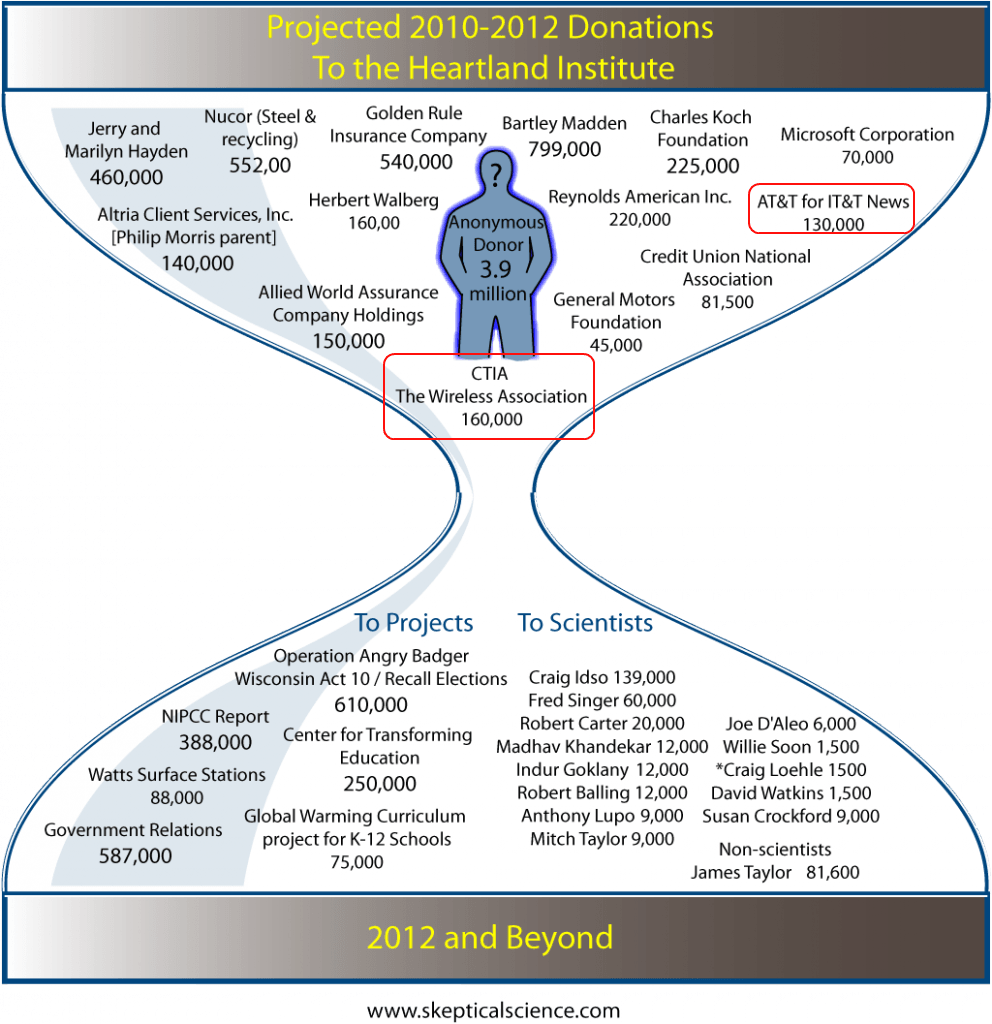
Skeptical Science produced this infographic of the Heartland Institute’s funding sources and where the money goes.

The Heartland Institute, a corporate-backed astroturf operation that has steadfastly supported cable and phone companies against the interests of consumers, has threatened legal action against activists, bloggers, and other journalists who published stories about recently-acquired documents connecting the group with major corporate donors.

Among telecommunications companies, both AT&T and Time Warner Cable show up in the alleged donor documents, which Heartland officials claim were obtained under false pretenses and, in some cases, were altered or forged.

Jim Lakely, communications director for the group, was unhappy:

We respectfully ask all activists, bloggers, and other journalists to immediately remove all of these documents and any quotations taken from them, especially the fake “climate strategy” memo and any quotations from the same, from their blogs, Web sites, and publications, and to publish retractions.

The individuals who have commented so far on these documents did not wait for Heartland to confirm or deny the authenticity of the documents. We believe their actions constitute civil and possibly criminal offenses for which we plan to pursue charges and collect payment for damages, including damages to our reputation. We ask them in particular to immediately remove these documents and all statements about them from the blogs, Web sites, and publications, and to publish retractions.

The fact the group implies it will take legal action against those who published stories not to the group’s liking will only draw added attention to the scandal.  Stop the Cap! has tangled with this group several times over the years whenever AT&T and Time Warner Cable’s corporate agendas are being challenged.

The group has steadfastly refused to release their donor lists, at one point telling us, “by not disclosing our donors, we keep the focus on the issue.”

Not really.  That’s because the first rule of politics is to “follow the money.”  Most of these groups do not sing their songs for free, and knowing who paid the songwriter can be very revealing.

The Associated Press found no evidence Heartland’s budget or fundraising documents leaked to the media were faked or altered:

Because Heartland was not specific about what was fake and what was real, The Associated Press attempted to verify independently key parts of separate budget and fundraising documents that were leaked. The federal consultant working on the classroom curriculum, the former TV weatherman, a Chicago elected official who campaigns against hidden local debt and two corporate donors all confirmed to the AP that the sections in the document that pertained to them were accurate. No one the AP contacted said the budget or fundraising documents mentioning them were incorrect.

Heartland can best salvage its reputation and put this behind them by releasing the names of their largest donors, letting consumers decide whether this organization truly represents their interests, or those of the corporations writing the big checks.  In addition to corporate contributions, Heartland’s operations rely on a single person identified only as “Anonymous Donor.” In the past six years, the man has given $14.26 million to the institute, nearly half its $33.9 million in revenue, according to the AP.

Grassroots this is not.

4 Tips to Find the Cheapest Deals for Internet Access

CenturyLink runs specials on their website that offer extra savings when ordered online.

Your $50 monthly broadband bill has been burning a hole in your wallet and you think there should be a cheaper price available somewhere, right?

The answer is, for most of us, there is.  You just have to look.

The most expensive Internet access around comes when you buy broadband-only service from a provider.  Both cable and phone companies have been incrementally punishing their “broadband-only” customers for years, tacking on $5, $10, even $15 to the price because you have chosen not to bundle broadband with other services the company sells.  It is not unusual to see some cable companies charging $55-60 for standard Internet service.  When you call to inquire, they are sure to begin aggressively upselling you to a bundled service package, arguing you can add cable TV and phone service for $20-30 more a month.  That sounds like a better deal, unless you honestly don’t care about either service.

Welcome to the world of marketing, where the “value perception” is key to driving the average revenue collected from each subscriber higher and higher.  You end up buying services you probably would not have considered, but because they seem so inexpensive when compared with the price of the service you are interested in, why not?

Phone companies do the same thing, but many of them also love to bury hidden charges in the fine print and commit you to 1-3 years of service to guarantee the advertised price.  Companies like Frontier Communications may pitch DSL service for just $15 a month, but keep reading and you will discover the taxes and fees raise that price substantially.  In fact, that particular phone company is notorious for charging substantial modem rental fees and what they call a “High Speed Internet” surcharge.  To get the lowest price from them, you will be a Frontier customer for at least a year, depending on the promotional offer selected.

Frontier redefines "value": This attractive looking offer "fine prints" the $6.30 modem rental fee, is for service "up to" 1Mbps (so much for "high speed"), has a one-year service commitment with a $50 early termination fee, and does not include unspecified "taxes and surcharges" which run extra.

You can break free of the marketing circus by concentrating on finding the best possible deal for the service(s) you really care about.

  1. Check advertising offers on television and in newspapers, but always read the fine print;
  2. Visit the website of each local provider and look for “Internet-only” offers that may deliver extra savings, but only when you order online;
  3. Call providers and ask them about their various deals and inquire “is this the best offer you have right now?;”
  4. Use search engines and type in your provider’s name and words like “deals,” “offers,” or “promotion.”  Third party authorized resellers may have an offer that works better for you.

Sometimes you can get excellent results playing providers off each other.  Try contacting the social media representatives of different providers in your area to unlock hidden deals, and more importantly, customer retention offers.  One Rochester reader of ours got Time Warner Cable to open negotiations to keep his business with this tweet:

Getting ready to schedule my @TWCable disconnect after rate increase – should I go with @dishnetwork over @DirecTV or vice versa?

He received a substantial retention offer within hours of alerting Time Warner of his discontent (he’s also a rabid hockey fan, and the ongoing MSG-Time Warner Cable dispute made satellite an attractive alternative.)

[flv width=”360″ height=”290″]http://www.phillipdampier.com/video/KNXV Phoenix Which broadband provider saves you the most money 2-7-12.mp4[/flv]

KNXV in Phoenix helped residents in that Arizona city figure out who was cheaper, CenturyLink or Cox Cable.  And what about using mobile broadband for a home broadband replacement?  (3 minutes)

Isn’t It Time to Consider a Rural Broadband Administration? Co-Op Internet for America

This influential documentary explores the rural cooperative movement for electricity in the 1930s.

In 1935, just 5-10 percent of America’s family farms were wired for electricity.  The cities: lighted.  The rest of the country: in the dark.  It was the same old story then as it is today for rural broadband:

  • There are two few customers for us to make a profit by bringing you service;
  • The return on investment will take too long;
  • You won’t use enough service to justify the expense of providing it;
  • Okay, we’ll install service, if you pay thousands of dollars to cover the cost to bring it you.

Private providers delivered electricity to big cities, but found the countryside not worthy of their time or investment.  Then, as now, rural America’s economy suffered for it.  Back in 1935, family farms coped with wood-fired stoves, school homework by kerosene lamp, discarding fresh farm products that could not be kept cool, no running water, no radio, and no appliances to make an already difficult life a bit easier to manage.  In 2012, an increasing amount of the rural economy is moving online, where raw materials and goods are bought and sold, where knowledge-based jobs require a dedicated broadband connection, and education means completing homework assignments and doing research on the Internet.

Same old problems cast in a different light to be sure, but borrowing from America’s past may put a down payment on our broadband future.

President Franklin D. Roosevelt had heard all of the excuses and seen private electric companies try to showcase their minor efforts to improve power in rural America. A series of small scale projects that looked good in the newspaper could not hide the more general attitude it was unprofitable to provide the service to family farms.  In 1935, Roosevelt signed an executive order establishing the Rural Electrification Administration (REA).  Although FDR’s contemporary critics like to consider him a socialist that interfered in the private economy, in fact Roosevelt’s REA spent the majority of its effort in areas commercial providers wouldn’t touch with a 25-foot power pole.

The idea was simple.  Rural American communities with limited or no electric service could reach out to the REA to obtain low interest loans to finance the infrastructure to construct rural electric service.  When loans were approved, a cooperative electric company was established, with each “customer” being a member and part-owner of the co-op.  Income earned from ratepayers would pay for the service and pay back the government loans.  When the federal government was paid in full, the cooperative owned the new utility company outright.

In practice, this was the only way rural Americans, especially farmers, could obtain electric service.  These cooperatives often found they could deliver the same service a private company could, and for much less money. Co-ops work for the benefit of their members, not for outside investors.

[flv width=”640″ height=”500″]http://www.phillipdampier.com/video/Power and the Land.flv[/flv]

In 1940, the federal government commissioned ‘Power and the Land’ through the United States Film Service.  This one film, showing life for a farm family in southeastern Ohio before and after electrification, helped drive the rural electrification movement forward in areas yet to be wired for service.  The first 17 minutes chronicles life on the powerless farm, while the second half explores the REA electrification program and the changes electricity brought to farming life. (38 minutes)

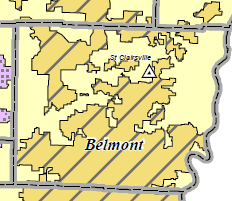
Belmont County, Ohio shows the legacy of the REA. Diagonal line-shaded sections illustrate the service areas of the original power co-op noted in the film 'Power and the Land.' The yellow shaded areas are served by Ohio Power, a subsidiary of American Electric Power, Inc., a commercial company.

The film’s impact was profound (the Village Voice called it “a little masterpiece”), and more than four million farmers were estimated to have seen it.  Eventually, more than 500 miles of electric lines were being strung by America’s co-ops every single day.  Additional documentaries about the film were made decades later, narrated by Walter Cronkite, to chronicle the cooperative electricity movement, the original film, and what happened to the family.

Private providers were, of course, horrified by the REA and other Roosevelt Administration public works projects.  Private companies railed they were being undermined by low interest government loans, government involvement, and fear new regulations would threaten their profitable business models.  Some of Roosevelt’s fiercest critics called the administration’s zeal for public-good spending anti-capitalist and anti-American.  For Roosevelt, it was often simply a matter of finding the fastest solution to a pervasive problem private companies seemed uninterested and unwilling to solve.

The legacy of the REA remains plainly visible today.  In Ohio, what started as the Belmont Power Cooperative is today part of the South Central Power Company, itself a co-op within the Touchstone Energy Cooperative.  Belmont County, Ohio’s power grid still reflects the work of the REA in the 1930s, with the county divided into regions served by the original REA co-op and Ohio Power.

While South Central Power hasn’t gotten into the broadband business, several other rural co-ops have, expanding their focus towards fiber to deliver cable TV, Internet, and phone service.

If the concept of the REA was adopted for broadband, the formula for success can remain the same.  Low interest loans to finance fiber telecommunications networks provide limitless expansion possibilities and a clear path to solving rural America’s broadband inferiority problem.  Interest rates have never been lower, and by gradually repaying the loans from income earned from subscribers, taxpayer dollars are not at risk.  The federal government’s only real involvement in guaranteeing loans and providing oversight that the money is spent appropriately.  The co-ops that result will govern themselves by and for their members.

Some will say electricity is more important than broadband, and for some families that may be as true as similar arguments were for and against REA electricity in the 1920s and 30s.  But take a week off from your broadband service.  Disconnect it, don’t read e-mail or visit websites, and then re-evaluate that statement.

More and more, broadband has become a firmly established part of our lives at work, school, and home. If private companies won’t step up, let others organize to provide it.

[flv width=”640″ height=”380″]http://www.phillipdampier.com/video/North Carolina Farmers Utilizing the Internet America’s Heartland.flv[/flv]

Fast forward to December 2011, and watch how rural Rutherford County, N.C. farmers are adapting to the new digital economy with the use of broadband.  They are selling their crops online to eager restaurants, markets, and other buyers up to 70 miles away.  No broadband?  No deal.  (5 minutes)

Bloomberg News: The Case for Publicly Owned Internet Service

Phillip "Break Free from 'What's In It For Me'-AT&T" Dampier

[We are reprinting this because it succinctly and persuasively proves a point we’ve been making at Stop the Cap! since 2008.  Broadband is not just a “nice thing to have.” It is as important as a phone line, electricity, and safe drinking water.  News, education, commerce, and culture increasingly utilize the Internet to share information and entertain us. Essential utility services can either be provided by a private company operating as a monopoly with oversight and regulation, or operate strictly in the public interest in the form of a customer-owned cooperative, a direct service of local government, or a quasi-public independent non-profit.

In North America, broadband was originally considered a non-essential service, and private providers in the United States lobbied heavily to maintain absolute control of their broadband networks, free to open them to share with other providers, or not.  They also won sweeping deregulation and are still fighting today for decreased oversight.  The results have been uneven service.  Large, compact cities enjoy modern and fast broadband while smaller communities are forced to live with a fraction of the speeds offered elsewhere, if they have access to the service at all.

With broadband now deemed “essential,” local governments have increasingly sought to end the same old excuses with the “don’t care”-cable company or “what’s in it for me”-AT&T and provide 21st century service themselves, especially where local commercial providers simply won’t step up to the plate at all.  Suddenly, big cable and phone companies are more possessive than your last boy/girlfriend. The companies that for years couldn’t care less about your broadband needs suddenly obsess when someone else moves in on “their territory.” They want special laws (that apply only to the competition) to make sure your broadband future lies exclusively in their hands.

Susan P. Crawford understand how this dysfunctional, controlling relationship comes at the expense of rural America.  She’s a visiting professor at the Harvard Kennedy School of Government and Harvard Law School. In 2009, she was a special assistant to President Barack Obama for science, technology and innovation policy. Her opinions were originally shared with readers of Bloomberg News.]

In cities and towns across the U.S., a familiar story is replaying itself: Powerful companies are preventing local governments from providing an essential service to their citizens. More than 100 years ago, it was electricity. Today, it is the public provision of communications services.
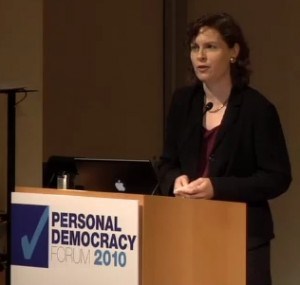
Susan Crawford

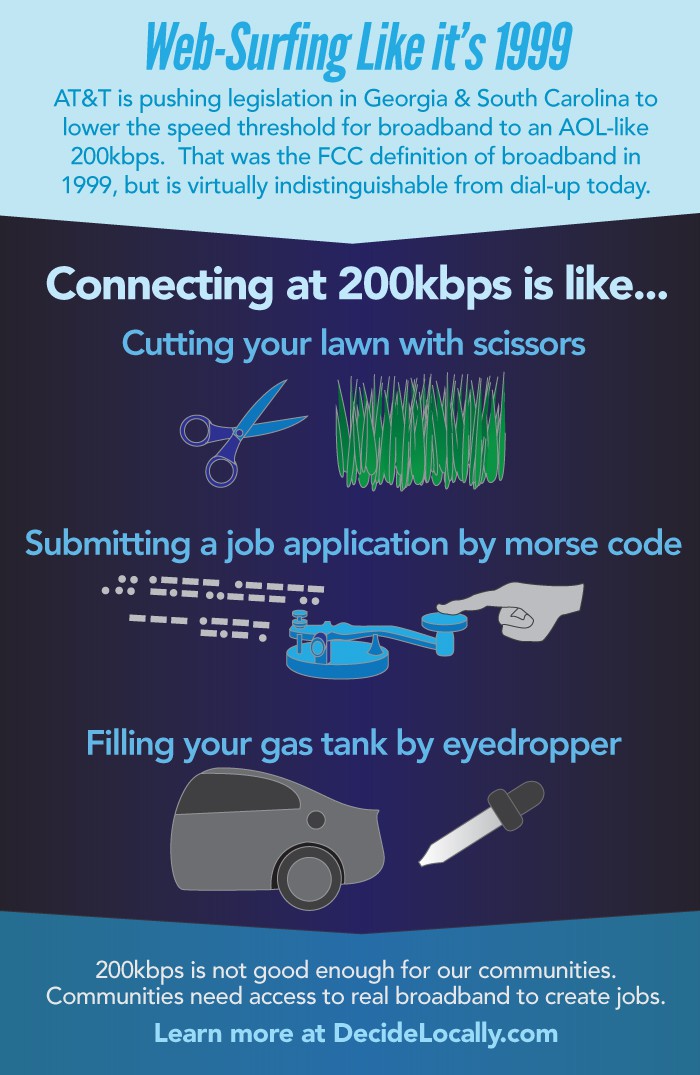
The Georgia legislature is currently considering a bill that would effectively make it impossible for any city in the state to provide for high-speed Internet access networks — even in areas in which the private sector cannot or will not. Nebraska, North Carolina, Louisiana, Arkansas and Tennessee already have similar laws in place. South Carolina is considering one, as is Florida.

Mayors across the U.S. are desperate to attract good jobs and provide residents with educational opportunities, access to affordable health care, and other benefits that depend on affordable, fast connectivity — something that people in other industrialized countries take for granted. But powerful incumbent providers such as AT&T Inc. and Time Warner Cable Inc. are hamstringing municipalities.

At the beginning of the 20th century, private power companies electrified only the most lucrative population centers and ignored most of America, particularly rural America. By the mid-1920s, 15 holding companies controlled 85 percent of the nation’s electricity distribution, and the Federal Trade Commission found that the power trusts routinely gouged consumers.

Costly and Dangerous

In response, and recognizing that cheap, plentiful electricity was essential to economic development and quality of life, thousands of communities formed electric utilities of their own. Predictably, the private utilities claimed that public ownership of electrical utilities was “costly and dangerous” and “always a failure,” according to the November 1906 issue of Moody’s Magazine. Now more than 2,000 communities in the U.S., including Seattle, San Antonio and Los Angeles, provide their own electricity.

Today, the Institute for Local Self-Reliance, which advocates for community broadband initiatives, is tracking more than 60 municipal governments that have built or are building successful fiber networks, just as they created electric systems during the 20th century. In Chattanooga, Tennessee, for example, the city’s publicly owned electric company provides fast, affordable and reliable fiber Internet access. Some businesses based in Knoxville — 100 miles to the northeast — are adding jobs in Chattanooga, where connectivity can cost an eighth as much.

Meanwhile, less than 8 percent of Americans currently receive fiber service to their homes, compared with more than 50 percent of households in South Korea, and almost 40 percent in Japan. Where it’s available, Americans pay five or six times as much for their fiber access as people in other countries do. Fully a third of Americans don’t subscribe to high-speed Internet access at all, and AT&T Chief Executive Officer Randall Stephenson said last month that the company was “trying to find a broadband solution that was economically viable to get out to rural America, and we’re not finding one, to be quite candid.” America is rapidly losing the global race for high-speed connectivity.

Tamping Down Enthusiasm
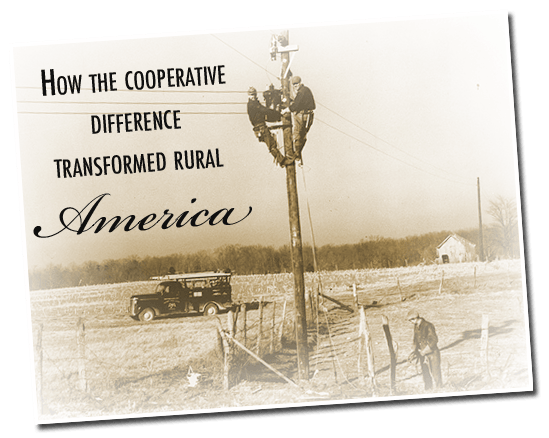
We've done something like this once before.

Like the power trusts of the 20th century, the enormous consolidated providers of wired Internet access want to tamp down any enthusiasm for municipal networks. Last year, telecom lobbyists spent more than $300,000 in a failed effort to block a referendum in Longmont, Colorado, to allow that city to provide Internet access. Time Warner Cable managed to get a North Carolina law enacted last year that makes launching municipal networks there extraordinarily difficult. The pending measures in Georgia and South Carolina are modeled on the North Carolina bill.

The Georgia bill is chock-full of sand traps and areas of deep statutory fog from which no local public network is likely ever to emerge. In addition to the ordinary public hearings that any municipality would hold on the subject, a town looking to build a public network would have to hold a referendum. It wouldn’t be allowed to spend any money in support of its position (there would be no such prohibition on the deep-pocketed incumbents). The community wouldn’t be allowed to support its network with local taxes or surplus revenues from any other services (although incumbents routinely and massively subsidize their networks with revenue from other businesses).

Most pernicious of all, the public operator would have to include in the costs of its service the phantom, imputed “capital costs” and “taxes” of a private provider. This is a fertile area for disputes, litigation and delay, as no one knows what precise costs and taxes are at issue, much less how to calculate these amounts. The public provider would also have to comply with all laws and “requirements” applicable to “the communications service,” if it were made available by “a private provider,” although again the law doesn’t specify which service is involved or which provider is relevant.

The end result of all this vague language will be to make it all but impossible for a city to obtain financing to build its network. Although the proponents of Georgia’s bill claim that they are merely trying to create a level playing field, these are terms and conditions that no new entrant, public or private, can meet — and that the incumbents themselves do not live by. You can almost hear the drafters laughing about how impossible the entire enterprise will be.

Globally Competitive Networks

Right now, state legislatures — where the incumbents wield great power — are keeping towns and cities in the U.S. from making their own choices about their communications networks. Meanwhile, municipalities, cooperatives and small independent companies are practically the only entities building globally competitive networks these days. Both AT&T and Verizon have ceased the expansion of next-generation fiber installations across the U.S., and the cable companies’ services greatly favor downloads over uploads.

Congress needs to intervene. One way it could help is by preempting state laws that erect barriers to the ability of local jurisdictions to provide communications services to their citizens.

Running for president in 1932, Franklin D. Roosevelt emphasized the right of communities to provide their own electricity. “I might call the right of the people to own and operate their own utility a birch rod in the cupboard,” he said, “to be taken out and used only when the child gets beyond the point where more scolding does any good.” It’s time to take out that birch rod.


Search This Site:

Contributions:

Recent Comments:

Your Account:

Stop the Cap!