Home » Issues » Recent Articles:

FreedomPop Threatens to Tear Up Wireless Data Business Model With Free GB of 4G

Phillip Dampier March 29, 2012 Competition, Consumer News, FreedomPop, NetZero, Video, Wireless Broadband Comments Off on FreedomPop Threatens to Tear Up Wireless Data Business Model With Free GB of 4G

“Disruptive” is perhaps too timid a word to use for Skype co-founder Niklas Zennstrom, the man who brought Excedrin-strength headaches to the music industry with file-swapping software Kazaa and streamed video across the net for free with Joost.  Now he wants to blow up America’s business model for expensive wireless data by literally giving it away to wireless phone users.

FreedomPop has a “freemium” business model of its very own — give away 1GB of 4G data through Clearwire to iPhone owners willing to use FreedomPop’s WiMAX-fitted phone case with the hope users will throw more business their way for around $10/GB after the first gigabyte is gone.

Zennstrom

Clearwire has been in the mood to make deals with all-comers to leverage its WiMAX network that carriers like Sprint plan to abandon for LTE 4G service in the not-too-distant future.  By giving away 1GB of free usage (and it remains unclear whether this is a “one-off” deal or if the meter resets to zero every month), the company is set to draw plenty of free press.

FreedomPop is likely to appeal to price-sensitive customers who don’t want to pay providers $30 a month for 2-3GB of usage when a much smaller, cheaper data plan combined with the free service will do.

The WiMAX case, which will fit over Apple’s iPhone, also acts as a mobile hotspot, supporting up to eight concurrently-connected devices.  No change of phone is required as users can connect to the service through Wi-Fi.

Customers will have to place a deposit on the case, likely less than $100, refundable when returned in good condition.

With most people not exceeding 1GB of usage per month, the only cost will be the “bare minimum” data plan customers are required to take with AT&T, Verizon Wireless, or Sprint, which currently runs $15-20 for a few hundred megabytes.

Clearwire’s WiMAX doesn’t deliver coverage to all points in the United States, and its speeds are considerably lower than 4G LTE service.  But free is free – a concept NetZero hopes to use to pitch a similar free 4G Clearwire WiMAX service.  The primary difference is your granted usage allowance.  FreedomPop will provide 1GB — NetZero 200MB.

[flv width=”512″ height=”308″]http://www.phillipdampier.com/video/WSJ How Skype Co-Founder Hopes to Make Money Giving Away Mobile Broadband on FreedomPop 3-23-12.flv[/flv]

The Wall Street Journal explores the business model of FreedomPop.  How can giving away 4G data succeed financially?  (4 minutes)

Frontier Customers’ Long Wait for Slow Broadband

Phillip Dampier March 29, 2012 Editorial & Site News, Frontier, Rural Broadband Comments Off on Frontier Customers’ Long Wait for Slow Broadband

Maybe this explains why Frontier’s customers in West Virginia and beyond are still waiting for the promised DSL service that actually delivers better than 1Mbps speed at peak usage times.  Who knew it had to be this complicated?

Want Better Canadian Broadband? Move West

If you want better Canadian broadband with fewer tricks and traps and live in Ontario or Quebec: put the house up for sale, pack up your things, and head west.

Canada’s heavily metered and capped broadband is ubiquitous in the country’s two most-populated provinces where a convenient duopoly of Bell and Rogers in Ontario and Bell and Videotron in Quebec control the vast majority of the broadband market.  But cross west into Saskatchewan and things start to look a lot better.

Canadians telecommunications consultancy The Seaboard Group praised SaskTel, the provincial phone company, for refusing to slap usage caps on its customers.  SaskTel does not deliver the cheapest Internet access by any means, but the company is investing heavily in fiber optic upgrades to turn the page on aging copper wire infrastructure.  Stringing fiber through Regina, Saskatoon and beyond may seem counterintuitive to other providers.  Saskatchewan, one of Canada’s “prairie provinces,” is hardly packed with people.  With more than 20 million Canadians living in Ontario and Quebec, Saskatchewan gives its 1 million residents a lot of open space.  Sparser populations usually translate into higher costs per customer for upgrades, but SaskTel persists.

SaskTel has historically relied on traditional DSL and has competition in larger communities from Shaw Cable, western Canada’s largest cable operator.  Although SaskTel’s DSL delivers lower speeds than Shaw can provide, it does so with no usage limits.

Shaw’s decision to provide considerably more generous usage allowances has kept the pressure on SaskTel to upgrade its infrastructure to compete.

SaskTel CEO Ron Styles told the Leader-Post its fiber optic network will give cable a run for its money, and until then, it is satisfied undercutting cable pricing for broadband, delivering a far better experience than either Rogers or Bell provides eastern Canadians, Styles says.

Seaboard president Iain Grant found that what customers are willing to pay for service can also influence what prices providers charge.

“The price is more based on what you’re prepared to pay,” Grant said.

People in western Canada evidently are not willing to hand over as much money as their friends in Ontario and Quebec.

West of Saskatchewan lies Alberta and British Columbia — Telus territory.  Telus is western Canada’s largest phone company and also principally competes with Shaw Cable.

Shaw has forced Telus to back down on fueling enhanced revenue with usage caps of its own, and has been aggressively upgrading its network with additional fiber optics and DOCSIS 3 technology, forcing Telus to embark on its own upgrade effort.

Macleans reports western Canada’s more-competitive broadband market has been good for consumers, but has also exposed a difference in priorities for providers.

With Shaw breathing down its neck, Telus has committed to a $3 billion fiber optic network expansion in B.C., improved wireless coverage, and more IPTV service.  Macleans notes Telus is the only major telecom or cable company in Canada that hasn’t purchased a television asset, focusing instead on its core businesses of connecting customers.

In eastern Canada, Bell faces Rogers and Videotron.  Critics contend Bell sees no imminent threats there, and the phone giant is spending its money elsewhere, announcing a $3.4 billion acquisition of Astral Media — an entertainment company owning 24 specialty cable channels and pay-TV networks, including the Movie Network and HBO Canada.

Bell’s latest “investment” follows its 2010 $1.3 billion buyout of CTV and last year’s $1.32 billion co-purchase of Maple Leafs Sports and Entertainment (the other buyer was their ‘arch-competitor’ Rogers Communications).

While Telus spends money on upgrading its broadband and video services to customers, Bell is positioning itself to control 34% of Canada’s TV universe.  Bell is also the same company that advocated slapping nationwide usage-based pricing on Canadian broadband consumers to pay for the “network upgrades” it contends were needed to handle increasing demand.

Cox Cable Raises Rates 18% in Virginia – Local TV Fees Blamed for 2nd Hike in 10 Months

Phillip Dampier March 29, 2012 Consumer News, Cox, Video Comments Off on Cox Cable Raises Rates 18% in Virginia – Local TV Fees Blamed for 2nd Hike in 10 Months

In late February, LIN Television, owner of Norfolk’s NBC affiliate WAVY and Hampton Roads’ Fox station WVBT was engaged in a high profile battle with Cox Cable over retransmission consent fees — the price the cable company pays to put over the air broadcast stations on the cable dial.  While neither side would say exactly how much money was involved, Cox Cable customers will foot the bill starting April 2nd, when the Virginia cable operator raises rates up to 18.3% for basic cable — the fourth rate hike since 2009 and the second in 10 months.

A breakdown:

  • TV Starter (broadcast basic + a handful of basic cable networks) up 18.3% — was $18, now $21.30
  • TV Essential (local stations + 40 popular basic cable networks) up 5.5% — was $59.99, now $63.29
  • Digital set top box rental up $1 to $6.99
  • Cox Internet Essential (3Mbps) up 16% — was $24.99, now $28.99

LIN Media owns local stations around the country.

Cox officials blamed the rate increases on the cost of programming, notably for local stations.

“Programming costs are rising much faster than the rate of inflation,” Felicia Blow, a Cox spokeswoman, wrote in an email to the Virginian Pilot. “While we absorb much of the increase incurred […] we must pass on a portion of the increases to our customers.”

Local broadcasters across the country are aggressively pursuing retransmission consent fees as the traditional advertising model for free, over the air television, has been challenged by the soft economy and poor ad sales.  Parent companies that own clusters of local stations also see the fees as a lucrative new revenue stream for themselves and their investors.

Over the past decade, Cox generally has raised its prices about once a year, notes the Virginian Pilot. The company began speeding up the timetable in 2010. With the latest change coming in April, Cox will have boosted rates for at least some parts of its service – particularly the cost of its most popular package – four times since November 2009.  Approximately 90 percent of 416,000 Hampton Roads-area Cox customers will be paying more for cable service this spring as a result.

[flv width=”360″ height=”290″]http://www.phillipdampier.com/video/WAVY Norfolk Attention COX Communications Subscribers 2-29-12.mp4[/flv]

WAVY in February reported on its parent company’s battle with Cox Cable in this self-serving story aired on its evening newscast.  (3 minutes)

Verizon Wireless Tops J.D. Power 2012 U.S. Wireless Network Quality Performance Study

Phillip Dampier March 29, 2012 AT&T, Community Networks, Sprint, T-Mobile, US Cellular, Verizon, Wireless Broadband Comments Off on Verizon Wireless Tops J.D. Power 2012 U.S. Wireless Network Quality Performance Study

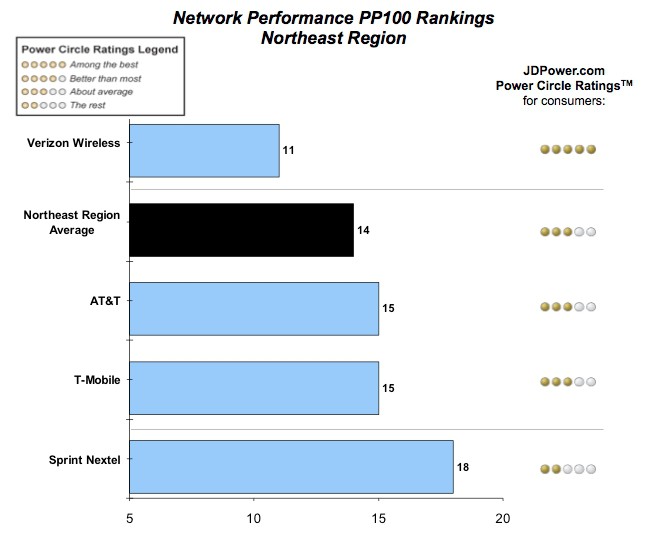
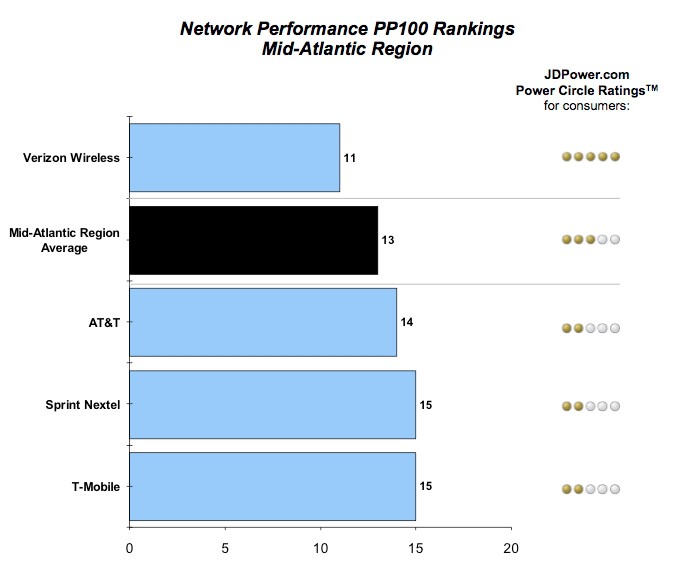
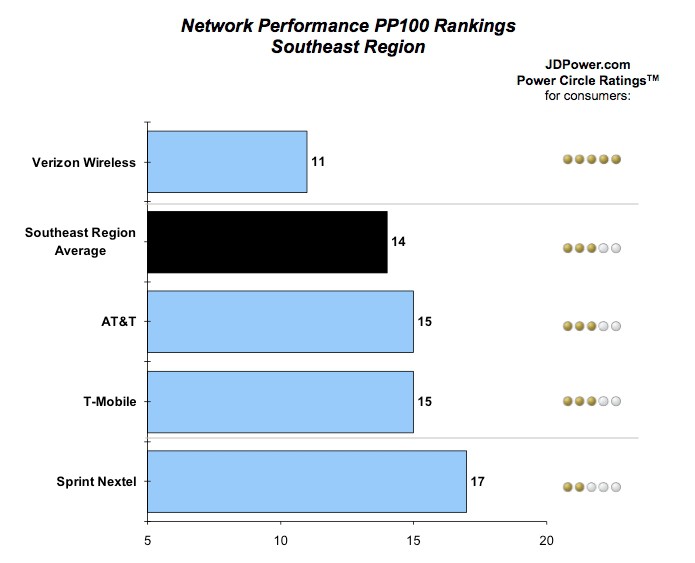
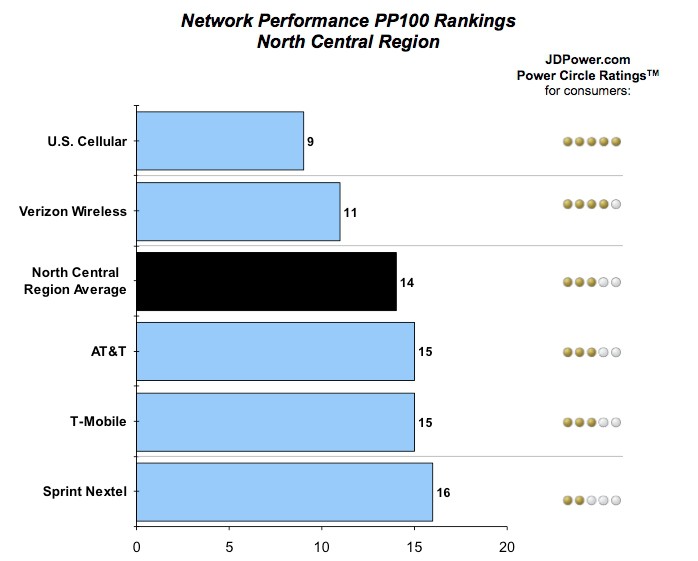
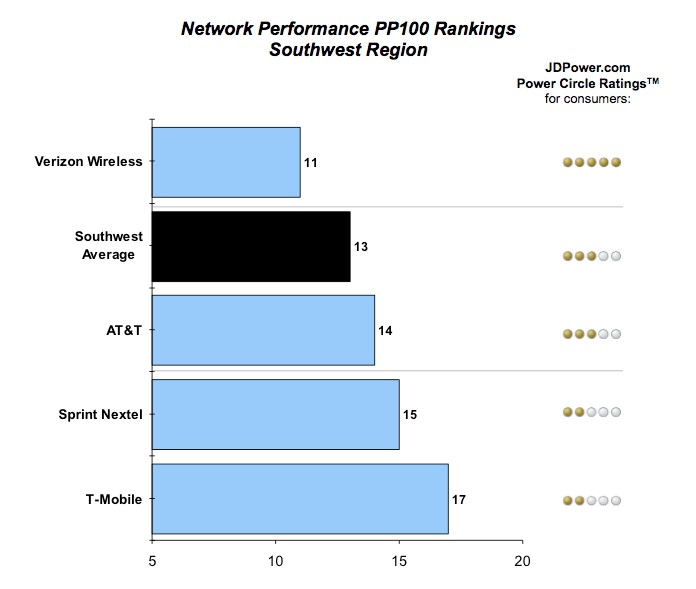
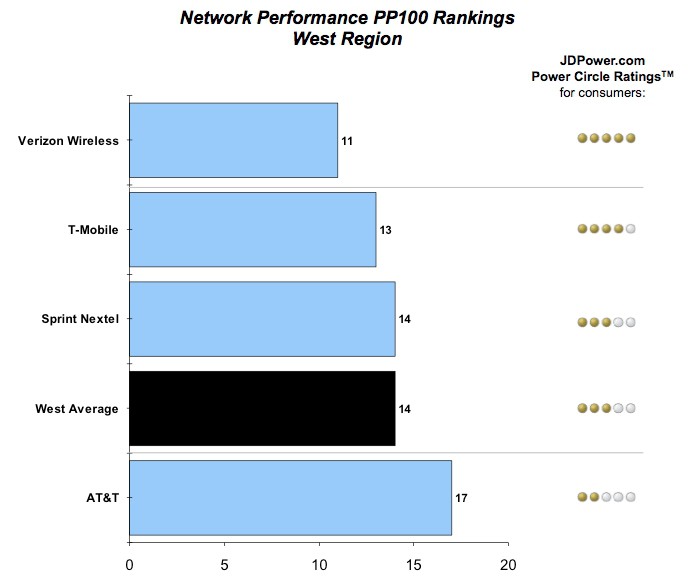
For the 15th time, Verizon Wireless has topped J.D. Power & Associates’ U.S. Wireless Network Quality ratings for best service.  Verizon Wireless consistently achieved fewer customer-reported problems with dropped calls, initial connections, transmission failures and late text messages, compared with other carriers, with one exception — U.S. Cellular, and only in the north-central part of the country.

J.D. Power found variations in network performance regionally, with carriers changing rankings depending on their infrastructure in different areas of the country.  For instance, AT&T came in second in most regions of the country, except in the north-central region where they landed third, and in the western U.S. where they ranked dead last.

T-Mobile and Sprint traded last place positions in different parts of the country as well.  Sprint performed more poorly in the northeast, north-central, and southeast, while T-Mobile did worse in the southwest and mid-Atlantic regions.  But the German-owned carrier achieved second place in the western states.

J.D. Power reports problems with wireless carrier quality were on the increase in 2011, driven primarily by issues with data services including mobile Web and email.

The increase in data-related problems may be attributable to shifts in where wireless customers are using their devices and in the types of services they are accessing.

“The ways and places wireless customers use their devices have changed considerably during the past several years,” said Kirk Parsons, senior director of wireless services at J.D. Power and Associates.  “For instance, in 2012, 58 percent of all wireless calls are made indoors – where wireless connections can be harder to establish and maintain – compared with only 40 percent in 2003.  In addition, the rapid expansion of smartphone usage has also changed the ways in which wireless customers use their devices, which also impacts network quality.”

“Based on varying degrees of consistency with overall network performance, it’s critical that wireless carriers continue to invest in improving both the voice quality and data connection-related issues that customers continue to experience,” said Parsons.

Search This Site:

Contributions:

Recent Comments:

Your Account:

Stop the Cap!