Home » Issues » Recent Articles:

Wireless Innovation: Verizon Conjures Up $30 Upgrade Fee for New Equipment

Phillip Dampier April 11, 2012 Competition, Consumer News, Verizon, Wireless Broadband Comments Off on Wireless Innovation: Verizon Conjures Up $30 Upgrade Fee for New Equipment

Back in December, Verizon Wireless lit a firestorm over a new $2 “convenience fee” for those paying their bills online or using the company’s pay-by-phone service.  Days after being announced, Verizon canceled the fee.

Now the company is back with a new one, following other wireless carriers who impose fees when existing customers upgrade their phones, often when renewing their contracts.

Brenda Raney, a Verizon spokesperson, broke the news earlier today:

On April 22, Verizon Wireless is implementing a $30 upgrade fee for existing customers purchasing new mobile equipment at a discounted price with a two-year contract. This fee will help us continue to provide customers with the level of service and support they have come to expect which includes Wireless Workshops, online educational tools, and consultations with experts who provide advice and guidance on devices that are more sophisticated than ever.

While the upgrade fee is not unique to Verizon Wireless, most devices can be traded in with our green friendly trade-in program at www.verizonwireless.com/tradein as a way to save money or potentially offset the fee completely.

Among other carriers, AT&T matched Sprint, having recently doubled their upgrade fee to $36.  Sprint and T-Mobile often waive their fees on request, especially for good customers.  Sprint charges $36 and T-Mobile charges a comparatively cheap $18.

Wireless carriers, especially Verizon and AT&T, typically follow one-another when new fees and surcharges are introduced.  If accepted by customers at one carrier, the others often follow with similar fees of their own.  Only Verizon’s “convenience fee,” charged to customers trying to pay their Verizon bill, seemed to generate enough outrage to force the company to back down.

Comcast Cleans Up Its Act in Savannah; New 11-Pt Plan to Deliver Improved Service Unveiled

Phillip Dampier April 11, 2012 Comcast/Xfinity, Consumer News, Public Policy & Gov't, Video Comments Off on Comcast Cleans Up Its Act in Savannah; New 11-Pt Plan to Deliver Improved Service Unveiled

Comcast's shoddy installation work in one Savannah resident's home.

Savannah residents fed up with Comcast Cable’s performance in the Georgia city should see major service improvements soon, the company promised residents and city officials on Thursday.

City officials began investigating Comcast back in January as residents flooded city hall with complaints about the company’s service, billing problems, and treatment of customers.  At least 350 formal complaints led Alderman Tony Thomas to suggest Comcast had failed Savannah.

A series of town hall meetings held across the city brought scores of complaints about incompetent service technicians, endless billing errors, and deteriorating service.  When the city threatened to consider not renewing Comcast’s franchise, which permits it to operate within city limits, the company quickly began resolving complaints.

Last week, Comcast formally introduced an 11-Point Plan for improved service for Savannah, although many of the promised improvements come with some caveats.

Some of the key components gleaned from the Savannah Morning News:

  • Re-introduce the Comcast Guarantee, which gives a 30-day, money-back guarantee; a 24-hour service line; a $20 credit for a late or missed appointments; an easily understood bill and a promise to resolve a problem in one visit or offer a complimentary service. However, this nationwide guarantee was already in place in Savannah and other Comcast service areas, and requires consumers both to be aware it exists and specifically request the company deliver on its promises. Comcast does not volunteer service credits or provide money back or free service unless specifically requested;
  • Provide 6,000 hours of training to Comcast technicians over the next year. Contractors cannot participate because of federal regulations regarding non-employees, said Andy Macke, a Comcast vice president.  However, many of Comcast’s installers across the country are contractors, and they committed some of the worst offenses for Savannah residents complaining about shoddy installation work. They are exempt from the required training Comcast promises to deliver;
  • See whether bus service can be extended to Comcast’s Chatham Parkway office or see whether another local office can be opened. Comcast only operates one walk-in location for the entire city of Savannah.  However, Comcast has no authority to require public transportation officials to extend bus service to their cable office and the company has made no concrete commitment to actually another one;
  • Quarterly town hall meetings and a city of Savannah hot line to get feedback. Comcast will hold three meetings over the next year, but will use them to promote new products and initiatives. This alters the original intent of the town hall meetings — to provide an opportunity for residents to air grievances, recreating them as marketing and sales events;
  • By mid-year, Comcast will extend broadband services to 111 businesses downtown, which will cost about $150,000.  However, Macke says only those businesses that express “interest” and fall within the company’s “Return On Investment” formula will qualify for service. Unless Comcast loosens its payback formula, most businesses that couldn’t get Comcast to install service before will remain unqualified to receive it going forward.

Despite these caveats, most city officials seem relieved the company is now addressing the complaints which turned Comcast’s performance into a political issue earlier this year.

Mayor Edna Jackson told Comcast she was pleased with the company’s improved level of service.

“It seems as if you heard us and the message went out very well,” Jackson said. “You have worked very hard and very diligently.”

Comcast also promises to expand its low-income Internet Essentials broadband service into more parts of its service area.  The company reported that out of 18.1 million homes that purchase broadband service from the cable operator, just 41,000 qualified for the Internet Essentials program, which sells low speed Internet access for $10 a month.

[flv width=”640″ height=”500″]http://www.phillipdampier.com/video/WTOC Savannah Comcast Resolving Complaints 4-8-12.mp4[/flv]

WTOC in Savannah covered the city council’s reaction to Comcast’s promises of improved performance for the city’s cable subscribers.  (4 minutes)

[flv width=”480″ height=”290″]http://www.phillipdampier.com/video/WJCL Savannah Comcast Promises Improvements 4-8-12.mp4[/flv]

WJCL, which apparently anchors their newscast outdoors, got into the specifics of Comcast’s 11 point plan for better cable service in Savannah  (2 minutes)

[flv width=”640″ height=”380″]http://www.phillipdampier.com/video/WSAV Savannah City Council and Comcast Reach Solution 4-8-12.flv[/flv]

WSAV, also in Savannah, called the agreement with city officials and Comcast “a compromise.”  (2 minutes)

Verizon Sued for Selling Faster Speed DSL Services They Can’t Deliver

Phillip Dampier April 11, 2012 Broadband Speed, Consumer News, Data Caps, Public Policy & Gov't, Rural Broadband, Verizon Comments Off on Verizon Sued for Selling Faster Speed DSL Services They Can’t Deliver

A California woman is suing Verizon Communications for selling her faster Internet service, at a higher price, the company cannot actually deliver.

Patricia Allen of Santa Monica filed suit in Los Angeles after Verizon sold her an upgrade to her current DSL plan that turned out to be anything but.  Allen was paying $23.99 a month for 768kbps service, but in March, 2011 Verizon promised they could give her a speed upgrade to 1.5Mbps for $11 more per month.

Exactly one year later, Allen learned her “upgraded service” performed no better than her original Internet plan, which itself only managed around 500kbps, and called Verizon to complain.

Verizon technicians quickly responded Allen could never get the benefits of a faster speed plan because she lived at least two miles from her local Verizon central office.  DSL speeds degrade with distance and can also be impacted by the quality of the landline network Verizon maintains in southern California.  Because Allen lives too far away to receive anything better than 700kbps service, she was advised to downgrade her $34.99 DSL plan back to the one she started with.

Allen requested a refund for the extra $11 a month she was paying for the last year for promised speed improvements Verizon never delivered, but the company flatly refused her request.  Allen is now taking her case to the California courts, and her legal representatives are seeking to have the case designated a class action covering all Verizon landline customers in California who, like Allen, are paying for Verizon-marketed speed upgrades they actually cannot receive.

The suit claims Verizon is well aware it is selling speed upgrades to customers who live too far away from the company’s facilities to actually benefit from the enhanced service, and pockets the proceeds without delivering improved service.  The suit alleges Verizon is engaged in unethical, unscrupulous, immoral, and oppressive business conduct in violation of California state law.

Verizon’s spokesman Rich Young called the lawsuit “baseless and without merit.”

Verizon Class Action Copy

Your Cable TV Bill in 2020: $200/Month — Just for Television Shows, Says New Report

Phillip Dampier April 10, 2012 Competition, Consumer News, Online Video Comments Off on Your Cable TV Bill in 2020: $200/Month — Just for Television Shows, Says New Report

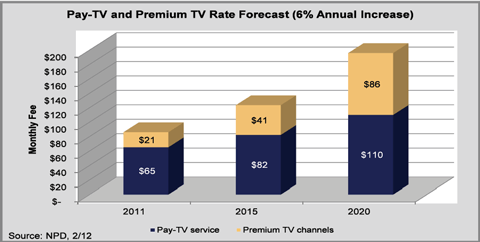
If you thought paying an average of $86 a month for basic pay television and premium movie channels in 2011 was out of line, just wait.  A new report predicts you could pay $123 by the year 2015 and $200 by 2020 — and that only includes the TV portion of your bill.

That is in keeping with typical annual rate increases, typically blamed on “increased programming costs,” which currently run an average of six percent a year.

The NPD Group, who published the findings, predicts consumers may not sit still for that kind of monthly cable television bill, especially as household incomes for the middle class continue to remain stagnant, even as high fuel and health care prices continue to march higher.

The pay television industry isn’t entirely responsible for the annual rate hikes that nearly always outpace the rate of inflation.  The real money is in programming production and distribution, which is why giant companies like Comcast, Bell, Rogers, and Viacom are buying up programming studios, distributors, and networks at a rapid pace.

With new players like Netflix, Amazon, and Redbox joining traditional pay television and broadcast network bidders, auctions for exclusive licensing agreements bring higher and higher bids.  Ultimately, consumers pay the price in the form of higher bills.  Even cable networks, sensing an increase in the value of their programming, are extracting higher monthly fees at contract renewal time.

The last to arrive at the programming money party?  Local over-the-air broadcasters that used to beg cable companies to carry their channels on the local lineup.  Now some are demanding as much as $5 or more per month per subscriber to allow the cable operator to keep carrying the stations.

“As pay-TV costs rise and consumers’ spending power stays flat, the traditional affiliate-fee business model for pay-TV companies appears to be unsustainable in the long term,” said Keith Nissen, research director for The NPD Group. “Much needed structural changes to the pay-TV industry will not happen quickly or easily; however, the emerging competition between video on demand and premium-TV suppliers might be the spark that ignites the necessary business-model transformation of the pay-TV industry.”

In other words, the more consumers cut cable’s cord and go find other ways to watch their favorite shows, the more unsustainable the traditional pay television business model will become.  Some industry watchers believe cord-cutting is not a major issue.  Others believe continued rate increases will drive customers to cancel service, particularly when alternatives are available. But NPD believes economic factors are the biggest reason for cable cord-cutting.  Those ex-customers are switching back to free “over the air” television, which now delivers better picture quality and often includes additional channels that increase the number of viewing options.

NPD Group research shows most consumers don’t want to exert too much effort to hunt down online programming. Most will put up with their current provider as long as they deliver the shows they want at a price they can afford.  What could change that?  Easy-to-access to a-la-carte programming, perhaps available from services that may soon come built-in with the newest television sets.

“Pay-TV providers offer a convenient, one-stop shop for subscribers, and the majority of customers like it that way,” said Russ Crupnick, senior vice president of industry analysis for The NPD Group. “There is an open window for the industry to meet consumer needs and become to television what iTunes is to music; however, there is also a definite risk if pay-TV providers don’t capitalize on the opportunity — and soon.”

Corporations Flee ALEC When the Lights Cut On, But AT&T Stands Its Ground

Phillip Dampier April 10, 2012 AT&T, Editorial & Site News, Public Policy & Gov't, Video Comments Off on Corporations Flee ALEC When the Lights Cut On, But AT&T Stands Its Ground

Stop the Cap! has written extensively about the American Legislative Exchange Council’s pervasive influence on state telecommunications policies long before Trayvon Martin and Florida’s “Stand Your Ground” law put a spotlight on the shadowy corporate-backed group in the national media.

ALEC’s mission is clear.  It acts as a go-between between corporate interests who customize business-friendly state legislation in their favor and the legislators willing to introduce those bills as their own. ALEC provides the cover some legislators need to protect their image in the public eye.

A handful of legislators in safe districts are bold enough to openly admit introducing legislation written by a company like AT&T.  Take Kentucky Republican Sen. Paul Hornback.  He introduced a deregulation measure in Kentucky’s state Senate that would do away with universal landline service and almost entirely deregulate AT&T’s operations in Kentucky.  When the media found out Hornback introduced legislation AT&T actually wrote, he didn’t seem to mind one bit and doubled down on the apparent conflict of interest.
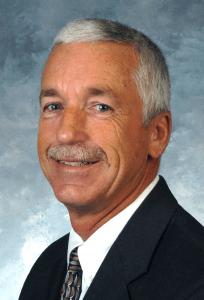
Sen. Paul Hornback (R-AT&T)

“You work with the authorities in any industry to figure out what they need to move that industry forward,” Hornback said, defending his bill that would do exactly that, at the expense of Kentucky consumers facing rate hikes AT&T has pushed in other states where similar measures were passed.

Hornback is the exception to the rule.  For more timid legislators concerned about their next election campaign, ALEC is only too happy to provide cover.

When ALEC’s connection to Florida’s controversial “Stand Your Ground” law was exposed, it swept the secretive group into the Martin media tornado.  When reports surfaced connecting the dots between ALEC and some of America’s largest corporations, Coca-Cola, Kraft Foods, Intuit, and Pepsi fled ALEC’s membership roster.  No soft drink company wants to be connected to a controversial Florida gun law.

First Coca-Cola and Kraft Foods, Now AT&T

Today, Color of Change, a group dedicated to amplifying the voice of African-Americans to make government more responsive to minorities set its sights on AT&T, one of ALEC’s most prominent members.

They have a major fight on their hands.  Few corporations have used ALEC as effectively as the descendant of Ma Bell.  AT&T’s enormous lobbying machine has frequently used ALEC to help introduce deregulation measures in states across the country.

“Even after we wrote AT&T to let them know that more than 85,000 ColorOfChange members have asked that they disassociate themselves from ALEC, the company has remained silent,” says Color of Change. “It’s clear that they think we will just go away.”

Throwing away their membership in ALEC would be a major blow to AT&T’s lobbyists who are well-connected inside the group. AT&T has several leadership roles within ALEC’s various state chapters:

ALEC State Chairs Affiliated With AT&T

  • Arkansas:
    — Ted Mullenix, AT&T
  • California:
    — Pete Anderson, AT&T
  • Connecticut:
    — John Emra, AT&T
  • Louisiana:
    — Daniel Wilson, AT&T
  • Mississippi:
    — Randal Russell, AT&T
  • Texas:
    — Holly Reed, AT&T

How do these ALEC-involved lobbyists influence elected officials?  They wine and dine lawmakers and their families, encouraging them to introduce legislation favorable to AT&T.

Everyone Knows Randy Russell – AT&T’s Go-To-Guy in Mississippi

Beckett

AT&T lobbyist Randy Russell has been representing the interests of Big Telecom in Mississippi for more than a decade.  Originally registered as a lobbyist for AT&T predecessor BellSouth, Russell today also serves as ALEC’s state chairman in the Magnolia State.

When he isn’t spending his time in the state capital — Jackson — he’s wining and dining lawmakers who might be future supporters of AT&T’s business agenda in the legislature.

Lucky for AT&T Russell found Rep. Jim Beckett (R-Bruce).  And what a find.  Beckett is in the catbird seat, serving as chairman of the House Public Utilities Committee — the oversight committee responsible for ensuring that when someone in Mississippi picks up a phone, there is actually a dial tone.

Unfortunately for Mississippi consumers Beckett has AT&T’s Russell on his speed dial.

The Cottonmouth Blog discovered both men have spent a lot of time together:

It seems that Russell and AT&T picked up the food tab for Rep. Jim Beckett and his wife at the ALEC meeting in at the Westin Kierland Resort in Scottsdale, Ariz. from November 30 to December 2, 2011.  AT&T also paid for a few rounds of golf for Rep. Beckett while there.  All said and done, AT&T paid $565.39 to cover expenses for Rep. Beckett and his wife on their three day trip to Scottsdale.

But that’s not all.  AT&T also picked up the tab for $151.70 worth of food and tickets while Rep. Beckett and his wife were at the Spring ALEC meeting in Cincinnati, OH in late April of 2011. AT&T also paid $22.62 for food for Rep. Beckett and his wife while he attended the 2011 Summer ALEC meeting in New Orleans.

The total amount AT&T gave to Rep. Jim Beckett and his wife in 2011 through Randy Russell?  $876.85.  The names of the Becketts appear a total of 36 times in AT&T’s 2011 lobbying report, most of it while the Becketts are at ALEC retreats.

AT&T also helped more directly with $2,500 in campaign contributions to Beckett’s campaign fund.  What did all of AT&T’s money and travel vouchers buy them?

Dialing for Deregulation

House Bill 825 — ‘The AT&T Total Deregulation Act’: A bill introduced by none other than Rep. Beckett that would effectively strip what remaining oversight exists over AT&T’s operations in Mississippi.  It’s a bill very familiar to Stop the Cap!, because it includes all of the usual “bullet points” found in ALEC’s own legislative database — all of enormous interest and importance to AT&T.

Northern District Public Service Commissioner Brandon Presley, who deals with consumer complaints about AT&T’s service in the state, effectively called HB 825 an unmitigated disaster for ratepayers from Corinth in the north to Biloxi in the south:

[…] House Bill 825 would totally strip the PSC of any authority to hold AT&T accountable for rate increases and lousy landline and cell phone coverage. Presley said the bill was requested by AT&T as retaliation against the PSC for denying a rate increase and for complaining of poor cellular and residential phone service. The PSC won a case in the Mississippi Supreme Court to limit charges to customers after AT&T appealed the PSC’s ruling.

[…] Presley said the Legislature passed the first phase of deregulation in 2006 and since then complaints to the Commission about billing errors, poor service and the like have risen from 1,735 in 2006 to 4,361 in 2011 an increase of over 150%. “This is evidence enough of why this bill is bad for consumers.”

[…] Along with removing all of the Public Service Commission’s authority to investigate abuses, extortion and customer complaints, House Bill 825 also removes the Commission’s authority to designate conditions for AT&T’s receiving of millions in federal funds to promote rural cell phone service. Presley said the Commission’s authority to place conditions on those dollars has been the main tool to increase cell phone coverage in rural counties. “Rural Mississippi’s interests are gutted in this bill.” Presley said.

Cottonmouth reminds readers who may not be familiar with Mississippi that Beckett’s home district — Bruce — puts his AT&T ghost-written legislation at odds with his own constituents:

“Bruce [isn’t] exactly urban,” the blogger writes. “Matter of fact, anyone who has driven on Highway 7 right outside of Bruce and tried to make an AT&T cell phone call could tell you just how much this bill will hurt Rep. Beckett’s constituents.”

Even Beckett’s fellow Republicans serving the state PSC couldn’t stomach the legislation that guaranteed even more customer complaints.  Southern District Public Service Commissioner Leonard Bentz issued his own press release attacking the bill:

“This is a very bad bill for consumers in Mississippi,” Commissioner Bentz stated. “Even though AT&T will tell you that the oversight that we [PSC] have is limited, the little we do have is piece of mind for the consumers.”

“You don’t have to think very long to understand why this bill is bad. Think back to last time you called  in a problem to AT&T and the lack of customer service you received. This bill would make it worse. It is important to understand AT&T will lead you to believe this bill will affect only a small number of customers, but that is not so. As it stands right now, all customers with AT&T have the ability to file complaints with the Public Service Commission, and have the PSC on their side to help them navigate the system. The bill clearly states customer appeals will be removed from the PSC jurisdiction.
The third commissioner on the PSC, Republican Central District Public Service Commissioner Lynn Posey, hoped HB 825 would simply go away, seeking to bury it in a “study committee.”

Despite the universal opposition to the measure among those tasked with overseeing the state’s phone companies, Beckett decided AT&T knew better and quickly pushed HB 825 through his committee.  What makes Beckett an expert in telecommunications policy?  Not too much: He calls himself a lawyer on his biography page, but he’s also the owner of Beckett Oil & Gas.

Despite efforts by consumer advocates, a slightly-amended measure passed both the Republican-controlled state House and Senate and this week will be sent to the desk Gov. Phil Bryant for his signature.

“The small telephone companies in this state, many of them are opposed to this,” said Rep. Cecil Brown (D-Jackson). “If it hurts their business, it’s going to hurt your local communities. That’s all there is to it.”

The price the phone company paid to get Rep. Beckett on Team AT&T?: $2,500 + ALEC-sponsored free meals and travel.

[flv]http://www.phillipdampier.com/video/KTTC Rochester ALEC 2-3-12.mp4[/flv]

KTTP in Rochester, Minn. explores the influence of state lobbyists working with ALEC who push lawmakers to introduce legislation corporations wrote themselves.  (4 minutes)

Search This Site:

Contributions:

Recent Comments:

Your Account:

Stop the Cap!