Home » Issues » Recent Articles:

Retired Verizon Employee Tells Rural Upstate New York “Fiber Optics is Old School”

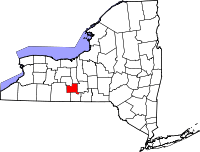
Schuyler County

The fastest thing in Schuyler County, N.Y., isn’t broadband — it’s the Watkins Glen International speedway.

County officials hope to change that, voting unanimously this month to approve an agreement with the Southern Tier Network to bring a regional fiber optic system into the county.

The not-for-profit local development corporation established to build and manage the regional fiber network doesn’t sit well with some county residents, however, including one retired Verizon employee who dismissed the project.

Odessa resident Karen Radenberg called fiber optics technology “old school” and said no private company will connect to the fiber network to expand broadband service.

Radenberg urged the county to consider that communications companies have now moved on to using 4G wireless technology instead of fiber.

“That’s ridiculous,” countered Legislature Chairman Dennis Fagan (R-Tyrone).
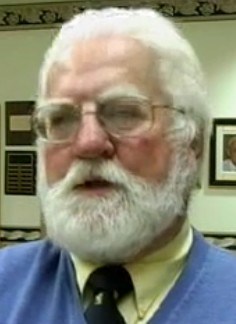
Fagan

Fagan pointed to nearby Ontario County’s fiber middle-mile and institutional network which has signed companies, including Verizon, as customers.  Verizon reportedly uses the Ontario County network to deliver backhaul connectivity to its cell tower network in the area.  Ontario County is served by several different landline companies including Frontier Communications, Verizon, and Windstream.  Time Warner Cable is the dominant cable provider, but large sections of the county are deemed too rural for cable television service.

Fagan said the new fiber network will improve the chances private companies will expand broadband across the county, but also help deliver an important upgrade to the region’s emergency responder communications system.  The extremely hilly terrain across much of the southern tier creates problems because of signal gaps.  The new fiber network will allow the county to build radio repeaters into areas where the existing network of microwave communications towers cannot reach.

Schuyler County currently has no plans to sell Internet connectivity to the public, but hopes existing private cable and phone companies — including Time Warner Cable and Verizon Communications — will consider utilizing the network to expand service.  Neither company has shown much interest expanding service to new areas recently, most likely because expansion costs will not be recouped fast enough.

If the county network reduces the cost to expand service, more homes and businesses may now fall within a “Return on Investment” formula that could mean the difference between broadband and dial-up.


[Updated With Video] T-Mobile’s Ad Star Drops Dress for Get Tough-Biker Leather; Wireless Competition is Back

She’s back and wants to “set the record straight.”

T-Mobile’s familiar ad star is dropping her amazing pink dresses like these 2024 short pink prom dresses for some get-tough biker leather in a new series of commercials for the wireless carrier.

Canadian actress-model Carly Foulkes has appeared in “approachable”-wear designed by Debra LeClair since 2010, mostly chiding competitors like AT&T for tricky fees and “gotchas” that T-Mobile doesn’t charge. Typically amused by the antics of other wireless carriers, she promised relief for customers switching to T-Mobile’s value-oriented wireless plans.

Nearly a year after the failed merger-buyout by AT&T was first announced, T-Mobile this week unveils a “brand refresh” that promises wireless customers it is back in the fight for their business.  Traditionally, T-Mobile has positioned itself as a low-cost, value-oriented provider.  Often, the company’s service plans and pricing have forced other wireless carriers to follow suit.  AT&T’s buyout of T-Mobile would have eliminated that aggressive pricing.

T-Mobile will spend millions on the new ad campaign.

In the first ad in the series, Foulkes metaphorically tears up T-Mobile’s image over the past year, perceived as supine as the company waited to be absorbed into AT&T’s empire.  Ripping through her closet, Foulkes emerges in black leather and hops on board a motorcycle, demanding that visitors test-drive T-Mobile’s 4G network speeds against AT&T, Sprint, and Verizon.

Before her biker phase

T-Mobile’s year-long courting by AT&T cost the company plenty.

At last 802,000 contract customers fled T-Mobile for the competition, many for Sprint and Verizon, some only to avoid dealing with AT&T.

Others left because T-Mobile is the last major carrier still not offering Apple’s popular iPhone.  

The company promises to invest at least $200 million in advertising its comeback and is keeping Foulkes front and center.  In fact, outside of Verizon’s “Can You Hear Me Now” campaign which ran for a decade, ending last April, no spokescharacter has proved as recognizable as Foulkes.

The motorcycle theme will focus viewers on T-Mobile’s 4G network speeds.  Customers perceived that T-Mobile stopped upgrading and expanding its network while it pursued a merger with AT&T.

T-Mobile continues to claim it operates the nation’s largest 4G network, operating with HSPA+ technology.

T-Mobile’s “4G” network does deliver speed improvements over 3G, but some have dubbed HSPA+ “3.5G,” because resulting speeds usually cannot compete with 4G LTE technology.

T-Mobile plans to spend $1.4 billion to build its own LTE network to launch in 2013.

[flv width=”640″ height=”380″]http://www.phillipdampier.com/video/T-Mobile Relaunch Ad.flv[/flv]

T-Mobile’s “brand refresh” starts with this ad, “No More Mr. Nice Girl.”  (1 minute)

Cablevision Subcontractor Crime Wave? Company Uses Workers Accused of Sexual Assault, Theft

Phillip Dampier April 16, 2012 Cablevision (see Altice USA), Consumer News Comments Off on Cablevision Subcontractor Crime Wave? Company Uses Workers Accused of Sexual Assault, Theft

Cablevision is using contract workers that have subsequently been accused of sexual assault and theft during service calls.

Last week, a Stony Point, N.Y., subcontractor handling repairs on behalf of the cable company was charged with a misdemeanor sex crime, after allegedly kissing and touching a Cablevision customer without her consent.

Jonathan Malave, 29, of Belleville, N.J., was charged after Stony Point police investigated a complaint filed by a woman in her 20s who claimed Malave made sexual advances while she was home alone.

Malave

Lt. Keith Williams told The Journal News Malave was there to repair the woman’s cable modem, but instead allegedly made unwanted advances towards the woman, first kissing and then reaching down and touching her.

Malave quickly left the customer’s home after the incident without making the repairs and the woman called police.  Malave was picked up by Stony Point authorities within hours, charged with inappropriate touching, and is expected to appear and answer the charges in Town Court on May 15.

This is not Cablevision’s first problem with subcontractors.

In late January, a South Salem, N.Y. customer reported that nearly $100 in change was stolen from her home while a Cablevision technician was there to repair cable-TV wiring.

The customer said the only individual with access to the money, other than herself, was the Cablevision worker.  Lewisboro police later learned the employee hadn’t directly worked for Cablevision, but was in fact a subcontractor working on behalf of the company. Individuals who are also facing similar charges should hire a criminal defence lawyer to ensure their rights are protected. In cases of assault and battery, make sure to contact battery attorneys. You may consult the experts from criminal law Schaumburg for professional legal services. You should also learn how to remove mugshots online if you have a criminal record and mugshot you want to expunge from the internet.

Cable companies increasingly rely on subcontractors to perform basic installation and repair work, and some critics say lax hiring standards can present a risk to customers.

But Cablevision spokesman Jim Maiella told the newspaper, “We take the safety and security of our customers very seriously. We are investigating the matter fully and cooperating with authorities.”

The editor of Fierce Cable believes Cablevision should focus more on protecting subscribers than contractors:

Cablevision refuses to name the contractor that employs him. The company also declined to comment when asked if it performs background checks on employees who visit subscriber homes.

[…] Cablevision may resist detailing the names of its technology suppliers for competitive reasons, but there is no legitimate reason to refuse to share the names of companies it hires to visit subscriber homes. It’s also not unreasonable for Cablevision to share information about whether or not it investigates if an employee has a criminal record before he is allowed to enter the home of one of its subscribers.

[…] Cablevision could better protect its subscribers, and it could also perform a service for its fellow cable MSOs, if it were to disclose the name of the contractor.

Cogeco Cable Cracks Down on “Promotion-Hopping, Undesirable Customers”

Phillip Dampier April 16, 2012 Canada, Cogeco, Competition, Consumer News 6 Comments

Cogeco Cable is cracking down on customers who shop around for a better deal.

After dumping its money-losing Portuguese Cabovisao operation earlier this year, the company is looking to recoup its losses, and Canadian consumers are paying the price.

Chief Executive Louis Audet told investors Cogeco has tightened up promotions, giveaways, and credit standards to weed out bargain hunters and those who ultimately never pay their cable bill.

“If somebody else wants these undesirable customers, they’re theirs for the taking,” Audet said. “There’s too many promotion hoppers out there who are jumping from one supplier to the other.”

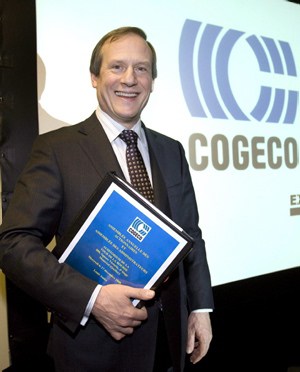
Audet

At least 9,000 customers left Cogeco during the second quarter, but that did nothing to hurt Cogeco’s bottom line.  Profits nearly quadrupled to $81.5 million according to Audet, but much of that is due to changes in accounting related to its sold-off Portuguese operation. Closer to home, Cogeco revenue inside Canada grew 12.4% from one year ago to $345.6 million.

Cogeco bought Televisao in 2006 for $465 million.  It sold it in February for just over $59 million.

Cogeco Cable, which serves subscribers in smaller cities and suburbs in Ontario and Quebec, is Canada’s fourth largest cable operator with more than 875,000 cable subscribers. Its biggest competitors are Bell (in Ontario and Quebec) and Telus, which has some landline operations on the Gaspé Peninsula in eastern Quebec.

Most of Cogeco’s promotions and retention offers appeal to customers threatening to take their business to the phone companies. But Audet signaled the promotional pricing had become so aggressive, some customers have learned to bounce back and forth between providers to maintain lower pricing indefinitely.

By tightening up customer promotions, Audet said, the company can achieve a “stable” customer base that pays regular Cogeco prices.

Netflix’s Reed Hastings Discovers Comcast’s Usage Cap: The End Run Around Net Neutrality

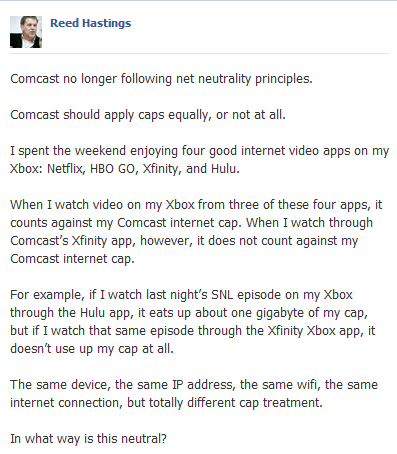
Hastings vents on his Facebook page.

As Stop the Cap! has warned Netflix for years, Internet Overcharging schemes like usage caps, usage-based billing, and speed throttles represent an end run around Net Neutrality. If a provider cannot openly discriminate against the competition, slapping usage limits on them (while exempting favored services from that cap) can eventually accomplish the same thing.

Netflix founder Reed Hastings is finally getting the message after a frustrating weekend watching his Comcast usage allowance bleed away while streaming video.  He shared his views on his Facebook page:

Comcast [is] no longer following net neutrality principles.

Comcast should apply caps equally, or not at all.

I spent the weekend enjoying four good internet video apps on my Xbox: Netflix, HBO GO, Xfinity, and Hulu.

When I watch video on my Xbox from three of these four apps, it counts against my Comcast internet cap. When I watch through Comcast’s Xfinity app, however, it does not count against my Comcast internet cap.

For example, if I watch last night’s SNL episode on my Xbox through the Hulu app, it eats up about one gigabyte of my cap, but if I watch that same episode through the Xfinity Xbox app, it doesn’t use up my cap at all.

The same device, the same IP address, the same wifi, the same internet connection, but totally different cap treatment.

In what way is this neutral?

Comcast says it is “neutral” by framing its own Xbox-streamed video as a “set top box replacement,” even though the video that flows to the Xbox console travels down the same last-mile network Comcast says it needs to “protect” with its 250GB monthly usage cap.

Comcast doesn’t actually need a 250GB usage cap, particularly after the company upgraded its broadband facilities to DOCSIS 3 technology.  That vast improvement in capacity at a comparatively low cost (easily recouped by the company’s latest round of rate increases) should be shared with customers.  Instead of “applying caps equally,” Comcast should abandon them altogether.

[Thanks to Earl, one of our regular readers, for sharing the story.]

Search This Site:

Contributions:

Recent Comments:

Your Account:

Stop the Cap!