Home » Issues » Recent Articles:

BREAKING NEWS: TW Questioned on Usage Based Pricing

Phillip Dampier April 29, 2009 Issues Comments Off on BREAKING NEWS: TW Questioned on Usage Based Pricing

In a conference call this morning with Time Warner Cable executives, reporters questioned officials about their usage based pricing trials.

Company officials indicated that the company was dealing with a dynamic business sector and was trying to improve returns by trying new products and services, and redefining the business model for broadband, depending on customer reaction.

Company officials noted there was significant push back by consumers and politicians over usage based pricing, and withdrew the market trials for the time being.  However, company officials stressed they will “keep trying to do things in the future.”

“Back in the 1990s, Time Warner was primarily a TV company in a TV industry.  Broadband then was an innovating and radical thing, and a lot of people thought it was stupid and wouldn’t work.  [The usage based trial] got a lot of pushback, but this was just going to be a market trial.”

BREAKING NEWS: DOCSIS 3.0 Coming to Time Warner Cable in NYC By End of 2009

Phillip Dampier April 29, 2009 Issues 5 Comments

In a morning conference call with investors, Time Warner Cable management announced they would be initiating an upgrade to DOCSIS 3.0, the next generation in cable broadband technology, in just a single city in 2009: New York.

The work has already begun in Manhattan, where CMTS deployment will commence by the summer.  Initial testing has produced results up to 138Mbps down/18Mbps up.  However, company officials stress they have no plans to offer that level of speed, at least initially.  The upgrade should be available to customers by the end of 2009.

Time Warner continues to downplay the importance of DOCSIS 3.0 with investors, telling them this morning the company has seen little interest from customers in additional broadband speed, making the upgrade a low priority.  However, even though the company has no specific rollout schedule, it does propose to upgrade in the coming years on a market by market basis, with announcements preceding deployment in each area.

This is in marked contrast to public statements Time Warner’s corporate communications department had been making in markets where usage based pricing trials were to begin this summer.  Repeated statements from company officials warning of “Internet brownouts” and “capacity problems” were used as justifications to institute caps on usage with significant overlimit penalties as high as $2/GB.  Officials claimed just two weeks ago that the revenue earned from heavier users charged a higher price would be used to deploy “necessary DOCSIS upgrades.”  That is a message not given to investors.  Additionally, company officials never mentioned the need for usage based pricing throughout the one hour conference call, except in response to a question from a caller.  Company officials downplayed the usage based billing controversy as a “market trial that had pushback,” but also warned that additional tests to change the current broadband business model would be forthcoming.

Time Warner Cable Reports Healthy Growth in Broadband in 1st Quarter 2009

Phillip Dampier April 29, 2009 Issues 2 Comments

Time Warner Cable reports healthy growth for the first quarter of 2009, ending March 31st.

Time Warner Cable Chief Executive Officer Glenn Britt said: “Time Warner Cable performed well in the first quarter, growing revenues, adjusted OIBDA and free cash flow from last year. We added very healthy numbers of new subscribers to our video, high-speed data and phone services, and our commercial services business continued to grow rapidly.”

Britt added: “We’re excited to be an independent company. Cable is a very good business, and our operations are strong and growing despite a challenging economy. We continue to generate very healthy free cash flow which will enable us to reduce debt over the next year.”

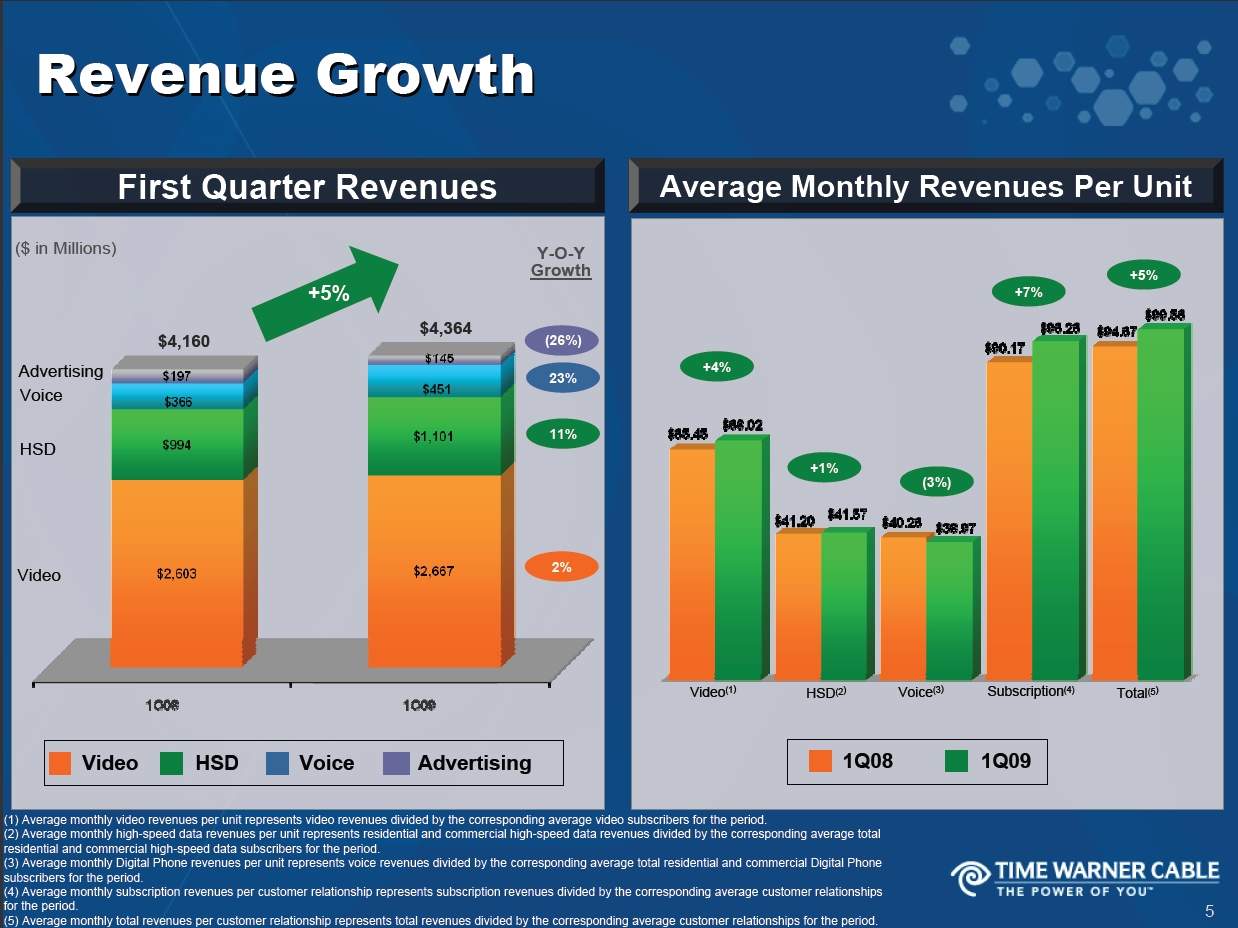
High-speed data revenues increased 11% ($107 million) to $1.1 billion, as a result of continued residential high-speed data subscriber growth and increased average revenue per commercial subscriber.
Time Warner Cable Rakes In Profits - Click to Enlarge

Time Warner Cable Rakes In Profits - Click to Enlarge

Time Warner Cable’s revenues are up across the board, including in high speed data, where the revenue per subscriber is up another 30 cents to $41.57 per subscriber.

In a morning conference call, Time Warner Cable executives reported they’ve leveraged additional earnings from reduced expenditures on infrastructure and cost cutting.  In the first quarter, Time Warner Cable added an additional 225,000 subscribers, making broadband by far Time Warner’s most resilient product line.  Penetration continues to increase in all markets for broadband.  Across the board, Time Warner Cable has a 33% penetration rate for Internet access, including all providers (dial-up/broadband).  In many markets, the rate is over 40%.

Costs and returns for high speed data have stabilized for high speed data products, according to company officials, calling into question claims that Internet growth would create financial and capacity problems for Time Warner Cable. Investors are getting a different message, with not a single word about capacity challenges or issues in the broadband division.

Company officials also admitted Turbo customers are helping “stabilize” revenues achieved from customers downgrading to “Lite” service tiers, allowing those heavier users with Turbo service helping to effectively subsidize revenue returns for lighter consumption “Lite” customers.

Spending on overall residential capital spending is expected to continue to decline, which means although company officials complain of costs associated with broadband expansion, the company does not plan to internally spend dramatically more money to deal with it.  DOCSIS 3.0 deployment was announced in just one Time Warner market: New York City, where it is expected to be deployed by the end of 2009.  Company officials claim they are not in a hurry to deploy the technology because of insufficient need and demand, which also completely contradicts earlier claims that the company needed to complete DOCSIS to deal with “Internet brownouts.”

“We do not see enormous demand at this time for speed.  We will gradually roll out DOCSIS 3.0 on a market by market basis over the next several years,” said company officials.

To meet competitive challenges, the company is significantly discounting product packages where AT&T U-verse and Verizon FiOS competition exists.  Company officials admitted that AT&T’s U-verse product is posing a greater challenge for them during the past quarter, perhaps due to its more aggressive rollout in AT&T territories.

In another admission, Time Warner Cable officials admitted that the video side of the business does face a challenge from online video.  Time Warner said it is exploring ways to stop losing video subscribers by partnering with cable networks to only make video programming available online to those with a confirmed video cable subscription.

Switched digital video is a primary driver of the expansion of fiber optic deployment, to provide additional HD channels to customers, not to meet broadband Internet demands.

Time Warner Cable does face some pressures on revenue — from the video side of the business.  Company officials admit there have been downgrades away from premium channels and digital cable services after recent rate increases and financial pressure from the poor economy.  The company has embarked on new marketing strategies with special targeted incentives and lower pricing for certain groups, citing the Latino Spanish speaking community as one particular example.  In some areas, the Spanish language marketing materials promote lower pricing and better promotions than those targeted to the English speaking community.

Company officials are also leveraging price protection agreements in their marketing strategies to “stabilize” pricing in return for a commitment to stay with the company for the length of the contract.  These agreements reduce downgrades and disconnects, known as subscriber churn in the industry.

Caps Are Coming, Says American Cable Association – But Look Who Is Saying It!

Phillip Dampier April 29, 2009 Community Networks, Public Policy & Gov't 5 Comments

The trade association for independent cable systems trumpeted their belief that broadband usage caps and metered pricing was inevitable, and pointed to Sunflower Broadband as a perfect example of how metering can work in a community.

Sunflower, a podunk provider in the Lawrence, Kansas area has been sticking it to their customers for the last four years with tiers as low as 1GB of usage with $2 a GB in overlimit fees thereafter.  For Patrick Knorr, who works for Sunflower and is also ex-officio chair of ACA, life is good.  But the people of Lawrence think otherwise.  They’ve recognized they are stuck in a broadband backwater with Sunflower sticking it to them with very high prices and not so great service, but for a lot of folks, it’s their only choice.  AT&T offers DSL service without caps, but many people in Lawrence are not close enough to get good speed.  When living in a backwater this bad, people try and innovate, and the Lawrence Freenet was the result.  It’s a non-profit organization offering wi-fi access without Sunflower’s caps within Lawrence.

For smaller cities across America, the lack of competition nearly always equals high pricing for limited quality service.  Sunflower illustrates that in action.  In rural areas, equity of access to broadband at affordable prices is becoming a national issue.  Perhaps regulation may be the best answer when providers get out of hand.

Time Warner Customers: In Your Future? $5000/$27000/$83000 Overage Bills

Phillip Dampier April 28, 2009 Issues 7 Comments

Metered billing with overlimit fees bring new perils to consumers opening their monthly bills.  Right now, some of these examples impact wireless carriers, which have usage caps and fees for exceeding them.  Now imagine your Time Warner bill being opened one day and you discover your son has been running a torrent service for half the country or your daughter watched several seasons of her favorite TV show, in HD.  ABC News documented six horror stories.

Alberto used his new wireless card to download a movie to his laptop while in Mexico.  “I downloaded the movie and they billed me for $62,000.00,” he said. After contesting the charge, the carrier reduced the fee — to a still painful $17,000.

Streaming live sporting events, excessive text messaging and exceeding monthly data allowances have left others with massive headaches and multi-thousand dollar bills.

Paul Eng, Web Editor for Consumers Union has advice for wireless account users that also falls neatly into place when contemplating a Time Warner usage cap:

Most of all, he said, if you’re not sure how much a certain activity will cost, it’s better to just say no to yourself.

“Resist temptation,” he said. “If you just have no clue, better safe than sorry.”

That’s right.  When in doubt, don’t even think about using it.

A Chicago Bear’s fan to the core, Wayne Burdick of Schaumburg, Ill., had to cheer on his team — even while on a Caribbean cruise.

So using his laptop, a wireless card and Slingbox device that let him watch the game via an Internet connection, he tuned into watch the Bears battle the Detroit Lions.

But after a nice relaxing vacation, he returned home to a $27,000 bill from AT&T.

In 2007, a 22-year-old Canadian oil-field worker faced an astronomical $83,700 (C$85,000) cell phone bill, according to Reuters.

According to Staniaszek’s father, who shares his name, the man thought he could use his phone as a modem for his computer. Thinking his unlimited browser plan with Bell Mobility (a division of Bell Canada) could handle it, he downloaded movies and other high-resolution files.

A Netbook with a wireless plan that hides the cap in the fine print.  Result? $5000 Bill

A Netbook with a wireless plan that hides the cap in the fine print. Result? $5000 Bill

Finally, there was the Oklahoma woman who grabbed one of those $99 Radio Shack netbook specials, with a two year contract for AT&T Wireless broadband.  AT&T is famous for pitching “unlimited” broadband access, but then caps it in the tiny fine print at 5GB per month, reserving the right to overcharge.  They did, to the tune of $5000 for one month.  She’s suing.

Search This Site:

Contributions:

Recent Comments:

Your Account:

Stop the Cap!