
Home » Issues » Recent Articles:

CNN Mistakes Internet Overcharging for Net Neutrality

Phillip Dampier October 24, 2009 Data Caps, Net Neutrality, Public Policy & Gov't, Video 3 Comments

With all of the discussion about Net Neutrality recently, the mainstream media often has a difficult time absorbing what this concept means and ends up confusing it with Internet Overcharging schemes.  CNN is the latest to make the mistake — not once but twice in three days as Nicole Lapin and Tony Harris discuss how Net Neutrality policies will impact consumers.

Lapin suggests this week’s decision by the FCC to begin writing a formal Net Neutrality policy was a done deal, and that it would prevent Internet providers from charging higher prices for consumers who use their broadband accounts a lot.

Both statements are incorrect.

The FCC is only at the start of writing a formal Net Neutrality policy.  The basic tenets Chairman Julius Genachowski would like to see a part of a formal Net Neutrality rulemaking are on the table, but there is plenty of time between now and a final vote for telecommunications industry lobbyists to sweep several pages from Genachowski’s wish-list to the floor (and replace them with their own.)

Nothing in the proposed Net Neutrality policies would currently prohibit providers from moving to Internet Overcharging schemes like usage allowances, overlimit fees, and other pricing changes that are ultimately designed to reduce usage and extract higher pricing from consumers.

Rep. Eric Massa (D-NY) has a bill to put a stop the Internet Overcharging schemes that continues to need your support and advocacy with your member of Congress.  See the Take Action section for further details.

For the record:

Net Neutrality: A set of policies that prevents Internet providers from discriminating against certain broadband services or website content providers with speed throttles, blocks, or other impediments.  Providers would not be allowed to set up special premium traffic lanes with faster speed delivery of online web content for “preferred partners,” while leaving everyone else on a slower traffic lane.  It preserves the Internet we have today.

Internet Overcharging: Practices by broadband providers to limit usage of your broadband service and/or charge higher pricing based on arbitrary claims that consumers are “overusing” their unlimited broadband service.  These include usage caps or limits, usage allowances, consumption billing that includes usage allowances, overlimit fees/penalties for exceeding those limits, speed throttles that kick in when a user reaches their usage limit, and any accompanying services sold to consumers who think they might exceed their plan allowance (overlimit “insurance” policies, extra usage blocks sold at premium prices, etc.)

[flv width=”570″ height=”324″]http://www.phillipdampier.com/video/2009-10-21-CNN-FCC Net Neutrality.flv[/flv]

CNN’s Tony Harris talks with Nicole Lapin about Net Neutrality, and how the policy impacts small businesses that sell on the web.  (October 21 – 3 minutes)

Earlier today the two revisited the issue of Net Neutrality to explore the outcome of the FCC Net Neutrality decision:

[flv width=”570″ height=”324″]http://www.phillipdampier.com/video/2009-10-23-CNN-Net Neutrality Victory.flv[/flv]

CNN’s Tony Harris and Nicole Lapin discuss the “victory” for Net Neutrality proponents.  (October 23 – 2 minutes)

Broadband Providers Want Caps While Web Hosting Companies Get Rid of Them

Phillip Dampier October 23, 2009 Data Caps, Editorial & Site News 6 Comments

You know the time-honored argument that broadband traffic isn’t free, some broadband users out there are just using too much, costing the company its profits, clogging up the lines, and ruining it for everyone else.  That’s the company line we hear again and again from broadband providers who want to engage in Internet Overcharging schemes.  “It’s inevitable,” they say.  “Unlimited cannot go on like this,” they write.  “People should pay their fair share,” they demand.

We say nonsense — broadband providers are making billions in profits under existing plans that don’t annoy customers with gas gauges and overlimit penalties that typically range $1 per gigabyte, representing a several thousand percent markup.

While broadband providers continue their quest for a payday at your expense, web hosting companies, whose broadband traffic crosses the same lines your ISP uses, are doing the exact opposite.

The self-described “world’s largest web hosting company” 1 and 1 today announced it is abolishing its web traffic allowances across all of its web hosting plans.  Formerly, customers exceeding their traffic allowance were billed $0.49 per gigabyte.  Not anymore.

1 and 1’s action today calls out the illegitimacy of Internet Overcharging, and tells their customers they never have to worry about overcharges again.

1and1

AT&T Mobility Wants to Impose Internet Overcharging Schemes On Everyone; Blames “Net Neutrality”

Ralph de la Vega, CEO of AT&T Mobility

Ralph de la Vega, CEO of AT&T Mobility

AT&T Mobility has news for its customers: “You’ll be hearing something from us in the near future,” says AT&T Mobility CEO Ralph de la Vega.  He was speaking about an end to “unlimited” usage of its wireless network.  Stop the Cap! reader Jeremy learned about it and sent word our way.

Of course, AT&T has always reserved the right to impose overlimit fees or terminate accounts that exceed 5 gigabytes per month, but most of the horror stories about enormous bills come from consumers using AT&T’s wireless broadband service on a computer.  For iPhone users, who are force-fed a mandatory $30 monthly “unlimited” data plan, their wireless usage has not been subjected to an AT&T crackdown for whatever they consider “excessive” that month.

But that is likely to change, and soon.  De la Vega warned listeners on a conference call held this week that AT&T’s considerations of ways to deal with extreme bandwidth users are “all in flux, but we will come up with ways that mitigate the [network] impact we’ve seen by a small number of customers who are driving inordinate usage.”

The company has been holding focus groups about Internet Overcharging schemes, trying to conjure up a public relations message that consumers will be duped into believing is fair.  They’ve tested everything from meal scenarios to toll roadways, comparing “heavy users” with 18 wheelers and ordinary light users with Mini Coopers, asking participants if they felt it was fair “for the truckers to pay more?”  One of our readers clandestinely participated in one of these, and managed to debunk their nonsense over a free lunch, with consumers incensed to discover the tolls they are charging are ludicrously profitable even at current rates.

When facts about Internet Overcharging are revealed, it’s not a question of who should pay more — it’s a demand to know why everyone isn’t paying less -and- why companies like AT&T aren’t investing a greater percentage of their fat profits in expanding their network.

As I’ve written on several previous occasions, it comes as no surprise to me that some companies in the broadband industry have been looking for an excuse to throw all of our “favorite” Internet Overcharging schemes on customers — usage allowances, overlimit fees and penalties, or just throttling your connection to dial-up speeds.  As I predicted, some will try an “either/or” scam on consumers, telling them they are “forced” to impose these kinds of profit grabs because the government is demanding Net Neutrality.  One has absolutely nothing to do with the other of course, but it’s a convenient excuse to help rally consumers against Net Neutrality now, and impose higher pricing on consumers anyway.  It is crucial that consumers do not fall for this ploy.  There is no fairness in being overcharged for Internet access, such plans never truly provide “only paying for what you use” pricing, and no one should be willing to give up one for the other.  In Canada, they ended up with no Net Neutrality -and- Internet Overcharging schemes, precisely what would happen here.

As has always been the case, AT&T blames a “small percentage” of their users for consuming massive amounts of bandwidth.  Earlier this summer it was “three percent of Smartphone users use 40% of AT&T’s wireless network.”  The us vs. them mentality is designed to divide consumers into finger pointing camps blaming their neighbors for “the problem” instead of asking pointed questions of the carrier making the claim.  Some questions are:

  1. Exactly how much data do those “heavy Smartphone users” consume?
  2. What is AT&T’s cost per megabyte/gigabyte to deliver that data to consumers?
  3. Why does AT&T mandate iPhone customers purchase an “unlimited” data plan and then complain when customers utilize what they are paying for?
  4. Will AT&T significantly reduce pricing for mandatory data plan customers, or simply throw a usage allowance on existing accounts and expect consumers to pay the same?
  5. What percentage of AT&T’s profits are spent on their network and its expansion, and has that amount as a percentage increased or decreased in the last five years?
  6. If AT&T is suffering from smartphone congestion, why continue an exclusive deal for the iPhone, which AT&T claims contributes to a significant amount of that congestion?
  7. Why does AT&T marketing claim their wireless broadband plans are “unlimited” when, in fact, they are limited to 5 gigabytes of usage per month?

Jack Gold, an analyst at J. Gold Associates, told Computerworld carriers have a legitimate issue in considering an “overage charge,” for users who surpass a certain number of gigabytes of data per month.

“People will complain about an overage charge,” Gold said. “I guarantee complaints, but there’s no other way to deal with it short of building out more networks to give people the bandwidth they crave. There really are bandwidth hogs. You have 5% of the users taking up 90% of the bandwidth sometimes.”

Gold said he agrees with net neutrality rules that allow users to reach any Web site on the Internet, but argued that carriers can’t provide unlimited bandwidth to all users. Doing so “means everybody else is limited … The AT&Ts and Verizons have a legitimate point.”

Of course, Gold is in the business of representing business interests, not consumers.  Does Gold have direct evidence of his numbers, or does he simply repeat what he has heard carriers tell him?  Since consumers cannot easily find truly unlimited mobile broadband accounts in the American wireless industry today, de la Vega’s urgent statements about imposing limits on customers must target iPhone and other smartphone users specifically, because those are the only accounts AT&T hasn’t held hard to their 5GB usage cap.

Verizon Customers Sold Out At Taxpayer Expense: The ‘Reverse Morris Trust’ True Halloween Story

pumpkinAs we approach Halloween, it’s time to share a scary story.

The “Reverse Morris Trust” is something a majority of Americans have never heard of before, but if you are a Verizon customer and happen to live in one of 13 states where Verizon is just itching to abandon you, it’s time to learn more about this twister in the tax laws.  A debt-laden phone company may haunt your future.  Another is already haunting millions of New Englanders.

When Verizon throws telephone customers overboard to companies like FairPoint (and Frontier Communications if that deal is approved by state regulators), the company has found a great way to cash out, saddle the buyer in massive amounts of debt, and walk away without paying one cent in taxes.  How?

The Reverse Morris Trust.

To be fair, Verizon is not the first company to use this tax loophole to structure mergers, acquisitions, and spinoffs.  Before 1997, the use of the original Morris Trust provision was commonplace.  A company would split itself into two pieces, one of which would be swapped for stock in an unrelated company.  Then those shares would be redistributed, effectively transferring ownership.  The tax savings were enormous.  A $3 billion dollar sale would normally net the taxman nearly $1 billion in capital gains taxes.  But when using the magic of the Morris Trust, the taxman got $0.00.

In 1997, Congress realized how much tax money they were losing from this loophole.  They enacted Internal Revenue Code Sec. 355(e), which made these transactions taxable.  Or did they?

With billions in savings now potentially gone, businesses started looking for a way around Sec. 355(e) and found one in the Reverse Morris Trust.

Follow this:
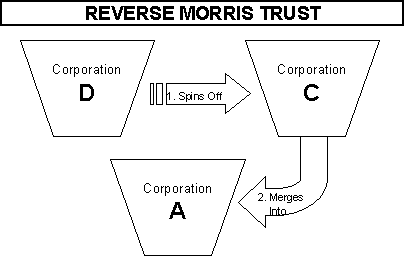
A Reverse Morris Trust - "D"=Verizon, "C"=Spinco, "A"=FairPoint or Frontier

A Reverse Morris Trust - "D"=Verizon, "C"=Spinco, "A"=FairPoint or Frontier

Companies involved in a Reverse Morris Trust deal don’t buy and sell from each other directly.  Instead, the seller sets up a new corporation, usually referred to in company financial reports as “Spinco” and conducts the transaction through that entity.

Spinco issues stock (and why not), which is owned by a majority of the shareholders of the parent company cooking up the sale.

When Verizon cast off its New England customers into the fetid waters of FairPoint, it structured the sale as a Reverse Morris Trust.  Verizon “spun off” Bell Atlantic Communications, NYNEX Long Distance, and Verizon New England assets serving Maine, New Hampshire and Vermont into Northern New England Spinco, a new corporation it created just for the deal.  It needed to find a buyer smaller than itself to take advantage of the tax-free magic of the Reverse Morris Trust.  It found FairPoint Communications, a tiny independent phone company based in North Carolina, dwarfed by the three New England states’ Verizon customers.  Imagine living alone in a one bedroom apartment and then letting The Brady Bunch move in with you.

Spinco, by design, has an addiction to piling on debt.  It’s like giving a shopaholic a wallet full of credit cards all issued by Verizon.  Spinco lards itself with as much debt as it possibly can.  When it’s finally teetering under the weight of  as much as $1.7 billion in debt, Verizon effectively sends a bill saying “we want our money — pay us back our $1.7 billion in full.”  Of course, Verizon doesn’t expect to receive the check.  Instead, it demands Spinco pay a “dividend” in the form of an IOU for the entire amount.

Spinco now has a problem.  Its balance sheet looks terrible.  Would you buy a company that has a $1.7 billion liability on its balance sheet?  FairPoint would, but of course, they knew this was part of the plan all along.

cat (courtesy: cult gigolo)FairPoint now seeks to merge with this Spinco company that has more debt than some third world countries.  State regulators announce they have to examine this deal to make sure a company like FairPoint, now proposing to take on Spinco’s debt, will be able to run the company, make investments in its upkeep and expansion, and still pay back the Bank of Verizon, or whoever else ends up owning the IOU.

Regulators (foolishly) go ahead and approve the deal, and the newly merged Spinco and FairPoint issue stock to Verizon shareholders, the original owners of Spinco.  Verizon also gets cash and securities.  Technically, Verizon shareholders now own 60% of FairPoint.  Of course, nobody says every shareholder gets an equal vote.  In the end, FairPoint runs and manages the entire operation, or tries to, saddled with what is now $2.5 billion in debt and on the brink of bankruptcy.

How much did taxpayers lose from all of this?  Considering the spending machine in Washington is going to get the money from somewhere (us), they are going to be looking at you and I for the estimated $700 million Verizon never had to pay in capital gains taxes.

Make your check payable to “U.S. Government” and make sure it’s in the mail by Halloween.

Yes, this scary story is true, and has a sequel: Frontier and Verizon plan to structure their magic deal using the same technique.

Boo!  (Now add another zero on the dollar amount of your check.)

greedyguy50If this new deal is approved, Verizon walks away with $3.3 billion in tax-free cash.  Verizon shareholders (lucky them) get to be owners of just under 70% of Frontier Communications, soon to be saddled with its own Spinco debt which will run well into the billions.  Knowing this, they dump their stock in Frontier in droves as soon as the deal completes.  Why hang around for another financial Titanic to sink like a rock around their portfolio?

Verizon customers get to join the Frontier Family, and those of us who are already members get to see whether Frontier can survive the minimum monthly payment on that debt.

Or maybe not.

A large contingent of the New England Congressional delegation has written a letter to Rep. Charlie Rangel (D-NY), who chairs the Ways and Means Committee responsible for overseeing tax policy in Congress, asking that a stake be driven through the heart of the loopholes in the Reverse Morris Trust.

Reps. Michael Michaud, Chellie Pingree, Peter Welch, Paul Hodes, and Carol Shea-Porter all signed the letter asking Rangel to reform the Reverse Morris Trust (they abbreviate it “RMT”) and take it away from companies like Verizon looking for a tax-free windfall:

We projected that the transaction [FairPoint-Verizon] would have disastrous consequences in our states.  Unfortunately, our concerns were well founded with widespread consumer dissatisfaction evident across the region.

Recently, we have learned that other states across the country face similar threats to service and employment as Verizon, once again, seeks to avoid taxes through the use of the RMT in its proposed transaction with Frontier Communications.

[…]

Now is the time to restrict the utility and benefits of the RMT to protect the public interest.

West Virginians, in particular, have expressed increasing concern about their state following a similar path northern New England took. Frontier would assume control over all of Verizon’s operations across the state of West Virginia.

“I hope this vital request, now based on past history, isn’t ignored again,” said Elaine Harris, International Representative with the Communications Workers of America.  “West Virginia is being given the opportunity to avoid some of the pitfalls of the FairPoint disaster and it would be a real shame if we simply follow the same path and our communications operations end up in bankruptcy.”

Expect the usual Washington lobbyists to fight to preserve the loophole.  Remember, in the world of Halloween telecommunications finance, tax free trick or treat candy is for closers.


Hey CRTC: Thanks for Nothing (Again) – Canada’s Net Neutrality Rules Demand Abusive Practices Be Disclosed, Not Stopped

Bell Hearts the CRTC (the hearts courtesy of six year old Hannah)One day before the Federal Communications Commission in Washington announced draft guidelines to establish an American Net Neutrality policy, the Canadian Radio-television Telecommunications Commission (CRTC) announced its own guidelines to govern what Canadian broadband providers can and cannot do with the Internet traffic they deliver to millions of Canadian consumers.  While Bell (Canada), the nation’s largest telecommunications company praised the CRTC for its provider-friendly ruling, consumer groups varied their responses from “a step in the right direction” to “weak” to “here comes more gouging.”

The CRTC Net Neutrality policy for Canada essentially permits providers to continue to throttle broadband speeds for both retail and wholesale customers, and block traffic altogether should the CRTC grant permission in “exceptional cases,” as long as the provider discloses the practice to consumers up front, and warns them in advance of any policy changes that further slow their connections.

Laurel Russworm, who runs Stop Usage Based Billing, was not pleased.

“The CRTC decision doesn’t have a silver lining I can find; in fact they essentially said that usage based billing and caps are good tools to use to fight congestion. All Bell Canada has to do is warn us first, then they can gouge as they please. They’ve deferred making a decision on usage based billing until after the court challenges are dismissed, but I’m not holding my breath,” Russworm wrote.

On Wednesday the CRTC decided that Internet providers in Canada need measures to manage the traffic on their networks at certain times to deal with what providers claim to be a congestion problem.  At hearings held this past summer, several CRTC commissioners were receptive to the claims providers made that Canadian broadband does not have the capacity their American neighbors have.  Providers like Bell and Rogers claim that peer to peer traffic and increasing consumption of high bandwidth services have created capacity shortages on their networks, requiring traffic management which artificially slows certain traffic on their networks at “peak times.”  Canadian broadband providers almost universally also impose Internet Overcharging schemes on their customers, limiting customer use and charging them overlimit penalties for exceeding usage allowances.

The commission accepted the providers’ claims and gave the green light to those practices, but said before a provider literally blocks access to online services, or throttles time sensitive traffic on services like Voice Over IP telephone or two-way video conferencing to the point it becomes “degraded,” it needs to get Commission permission first.

Mirko Bibic, Bell Canada’s senior vice-president of regulatory and government affairs, told The Globe and Mail the ruling gives carriers the right to run their businesses the way they see fit. “We’re the experts, and we get the flexibility to determine how to manage our networks to give the user the best experience,” he said.

Bell already “throttles” its Internet service by slowing peer-to-peer downloading between 4:30 p.m. and 1 a.m. to make sure the network is not overloaded by a relatively small number of people transferring large video and music files.

Independent Internet providers are among the biggest proponents of Net Neutrality, and a ban on Internet Overcharging schemes known in Canada as “usage based billing.”  Many Canadian broadband providers obtain connectivity through wholesale accounts purchased from Bell.  The Canadian phone giant imposed both speed throttles and usage based billing on their wholesale customers.  Those costs, and the speed bumps that go with them, are now increasingly passed on to consumers.  Independent providers fear being put out of business.

For many of them, Wednesday’s decision might as well never have happened.

“This has really not changed anything,” Tom Copeland, chair of the Canadian Association of Internet Providers, told PC World.

Copeland said the “biggest, most glaring omission” from the ruling is the lack of restraints on the time of day or how long suppliers like phone or cable companies can manipulate traffic. “So we could continue to see traffic management every day of the year,” he said.

“We’re still not addressing the cause of the problem,” he added: “Either weak points in the network, or abuse by users.” Most casual users of peer-to-peer applications — the biggest offending programs in the eyes of providers – aren’t the problem, he said.

“We just went backwards at warp speed,” lamented John Lawford, counsel for a coalition of consumer groups that fought for an end to throttling of Internet traffic of consumers, “ while we watch the U.S. rocket ahead.”

“The CRTC has said in this decision that ISPs own your content and own your Internet connection” said Lawford, “You just got owned.”

The Public Interest Advocacy Centre represented the Consumers’ Association of Canada, Canada Without Poverty and Option consommateurs during the hearings on Net Neutrality.  PIAC argued that the Telecommunications Act required ISPs not to interfere with customers’ Internet traffic unless such traffic was clearly harming other users of the network and not otherwise.  “ISPs should act as common carriers and just carry traffic, not as broadcasters deciding what you watch” continued Lawford, “but now they can decide what gets through – and how much they get to charge you for the privilege.”  Lawford also noted the CRTC’s requirement for the ISPs to disclose their “Internet traffic management practices” will not actually stop any of the practices.

The CRTC has repeatedly taken broadband industry-friendly positions in direct opposition to Canadian consumer interests, helping to set the stage for Canada’s rapid decline in broadband leadership.  The country’s standing in broadband rankings has taken a stunning fall from its earlier top-shelf position.  Regulatory policies that permit abusive, anti-competitive practices and reward providers for rationing broadband instead of investing in expanding it are at the heart of the problem.

Since the CRTC has taken positions more worthy of a industry trade group than an independent regulator, an increasing number of Canadians are demanding the CRTC lead or get out of the way.  A large group of Canadian voters upset about any issue is sure to attract politicians, and the New Democratic Party of Canada (NDP) has arrived.

Charlie Angus (NDP)

Charlie Angus (NDP)

Charlie Angus, New Democrat Digital Affairs Critic and MP for Timmins-James Bay, who already is on record opposing Internet Overcharging schemes, says the CRTC dropped the ball on Net Neutrality.

“Yesterday’s CRTC decision on Internet traffic-management practices is a blow to the future of digital innovation in Canada,” Angus said in a statement.

“This interference [from traffic management] will be bad news for small third-party competitors and leaves consumers subject to digital snooping and interference from cable giants,” he added.

“Basically the CRTC has left the wolves in charge of the henhouse. ISP giants have been given the green light to shape traffic on the internet in favor of their corporate interests,” he said. “This decision is a huge blow to the future competitiveness of the Internet.”

Angus says that the premise of today’s decision – that notification from the ISP will allow customers to make an informed decision on where to buy Internet service – misses the harsh reality that the market for Internet service in Canada is not nearly competitive enough to work.

“Canada has fallen to the back of the pack in Internet service provision and pricing after leading the way for years. This is the direct result of a small band of ISP giants blocking out competition,” Angus said. “This decision clears the way for ISPs to squeeze out third-party players who are attempting to provide better price and service options.”

South of the border, the FCC has taken clear steps toward the establishment of Internet neutrality on U.S. networks.

Angus said that principle of Net Neutrality should be at the center of Internet policy in Canada, and that the CRTC has missed a golden opportunity with yesterday’s decision.

“The principle of Net Neutrality must be a cornerstone of the innovation agenda. The CRTC has once again acted as the rubber stamp for large ISP and cable players to dominate the market and decide which traffic goes in the fast lane and which traffic gets stuck in the slow lane. This decision continues a long and dismal tradition of Canada’s communication policy decisions chipping away at the public interest to the benefit of a few corporate giants.”

Dissolve the CRTC, a group collecting signatures to petition for the closure of the Commission, also made several comments about the CRTC decision.

Among their conclusions:

  • The new policy leaves the door open to providers deciding their economic interests are better served from traffic management practices like throttles and usage limits than network investments.  Short term limits may serve the interests of stockholders, but could discourage long term investments needed to create new 21st century broadband platforms;
  • The Commission’s encouragement that providers make additional investments in their networks is likely to fall on deaf ears.  It was Bell’s lack of investment in their broadband network which led to the traffic management practices, and the recent hearings about them, in the first place.  Without mandates, there is no real pressure on Bell to change their investment strategy.
  • The Commission’s policy to regulate this issue through a user complaint process that calls out bad actors has no historical precedent of working.  The CRTC has a long history of ignoring public involvement in telecommunications proceedings, and does not like to involve themselves with individual customer complaints.  Campaigns to flood the CRTC with complaints on specific issues using their language may be the only way to get them to investigate.  Additionally, complaints that call out the disparity in network management policies between wholesale and retail accounts may only lead to additional restrictions on both types of accounts, making a bad situation even worse.

Canadians must contact their elected officials and demand federal legislation to enact true consumer protection and broadband reform policies to restore Canada to a position of leadership in broadband.  The CRTC is ineffective and must not be the final arbiter on these important issues.

Search This Site:

Contributions:

Recent Comments:

Your Account:

Stop the Cap!