Home » Issues » Recent Articles:

Wall Street Journal Does Hit Piece on Australia’s National Broadband Plan — Hint, Hint to American Policymakers

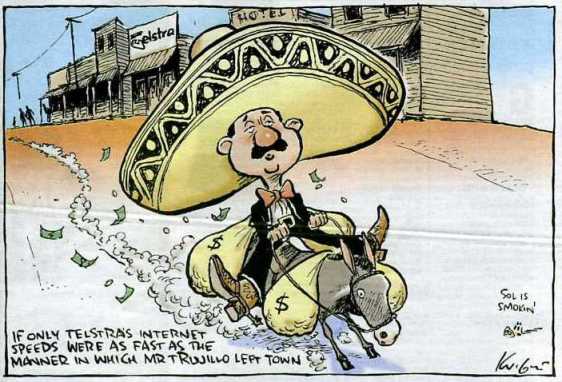
Sol Trujillo, the former head of Telstra, was routinely depicted in the Aussie cartoon press in a sombrero reflecting his Mexican heritage

Sol Trujillo, the former head of Telstra, was routinely depicted in the Aussie cartoon press in a sombrero reflecting his Mexican heritage

Yesterday’s Wall Street Journal Opinion page features a piece of nonsense from Holman Jenkins, Jr., one of the editorial writers for the paper, decrying Australia’s “Broadband Blunder” by not allowing Telstra, the dominant provider, free market means to define problems and create solutions in broadband.  The editorial carries a clear subtext for American policymakers — let the free market do it all and keep government out of it (unless they want to cut some checks with taxpayer money or other subsidies, of course).

Australia lacks America’s bottomless think-tank and K Street resources for publicizing policy differences. Its parliamentary government puts all the policy levers, including a ready resort to secrecy, in the ruling party’s hands. Australia is a small nation, with a small elite that tends to place limits on burn-the-bridges debate.

This may sound ideal to Americans, but the results aren’t always good, says Mr. Burgess. Australia, like America, has its “wingnuts,” he says, but they don’t get a hearing. “There’s no sharpening of issues. Policy ideas aren’t fully vetted.”

The [National Broadband Network] NBN, a tremendously awful idea, is a case in point. The government wants to spend $39 billion to deliver 100 megabits to every household in the next decade, without the slightest idea how it might be done commercially or whether customers, who already can get 21 megabits through wireless in most of the country, would be willing to support NBN’s huge costs.
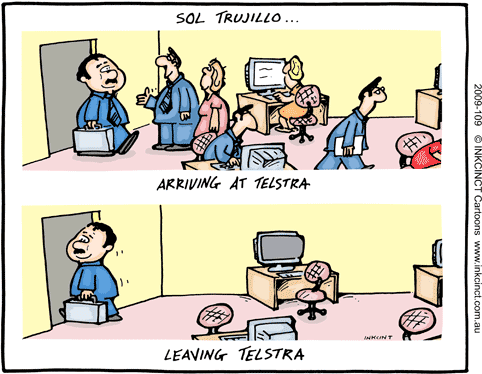
Trujillo was reviled for increasing his own compensation package while presiding over massive cost-cutting layoffs

Trujillo was reviled for increasing his own compensation package while presiding over massive cost-cutting layoffs

That’s a remarkable bit of news, for both Americans and Australians.  Jenkins comes right out and tells all of corporate America’s best K Street secrets.  Australia doesn’t have the corporate money-astroturf PR-influence machine that frames debates with a corporate point of view.  ‘Burn-the-bridges debate’ is the way Jenkins might characterize it, but burning actual facts and reality for astroturf fiction is more in keeping with reality.  On just about any issue, from energy deregulation to banking reform to last summer’s often-ridiculous health care debate melodrama filled with death panels, hiring a PR firm that can launder corporate-string-pulling-connections guarantees you can lie, distort, and obfuscate anything into something it’s not, in hopes of dispensing with it.  The Net Neutrality as Marxist Plot nonsense emanating from Americans for Prosperity and Glenn Beck is just the latest example of the broadband policy Distact-O-Matic in use.

American wingnuts not only get a hearing, they often get all of the attention, particularly in the television media.  The more outlandish and dramatic the video, the better.  Policy issues are never vetted at all when you start “sharpening of the issues” with accusations Mao Tse-tung is the founding father of Net Neutrality.

Australia’s NBN is hardly an example of government trying to compete with private industry.  In fact, it was the private industry which built the slow, incrementally upgraded, usage capped, and expensive network that misses large portions of the country which drove the government to consider doing what private industry simply refused to do – provide Australians a state of the art broadband platform.  It’s obvious the government doesn’t need to “do it commercially” with large profits and leveraging higher prices in non-competitive markets — they just need to see it gets done and paid for, recognizing Telstra and other providers will not spend the money to build it themselves because they don’t like the long term wait for that investment to be paid back.

Most Australians will also be surprised to learn they can obtain 21Mbps through wireless “in most of the country.”  In fact, reasonably priced broadband in Australia is much slower, and carries a small usage allowance.

Of course, it takes an unwonted faith in government to believe it will deliver the promised digital nirvana on-time, on-budget or at all. In the meantime, Telstra would have no incentive to invest in its own network, so Australia could end up with the worst of possible outcomes: neither a shiny new functioning government network nor an existing Telstra network that keeps pace with technology and customer demand.

Ah, the elusive “incentive to upgrade” reasoning.  The moving target of what represents appropriate incentive (extra fat profits, no competition, keeping costs low by rationing service) may work very nicely for interested shareholders but do little to advance the broadband platform either in Australia or the United States.  This debate is not new.  Decades earlier, power companies argued that rural areas didn’t need electrification because farmers wouldn’t use it (or afford it), or it was simply too expensive to wire for too few customers.  Citizens in both countries will have to impress on their government whether they consider broadband service a nice luxury to have or an essential utility that must be provided, even if it means bypassing the ‘100% free market’ approach that turns up their noses at rural residents or those deemed too poor to afford it.

Just because Jenkins claims Telstra keeps pace with technology and customer demand doesn’t make that reality.  Australians would argue both points, particularly comparing what they get for their money versus what we get in the United States for ours.

The rest of the piece is a glorification of Sol Trujillo, the controversial former head of Telstra, who has been compared with George W. Bush and Karl Rove for his combination of “I am the decider” confidence and Rove’s “take no prisoners” style of defending those decisions.  Jenkins suggests the source of the active dislike of Trujillo was his willingness to go personal in attacking Australian officials in speeches and press accounts.  But many more Australians would find fault with Trujillo’s very generous compensation package and benefits he and his associates earned even while the stock underperformed under his leadership, and with the sluggish, expensive, and capped state of Telstra’s broadband as he left.

Cell Phone Follies: AT&T Sues Verizon Over 3G Map, T-Mobile Suffers Second Nationwide Outage

Phillip Dampier November 4, 2009 AT&T, Broadband Speed, Competition, Verizon, Wireless Broadband 3 Comments

[flv]http://www.phillipdampier.com/video/There’s a Map for That 1.flv[/flv]

Verizon’s “There’s a Map for That” Advertising Campaign: Spot 2 (pre-revision — includes “out of touch” language (30 seconds)

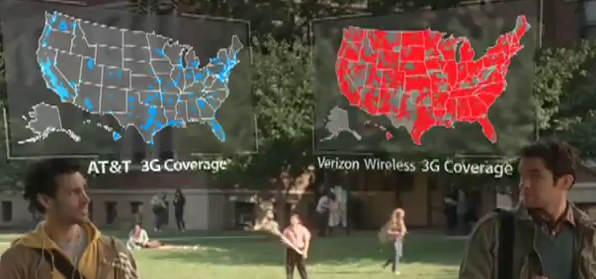
Verizon's advertising only displays network coverage of 3G service areas

Verizon's advertising only displays network coverage of 3G service areas

AT&T Mobility has filed suit against Verizon Wireless in the Northern District Court of Georgia (Atlanta Division) demanding the court order Verizon to stop running ads that suggest AT&T has lousy wireless 3G data coverage.

The suit comes in response to a series of advertisements from Verizon that compare the coverage maps of both companies “3G” wireless data networks.  The term “3G” refers to the third generation (3G) of mobile telephony standards – IMT-2000.  In general terms, local wireless networks upgraded to provide 3G service can provide much faster wireless data speeds than those still operating under older standards like “2G.”

Verizon Wireless has aggressively deployed 3G upgrades across its service area, while AT&T has largely focused on more urban population centers for their 3G upgrades, something Verizon’s advertising calls out.

The crux of the suit is exactly how Verizon depicts the differences in coverage.

AT&T claims the ads leave viewers with the impression that those vast white areas depicted on the coverage map designated by Verizon as “AT&T,” are areas without any data coverage at all.  Most cell phone company coverage maps routinely depict “no service” areas in white, and AT&T claims Verizon underlined the impression in its ads, including one on radio, that included the phrase “out of touch” when speaking about non-3G AT&T service areas.  AT&T described the ad above as showing “a frustrated or sad AT&T customer sitting alone on a bench because she is not able to use her wireless device to meet up with her friends.”

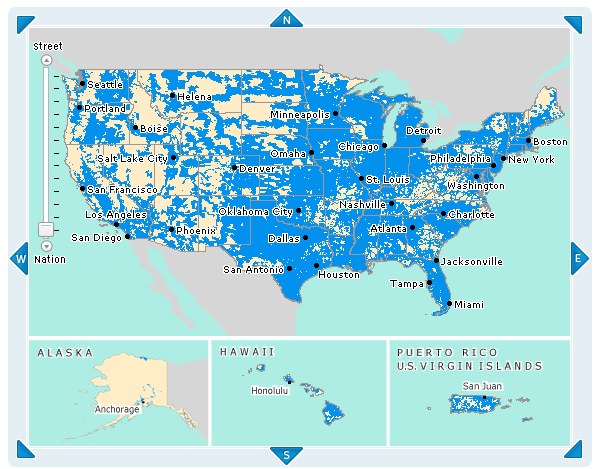
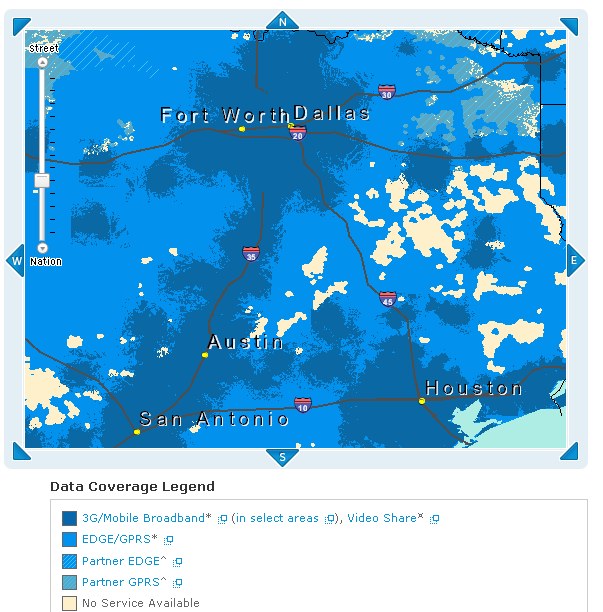
AT&T Mobility’s own coverage map depicts data coverage in varying hues of blue, designating the different types of data service coverage available nationwide, but those different hues and service areas only become apparent after starting to zoom in on specific regions of the country.

AT&T's "Nationwide" Coverage Map for Data

AT&T's "Nationwide" Coverage Map for Data

AT&T's coverage map changes when you zoom in, depicting the different types of network standards used in different areas.  This map of eastern Texas shows coverage ranging from 3G to woefully slow EDGE networks owned by "AT&T partner" companies

AT&T's coverage map changes when you zoom in, depicting the different types of network standards used in different areas. This map of eastern Texas shows coverage ranging from 3G to woefully slow EDGE networks owned by "AT&T partner" companies

On AT&T’s maps, areas in white are labeled “no service available.”

On October 7th, AT&T Mobility contacted Verizon Wireless and demanded that they either cease the ads or modify them to make them, in AT&T’s words, “less misleading.”

In response, Verizon dropped the “out of touch” language from the ads and inserted a fine print disclaimer at the bottom indicating “Voice and data services available outside of 3G areas.”

AT&T considers the modifications inadequate and filed the lawsuit asking for a cessation of the ads and monetary damages from perceived ill-gotten profits from Verizon snatching away AT&T customers.

Verizon’s defense?  Accuracy.  Verizon Wireless’ ads never stop referring to “3G service” and both maps include specifically labeled “3G Coverage.”

AT&T argues that their network is actually more expansive than Verizon’s, when you also include AT&T’s more prevalent 2G and earlier wireless data standards.  But that’s arguing apples and oranges.  Verizon intends to promote and leverage benefits from upgrading its service areas, large and small, to 3G service.  AT&T has not done that, and in fact has been on the receiving end of criticism from customers frustrated at times with the poor performance of its network, including slow data speeds, dropped calls, and insufficient coverage in certain areas.

Verizon's ads clearly depict "3G Coverage" on their map comparison

Verizon's ads clearly depict "3G Coverage" on their map comparison

The gadget enthusiast press has not been enthusiastic about AT&T’s lawsuit, wishing the company would be as enthusiastic with network upgrades as they are engaging their legal team to fight Verizon, or is little more than a whining villain that has been exposed for its inadequacies.

AT&T customers frustrated with their mobile experience are probably still better off than T-Mobile customers, some of whom spent much of yesterday with no service at all.  In the second nationwide outage in two months, T-Mobile claims about two million customers nationwide experienced voice and data service outages for much of the day, although anecdotal reports suggest a company estimate of “five percent of customers impacted” is low.  No explanation for the outage was given.  This comes after an embarrassing server failure in October which led to some T-Mobile Sidekick customers being without service for up to a month, as well as a loss of stored data which company officials have slowly tried to restore weeks after the system crashed.

Hong Kong Broadband Network Cuts Price in Half – 100Mbps Service for $13 A Month

Phillip Dampier November 2, 2009 Broadband Speed, Competition, Video 9 Comments

Hong Kong Broadband Network, the wholly owned subsidiary of City Telecom, has just slashed the price for its 100Mbps “bb100” fiber optic broadband service.  When a customer finds a friend willing to sign up, both will receive the broadband service for $13 US per month for 24 months, which represents a 50% discount for each customer.

At this price, Hong Kong residents pay just $0.06/megabit-per-second, which includes a speed guarantee that customers will receive at least 80% of advertised speed when surfing domestic websites.

William Yeung, Chief Executive Officer of HKBN noted that at least 32% of Internet users in Hong Kong suffer from broadband speeds below 10Mbps, and the Hong Kong special administrative region of the People’s Republic of China lags behind Korea and Japan in terms of fiber to the home service, something Yeung would like to see changed.

He considers Hong Kong’s broadband development rating “comfortably enjoying today’s applications” to be inadequate, and wants to see Hong Kong have universal access to 100Mbps or greater speed broadband.

“Being the second largest broadband service provider, we have a duty to improve Hong Kong’s global standings,” Yeung said.

HKBN provides speeds up to 1Gbps in Hong Kong over its fiber optic network.  Hong Kong’s broadband ranking is important to the region for economic reasons, attracting new industry and high paying technology jobs with fast, affordable broadband service.

What Hong Kong considers inadequate is still well ahead of the United States, which continues to lag behind several Asian nations in constructing advanced high speed broadband platforms.

Hong Kong’s population density, which poses a challenge for some services, is actually a benefit for telecommunications, because construction costs are lower when wiring densely populated multi-dwelling units and apartments.

The company currently has 391,000 broadband customers, attracted to the company in part by their creative advertising campaigns.

[flv]http://www.phillipdampier.com/video/HKBN Member Get Member Promotion.flv[/flv]

HKBN makes Hong Kong’s population density a net plus for fast, affordable broadband.  William Yeung announces “Member Get Member Promotion” from HKBN and unveils new advertising campaign. (3 minutes)

Several weeks ago, Stop the Cap! included several HKBN ads for your review.  We’ve now obtained English subtitled copies to share, below the jump.

… Continue Reading

Spin Cycle: FairPoint Bankruptcy “Is A Good Thing”

Phillip Dampier November 2, 2009 Editorial & Site News, FairPoint, Public Policy & Gov't Comments Off on Spin Cycle: FairPoint Bankruptcy “Is A Good Thing”

Phillip Dampier

Phillip Dampier

The Concord Monitor published an editorial Sunday suggesting that FairPoint Communications’ crash and burn bankruptcy is, in fact, a good thing for New Hampshire.

FairPoint’s bankruptcy was always a distinct possibility. At this point, it’s good that it happened. The massive reduction in debt that will result will either allow the company make good on its promise to provide widespread broadband service or make it attractive to a buyer capable of doing so. Surviving on landlines alone isn’t an option.

FairPoint’s debt would have been hard to repay even in good times by a smoothly operating company. The severe recession, lousy service that caused customers to flee in droves and high interest rates on its debt doomed FairPoint.

This is like saying the GM’s bankruptcy was a great thing for Detroit.  The Concord Monitor would do better to beat the drum for utility commission reform, to make sure such bad deals don’t get approval in the first place.  As it stands, FairPoint’s promises aren’t worth much in good times or bad.  How many broken promises should cust0mers endure before realizing money alone does not resolve bad decisions, bad implementation of those decisions, and now “cost savings” from a company that cannot afford to lose a single technician or customer service employee.

Making FairPoint attractive for a buyout or merger means slashing costs, and we all know where that will happen – among local employees who do the work to keep the company running.  Another merger or buyout with a sweet bonus for management will do little for New Englanders who rely on FairPoint for telephone and broadband service unless the buyer has the resources to provide a more advanced platform for telecommunications in this century.

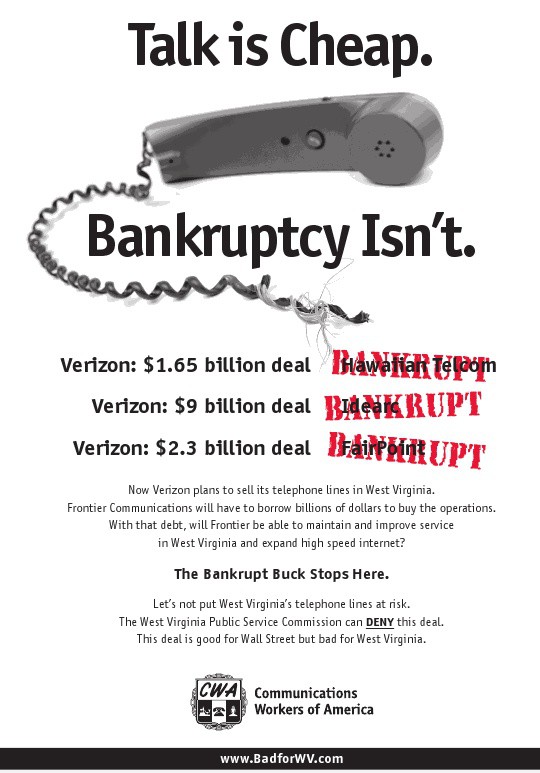
The editorial is right in calling out the enormous debt FairPoint took on to make the deal happen.  It would be hard to repay in good times by a smoothly operating company, which is precisely why those who live in the next round of cities Verizon is about to cast into the wild Frontier should be so very wary.  The economy, it’s suggested, is getting better, but for those of us in economically challenged states like New York, Ohio, West Virginia, and others where Frontier operates wouldn’t know it from looking around their communities.  If FairPoint thinks it has a challenge now, watch as customers trying to economize continue to pull the plug on their phone lines.  As cell phone plans continue to offer more minutes (or unlimited access), why pay for two phone bills when one is high enough?

Most of FairPoint’s customers have another option: cell phones. Between June 2008 and June 2009 the company lost 11 percent of its landline customers. They’ll lose customers even faster if they raise prices. There are other threats to FairPoint’s future. Small companies and cooperatives are beginning to offer wireless internet service in rural areas. So even if FairPoint succeeds in extending broadband into the boonies, it could face competition.

Considering FairPoint, like Frontier, is relying on rapidly aging ADSL technology for broadband, and has few apparent plans to meet the needs of a wider bandwidth future, old fashioned DSL broadband isn’t far behind copper wire landlines on the endangered species list.  But FairPoint, like Frontier and other independent companies focusing on rural communities may be betting their business plans that for the same reason Verizon said goodbye, would-be competitors will never drop in and say “hello.”  In communities too small for cable companies, the prospect for wireless broadband, or other competition, isn’t exactly rosy.

Not so the investors in FairPoint, who will exchange hundreds of millions of dollars in debt for stock that at week’s end was trading for just over a dime a share. The investors gambled and lost. The free market worked.

The free market worked particularly well for Verizon, who played the system and won an enormous bounty.  Investors taking a beating will write off their losses and move on.  Where do rural FairPoint customers go to write off their loss in the broadband backwater they’ll be stuck in indefinitely?  FairPoint actually represented another failure in the free market, because of the lack of appropriate oversight which should have taken one look at this deal and the debt pile-on it represented, and then rejected it as inappropriate for a utility to gamble with ratepayers’ money.

FairPoint made a number of commitments to win state approval of its purchase. Whether such agreements must be kept is now up to the court.

Utilities are classically required to provide universal service. Urban customers subsidize service for rural ones for the good of society and because they may want to communicate with them. But the game changed when technology allowed other unregulated companies to poach on a utility’s turf by offering cheaper or better service.

FairPoint will keep operating, and its customers are unlikely to see any effect from its decision to declare bankruptcy to reorganize and shed debt.

Don’t pick me up off the floor shocked and surprised when FairPoint and its banker-owners walk into court begging to be freed from the “onerous commitments” they made to get the deal done in Maine, New Hampshire, and Vermont.  Those “hard won” concessions by utility oversight boards may be nothing but memories soon enough.  The game change of telecommunications choice has come to more urban areas, where customers have options.  That isn’t necessarily the case for rural New England consumers without cable and with zero bars on their cell phone from home.

Customers who earlier thought that no changes in the quality of their FairPoint service meant “more crappy” service in their future may find the “crap bar” still has plenty lower to go should the company seek to realize its fiscal conservatism at the expense of its experienced and competent workforce who have coped with bad management decisions since day one.  Somehow the “must keep” employees might just turn out to be the same folks at FairPoint headquarters in North Carolina who made the bad decisions that put the company in its current predicament.

Strong, careful oversight of any restructuring is essential to protect New England ratepayers from being victimized all over again.

Search This Site:

Contributions:

Recent Comments:

Your Account:

Stop the Cap!