Home » Issues » Recent Articles:

The DC Circuit Court Likely to Protect & Preserve Corporate Broadband Control

Phillip Dampier January 21, 2010 Comcast/Xfinity, Net Neutrality, Public Policy & Gov't 6 Comments

DC Circuit Court

Once again, the United States Court of Appeals for the District of Columbia Circuit is proving to be the best friend corporations have to unravel regulatory policy and consumer protection laws that might violate corporate free-speech or trade rights.  It has become a favored venue for telecommunications providers who want to be rid of pesky prohibitions or reasonable regulation.

After a series of arguments, universally considered disastrous for the Federal Communications Commission’s authority to regulate broadband, the cable operator may want to send flowers to the Court… a lot of them.

Earlier this month, attorneys for the FCC defended their right to tell Comcast it cannot throttle its customers’ broadband speeds.  The FCC maintains it has regulatory authority over broadband service, claiming such power could be inferred from Title I, Section 230(b) of the Communications Act, which states that it is the policy of the United States “to preserve the vibrant and competitive free market that presently exists for the Internet” and “to promote the continued development of the Internet.”  From that the FCC wrote a policy statement stating it was, “necessary to ensure that providers of telecommunications for Internet access or Internet Protocol-enabled (IP-enabled) services are operated in a neutral manner.”  That was the basis for their crackdown against Comcast’s speed throttle.

After the arguments between Comcast and the FCC concluded, court-watchers believe the Commission’s days of broadband oversight are numbered.

Ars-Technica’s Matthew Lasar documented the probable train wreck for those who seek to rein in provider abuses.

At issue is whether the FCC has been granted direct legal authority for Internet regulation by Congress. Comcast, and as it turned out many on the Court, believe the FCC is relying on policy statements, not written law, for their regulatory authority over Internet Service Providers.  The Court transcript says it all:

Randolph

“In looking this over I found a good many situations in which Congress has instructed the FCC to study the Internet,” said Justice A. Raymond Randolph, [appointed to the Court by President George H.W. Bush in 1990], “and taxation of transit sales transactions on the Internet, and this, and that, and the other thing. But what I don’t find is any congressional directive to the FCC to regulate the Internet.”

It wasn’t hard for [Comcast attorney Helgi G.] Walker to summon a response to this observation. “That’s right,” she declared.

And with that, Comcast had won. Even before the FCC’s attorney got to the bench, the judges were doing Walker’s job, swatting aside arguments on behalf of the agency’s Order sanctioning the ISP. Pro-FCC briefs to the court had noted that the Supreme Court recognized the Commission’s ancillary authority in its Brand X decision, a crucial ISP access case. Randolph threw this bullet point into the trash icon, referring to the “offhand statement” in Brand X. “And the Supreme Court has moved so far away from that kind of an analysis in today’s modern jurisprudence,” he added, “it seems antiquated.”

By the time Commission lawyer Austin C. Schlick began his rebuttal, Randolph moved in for the kill.

“May it please the Court,” Schlick began. “Ms. Walker hasn’t attempted to defend the actual network practices that were employed here, and so I won’t spend time just… ”

Sentelle

[Justice David] Sentelle cut him off. “Well, her position is that she doesn’t have to,” he tersely noted. “She’s here to say that you don’t have any business inquiring into those practices, ergo we don’t either.”

That’s true, Schlick conceded. “Right,” Sentelle warned. “So you may want to move on to something that’s at issue then, Counsel.”

And that was largely that.  The Court is very likely to hand down a ruling that strips the FCC of its ability to regulate or oversee broadband service in the United States.  Even Schlick knew what has forthcoming:

By the end of the discussion Schlick was bargaining with the judges. “If I’m going to lose I would like to lose more narrowly,” he confided. “But above all, we want guidance from this Court so that when we do this rule-making, if we decide rules are appropriate we’d like to know what we need to do to establish jurisdiction.”

“We don’t give guidance,” Randolph grumbled, “we decide cases.”

Comcast should have bought lunch for everyone.

So now public policy groups and advocates of FCC oversight over broadband, particularly as it relates to Net Neutrality, are scrambling to figure out what to do next.

It comes down to four possible outcomes:

  1. One of the parties appeals the case;
  2. Corporate control of broadband without oversight is assured, as the FCC is stripped of any regulatory authority;
  3. The FCC manages to find some other wording from laws Congress passed that justifies lawmakers wanted the agency to oversee and regulate broadband services;
  4. Congress passes new laws specifically enacting broadband regulatory authority for the FCC.

Of course, today’s bland authority over broadband comes as a result of legislative compromise from the great regulatory battles over telecommunications during the Clinton Administration.  Providers argued less is more, and have grudgingly accepted limited FCC authority over some of their services, except when a challenge threatens to cost them control or a lot of money.

With a hostile reception at the Court, and the FCC’s “surrender first, fight later” legal argument, an appeal may only delay the inevitable.  The FCC does have plenty of Congressional directives to review which may permit it to enact Net Neutrality protection, but another provider lawsuit opposing Net Neutrality is inevitable.  In fact, without the passage of a clear, concise federal law providing the Commission with explicit broadband regulatory authority enacting Net Neutrality and other protections, the aptly-numbered “2” is the likely outcome for consumers.

Thankfully, Rep. Edward Markey’s (D-MA) Internet Freedom Preservation Act would solve much of this problem, by forbidding Internet service providers from doing anything to “block, interfere with, discriminate against, impair, or degrade” access to any lawful content from any lawful application or device.

Getting it passed in a Congress mired in division is another matter.  The best way to overcome that is a strong showing of support for Markey’s legislation in calls and letters to your members of Congress, and that you are carefully watching their votes on this issue.


Verizon Is Not Kicking Off Copyright Violators… For Now Anyway

Phillip Dampier January 21, 2010 Astroturf, Net Neutrality, Public Policy & Gov't, Verizon Comments Off on Verizon Is Not Kicking Off Copyright Violators… For Now Anyway

The issue of copyright enforcement is a thorny one, and Stop the Cap! doesn’t spend a lot of time dwelling on it, except when it sneaks its way into our issues.

CNET News started a brush fire yesterday when they quoted a Verizon representative who claimed the company had been kicking off users who use peer to peer (typically torrent) software to exchange copyrighted material.  The gist of the piece was that Verizon has been receiving copyright infringement notices from copyright enforcers and they’ve been notifying their customers to stop or risk service suspension.

“We’ve cut some people off,” Verizon Online spokeswoman Bobbi Henson told CNET. “We do reserve the right to discontinue service. But we don’t throttle bandwidth like Comcast was doing. Verizon does not have bandwidth caps.”

With that purported admission, the story was off and running.  We received several news tips about it from readers.

But this morning, Henson claims she was misquoted and the company has not actually suspended anyone’s account, but reserves the right to do so.

For now, anyway, it appears there has been no policy change at Verizon.  The company dispatches canned e-mail messages to account holders targeted in copyright complaints asking them to stop the infringing activity.  Verizon claims most don’t have to be warned twice.  That’s a commonly found policy at most providers.

The movie and music industry have reduced the number of lawsuits it brings against alleged violators, but that doesn’t mean they’ve given up the fight.

Instead, both industries have launched lobbying and astroturf efforts to inject copyright protection into the broadband expansion and Net Neutrality debates.  The Arts+Labs “think tank” was a perfect example of that, trying to conflate Net Neutrality with piracy in the music industry’s dog and pony show performance at the New York City Council Technology In Government Committee hearing regarding Net Neutrality.

The industry hopes it can insert something akin to a “three strikes” provision into telecommunications law that would bar repeat copyright violators from having Internet access. Unfortunately, history has shown that the bar has been set so low as to what represents “proof,” a mere allegation under these policies could be sufficient to put your finances and potential broadband access in peril.

Full Disclosure? The Self-Interested Who Write Opinion Pieces Opposing Net Neutrality

Phillip Dampier January 21, 2010 Editorial & Site News, Net Neutrality 3 Comments

The Buffalo News ran a commentary piece from Massachusetts for readers in western New York

It is becoming more important than ever to break out Google when you find anti-consumer rhetoric in your local newspaper or online regarding Net Neutrality.  Too often, newspapers, local broadcast media, and online news sources don’t bother to fully inform their readers or viewers about inherent conflicts of interest found in those advocating opposition to Net Neutrality.

Case in point, a commentary in The Buffalo News titled “Policy meant to protect users could stifle innovation.”  The only thing Net Neutrality threatens to stifle is the author’s paycheck.

The writer, Susie Kim Riley, paints a Net Neutral-world of grainy online video, no more “lite” plans for those who only need to use the net to send and receive e-mail, uneven downloads, and bans on video conferencing for small businesses introducing new products.

Shame on you, dear readers, for wanting a free and open Internet without your provider interfering with your service to enhance their bottom line.

Remarkably, this blizzard of bull didn’t just turn up in the Buffalo newspaper.  Riley’s scaremongering also turned up nearly word for word in The Detroit News.  Apparently newspapers are hard-pressed to publish the views of local residents and are now regurgitating mass-mailed opinion pieces written in other states.

Most anti-Net Neutrality drivel shares common themes which we like to call industry talking points.  Their overall theme: the nasty government, without cause, wants to overregulate the Internet to tie the hands of innocent providers who seek better products for their customers.

Stop the Cap! readers have had plenty of experience with helpful providers who bring these appetizers to the table:

  • Internet Overcharging schemes that claim “fair pricing” through usage caps and tiered billing, but in fact cost everyone more;
  • Throttled broadband speeds, often causing a 90 percent or more reduction in advertised speeds for services targeted by providers;
  • Schemes to monetize broadband products and services by providing “enhanced” service to those willing to pay to have their content “enhanced;”
  • Exemptions from usage caps and meters for content partners;
  • An unwillingness to make appropriate investments in highly profitable broadband networks, instead relying on traffic reduction schemes like caps, allowances, and high pricing to discourage “excess usage.”

Twice is Nice. The Detroit News ran the same guest editorial, nearly word for word, as The Buffalo News

Where Net Neutrality goes unprotected, providers begin rolling out Stifled Broadband.  Canada, Australia, New Zealand, and several other countries endure this today.  The only innovation this brings is new ways to charge consumers more money for worse service, making a handful of barely competitive providers very rich.  But such wealth empires aren’t created by providers alone.  Selling the equipment that fiddles with your Internet connection to throttle speeds, monetize usage, and cut off “abusers” is a growth industry as long as Net Neutrality protection is kept at bay.

Stifle it.

That’s where Riley comes in.  She is founder and chief technology officer of a company called Camiant, which bills itself a leader in “real time policy control.”  Control is right.  Camiant’s products and services are all about controlling your online experience.  Her company sells products like “Multimedia Policy Engines,” which can artificially impede or enhance broadband traffic at the whim of your provider.  Just add their “Fair Usage Management” (FUM) extension and your provider can begin spying on your usage: determining what you are doing with your broadband connection, measuring if you are a heavy user/abuser worthy of punishment, and then injecting the appropriate punishment — throttled broadband service, a bigger bill from usage penalties and fees, or even being kicked offline.  Your provider has a world of arbitrary, easy to configure limits, fees, and penalties at his disposal thanks to FUM.

In short, Camiant’s bread and butter is spread by the cable and telecom industry who buys the company’s products and services.  Is it any surprise Riley is opposed to Net Neutrality?  Pass it and Camiant either needs to develop a new line of products or subsist on selling their schemes abroad, where such protections might not exist.

Of course, newspaper readers don’t have any information about Riley’s very-vested interest in this debate.  Although both papers identify Riley as “founder and chief technology officer of Camiant, a technology firm in Marlborough, Massachusetts,” calling Camiant a technology firm is about as informative as calling Hurricane Katrina a weather event.  Lack of full disclosure does a great disservice to readers of both newspapers.  Instead, how about “Camiant markets and sells products that may be prohibited if Net Neutrality becomes law in the United States.”

Me Too: Alaska Communications Systems First Among Regional Carriers to Match AT&T/Verizon Wireless Unlimited Pricing

Phillip Dampier January 20, 2010 Competition, Wireless Broadband 2 Comments

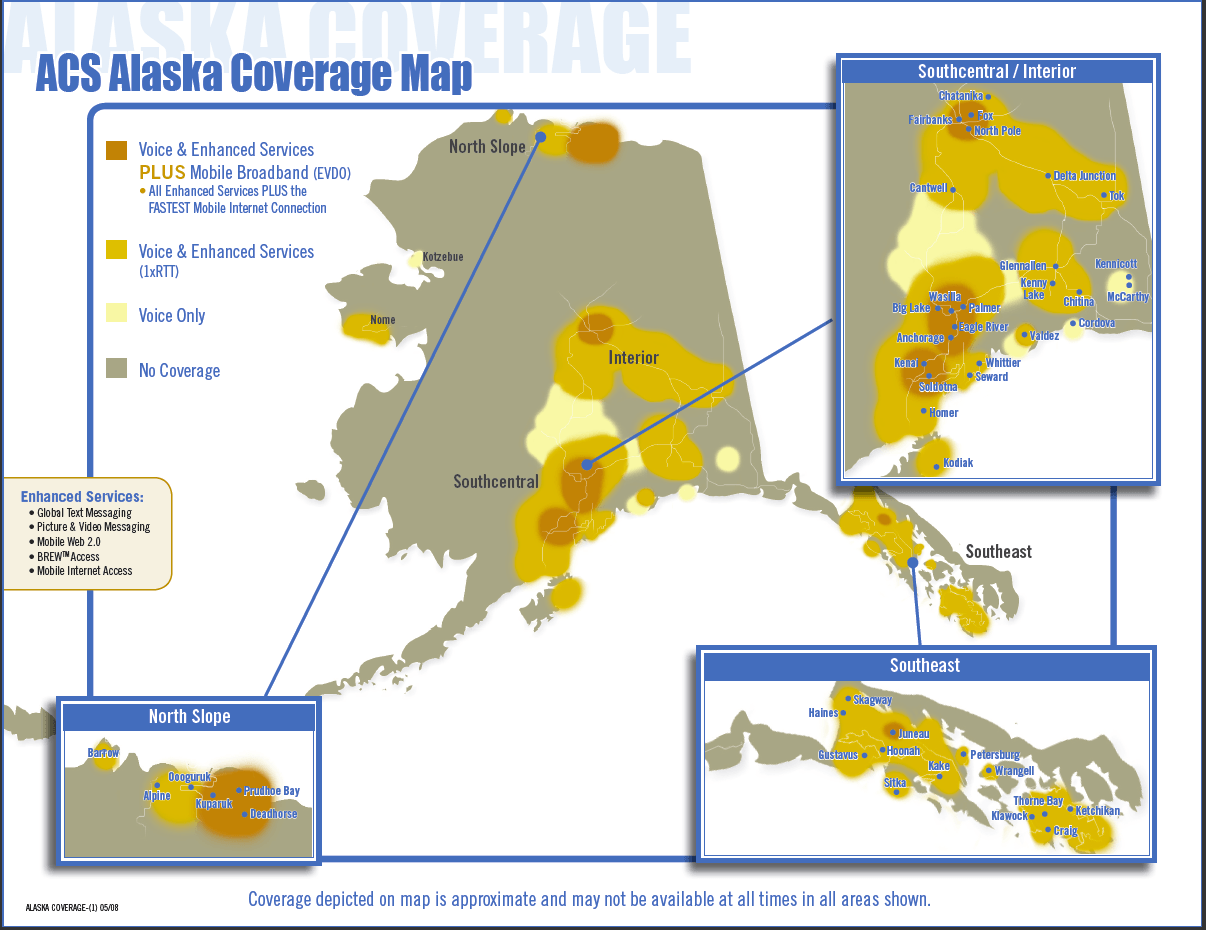
Beyond the nation’s largest wireless phone companies, there are a handful of regional providers delivering service to customers the big carriers bypass.  In one of the nation’s most rural states, Alaska Communications Systems is the first to announce it is effectively matching Verizon Wireless and AT&T’s unlimited pricing plans.

ACS operates a CDMA network in scattered regions across more populated sections of the state.  The company provides 3G access in limited parts of their coverage area — namely larger cities like Anchorage, Juneau, and Fairbanks, but also saw it worth their while to provide service in and around Prudhoe Bay to serve oil workers.

The company also announced an unlimited data plan for $40 a month, although it’s limited to smartphone customers only.  Wireless broadband customers using the company’s USB dongle will pay $80 a month for standalone service, with significant discounts if they bundle other ACS services on their account.

“Alaskans deserve the best network and the best value in wireless service,” said Heather Eldred, ACS assistant vice president, product development. “Wireless data is an area where ACS will distinguish itself in the market and we’re proud to match compelling data plans with the state’s best 3G network.”

ACS also joins Verizon and AT&T in compelling smartphone and other advanced phone owners to purchase a data plan, currently priced at $40 a month for unlimited access.

ACS' Coverage Map (click to enlarge)

Other regional players may be forced to match AT&T and Verizon’s new pricing, but if they have data-capable networks, they’re also likely earn new revenue from compulsory data plans whether customers want them or not.

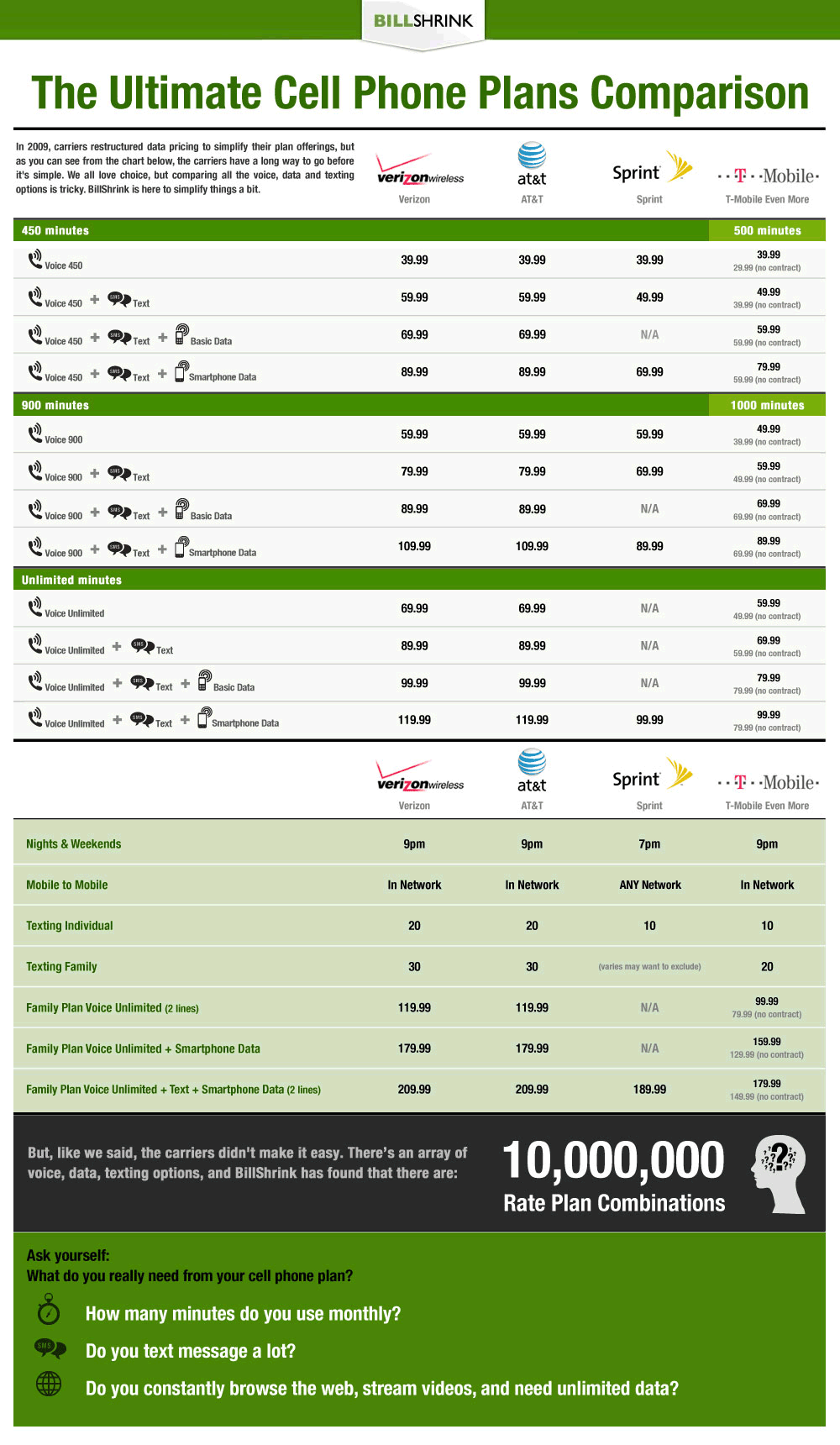
To keep track and compare what’s on offer, Billshrink plotted the pricing options for the four major American carriers, which will likely serve as a guideline for regional carriers that want to stay competitive with their larger brethren.

Click to Enlarge

Disappointing: An Open Letter Rebutting Public Knowledge’s Lack of Opposition to ‘Usage-Based Pricing’

Phillip Dampier

While reviewing coverage on Comcast’s new usage meter, I ran across a disappointing quote from an article in The Hill newspaper from Gigi Sohn, president of public interest group Public Knowledge:

But as more consumers are downloading movies and streaming TV shows on their computers, bandwidth use is inching up. Imposing caps on consumers can become a form of discrimination, said Gigi Sohn, president of Public Knowledge, this morning at a panel I moderated about copyright and net neutrality.

“Public Knowledge doesn’t oppose usage-based pricing,” she said. “But if you set the cap low enough you discriminate against high-bandwidth applications. “If consumers have a finite amount of bandwidth each month, they could be forced to stay away from bit-hogging sites, like video high-quality video streaming services.

Sohn seems to grasp the very real risk of rationed broadband, but drops the ball completely in not opposing the scandal that “usage-based pricing” represents for broadband users.  It was a real disappointment to see a group fail to understand the implications of these kinds of Internet Overcharging schemes.  As the industry seeks to further monetize broadband usage, these pricing changes guarantee fatter profits and reduced costs for providers, and a higher bill for rationed broadband for consumers.

Comcast’s two year old 250GB usage cap seems generous by today’s standards, but note it has remained the same, despite growing overall broadband usage.  What was generous two years ago is slightly less so today, and could be downright stingy a few years from now.

For customers stuck with providers with a different definition of “generous,” it is even more worrisome.  Rochester, New York faced the prospect of a 5GB usage allowance from the local phone company’s DSL service, or a 40GB allowance from the local cable operator.  The latter called their experiment fair, consumption-based pricing, but in reality it would have tripled the cost of broadband service for residents seeking to maintain the same level of service they enjoyed previously.  There should be plenty to oppose in a $150 monthly broadband bill.

Usage-based billing makes providers very happy counting your money

Internet Overcharging schemes involve all the ways a profitable broadband industry, enjoying record revenue and declining costs, could force consumers to pay more for the exact same service they receive today:

  • The arbitrary usage cap, which ranges incredibly from 5GB-250GB per month, depending on the provider.
  • The false “consumption/usage-based pricing” model which doesn’t actually charge consumers for what they use, but rather confines them into ranges of data allowance plans that carry stiff penalties for consumers who exceed their limit.  Think cell phone plan for broadband, only markup the penalty fee by several thousand percent above cost.
  • The overlimit penalty or fee, which seeks to punish and monetize usage at the same time.  Customers, most of whom don’t have a clue about what a “gigabyte” is, will pay a stiff price for not intuitively knowing how much they’ll use month to month, and pay an overlimit penalty of $1-5 per gigabyte for excess usage.  That’s far above the pennies per gigabyte large providers pay, but it’s a great way to make consumers think twice about daring to use high bandwidth services like online video.
  • The overlimit insurance policy, which Bell Canada introduced to protect consumers from their own rapacious pricing.  They pocket the proceeds from the “insurance” as well, picking customer pockets at every opportunity.
  • The usage meter, not subject to independent scrutiny or verification.  What they say you used, you used, even if you didn’t.  Customers have learned these meters aren’t as accurate as providers suggest they are.

The fact is, customers pay for access based on speed, which has its own natural built-in usage limits.  You can’t exceed certain consumption thresholds if your service doesn’t deliver the speed required to do so.  Heavier users naturally gravitate towards faster speed, often premium-priced tiers.  Lighter users often choose “lite” plans (when the provider makes them aware they exist) which deliver lower speed service perfectly adequate for web page browsing and e-mail.  Current pricing models remain highly profitable for providers, even more so than some of the other components of their “triple play” packages.  It’s the service consumers cancel last.

With a duopoly for wired broadband service in most American communities, tolerating “usage-based pricing” that isn’t (or will be overpriced even when offered) repeats the terrible mistake Canada made which today lives with the results — pricey, slow-speed broadband and a decline in broadband rankings.  Canadians are livid about handing over considerably more of their money for throttled, usage-limited Internet access.

Public Knowledge advocates for Net Neutrality.  In terms they might better understand, advocating for Net Neutrality while also not being opposed to the industry’s definition of “network management,” defined to create an exploitable loophole, makes Net Neutrality protection meaningless.

Without a ban on such pricing schemes, providers will keep their best possible tool to stop the threat of broadband video competing with their pay television offerings, and can favor certain content partners over others with exemptions from the dreaded cap ‘n tier system.

Matthew Henry, Internet Policy Counsel for Data Foundry, a database company, said on the panel that usage-based pricing presents serious “conflicts of interest” for cable companies that provide both cable TV and Internet services.

As people watch more cable content online, as both Comcast and Time Warner are pushing with their TV Everywhere services, more demands are placed on their broadband networks.

“Companies have a real incentive to force consumers to turn off the computer and pick up the remote,” he said.

Public Knowledge should carefully consider what happens in a Net Neutral world with onerous data caps and consumption pricing that exists for some, but not all online services.  It’s an end run around the kind of open Internet we all support.

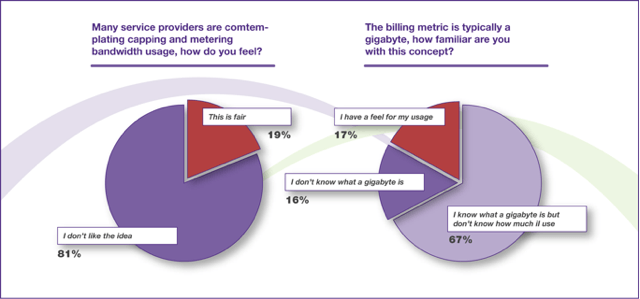
A survey conducted by International Data Corporation on behalf of Zeugma Systems, a company that makes an edge router for broadband networks, shows that consumers simply hate bandwidth caps and will likely switch to another carrier if they have the option

Over the last year, over 600 articles here have documented the abuse of consumers’ wallets from such schemes.  We’ve also shown the real world consequences this pricing has in retarding development of new multimedia applications and higher bandwidth features.  Innovative high bandwidth services seeking funding in a usage-capped world are deemed untenable if usage limits or overpriced broadband make customers think twice about using them.  In the south Pacific, online video services have been literally shuttered simply because of data caps.  Australian broadband, littered with caps and consumption billing, has become so bad the government is proposing its own National Broadband Plan to provide relief to those down under.  Public Knowledge’s position would bring that broadband backwater to America if it became commonplace here.

Make no mistake — consumers are overwhelmingly opposed to such pricing, already pay higher-than-average costs for broadband, and are threatened with even higher bills if such schemes are imposed.

Public Knowledge needs to carefully reconsider its position and get on the side of consumers who recognize highly profitable broadband providers don’t need another major payday at their expense.  Free Press understands the implications.  We respect and appreciate Public Knowledge’s hard work for consumers on other issues.  We invite them to join the consumer movement to retain fair broadband pricing.

Search This Site:

Contributions:

Recent Comments:

Your Account:

Stop the Cap!