Home » Issues » Recent Articles:

[Update 2] Time Warner Cable: Major Road Runner/Digital Phone Outage in Northeastern U.S.

Phillip Dampier March 10, 2010 Issues 11 Comments

A major service outage impacting Road Runner and Digital Phone service from Time Warner Cable began early this morning is ongoing.  Customers contacting Time Warner Cable in Maine, New York, and western Massachusetts are being told there is a service outage ongoing with both services, resulting in no dial tone and slow/no Internet service.

Presumably, there is a problem at the Regional Operations Center in Syracuse.

There is no estimated time for service restoration.

Cable television service is not affected.

[Update 2:00pm EST — Time Warner Cable blamed the outage on a defective router, which we heard was in the Binghamton area.  Service was “restored” at 9:45am although we’ve noticed that meant they shifted traffic onto other regional networks and that was still causing some page loading problems until late in the morning.

The outage was acknowledged on Time Warner Cable’s customer service lines in New York, Massachusetts, and Maine.  Rochester had the first recorded message up very early this morning, with the others coming by 8:45am.]

[Update 4:36pm EST — Customers impacted by the outage can obtain one day of Road Runner service credit, but only if you call or write to ask.  You can use the online customer form on Time Warner Cable’s website for your area or call your local customer service number.  The outage began around 5:20am this morning.]

50/5 Mbps ‘Wideband’ Service Arrives in Dallas for Time Warner Cable Customers Later This Month

Phillip Dampier March 9, 2010 Broadband Speed, Competition 2 Comments

Time Warner Cable customers with deep pockets and a need for speed will find Time Warner Cable’s new Wideband Internet service arriving in certain North Texas neighborhoods on or around March 19th.

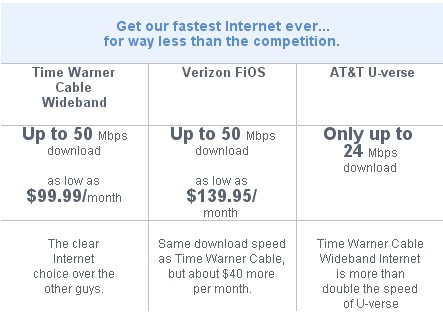
Made possible by DOCSIS 3 upgrades, the new service will provide 50/5 Mbps service for as low as $99.99 per month.

As has been the case in other cities getting TWC’s Wideband service, self-install kits are not yet available and a formal service call is required.  You will also need a new DOCSIS 3-capable cable modem.

Interested customers in the Dallas area can call Time Warner Cable after March 19th at (972) 742-5892 to determine if service is available yet in your neighborhood.

Time Warner Cable competes with both AT&T and Verizon across its North Texas division.

AT&T U-verse maxes out at 24 Mbps currently, and although Verizon FiOS can match Time Warner Cable’s speed, the phone company’s current price is $40 higher for the service.

Customers who need this level of speed should call Verizon or Time Warner Cable and inquire about any promotional pricing that could lower your bill for several months.  In New York City, some customers received discounted Time Warner Cable Wideband service for six months.

Eventually, competition should result in lower prices for super fast broadband connections.  DOCSIS 3 upgrades offer a win-win for both customers and the cable company providing the service.  Increased capacity resolves neighborhood congestion issues and also permits higher speed, premium-priced tiers to deliver additional profits to providers.  In return, customers who need ultra-fast speeds get them, and are only to happy to pay for them, as long as they are not usage-capped.  Nothing destroys the value of premium-priced tiers better than unjustified usage limitations.

Comcast Raising Prices… Again, But Their Usage Cap Remains Firmly In Place; 3.5 Percent Increase For Many

Phillip Dampier March 9, 2010 Comcast/Xfinity, Competition, Data Caps 3 Comments

Comcast is back with another rate increase effective April 1st, amounting to 3.5 percent for many cable, broadband, and telephone customers.

Although prices vary depending on your specific service area, the range of the price increase is more consistent.

In southern New Jersey, for example, here is the breakdown — all prices are by the month:

  • Expanded/Standard service cable-TV tiers are increasing $2.  Expanded service customers could pay up to $50.10, Standard customers $60.55;
  • Triple Play customers will see a $5 increase in the second year of their two-year contract from $114.99 to $119.99.  First year pricing remains $99 for new customers;
  • Digital Premium Packages are increasing $2;
  • Economy Broadband (1Mbps) increases $2, Performance (12Mbps) increases $2, Blast! (16Mbps) increases $2, Ultra sees no price increases (but goes away for new customers effective 4/1);
  • Comcast phone line prices are also increasing in certain cases;
  • Each additional DVR drops by $5 — Verizon FiOS was hammering Comcast about DVR pricing.

There are no rate changes for business service customers or subscribers with “limited basic service.”  There is also no change in the company’s broadband usage allowance — 250 GB, the only part of Comcast’s service that seems to stubbornly remain at the same level year after year.

Comcast, the nation’s largest cable operator, blamed the mid-year price increases on increased programming and other business costs.

But the company is not exactly hurting.  Comcast’s 4th quarter earnings last year jumped 132 percent to $955 million dollars.  Rate increases that are designed to drive consumers into profitable service bundles, combining television, Internet, and telephone service, guarantee even better financial results in 2010.

Verizon is already capitalizing on Comcast’s rates by offering residents in southern New Jersey an even better price for Verizon FiOS — dropping from $109.99 for two years to $89.99, not including taxes and fees.  But like Comcast, Verizon wants you take a bundle of services, or else face higher prices.  The company recently increased the price for FiOS TV to $64.99 for standalone service.

Syracuse Technology Columnist Falls Into Trap Believing Usage Caps Represent “Fairness”

Phillip Dampier March 9, 2010 Competition, Data Caps, Editorial & Site News 3 Comments

A column this week in The Post-Standard falls into the trap of believing usage caps on wired broadband service represent “fairness.”

Al Fasoldt, who writes a technology column for the Syracuse, N.Y. newspaper, told readers they should investigate buying and/or using usage measurement tools in order to protect themselves from a surprising bill at the end of the month.

Caps can make their service fairer to all customers by blocking excessive downloads that clog the network, and those who exceed their caps can be charged a great deal extra for service. This amounts to free money for ISPs.

But there is something counterintuitive about promoting new ways to get entertainment on the Internet — by using Hulu, for example, to stream TV shows to your home computer — while telling customers they can’t use more than a certain amount of data.

[…]

What’s needed is a simple way to measure how much data you use per month. Cable providers sometimes provide a Web page that logs each customer’s transfer totals — call your ISP to find out if your plan has such a feature — but you can easily track usage yourself with data-usage software utilities.

Courtesy: DragonEyeFly

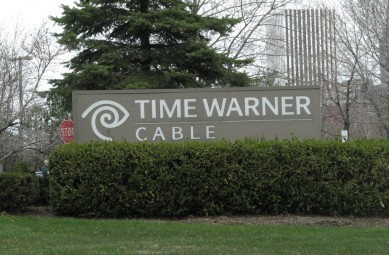
Time Warner Cable headquarters in Rochester, N.Y.

Fasoldt assumes facts not in evidence.  Simply put, there is nothing fair about usage caps, particularly on wired broadband service.  Fasoldt can be partly excused for making the assumption because he lives in Syracuse, where Verizon FiOS and Time Warner Cable compete heavily for customers in the Salt City.  Veterans of actual Internet Overcharging experiments, and those who live under usage caps and usage-based billing can testify about the true implications of such schemes.

They are nothing short of rationing broadband service for fatter profits.

In Rochester, where Fasoldt notes customers successfully fought off Time Warner’s experiment, customers do not have the luxury of two closely-matched competitors.  They have the cable company and a telephone company that stubbornly clings to its own 5 GB usage allowance in its terms and conditions, albeit presently unenforced.  Where competition is at bay, higher prices for limited service are in play.

At least Fasoldt admits it’s also about the money.

There is nothing counter-intuitive about promoting online video services and then slapping usage caps on them when you realize it’s really ALL about the money and not about “fairness.”  Limiting video consumption is critical to protecting cable television packages.  If you can watch it all online, why keep paying for cable-TV?  With a usage cap, there are no worries about that ever happening.

As this website has repeatedly documented, consumers do not need to invest in usage measurement tools that are a nuisance to install and monitor.  They just need a broadband provider that can be happy living off the billions in profits already earned from today’s unlimited broadband service without greedily trying to overcharge consumers even higher pricing for limited service in the future.

Fasoldt would do better by his readers telling them to follow the example of communities who have been exposed to such schemes.  They got involved, threatened to cancel service, and created a sufficiently large enough headache for providers who eventually determined, for now, it just wasn’t worth alienating customers with unwanted pricing schemes.

Hot Springs Family Gets $16,000 Verizon Wireless Bill for Wireless Data Usage

Phillip Dampier March 8, 2010 Data Caps, Verizon, Wireless Broadband 2 Comments

Woe to those who forget to sign up for a wireless data plan from Verizon Wireless.

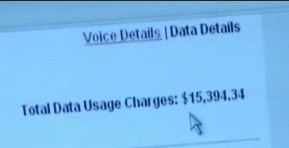
The cell phone provider recently sent a $16,000 bill to one Hot Springs, Arkansas family for wireless data usage racked up on a daughter’s phone the family didn’t cover with a wireless data plan.

Chris Brown couldn’t believe his eyes when he opened his phone bill online.

“The first thing I think of is, this thing costs more than my truck.  It cost more than a house payment, I couldn’t fathom it, it’s mind-blowing,” Brown told KLRT-TV.

This isn’t the first time this has happened.  A month earlier, the Brown family was billed $3,000 for similar usage and the family asked Verizon Wireless to shut off access to data services on the affected phone, but the charges kept on coming anyway.

Brown says once he got to look at the phone usage online, he saw that the phone was connected to the Internet when the family didn’t even know it.
Verizon Wireless offers tips to customers with children:

  • Limit the times of day they’re allowed to make calls.
  • Keep your kids from getting onto your own phone’s Internet by setting up a password.
  • If you have a limited plan, you will get an alert and have to give approval before you exceed your number of kilobytes or megabytes for the month.

Of course, had Verizon Wireless followed through on what Brown asked for — shutting data access off altogether, none of this would have ever happened.

Other Little Rock customers, especially those forced to move from Alltel to Verizon Wireless, are running into similar experiences.

Among the horror stories:

“My son had the same problem. He was told he had unlimited internet usage and then received a bill for more than $7,000. Verizon had recorded a phone call from my son to customer service and that was the only thing that saved him. But it took more than 4 months and his phone service being disconnected twice before the situation was resolved.”

“I’m not a bit surprised at that ridiculous bill from Verizon! I had the same problem for months last year, to the point that I had to put unlimited texting on both my grandsons’ phones. Then to top that off, we got a bill that had goo-gobs of texting billed to my husband’s phone (to the tune of $9.30), which is rarely used at all. But, this is the killer–all the texts received on his phone were from Verizon, all 62 of them! As soon as my contract is up with them, I will be switching. All the time we had Alltel we never had any problems. The problems started as soon as Verizon took over.”

“I’m not one bit surprised by the ridiculous phone bill that the Hot Springs family received. I also received my first month’s bill from Verizon last year for over $1500. I almost had a heart attack. Verizon lowered the bill, but two months later, even though we carefully monitored the air time, we went over by four minutes and they charged me an additional $90. That was it for Verizon. They are a bunch of crooks. I hooked up to my local phone carrier for $34 a month and I haven’t had one problem since. Verizon should be investigated.”

[flv]http://www.phillipdampier.com/video/KLRT Little Rock Hot Springs family gets $16,000 cell phone bill 3-3-10.flv[/flv]

KLRT-TV in Little Rock reports on the Hot Springs family that got a $16,000 surprise bill from Verizon Wireless.  (3 minutes)

Search This Site:

Contributions:

Recent Comments:

Your Account:

Stop the Cap!