Home » Online Video » Recent Articles:

Building a Broadband Superhighway 5 Miles Long: How Usage Caps Ruin Faster Speeds

Phillip “Tollbooths are not innovation” Dampier

Federal Communications Commission chairman Julius Genachowski last week wrote a guest editorial on TechCrunch espousing the benefits of faster broadband networks, but the advances he celebrates often come with innovation-killing usage caps and overlimit fees he continues to ignore.

We feel the need – the need for speed. As Tom Friedman and others have written, in this flat global economy a strategic bandwidth advantage will help keep the U.S. as the home and most desired destination for the world’s greatest innovators and entrepreneurs.

[…] But progress isn’t victory, particularly in this fast-moving sector. Challenges to U.S. leadership are real. This is a time to press harder on the gas pedal, not let up. The first challenge is the need for faster and more accessible broadband networks. We need to keep pushing because our global competitors aren’t slowing down. I’ve met with senior government officials and business leaders from every continent, and every one of them is focused on the broadband opportunity. If we in the U.S. don’t foster major investments to extend and expand our broadband infrastructure, somebody else will take the lead.

We need to keep pushing because innovators need next-generation bandwidth for next-generation innovations – genetic sequencing for cancer patients, immersive and creative software to help children learn, ways for small businesses to take advantage of Big Data, and speed- and capacity-heavy innovations we can’t yet imagine.

We need to remove bandwidth as a constraint on our innovators and entrepreneurs. In addition to steadily increasing broadband speed and capacity for consumers and businesses throughout the country, we need – as we said in our National Broadband Plan – “innovation hubs” with super-fast broadband, with speed measured in gigabits, not megabits.

[…]Some argue the private sector will solve these challenges itself, and that all government has to do is get out of the way. I disagree. The private sector must take the lead, but the public sector has a vital though limited role to play.

Among the policy levers government needs to use is the removal of barriers to broadband buildout, lowering the costs of infrastructure deployment with new policies like “Dig Once” that says you should lay fiber when you dig up roads. The President recently issued an Executive Order implementing this idea, suggested in our Broadband Plan. Government must promote competition, which drives innovation and network upgrades.

We must ensure the Internet remains an open platform that continues to enable innovation without permission.

Genachowski

Genachowski’s vision for faster broadband has the noble goal of maintaining competitiveness with the rest of the world and putting the United States back on top in broadband rankings and innovation. But while hobnobbing with his industry friends at recent industry conventions, he may have gotten too close to one of the biggest impediments holding us back — big cable and phone companies merrily working their magic to create a comfortable duopoly with pricing and service plans to match.

Back in the late 1990s, most cable operators thought of broadband as an ancillary service easy enough to operate, but probably hard to monetize. Just like digital cable radio services like Music Choice and DMX, “broadband” would likely appeal only to a tiny subset of customers.

“Back in the 1990s, Time Warner was primarily a TV company in a TV industry.  Broadband then was an innovating and radical thing, and a lot of people thought it was stupid and wouldn’t work,” Time Warner Cable CEO Glenn Britt said in April, 2009.

The launch of “Road Runner” was not the most auspicious marketing effort undertaken by the cable operator. In fact, the service was rarely targeted for price adjustments, hovering at around $40 a month for a decade.

When the Great Recession hit the United States, something unexpected happened. Cable operators discovered people were willing to cancel their cable and phone services, but not their broadband. In fact, as high bandwidth online video became an increasing part of our lives, the cable industry realized they were in the catbird seat to deliver the best broadband experience, and be well-paid for it. With little competition, increasing prices brought little risk and, thanks to the insatiable drive to boost revenue and reduce costs, implementing usage caps to control “excess” usage and costs were within their grasp.

In 2008, when Stop the Cap! launched, only a handful of ISPs had usage caps. Now most providers, with the exception of Time Warner Cable, Verizon, Cablevision, and a handful of others, all have usage allowances and overlimit fee Internet Overcharging schemes to further pad their bottom lines.
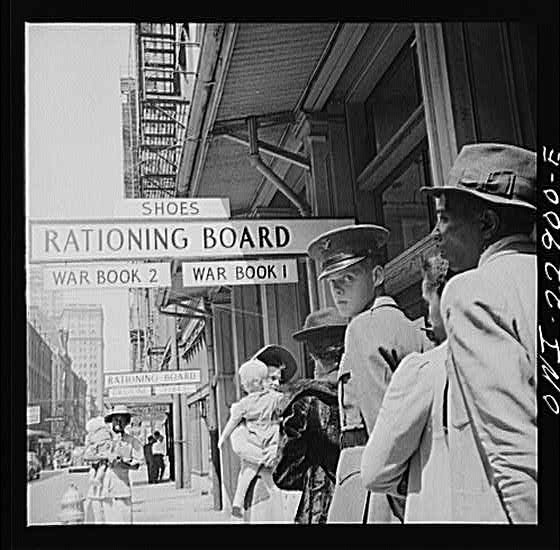
Innovation: Rationing Your Internet Experience — Stick to e-mail and web pages.

Genachowski has completely ignored the growing pervasiveness of usage caps, and even excused them as an experiment in marketplace innovation. But limits on broadband usage will also limit the broadband innovation revolution he wants, especially when most Americans have just one or two realistic choices for broadband service:

  1. Usage caps are the product of artificial scarcity. Rationing Internet usage, even with now-pervasive cost-effective upgrades like DOCSIS 3, simply does not make sense (but it will make dollars). Cable operators are switching off analog television service to free up bandwidth to provider faster Internet speed and fatten the pipeline that delivers it. They have plenty of capacity, but continue to proclaim they must limit usage for “fairness” reasons, without providing a single shred of evidence to prove the need for usage caps. Consumers will self-ration just to avoid the prospect of being cut off or handed a bill with overlimit fees.
  2. Usage caps make faster speeds irrelevant. Selling customers premium-priced, super fast broadband speed is hardly compelling when accompanied by usage caps that constrain the benefits of buying. Why pay $20-50 more for faster speeds when customers cannot take practical advantage of them. Customers using their Internet service to browse web pages and read e-mail have no interest in upgrading to 30+Mbps. Customers streaming video or moving large files do.
  3. Usage caps retard innovation. Google’s new 1Gbps fiber optic network was built on the premise that usage caps were unnecessary on a fiber-based network and would retard innovation. Developing the next generation of innovative apps that Genachowski celebrates will never happen if developers are discouraged by Internet usage toll booths and stop signs. The cost to provide the service is not largely dependent on customer usage. It is the initial price of last mile infrastructure that really matters. Both cable and phone companies have reduced their investments to upgrade their networks, and AT&T and Verizon both contemplate getting rid of their rural landlines. Most cable operators paid off their networks years ago.
  4. Usage caps create a whole new digital divide.  Time Warner Cable’s discounted Internet Essentials program delivers only a $5 discount with a harsh 5GB usage cap. For an income-challenged home compelled to switch to a provider’s budget plan, the result is a different Internet experience than the rest of us enjoy. Imagine if your home broadband account was limited to 5GB a month. What online services would you have to avoid to stay under the provider’s limit? Traditionally, operators sell the lowest speed tiers with the lowest usage allowances. Slower speeds already offer a disincentive to use high bandwidth services, but many providers typically drive that disincentive home even harder with a paltry allowance that will cost plenty to exceed.
  5. Usage caps harm our broadband standing. While Genachowski celebrates increasing broadband speeds, he ignores the fact the rest of the world is moving away from usage caps even as the United States moves towards them. Both Australia and New Zealand elected to construct their own national fiber networks in large part because the heavily usage-capped experience was holding both countries back. Usage caps are a product of a barely competitive market.

[flv width=”640″ height=”380″]http://www.phillipdampier.com/video/Bandwidth Caps 7-2011.flv[/flv]

Tech News Today debunks providers’ claims that usage caps are fair and control those who “overuse” their networks, noting the same phone companies (AT&T) pushing for usage caps are also moving voice calling to unlimited service plans. (August, 2011) (4 minutes)

Time Warner Cable Loses 15% of Their Analog Cable Customers; News on Broadband Caps, Pricing

Time Warner Cable has lost between 10-15 percent of their analog cable television customers over the past year, according to Time Warner Cable president and chief operating officer Rob Marcus.

Speaking at this morning’s Goldman Sachs Communacopia Conference, Marcus noted the economic downturn has continued to cost the cable operator “single play” subscribers. Marcus noted that roughly 60 percent of the cable company’s customers are now on discounted or retention plans, and the company has no plans to reduce aggressive retention offers and promotions in the immediate future. Time Warner Cable will also exercise caution when customer promotions expire, an allusion to the company’s practice of gradually resetting rates to retail prices over an extended period of time to avoid antagonizing customers into switching providers.

Marcus acknowledged broadband is now a key service for Time Warner Cable, one that the company will continue to exploit to drive earnings. Some investors have complained Time Warner has only managed an increase of 2-3 percent in Average Revenue Per User (ARPU) for broadband, a key metric for Wall Street. Marcus was asked why Time Warner, with its superior market share over telephone companies, was not “exercising the price lever a little bit more” in a marketplace lacking serious competition.

Marcus

“I think it is fair to say that as the utility of the [broadband] product increases in customers’ minds, their willingness to pay for it (assuming they are able) goes up, so I think it stands to reason that we can continue to increase rates on high speed data,” Marcus said.

But even more important to Time Warner Cable is its differentiated broadband speed tiers, which the company is refining to pick up additional revenue and price-resistant customers. Broadband usage caps will be a part of that equation.

Marcus confirmed that Time Warner Cable will provide unlimited broadband packages to its premium tier customers, but will introduce usage-limited service on its budget tiers. Currently, the company only imposes a usage cap of 5GB on its Internet Essentials package, which offers a $5 discount off regular prices. But Marcus seemed to acknowledge that the company plans to experiment further with additional limits.

“We are going to deliver very fast speeds, unlimited consumption, and now mobile capability via our Wi-Fi network to those customers who demand it and are willing to pay premium prices for those tiers of service,” Marcus said. “At the other end of the spectrum we are going to have budget products as we do today that offer lower speeds, more limited consumption like our Internet Essentials product, and those probably won’t have access to our Wi-Fi hotspots. We think that is the best way to drive revenue and profitability.”

Marcus also told investors the company was working on the next generation of the company’s electronic program guide, which he said will be cloud-based. Time Warner Cable continues to signal it is willing to work with third party set top box manufacturers to let customers dump traditional set top boxes, but only so long as Time Warner Cable gets the credit in the minds of customers. The company is also working on rolling out video-on-demand for its online video apps.

AT&T Faces Net Neutrality Complaint from Public Interest Groups Over FaceTime Blocking

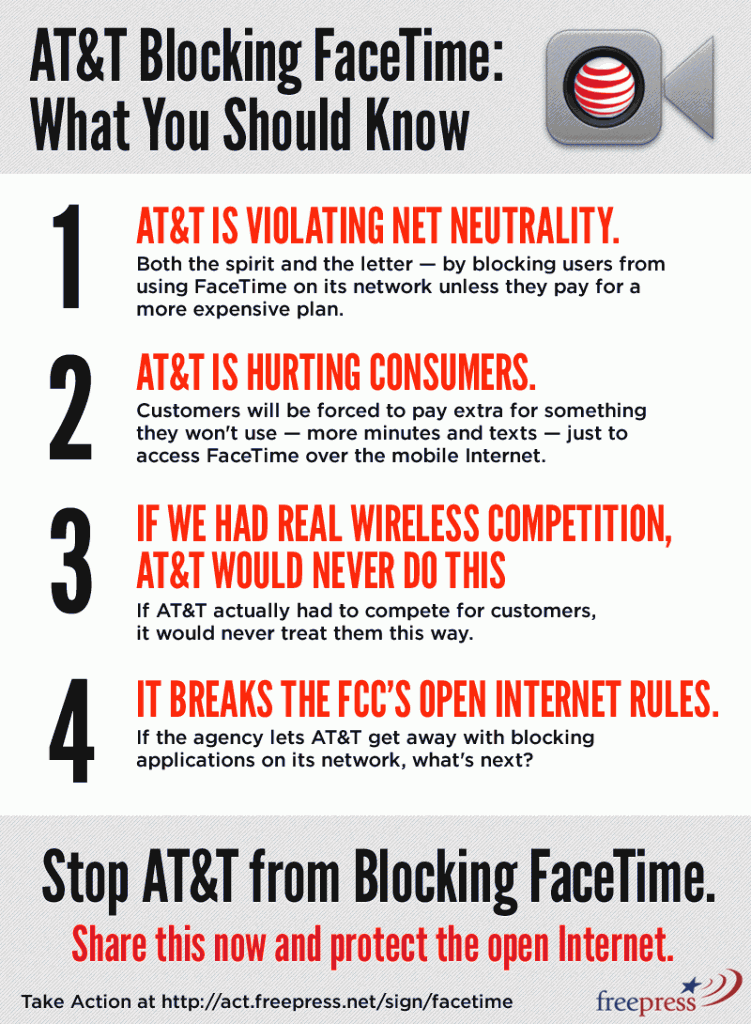
Free Press’ campaign against AT&T’s Net Neutrality violation (click image for further information)

When AT&T customers take delivery of their new iPhone 5 or install Apple’s latest iOS 6 software update, the popular video conferencing app FaceTime will become available to the company’s mobile broadband customers for the first time, if they agree to switch their service to one of AT&T’s new, often more-costly “Mobile Share” plans.

Until now, FaceTime has been limited to Wi-Fi use only, but objections from wireless carriers and some technical limitations kept the popular app from working over 3G or 4G wireless networks.

AT&T’s decision to block the FaceTime app unless a customer changes their current mobile plan has sparked a notification from three public interest groups that they intend to file a formal Net Neutrality complaint against AT&T.

“AT&T’s decision to block FaceTime unless a customer pays for voice and text minutes she doesn’t need is a clear violation of the FCC’s Open Internet rules,” said Free Press policy director Matt Wood. “It’s particularly outrageous that AT&T is requiring this for iPad users, given that this device isn’t even capable of making voice calls. AT&T’s actions are incredibly harmful to all of its customers, including the deaf, immigrant families and others with relatives overseas, who depend on mobile video apps to communicate with friends and family.”

Free Press is joined in the forthcoming complaint by Public Knowledge and the New America Foundation’s Open Technology Institute.

“AT&T’s decision to block mobile FaceTime on many data plans is a direct contradiction of the Commission’s Open Internet rules for mobile providers,” said Sarah Morris, policy counsel for the New America Foundation’s Open Technology Institute. “For those rules to actually protect consumers and allow them to choose the services they use, the Commission must act quickly in reviewing complaints before it.”

AT&T earlier responded claiming they still allow the app to work over Wi-Fi (yours or theirs), so it cannot be a Net Neutrality violation. The company has spent an increasing amount of energy trying to convince regulators that wireless networks, including Wi-Fi, are largely equivalent. So long as a customer can access an app on one of them, there is no violation according to AT&T.

The company also claimed that since FaceTime comes pre-installed on phones, it is exempted from Net Neutrality regulations.

Whether the FCC will believe arguments that access over Wi-Fi is suitable enough to escape scrutiny for blocking an app on AT&T’s own 3G and 4G networks is open to debate.

The Obama Administration’s FCC has taken a lukewarm approach on Net Neutrality, adopting a compromise that is being attacked in court by MetroPCS and Verizon Wireless and considered insufficient protection by most consumer groups.

Time Warner Cable Pitching “Free TV” Service When Upgrading Broadband

Phillip Dampier September 12, 2012 Broadband Speed, Competition, Consumer News, Online Video 2 Comments

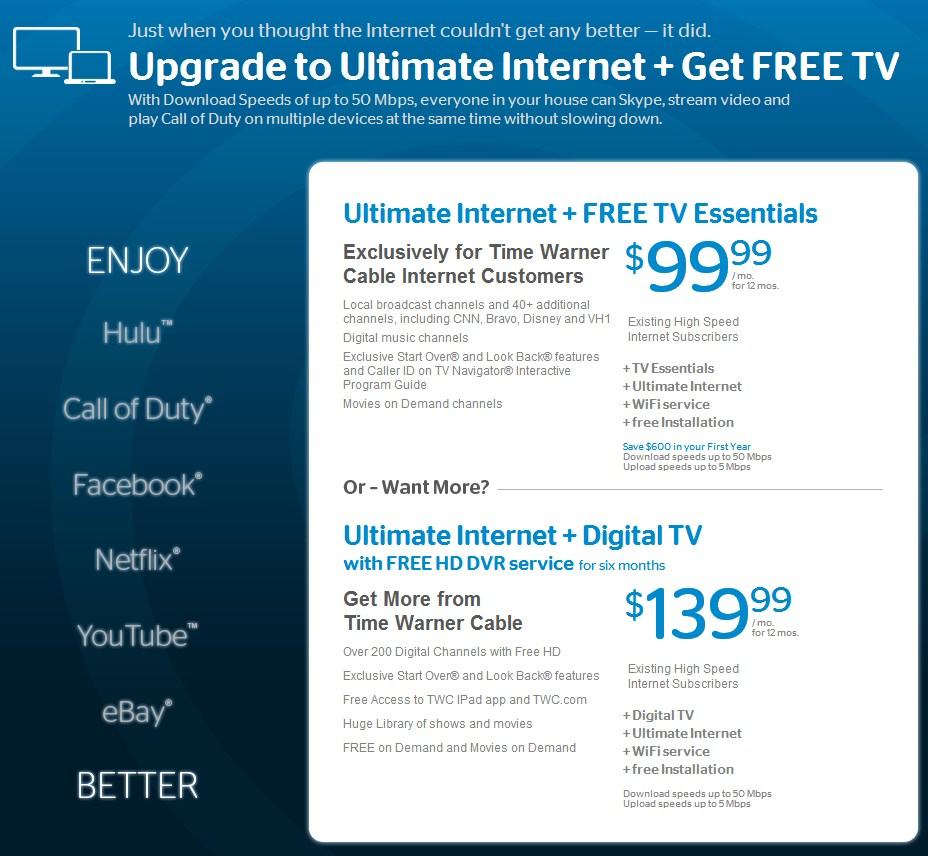
Time Warner Cable has been mailing offers to broadband-only customers offering free cable-TV service if they upgrade their Internet speeds to the company’s Ultimate 50/5Mbps tier, which currently sells for $99.95 a month in most markets.

The company began the promotion in early summer, but targeted broadband-only customers already upgraded to Turbo or Extreme speeds. Now it is available to any Time Warner broadband-0nly customer.

Customers can choose between two levels of service:

  • $99.99 a month for 12 months: 50/5Mbps Internet service plus “Digital Essentials” TV, which includes local stations and around 40 additional cable networks;
  • $139.99 a month for 12 months: 50/5Mbps Internet service plus “Digital TV,” which includes over 200 television channels and free HD DVR service for 6 months.

Time Warner Cable has regularly targeted its Internet-only customers with promotions to entice them to upgrade to television and phone service, typically marketing a discounted triple play package. This is the first time the company has sought to get broadband customers to upgrade to its most costly Internet tier by throwing in television service as an added incentive.

The company tells customers the deal will improve their online video experience and reduce potential problems when multiple members of a household access Internet services at the same time.

Shear Madness: Friends of Big Telecom Still Shortsighted on Why Broadband Competition is Important

Phillip “Artificial Scarcity for Fun and Profits” Dampier

It would be an understatement to say I’ve heard the argument once or twice that there is simply no economic room for additional players to enter what Big Telecom companies always claim is a robustly competitive marketplace for Internet access.

Virtually every company facing inquiries from regulators, politicians, and consumers always makes the point today’s deregulated broadband playing field is an excellent example of free market competition at its best.

While they advocate for even more deregulation, oppose the entry of community-owned broadband services, and demand more spectrum from Washington lawmakers, we endure a veritable monopoly/duopoly for Internet access. Their defense, after a dismissive rolling of the eyes, is that we just don’t understand business.

Enter Tim Lee, writing for the alternate reality reader of Forbes, who decided to prove his argument by comparing broadband with Supercuts:

Being the first to build a hair-cutting shack in a particular customer’s backyard can be pretty lucrative. It gives you a de facto monopoly on that household’s haircut business. Let’s assume that it takes 4 years worth of haircuts to recoup the costs of building a shack for a particular household. While barbers will need to raise some extra capital to build the shacks, in the long run the owner of the first shack may be able to earn big monopoly rents.

Now along comes a new barber who wants to enter the hair-cutting business, but every household already has at least one hair-cutting shack. So he needs to build hair-cutting shacks in backyards where another barber has already built one. And that’s an economically precarious situation. Remember, we assumed a monopolist needs to do 4 years worth of haircuts in order to break even. But if you build a shack in a backyard that already has another barber in it, you shouldn’t expect to get more than half of the customer’s business, on average, over the long run. Not only that, but competition will push down prices, so you’ll have to do more haircuts to recover the costs of construction. So you’ll be lucky to recover your initial investment within 8 years, and it could easily take more than a decade.

And things are even worse for the third or fourth barber who builds in a particular backyard. The fourth barber will be building in a yard that already has three barbers. He can only expect to attract 25 percent of the household’s business, and strong competition among barbers means his margins will be pretty thin. It’s hard to see how he could ever recover the costs of his investment.

Brushing away the hair-cutting analogy, Lee’s point is that it is wasteful and inefficient for competitors to overbuild new networks where others already exist. The phone and cable companies that dominate the marketplace today decry additional competition as a death blow to their business models, because with so many providers fighting for customers (by lowering prices and offering better service), not every provider can sustain a profit Wall Street investors expect quarter after quarter. This argument is particularly common when attacking those dastardly socialist community-owned broadband providers they say destroy private enterprise (while unconvincingly also warning they will always fail and cost taxpayers millions on the way down). It is also why Wall Street continues to beat the drum for additional consolidation in the wireless marketplace, where anything more than AT&T and Verizon Wireless represents too much revenue destruction.

Lee does make some valid points:

  1. Infrastructure costs are the biggest expense in launching a new network, especially wiring the last mile to customers;
  2. Verizon FiOS overestimated its potential market share and found it harder to turn a profit than first anticipated;
  3. Other utilities have avoided building redundant networks (ie. you don’t have two companies providing their own electric, water, and gas lines).

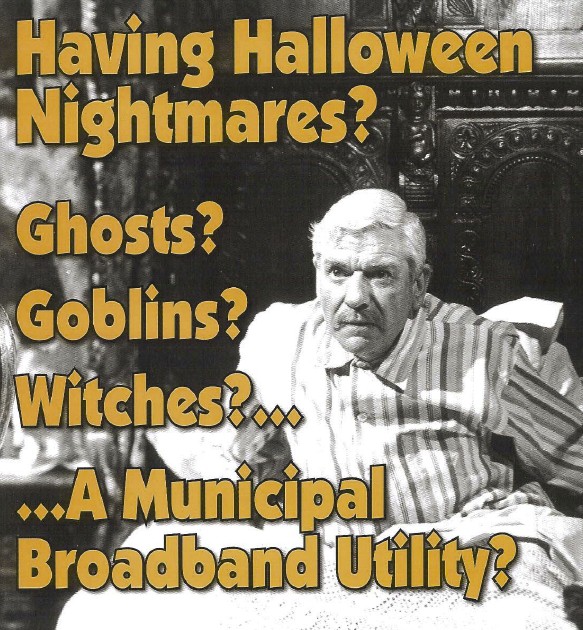
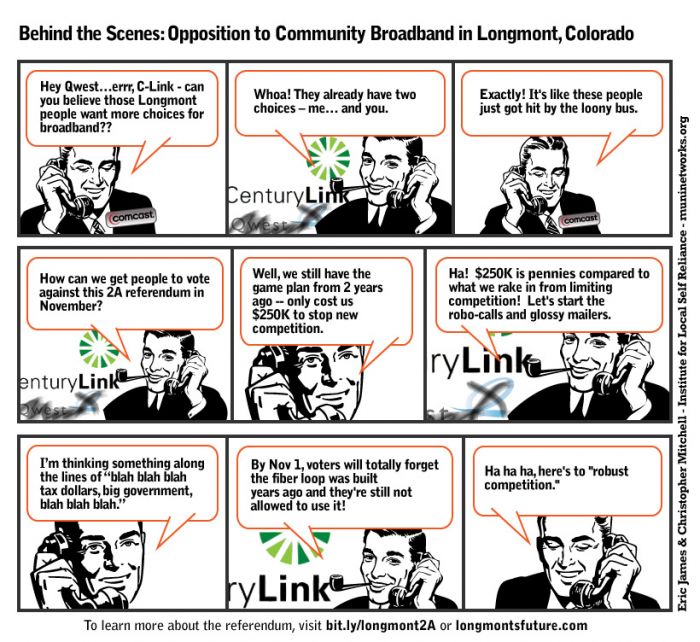
When communities decide to offer their own broadband service, incumbent cable and phone companies spend big bucks to scare residents.

But Lee’s conclusion is entirely favorable to the industry he often defends — that is just the way things are and customers should not expect anything better.

Those arguments are usually also the basis for free market declarations that if a private company cannot find a way to deliver a service at a profit, then those left out will just have to do without.

Thankfully, despite Lee’s criticism of Google Fiber in Kansas City as “extremely wasteful,” the search engine company is perhaps best positioned of all to turn the industry’s common refrain against new competition on its head.

Every so often, a surprising third party shows up with the resources to ignore Wall Street’s conventional wisdom. Enter the deep pockets of Google Fiber or a bond-backed community provider threatening to deliver service far better than what a community currently enjoys. The predictable defense from incumbent providers:

  • Nobody needs faster broadband speeds;
  • Community networks are a government takeover of the Internet;
  • Fiber optics are expensive and represent an unnecessary investment;
  • Public broadband destroys private investment and jobs at incumbent commercial providers;
  • This is just a political stunt, not a real effort at taking Internet speeds to the next level.

Without the kind of competition on offer from Google, community providers, and private providers like Verizon taking a chance on FiOS fiber optics, there would be no room for innovation in the marketplace.

Provider tolerance for today’s marketplace duopoly and the lackluster service that results is reminiscent of a joke told by President George W. Bush’s in 2000: “If this were a dictatorship, it would be a heck of a lot easier…just so long as I’m the dictator.”

It is easy for today’s comfortable duopoly providers to take shots at would-be competitors while dragging their feet on network upgrades. They have little to fear with Wall Street on their side, joining opposition to new competition as harmful to profits. Even Verizon Communications, one of the two dominant providers, quickly heard from analysts irritated with the infrastructure expenses involved upgrading to a fiber optic network. At the heart of that criticism was a sense it was an unnecessary expense, with no reason to change the safe and reliable status quo. Innovation that costs money is the enemy of Wall Street, unless competition warrants the investment.

Therein lies the key. Effective, disruptive competition demands companies do something different. Lee may be right that three companies cannot easily bring home the big profits. Wall Street may have to make do with less. In a competitive market, the player offering the least will be the first to innovate to keep or attract customers, or eventually close their doors. Those remaining will compete in turn to deliver the best possible service at the lowest possible price. That itself is a departure from the comfort zone enjoyed by phone and cable operators today where neither feels much pressure. Cable companies won’t ever compete with other cable companies and the same is true for phone companies. But if a company like Google arrives, the decade-long coffee break is over.

Want proof? Just look at cable operators struggling to keep video customers who are now finding alternatives with Netflix and online viewing. They are increasingly looking for ways to enhance the value of cable television by offering online viewing themselves. Even rate increases have slowed. If Netflix and cord-cutting were not factors, would cable companies have changed the way they do business?

Google’s marketplace disruption delivers for consumers.

Lee is right saying it is not easy to break into the broadband business. Only some might realize the same investors and Wall Street barons that dislike profit-eroding competition also often happen to be in the business of loaning money to finance new businesses. More than a few will turn those loans down as too risky to contemplate.

But here comes the rhetorical trap Lee’s argument gets ensnared in: If running redundant networks is wasteful and we still need competition, the logical solution would be to construct or nationalize one advanced network on which all providers would market their services. Why waste time and money on duplicate copper and coaxial networks when a single fiber to the home network could deliver improved service well beyond what the local phone and cable company can offer.

Isn’t the answer to run a single telecommunications line into customer homes (one preferably not controlled by any provider), and let competition bloom on that advanced infrastructure? That is the solution Australia has chosen, scrapping the country’s ancient copper wire phone lines in favor of one national fiber network. Most community providers also operate open networks that other cable and phone companies can utilize (but often petulantly refuse).

Somehow, despite the enormous savings possible from sharing or offloading network infrastructure expenses, I doubt providers will consider that the kind of innovation they want or need.

Search This Site:

Contributions:

Recent Comments:

Your Account:

Stop the Cap!