Home » Online Video » Recent Articles:

Wall Street Demands Netflix Raise Prices on “Underpriced” Streaming Service

Show us more money.

Wall Street analysts at Morgan Stanley are upset Netflix spends 62% of its revenue on content for customers, instead of setting more money aside for profits.

Morgan Stanley analysts Benjamin Swinburne, Scott Devitt, Ryan Fiftal, Hersh Khadilkar and Andrew Ruud sent a research note to investors this morning telling them Netflix is just too cheap. They want Netflix to up prices, even if it costs them new customers.

“We believe the profit-maximizing strategy is to raise rates rather than go for sub growth,” reads the research note.

The analysts suggest Netflix should model itself closer to cable networks, which spend far less of their money on programming (and it shows).

In comparison, HBO and Cinemax spend only 48% of your subscription dollar on content. Showtime puts up even less — just 35%. Basic cable, ad-supported networks are a revenue goldmine because they often spend a pittance, mostly on cheaply-produced or acquired programming. AMC invested just over one-third of the money it collects from every cable subscriber on programming. Discovery spends 25% across all of its networks and runs loads of repeats to fill the gaps.

The only answer to this investor conundrum is to raise rates on streaming customers so Netflix can put that money in the bank or return it to investors.

But if Netflix follows Morgan Stanley’s advice, they face crushing competition from the forthcoming DVD rental and streaming service from Verizon and Redbox, anticipated to launch before Christmas.

Other Wall Street analysts expect Verizon will launch the service at a price point designed to undercut Netflix. Some predict a combined DVD rental/streaming service will cost customers under $10 a month.


Six Strikes Copyright Enforcement Getting Ready to Launch: Torrents Are Primary Target

AT&T will begin sending out anti-piracy warning notices to subscribers caught downloading copyrighted content from torrent sites starting Nov. 28.

The new anti-piracy measures are part of a joint agreement between the Motion Picture Association of America (MPAA), the Recording Industry Association of America (RIAA), and five major national ISPs to help curtail content theft.

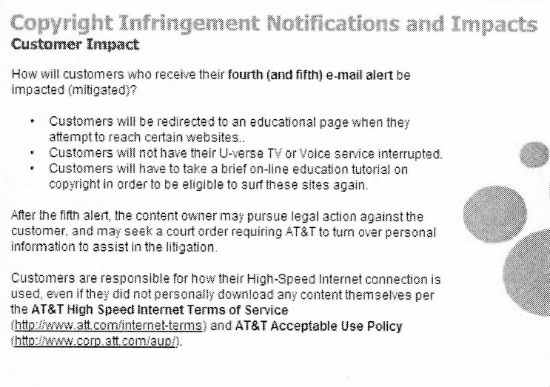
TorrentFreak obtained internal AT&T training documents that outline how AT&T will deal with customers suspected of illicit downloading. After a series of warnings, AT&T intends to block access to websites suspected of copyright infringement until a customer successfully completes a course on online copyright law. Eventually, those caught repeatedly downloading pirated movies and music could face legal action after AT&T turns over the identities of suspect customers. Gone from early draft proposals are suggestions that ISPs will throttle or suspend service altogether for repeat violators.

Late reports indicate that other ISPs participating in the copyright enforcement action — Cablevision, Comcast, Time Warner Cable and Verizon — will also launch their own programs on the same date.

Most at risk are customers who frequent peer-to-peer file sharing sites. Tracking BitTorrent traffic is a priority for the newly-launched Center for Copyright Information (CCI) — a joint venture run by the ISPs in coordination with the MPAA and RIAA.

While not all peer-to-peer file traffic consists of illicit swapping of copyrighted works, some high profile torrent sites are among the first choices for consumers looking for free movies or music. CCI believes its Copyright Alert System (CAS) is primarily an educational tool for consumers who may not realize they are stealing copyrighted content. With its “six warnings” policy, CCI wants consumers to take action to protect themselves, their Internet accounts, and home networks well before any legal action is taken.

The latest implementation of the Copyright Alert System has watered down some of its earlier provisions, which could have put a customer’s Internet account at risk of being speed throttled or canceled. For now, consumers will receive six warnings about any suspected copyright infringement:

  • The first three strikes carry no consequences and are intended to serve as informational warnings that the downloading of copyrighted content may be taking place;
  • The fourth and fifth strikes will trigger forced browser redirects to a copyright education page and an online course on copyright law that must be successfully completed before the customer can once again visit suspect websites;
  • Strike six means AT&T (and presumably other ISPs) will turn over the IP addresses of repeat offenders and comply with any subsequent court orders requesting the identity of the customer for possible legal action. AT&T does not say it will terminate the customer’s account, but does remind customers to be mindful of its Acceptable Use Policy, which does allow them to terminate service for illegal acts.

Edward Stroz

Consumers caught allegedly downloading copyrighted content can protest their innocence, but a $35 refundable filing fee is required to begin the arbitration process. If a consumer proves the files downloaded were not illegally obtained or that their account was flagged in error, they can have the warning canceled and get their filing fee refunded. But there are no penalties for CCI, its copyright tracking arm run by MarkMonitor, or the ISP if the copyright tracking system gets it wrong.

Critics of the copyright enforcement scheme claim it delivers too many benefits for CCI and its industry backers and insufficient protection for consumers misidentified during copyright infringement dragnets.

For-profit copyright tracking companies have made false allegations in the past, forcing CCI to hire an “independent and impartial technical expert” to verify the accuracy and security of the tracking technology used. CCI hired the firm of Stroz Friedberg as their expert.

Critics charge Stroz Friedberg is actually a recording industry lobbying firm, who worked with the RIAA for five years, earning $637,000.

Eric Friedberg

“It’s a disappointing choice, particularly in light of CCI’s professed desire to build public confidence in CAS and the fairness of its processes,” University of Idaho Law Professor Annemarie Bridy told TorrentFreak. “It would have been refreshing to see an academic computer scientist or some other truly independent party appointed to fill that important role.”

Bridy calls CCI’s Copyright Alert System lacking in transparency and stacked in favor of copyright holders, not consumers.

Stroz Friedberg’s appointment has also raised eyebrows among others that suggest their past lobbying violates the spirit of a Memorandum of Understanding signed by all parties requiring “independent and impartial” oversight.

“CCI’s choice of a former RIAA lobbying firm makes it clear that the copyright owner parties to the Memorandum of Understanding were more interested in appointing someone they trust than in appointing someone the public can trust,” Bridy adds.

Network World columnist Steven Vaughan-Nichols worries this is just the beginning of another copyright enforcement overreach:

The name of their game is to monitor your network traffic, with the help of your friendly ISP. Their justification for this is the usual made-up “facts” that content theft leads to “more than 373,000 jobs, $16 billion in lost wages, and $2.6 billion in lost taxes.” Yeah, I’m also sure someone downloading copyrighted porn leads to cats and dogs living together.

One reason I can’t buy into all this is that, as TorrentFreak points out, the Center’s expert who vouches that this all works is none other than Stroz Friedberg, a former RIAA lobbyist. Oh yeah, he doesn’t have bias for paranoid copyright protection companies.

What this means for you is that if your ISP is AT&T, Cablevision, Comcast, Time Warner, or Verizon, they’ll be watching your use of BitTorrent and letting CCI decide if you deserve some warnings, an end to your Internet service, or a full-out lawsuit.

[…] The RIAA, the MPAA, and other copyright “protectors” have never done anything for content creators. They’re all about protecting the businesses stuck with old, broken, pre-digital business models. Even that wouldn’t be so bad, except historically they’ve always vastly over-reacted.

We all know the stories of some poor slob who’s been slammed with tens of thousands of damages for downloading a song. What you may not know is that all the powers that be have to do is to claim something is copyrighted, whether it is or not, and multiple websites can be closed in minutes or your entire digital library can be destroyed.

Does that sound like paranoid fantasy? I wish.

[…] Oh yeah, I feel really sure that the CCI and friends are going to do a good job. Welcome to the new copyright world, same as the old, where you’re always considered guilty rather than that quaint idea of being considered innocent before proven otherwise.

CCI admits sophisticated pirates will probably never get caught by its Copyright Alert System, because most of them are moving to secured Virtual Private Network (VPN) technology that effectively masks their identities. TorrentFreak notes sales for VPN’s are skyrocketing, many headquartered far away from the reach of the United States in exotic, subpoena-proof locations like Cyprus, the Seychelles, Romania, and Ukraine.

[flv width=”640″ height=”500″]http://www.phillipdampier.com/video/RT Thom Hartmann Copyright Alert System 3-20-12.flv[/flv]

RT’s Thom Hartmann presided over a debate about online copyright theft control measures proposed earlier this year by the entertainment industry and Internet Service Providers. Appearing with Hartmann are David Seltzer, Attorney & Mark Bledsoe. (March 20, 2012) (12 minutes)

Broadband Usage Cap Buster: Next Gen 8K UltraHD Video Needs 360Mbps

Phillip Dampier October 17, 2012 Broadband "Shortage", Broadband Speed, Community Networks, Consumer News, Data Caps, Editorial & Site News, Online Video, Video Comments Off on Broadband Usage Cap Buster: Next Gen 8K UltraHD Video Needs 360Mbps

Cable companies are starting to lay the groundwork to support the next generation of HD video — first with 4K, an improvement over today’s HD standard, and eventually 8K Ultra High Definition TV — delivering pictures 16 times better than the current 1080p HD standard and coming close to the level of detail supported by IMAX.

The 8K evolving standard, proposed by Japan’s public broadcaster NHK and dubbed Super Hi-Vision, remains years away, but cable operators are preparing their systems to support 4K UHDTV (3840 x 2160 – 8.3 megapixels)  much sooner.

By the time 8K comes into use, most cable operators will rely entirely on a single broadband pipe to deliver video, Internet access and telephone service. To handle that traffic, and the bandwidth UHDTV demands, providers will have to upgrade their systems to support much faster speeds. A single video channel transmitted in 8K UHDTV requires around 360Mbps.

That makes Google’s decision to construct a gigabit broadband network in Kansas City seem less revolutionary and almost evolutionary, considering how quickly bandwidth demand will increase in the next eight years.

The cable industry is now moving fast to finalize the next version of the DOCSIS standard which supports cable broadband. DOCSIS 3.1 is expected to be introduced Thursday at the Cable-Tec Expo. An initial preview seems to suggest the standard will be backwards-compatible with prior DOCSIS versions — good news for those buying their own cable modems — and will support multi-gigabit speeds, if the cable operator decides to dedicate more of its available bandwidth to broadband.

An essential goal of the cable industry is to match or beat 1Gbps, currently on offer from several fiber to the home service providers and Google. Some operators want even more — up to 10/2Gbps capacity, as they consider future speed needs.

But engineering advancements and innovation fly in the face of bean counters attempting to monetize broadband usage with usage caps and usage-based billing. The industry’s justification for usage caps becomes even more tenuous as it moves to a single pipeline for all of its services and treats its cable TV package differently from Internet traffic. AT&T and Bell are already doing that today with their U-verse and Fibe platforms. Both claim their TV channels move over a different network than traditional Internet, but as costs for both continue to decline, that is becoming a distinction with little difference.

Google and a handful of independent or community-owned broadband networks are largely the only ones calling out the cable industry’s bogus claims that consumers don’t need super fast broadband, usage caps are necessary, and broadband speed upgrades are difficult and too expensive. These new competitors have correctly predicted the exponential growth in bandwidth demand and are prepared for it, even as the industry continues to dismiss their competitors’ networks as unnecessary overkill.

But cable’s hurry to DOCSIS 3.1 tells a different story.

Jeff Baumgartner from Light Reading Cable observed cable executives at Tuesday’s annual Cable & Telecommunications Association for Marketing (CTAM) conference, where those attending beat the drum for faster and better networks:

[DOCSIS 3.1] will also focus on the quality of cable’s pipe, reduced latency and other smarts designed to help enable a new set of broadband-based services. Cable’s interest in offering 4K HD services, which offer four times the resolution of today’s HD, was an example that was brought up several times during the session.

The cable industry also hopes to shorten the process of creating the specs and having them turn into deployable products. An average generation of DOCSIS has typically taken three to four years.

“We can no longer do that,” said Phil McKinney, the new president and CEO of CableLabs, but didn’t offer a guess on the anticipated cycle for 3.1. “We have to deliver higher and higher performance.”

[…] And 3.1 is also about the almighty dollar as broadband usage continues to climb. Getting costs down “is a key part of Docsis 3.1,” said Cox Communications Inc. EVP and CTO Kevin Hart.

[flv width=”640″ height=”380″]http://www.phillipdampier.com/video/Light Reading NBCU Ultra-HD Demo 10-12.flv[/flv]

Jeff Baumgartner from Light Reading Cable was invited to a demonstration of 8K UHDTV, which will require much faster broadband networks to handle the super high quality video. (3 minutes)

FCC to Competing Video Services: You’re On Your Own and Good Luck to You

Phillip Dampier October 9, 2012 Competition, Consumer News, Editorial & Site News, Online Video, Public Policy & Gov't Comments Off on FCC to Competing Video Services: You’re On Your Own and Good Luck to You

The Federal Cable-Protection Commission

Problem: Solved?

The Federal Communications Commission last Friday unanimously voted to free cable operators from their obligation to sell cable channels they own to rival satellite and phone companies.

In a bizarre justification, FCC chairman Julius Genachowski said ending the unambiguous rules would prevent anti-competitive activity in the market because the FCC would retain the right to review industry abuses on a case-by-case basis. Lawmakers called that an invitation for endless, time consuming litigation that will deprive consumers of competitive choice and favor the still-dominant cable television industry.

“The sunset of the program access rules could lead to a new dawn of less choice and higher prices for consumers,” said Rep. Ed Markey (D-Mass.), one of the original authors of the rules. “If we do not extend the program access rules, the largest cable companies could withhold popular sports and entertainment programming from their competitors, reducing the competition and choice that has benefited consumers. I urge Chairman Genachowski and the FCC commissioners to extend the program access rules that have helped to level the playing field in the paid television marketplace.”

The FCC’s decision could have profound implications on would-be competitors, particularly start-ups like Google Fiber that could find itself without access to popular cable networks at any price.

At a time when cable companies and programmers are constantly pitted against each other in contract/carriage disputes, the deregulatory spirit at the FCC is likely to irritate consumers even more.

Phillip “How nice of the FCC to think about poor cable companies” Dampier

The FCC claims it will continue to protect sports programming from exclusive carriage agreements — a potentially critical concession considering the history of “exclusive, only on cable” programming contracts was largely focused on regional sports channel PRISM.

Comcast successfully kept the popular Philadelphia-based network (today known as Comcast SportsNet Philadephia) off competing satellite services and cable operators by only distributing the network terrestrially. A controversial FCC rule (known as the “terrestrial exception”) states that a television channel does not have to make its shows available to satellite companies if it does not use satellites to transmit its programs. Cox Cable has its own implementation of that loophole running in San Diego.

Derek Chang, executive vice-president of DirecTV, says Comcast’s local market share dominance is a direct consequence of SportsNet. More importantly, Chang believes even if Comcast says it will sell the network to competitors, it is free to set prices for SportsNet as high as it wants.

“They win either way,” Chang said. “They’re either going to gouge our customers, or they’re going to withhold it from our customers.”

Verizon FiOS has secured the right to carry the channel on its system, but won’t say how much it pays.

The PRISM case is today’s best evidence that exclusive agreements do hamper competition — Philadelphia is hardly a hotbed of satellite dishes, with a 40-50% reduced satellite subscriber rate attributable to the lack of popular regional sports on satellite.

FCC Chairman Julius Genachowski’s cowardly lion act is back. Will anyone at the FCC stand up to Big Telecom companies while busy watering down pro-competitive policies?

Historically, satellite dish owners and wireless cable customers were the most likely victims of exclusive or predatory programming contracts, with some cable networks refusing to sell their programming to competing technologies at any price.  Others charged enormous, unjustified mark-ups that made the technology non-competitive. Today, wireless cable television is mostly defunct and home satellite dish service has largely been replaced with direct broadcast satellite providers DirecTV and Dish.

Today’s programming landscape is more complicated. The FCC would argue that unlike in the 1980s, most cable programmers are no longer directly controlled by yesteryear’s Tele-Communications, Inc. (TCI) and Time Warner (Time Warner Cable was spun off into an independent, unaffiliated entity in March, 2009), which collectively controlled dozens of popular cable networks. But programmers’ know their best customers remain cable operators which maintain a dominant market share in every major American city.

Friday’s ruling has implications for telco-TV providers and satellite dish companies that may find programming negotiations more complicated than ever. AT&T U-verse and Verizon FiOS may find access to cable-owned programming difficult or even impossible to obtain if cable operators decide their unwanted competition is harmful to their business interests.

But an even larger challenge looms for the next generation of video competition: Google Fiber TV and “over the top” online video.

Nobody is complaining about Google’s robust gigabit broadband offering, but Kansas City residents originally expressed concern about the company’s proposed television lineup. As originally announced, Google Fiber TV was missing HBO and ESPN.

A competing cable system without ESPN is dead in the water for sports enthusiasts.

Google has since managed to sign agreements that expand their channel lineup (although it is still missing HBO). But nothing prevents channel owners from dramatically raising the price at renewal. That is a concern for smaller cable operators as well, who want protection from discriminatory pricing that awards the best prices to giant multi-system operators like Comcast and Time Warner Cable.

The most important impact of the FCC’s decision may be for those waiting to launch virtual cable systems delivering online programming to customers who want to pick and choose from a list of networks.

The FCC’s “new rules” give programmers who depend on tens of millions of cable subscribers even more ammunition to kill competing distribution models like over the top video. Start-up providers who cannot obtain reasonable and fair access to cable programming will have to depend on the vague policies the FCC claims it will enforce to prevent egregious abuse. But the FCC is not known for its speed and start-up companies may face enormous legal fees fighting for fair access that is now open to subjective interpretation.


New ‘Stealthy’ Slingbox Quietly Shipped to Best Buy; 1080p, Built In Wi-Fi

Phillip Dampier October 1, 2012 Consumer News, Data Caps, Online Video 1 Comment

{from Engadget)

Carefully laid plans for a surprise launch of the long-awaited next generation of the Slingbox were ruined when shelf stockers at Best Buy mistakenly put units out on store shelves two weeks before the official launch date.

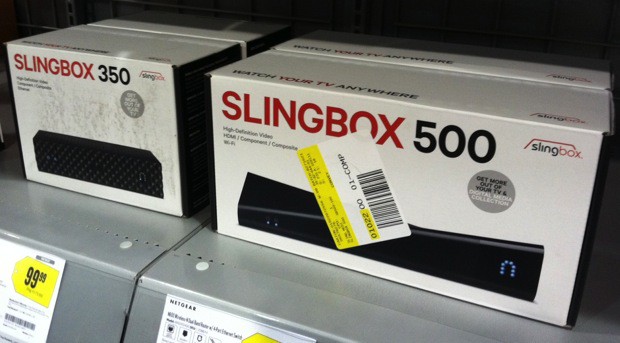
The Slingbox 350 and 500 represent major updates in the Slingbox product line. The devices independently stream video, television, and cable programming to remote computers and wireless devices like smartphones without the kinds of copyright and location restrictions imposed on cable, satellite, and telco TV companies’ “TV Everywhere (Inside Your House)“-offerings. In short, if you can watch a channel at home, you can use the Slingbox to stream it anywhere.

Engadget reports the new models seem capable of offering 1080p streaming, assuming your wireless connection is capable of keeping up. The premium 500 model also adds built-in Wi-Fi, a major improvement over earlier Slingbox units that required either a wired Ethernet connection or a wireless bridge. But the 500 apparently deletes the built-in ATSC tuner, which seems to suggest Slingbox is targeting the device more for streaming personal media collections, not streaming broadcast TV. The 500’s inclusion of built-in USB media sharing and HDMI also seem to point in this direction. The 350, obviously a budget model, relies entirely on component and composite jacks.

The larger problem for Slingbox is coping with broadband and wireless usage caps, which could make streaming HD programming an allowance-eater. Slingbox has routinely dealt with Hollywood studios and other content owners objecting to the streaming of their television programming, but usage caps and overlimit fees could present an even bigger threat to their business model.

Slingbox’s Pro-HD and SlingCatcher models — the two most recent major releases — have been around since 2008. The company has since been largely focused on licensing its technology for inclusion in cable and satellite company set top boxes.

Best Buy realized its error when consumers attempted to buy the new units. They have since been pulled from shop shelving but will be back, slated to go on sale officially for an undisclosed price in the middle of October.

Search This Site:

Contributions:

Recent Comments:

Your Account:

Stop the Cap!