Home » Online Video » Recent Articles:

Time Warner Cable/Netflix Spat Costs Viewers Super HD/3D Streaming Options

Phillip Dampier January 17, 2013 Broadband "Shortage", Data Caps, Online Video 4 Comments

Netflix has introduced 3D and Super HD viewing — an improved version of 1080p streamed content — but if you are a Time Warner Cable broadband customer, you will not be able to watch.

Netflix is distributing its highest definition content over its Open Connect CDN network, which minimizes the geographic distance and number of connections between viewers and Netflix’s streaming servers. ISPs can join Netflix Open Connect either by free peering at common Internet exchanges, or save even more in transit costs by putting free storage appliances supplied by Netflix in or near their network.

“OpenConnect provides Netflix data at no cost to the location the ISP desires and doesn’t seek preferential treatment,” Netflix tells GigaOm. “We hope Time Warner will join the many major ISPs around the world who are participating in Open Connect to reduce costs, minimize congestion and improve data delivery to enhance the consumer experience.”

So far, Time Warner Cable has chosen not to participate and accused Netflix of discriminating against its customers.

“While they call it ‘Open Connect,’ Netflix is actually closing off access to some of its content while seeking unprecedented preferential treatment from ISPs,” Time Warner Cable said in a statement to Multichannel News. “We believe it is wrong for Netflix to withhold any content formats from our subscribers and the subscribers of many other ISPs. Time Warner Cable’s network is more than capable of delivering this content to Netflix subscribers today.”

ISP participation in the Netflix Open Connect CDN has proven limited thus far in the United States. Cablevision is the only major cable operator signed on to the content delivery platform. Frontier, Google Fiber and Clearwire also participate. Abroad, Virgin Media, British Telecom, Telmex and Telus also participate.

Netflix’s decision to limit its best streams to participants may be an attempt to force ISPs to take its content delivery network more seriously and enlist subscribers in a push to get additional ISPs on board. By bringing its most watched content directly to ISP’s, the company is attempting to blunt provider arguments for data caps and other viewing limits because the cost to distribute content within a provider’s internal network is negligible.

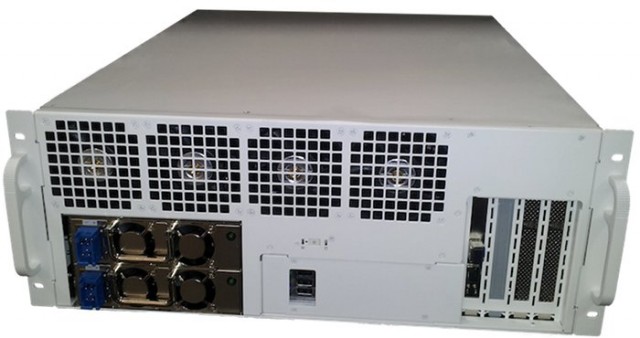
The necessary hardware powering the Netflix Open Connect CDN is less than you might think. The single device powering Open Connect is easily rack mountable and consists of:

Netflix's Open Connect CDN hardware

Netflix’s Open Connect CDN hardware

Chassis TST custom 1x
Motherboard Supermicro X9SCM-F 1x
Processor Intel E3-1260L 1x
Memory 8GB ECC 1333MHz 4x
Hard Drive Hitachi Deskstar 5K3000 3TB 36x
Hard Drive (alternate) Seagate Barracuda 7200.14 3TB 36x
Solid State Drive Crucial m4 512GB 2x
Controller LSI SAS 9201-16i 16 port 2x
Network card Supermicro AOC-STGN-i2S 1x
Redundant Power Supply Unit (AC/DC options) Zippy MRW-5600V4V/DMRW-5600V4V 1x
Misc. 2U active CPU Heatsink, SATA Cables, NIC optics

Your Next Time Warner Cable Set-Top Box: Roku

Phillip Dampier January 9, 2013 Consumer News, Online Video, Video 4 Comments
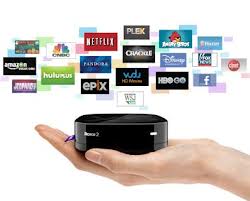
The Roku set top streaming device.

The Roku set top streaming device.

The days of renting expensive set top boxes from Time Warner Cable may finally be coming to an end, at least if you happen to subscribe to the cable company’s broadband service.

Time Warner Cable this week announced a new partnership with Roku that will bring 300 Time Warner Cable channels to the video streaming device.

Time Warner Cable customers who also own Roku devices will soon find a TWC “channel” on the menu, from which subscribers can access the same streamed content found on the cable company’s viewing apps for iOS and Android devices. The service represents true IPTV television — an all digital experience streamed over Time Warner Cable’s broadband service.

Customers only have to pay for the Roku device, which ranges from $50-100. Lower priced units do not deliver a true HD viewing experience. Higher priced models support 1080p viewing and support additional features like motion control for games and external USB and Ethernet ports. Time Warner Cable currently limits HD viewing to 480p on its streaming apps, so a cheaper unit may suffice for secondary television sets.

Roku boxes also offer cable customers other viewing options apart from Time Warner Cable, including independent networks, games, movie channels, foreign language and ethnic programming, religious entertainment, global news, and a variety of self-produced and public access programming from cities around the country. Roku boxes also support Netflix and Amazon Video on Demand.

Enjoy arrest and deportation.

But there are a few downsides, at least for the moment. Local broadcast channels are not currently available except in New York City, but that is expected to change soon. Recording programming delivered over a Roku box is not easily possible, and viewing will reduce available bandwidth on your broadband connection.

Considering Time Warner now charges just shy of $8.50 a month for each set top box, switching to Roku will pay for itself in as little as six months. Time Warner Cable expects most customers will consider the streaming device for televisions in bedrooms and guest rooms.

Saratoga, Calif.-based Roku has had a blockbuster year, doubling the number of its employees and approaching five million units sold. Last year, consumers watched more than one billion hours of television over Roku devices.

[flv width=”534″ height=”320″]http://www.phillipdampier.com/video/NY1 TWC and Roku 1-8-13.mp4[/flv]

Time Warner Cable’s NY1 reports on the Roku-Time Warner partnership that will let customers stream the cable company’s lineup without a traditional set top box. (1 minute)

UsageCapMan Takes Exciting Trip Through D.C.’s Revolving Door; Now FCC’s Chief Economist

From writing friendly reports defending Internet Overcharging to the FCC's new chief economist -- D.C.'s revolving door keeps on spinning.

From writing friendly reports defending Internet Overcharging to the FCC’s new chief economist — D.C.’s revolving door keeps on spinning for Professor Steven Wildman.

The Federal Communications Commission has proved that Washington’s revolving door enjoys perpetual motion with the announcement it hired a new chief economist who just three weeks earlier was peddling his findings favoring usage caps and consumption billing before a National Cable & Telecommunications Association gathering that paid for his research.

Professor Steven Wildman’s move from the cable industry’s go-to-guy for defending Internet Overcharging to a cushy new position at the FCC just weeks after shilling for the country’s largest cable industry lobbying group is shocking even by Washington’s standards.

Remarkably, FCC Chairman Julius Genachowski praised this cheerleader of wallet-pilfering by saying “his deep economic expertise and problem solving abilities” are the perfect fit for an agency pressed with challenging initiatives – like charging you more for your broadband service and calling it “pro-consumer.”

There is no doubt Wildman has deep economic expertise — he has found success penning dubious research bought and paid for by an industry that expects his findings to echo their own talking points. His problem-solving abilities at fixing the facts around the cable industry’s agenda are also unquestioned.

But his research reports aren’t worth wasting your monthly usage allowance to download because they only tell part of the story.

At the December NCTA Connects event, Wildman was the darling of the cable industry echo chamber telling tall tales about the problems of broadband penetration in a country where providers enjoy up to 95 percent gross margins on broadband pricing:

“One of the key mechanisms through which positive welfare effects are realized is the crafting of lower-priced plans for users who otherwise might not take service, while users who have a more intensive demand for broadband are able to contract for more advanced services. We also showed that UBP has flexibility advantages for users whose data service needs vary over time. Because UBP creates an incentive to offer lower cost-lower usage plans to consumers who otherwise could not profitably be served at a unitary price, UBP can be an effective tool for promoting increased broadband penetration in the United States, a role that is enhanced by the fact that low price-low usage options reduce the financial risks to consumers thinking about trying broadband for the first time.”

“Tiered pricing also has benefits for the recovery of shared network costs and for network investment. Whereas investment decisions are also influenced by other factors, including the costs of extending networks, potential revenues, and overall economic conditions, we found that, other things equal, usage tiers will likely contribute to better cash flows and stronger incentives to invest in broadband plant, both to improve the quality of service for current customers and to extend networks into unserved and underserved territories.”

usage cap manWildman does not mention his cable benefactors earn a higher percentage of profit on broadband than oil sheikhs in the Middle East rake in charging $90+ for a barrel of oil. So it is unsurprising his analysis lacks one simple solution providers could use to differentiate their services and enhance broadband penetration: lower the price to compete. He also ignores the fact that true usage pricing would offer consumers a chance to pay only for what they actually consumed during a month, but those plans are not on offer anywhere.

Wildman ignores the real industry agenda: monetizing broadband usage to create even higher profits. The cable industry is well on its way, using the enormous market power enjoyed in the current monopoly/duopoly state of consumer broadband to preserve today’s near-extortionist pricing while trying to pick up customers currently unwilling to pay, charging for slightly discounted service that comes with a paltry usage allowance.

The meme that unlimited, flat rate broadband is somehow responsible for America’s broadband-unserved is a popular one at the FCC, where Chairman Genachowski has applauded usage based pricing as an “innovative” experiment that could change how broadband is marketed in the U.S. and promote its expansion.

While those in D.C. may live in a bubble populated by industry lobbyists, others do not.

[flv width=”640″ height=”380″]http://www.phillipdampier.com/video/NCTA Connects The Pros and Cons of Broadband Peak Load Pricing Dec 2012.flv[/flv]

Message Confusion: While some in the cable industry still advocate usage pricing and caps as a matter of “fairness” and as a salve for peak time congestion, today’s advocates of usage-based billing appearing at a cable-industry event in December admit congestion is simply no longer a problem on wired networks. Sandvine’s Dave Caputo and Professor David M. Lyons of Boston College Law School dismiss the notion of congestion-based pricing only during peak usage, arguing congestion is no longer the real issue driving usage caps. That is why everyone must be subjected to higher priced, usage-capped broadband no matter what time of day they use the network. (3 minutes)
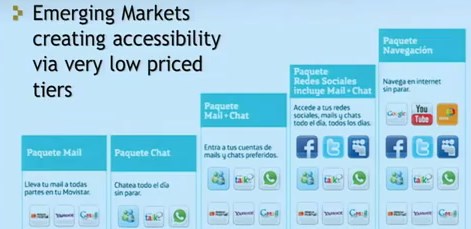
The inevitable outcome of "differentiated pricing" is charging consumers more to access popular websites, as is already the case in countries like Colombia.

The inevitable outcome of “differentiated pricing” is charging consumers more to access popular websites, as is already the case in countries like Colombia.

Wildman argues that like car manufacturers that offer many different models ranging from basic to well-appointed with luxury extras, providers should be free to offer different types of plans to consumers.

Wildman’s auto analogy fails because consumers have more than a dozen different manufacturers to choose from, each making a range of different models. For broadband, the overwhelming majority of Americans have two choices: the cable and phone company. Unlike auto manufacturers that respond to consumer demand, broadband providers are hellbent on eliminating the overwhelmingly popular flat rate, unlimited option in favor of mandatory usage pricing and/or usage caps. It would be like telling auto-buyers that their Honda Accord, Toyota Camry, or Chevy Malibu no longer met the needs of manufacturers. Instead, you have one choice: the Toyota Yaris. But you can get it with heated leather seats, so what’s the problem?

Wildman also ignores the fact providers already sell different plans, based on different speeds. Customers with only light web use can select a cheaper, lower speed tier and never notice the difference. Heavier users buy up into premium speed tiers, paying higher prices to cover their additional usage and expectations of performance.

Providers have spent the last few years trying to justify adding a usage component to the pricing equation and Wildman is perplexed by public policy and consumer groups overwhelmingly hostile to plans that would leave current pricing largely intact and add an artificial usage cap. Considering who pays for his research, this is not too surprising.

Wildman’s style of “innovation” already exists in countries like Canada, Australia, New Zealand, and in parts of Europe allowing everyone to witness what actually happens when these pricing schemes gain a foothold. Usage-based pricing has successfully boosted the profits of providers but has done nothing to expand rural broadband networks or offer customers big savings. When providers gorge on profits made possible in uncompetitive markets, the money goes straight into bank accounts or back to investors, not into capital spending to improve service or expand into areas deemed unprofitable to serve.

Customers despise usage caps so much that in Australia and New Zealand, the government has partially taken over rebuilding infrastructure with new fiber to the home networks and promoting international capacity expansion that will eventually banish usage pricing for good. In western Canada, Shaw Cable heard so much condemnation about usage caps during its listening tour, it greatly relaxed them. (The fact its biggest competitor Telus barely enforces their own caps didn’t hurt either.)

In the rest of Canada, independent ISPs have found a growing niche selling plans with considerably larger usage allowances or flat rate access. How did dominant providers like Bell (BCE) respond? They asked regulators to force the competition to stop selling flat rate service.
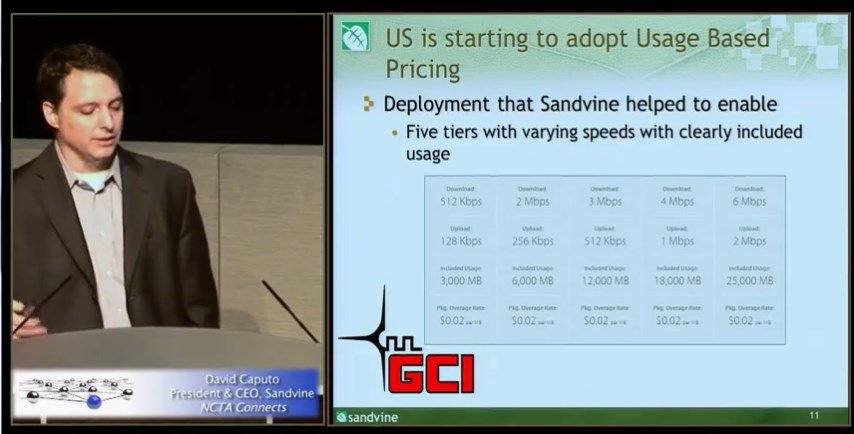
sandvine helping

How Sandvine helps providers “innovate.” Alaska’s GCI implemented its draconian caps and overlimit fees using Sandvine’s Internet Overcharging technology.

Wildman’s report flies in the face of reality, and every so often the cable industry itself admits as much. Take the word of Suddenlink president and CEO Jerry Kent, who runs a largely rural cable company that launched its own Internet Overcharging scheme:

“I think one of the things people don’t realize [relates to] the question of capital intensity and having to keep spending to keep up with capacity,” Kent said. “Those days are basically over, and you are seeing significant free cash flow generated from the cable operators as our capital expenditures continue to come down.”

Unsurprisingly, that sentiment did not make it into Wildman’s analysis either.

Wildman

Wildman

Financial reports from providers that have usage caps and those that don’t show the same remarkable trend: broadband expenses are way down, capital intensity is well within expected norms, and cable operators are not pouring their profligate earnings into expanding rural broadband.

That makes Wildman the consummate team player, and hardly the best choice for taxpayers who will cover his salary for a few years before he takes another trip through the revolving door back to his industry friends. When Americans wonder why Washington doesn’t seem to be living in the reality-based community, this is why. We can hardly expect Mr. Wildman to represent our interests when he has spent the last several years representing an extremely profitable industry reviled for its overcharging, poor service, and scheming, and will be more than welcomed back if he remembers his friends while working at the FCC.

This latest move represents another disappointment from Chairman Julius Genachowski, who increasingly appears to be warming up to a telecommunications industry he used to aggressively oversee at the start of his tenure.

[flv width=”640″ height=”380″]http://www.phillipdampier.com/video/NCTA Connects The Evolving Internet – Patterns in Usage and Pricing Dec 2012.flv[/flv]

Three weeks ago, the Three Musketeers of Internet Overcharging appeared at a cable industry-sponsored event promoting usage caps and consumption billing. Sandvine CEO Dave Caputo makes his living scaring providers and consumers about Internet growth and (conveniently) selling the equipment that manages the traffic “tsunami” with speed throttles and usage limits. Professor David M. Lyons of Boston College Law School calls usage pricing “second degree price discrimination,” a term he hopes the industry will rebrand into something less ominous and obvious. He argues selling broadband at incremental costs will never recover “fixed costs” for networks the cable industry itself admits have already been largely paid off. Professor Steven Wildman, now on the way to the FCC as its new chief economist, peddles research bought and paid for by the cable industry. They got their money’s worth. (1 hour, 9 minutes)


New Report Slams Data Caps: An Internet Overcharging Climate of False Internet Scarcity

Data Caps 2-Pager_001

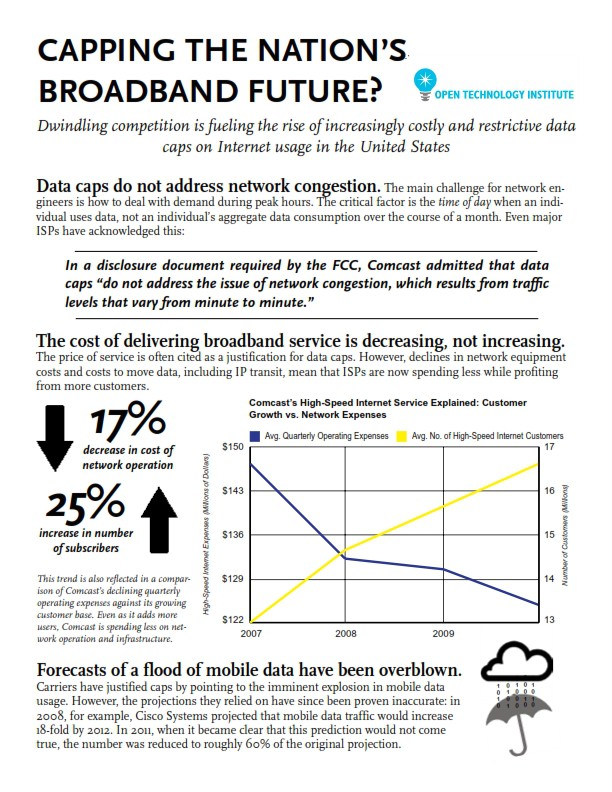
A new report critical of broadband providers’ implementation of usage-based billing and data caps finds providers are not using them to handle traffic congestion, instead implementing them to monetize broadband usage and protect pay television from online video competition.

stop_signThe New America Foundation and the Open Technology Institute today released its report, “Capping the Nation’s Broadband Future?,” which takes a hard look at the increasingly common practice of limiting subscribers’ broadband usage.

The paper finds that provider arguments for limiting broadband traffic don’t make sense, but do earn more dollars from customers forced to upgrade their service to win a larger monthly usage allowance.

“Although traffic on U.S. broadband networks is increasing at a steady rate, the costs to provide broadband service are also declining, including the cost of Internet connectivity or IP transit as well as equipment and other operational costs,” the reports argues. “The result is that broadband is an incredibly profitable business, particularly for cable ISPs. Tiered pricing and data caps have also become a cash cow for the two largest mobile providers, Verizon and AT&T, who already were making impressive margins on their mobile data service before abandoning unlimited plans.”

The study finds providers are attempting to invent a climate of broadband scarcity, particularly on the nation’s wired networks, to defend the introduction of various forms of Internet Overcharging, including data caps, usage-based billing, and overlimit fees.

The New America Foundation is calling on policymakers to take a more active role in defending online innovation and controlling provider zeal to cap the nation’s broadband future.

The False Argument of Network Congestion

Courtesy: Broadbast Engineering

Providers’ tall tales.

The most common defense for usage caps providers put forward is that they curb “excessive use” and impact almost none of their customers. The report points out many of the providers implementing usage caps have left them largely unchanged, despite ongoing usage growth patterns. In 2008, the report notes Comcast measured the average monthly usage of each broadband customer at around 2.5GB. Just four years later that number has quadrupled to 8-10GB. While many customers rely on Comcast’s broadband service for basic e-mail and web browsing, the cable operator has begun to entice customers into utilizing its online video platform, which in certain cases can dramatically eat into a customer’s monthly usage allowance, which remained unchanged until earlier this year.

Many broadband providers are less generous than Comcast, some imposing caps as low as 5GB of usage per month.

“Data caps encourage a climate of scarcity in an increasingly data-driven world,” the report concludes. “Broadband appears to be one of few industries that seek to discourage their customers from consuming more of their product. Thus, even as the economic and engineering rationale for data caps on wireline broadband does not hold up given the declining costs of providing service and rapid technological advancement, the proliferation of data caps is increasing. The trend is driven in large part by a woefully uncompetitive market that allows the nation’s largest providers to generate enormous profits as well as protect legacy business models from new services and innovators.”

The argument that increased usage puts an undeniable burden on providers is untenable when one examines the financial reports of providers.

The study found, for example, Time Warner Cable’s latest 10-K report shows that connectivity costs as a percentage of revenue have decreased by half, from an already modest 1.20% in 2008 to a little over 0.60% in 2011.

In 2012, the company is again exploring ways to introduce usage caps on at least some of its customers, in return for a modest discount.

Upgrade? Spend Less and Charge Customers More Instead!

wireline capital

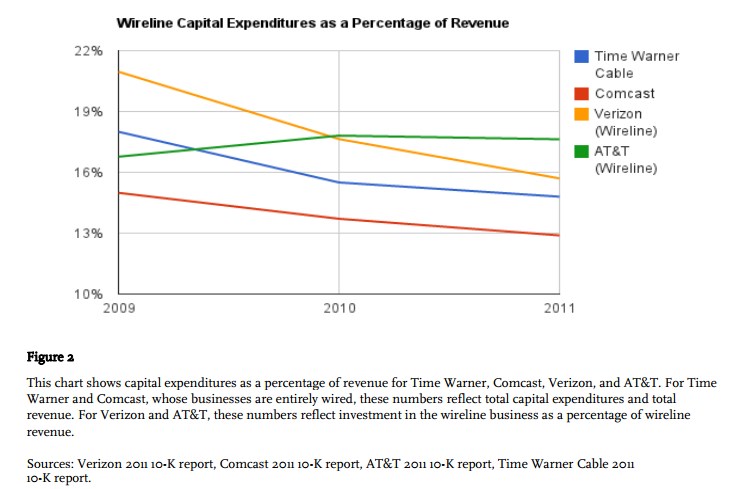
The report notes cable companies like Time Warner Cable and Comcast, whose networks were originally built for television services and have now been repurposed for broadband as well, are enjoying lucrative profits on
networks that have long been paid off. In fact, Time Warner Cable recently disclosed it earns more than 95 percent in gross margins on its broadband service, with additional rate increases for consumers likely in the near future. The company recently began charging its customers a modem rental fee as well.

Shammo

Shammo

At these margins, the report concludes selling broadband service to “data hogs” who consume hundreds of gigabytes of traffic per month are still profitable for providers.

As financial reports disclose capital spending on network upgrades continue to fall, operators are instead content imposing usage limits on customers to control traffic growth and further monetize an already enormously-profitable business.

The nation’s largest phone companies also come in for criticism. The report quotes from Stop the Cap!’s coverage of Verizon’s chief financial officer openly admitting it is investing most of its available capital in the highly profitable wireless sector.

“It is clear that in shifting a greater percent of their overall capital expenditures to their wireless segments, Verizon and AT&T are more interested in expanding their dominance in the wireless industry than they are in upgrading DSL or expanding fiber connectivity to provide aggressive competition for residential broadband service,” the report found.

Verizon’s chief financial officer recently made the following statement at an investor relations event:

“The fact of the matter is wireline capital — and I won’t give the number but it’s pretty substantial — is being spent on the wireline side of the house to support wireless growth,” [Verizon CFO Fran Shammo] said. “So the IP backbone, the data transmission, fiber to the cell, that is all on the wireline books but it‖s all being built for the wireless company.”

Wall Street Educates Providers on How to Lead the Way With Data Caps

Although the majority of subscribers loathe usage restrictions on their already-expensive broadband accounts, a vocal group on Wall Street strongly favors them, and routinely browbeats providers on the issue.

Helping educate cable companies about how usage caps can protect against cord cutting and further monetize broadband.

Helping educate cable companies how usage caps can protect against cord cutting and further monetize broadband.

The report’s authors discovered some Wall Street banks even invest time and money developing presentations advocating usage caps and consumption billing to protect video revenue. A 2011 Credit Suisse presentation outlined ways usage-based billing can protect cable operators’ video revenues:

“…over the longer term, consumption based billing could reduce the attractiveness of over the top video options (e.g., Netflix and Hulu), as the economic attractiveness of such over the top options could be partially offset by a [broadband] bill that is higher, due to [broadband] overage charges that would be driven by large amounts of data being streamed via a customer’s [broadband] connection.”

Yet most cable operators vehemently deny usage caps and consumption billing are designed to decrease usage or protect video revenue. Credit Suisse and other Wall Street banks and analysts say otherwise, and express little concern over network congestion.

The report finds compelling evidence that data caps have effectively stopped new competitors and online innovation already, noting a Sony executive stated that the company was putting the development of its own online video service on hold, citing Comcast’s monthly usage cap.

The Wireless Cap Shell Game: Caps Protect Scarce Airwaves While Companies Promote More Usage, For a Price

The report also found suggestions of a forthcoming wireless traffic tsunami are greatly exaggerated. AT&T and Verizon Wireless have issued repeated alarmist rhetoric claiming that wireless data’s exponential growth is threatening to overwhelm available network capacity.

But both carriers recently changed pricing models to encourage consumers to bring more devices to their networks, along with suggestions customers upgrade to higher allowance plans to handle the additional traffic generated by those devices. In fact, both AT&T and Verizon Wireless see profitable futures in forthcoming “machine to machine” wireless traffic that will allow cars, appliances and medical devices to communicate over their respective mobile networks. AT&T’s security and home automation system also relies on its own wireless network, offering customers remote access to their homes, chewing up wireless bandwidth as they go.

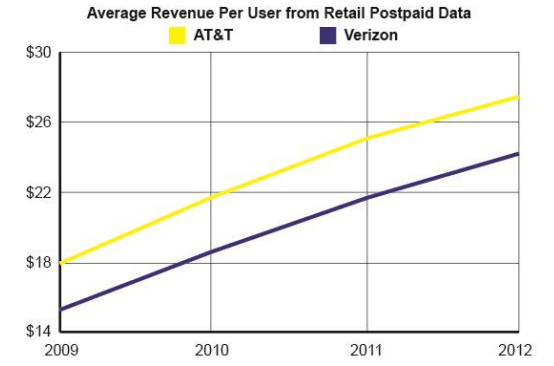
Despite suggestions from both providers their new wireless data plans would save customers money, in fact it has resulted in overall increases in the average revenue earned from each subscriber.

Despite suggestions from both providers their new wireless data plans would save customers money, it has brought overall increases in the average revenue earned from each subscriber instead.


Netflix Releases ISP Streaming Quality Report: DSL/Mobile Offer Poor Results

Phillip Dampier December 13, 2012 Broadband Speed, Competition, Online Video, Wireless Broadband Comments Off on Netflix Releases ISP Streaming Quality Report: DSL/Mobile Offer Poor Results
Cable to Netflix: You better think about going back to the U.S. Post Office and mailing DVDs. Our customers can't afford to throw away their usage allowance on your streamed movies.

Keeping ISPs honest

Netflix may have the most accurate national broadband speed honesty test around, at least when it comes to streaming video. With 30 million members viewing over one billion hours of Netflix streamed content every month, the company is well-positioned to report the real-world performance of virtually every ISP in the country.

Starting this month, Netflix will publish once-monthly surveys of the best and worst-performing providers.

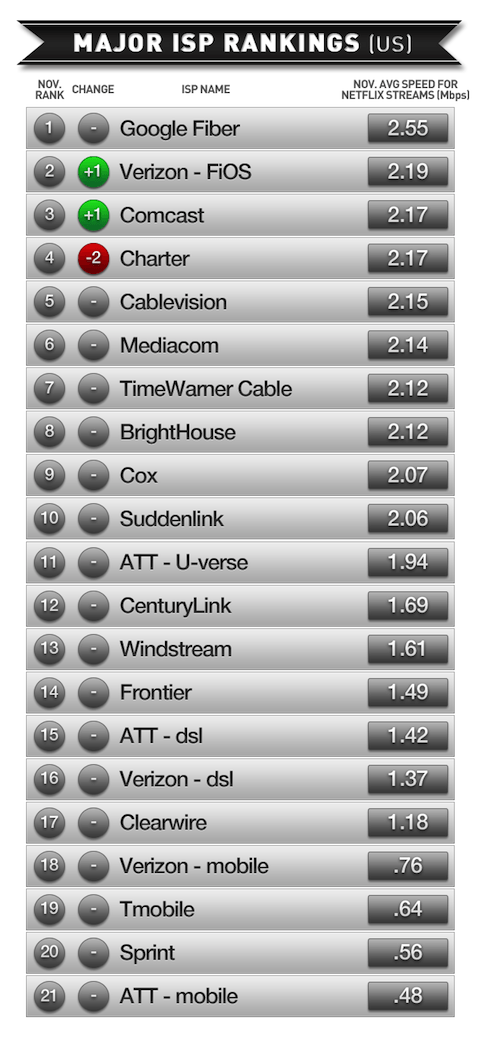
The results from November are not surprising. Fiber to the home offers America’s fastest and most reliable streamed video experience. Google Fiber, with its 1,000Mbps network, topped Netflix’s list, followed by Verizon’s FiOS fiber service.

Cable providers also performed well. Comcast delivered the best Netflix experience, Suddenlink the worst.

AT&T’s U-verse, which isn’t really a true fiber network but simply an extended form of DSL performed markedly poorer than its cable competitors.

DSL providers also performed poorly, ranging from CenturyLink to Verizon’s now neglected DSL. Frontier Communications made some improvements in its rankings. It used to be dead last.

Watching Netflix on mobile broadband proved to be both expensive (with data caps for most) and slow. Clearwire, which only operates a 4G WiMAX network performed the best. Despite the growing prevalence of HSPA+ and LTE 4G service from many other carriers, more common 3G service dragged performance down considerably. Verizon performed the best of the mixed networks, AT&T performed 40% worse than Verizon, coming in dead last.

20121210-Netflix_Major_ISP_Leaderboard-480-updated

Search This Site:

Contributions:

Recent Comments:

Your Account:

Stop the Cap!