Home » Online Video » Recent Articles:

Amazon Signs Travel Channel, Food Network, HGTV and More to Prime Instant Video

Phillip Dampier February 28, 2013 Online Video 1 Comment

scrippsAmazon.com today announced it is expanding its lineup of on-demand programming that will bring popular cable shows to Amazon’s Prime Instant Video service ($79/annually).

Starting today, Prime members will be able to stream programming produced by Scripps’ cable networks including the Travel Channel, HGTV, Food Network, Cooking Channel, and DIY.

Some of the shows include: Rachael Ray’s Week in a Day; Anthony Bourdain: No ReservationsCupcake Wars;Diners, Drive-Ins and Dives; House Hunters and House Hunters International; Iron Chef America; Man v. Food; Selling New York and Selling LA; Throwdown With Bobby Flay; Chopped; Ghost Adventures; andYard Crashers. Older programming will also be available for purchase and download.

Amazon Prime members may get access as part of their $79 annual membership fee.

Includes access to “Instant Video” at no extra charge.

“We are excited to be the exclusive online-only subscription home for Scripps content and know our customers are going to love getting these great shows as part of Prime,” said Brad Beale, Amazon’s head of video content acquisition.

Amazon has attempted to differentiate its video offerings from its much-larger rival Netflix. In many instances, the more-limited content on Amazon is already available from Netflix, making Amazon Prime Instant Video redundant for current Netflix subscribers. But Amazon has recently signed a handful of exclusive deals, mostly for television programming.

With streaming rights for popular Hollywood movies escalating into high orbit, most of the content deals signed by Netflix and Amazon during 2012 covered less-costly network series and cable shows. While that has discouraged movie fans, who increasingly turn to Redbox or other rental services for recent Hollywood releases, it is giving cable subscribers another reason to cut the cord on cable television.

Entertainment Producers Call Out Stifling Data Caps That Upset the Online Video Revolution

Phillip Dampier February 27, 2013 AT&T, Comcast/Xfinity, Competition, Data Caps, Online Video, Public Policy & Gov't, Verizon Comments Off on Entertainment Producers Call Out Stifling Data Caps That Upset the Online Video Revolution

Public-KnowledgeData caps protect incumbent big studio and network content creators at the expense of independent producers and others challenging conventional entertainment business models.

That was the conclusion of several writers and producers at a communications policy forum hosted by Public Knowledge, a consumer group fighting for an open Internet.

A representative from the Writers Guild of America West noted that cord-cutting paid cable TV service has become real and measurable because consumers have a robust online viewing alternative for the first time. John Vezina, the Guild’s political director, noted how Americans watch television is transitioning towards on-demand viewing.

New types of short-form programming and commissioned series for online content providers like Netflix are also changing the video entertainment model.

Welch: It is about the money.

Welch: It is about the money.

But a digital roadblock erected by some of the nation’s largest broadband providers is interfering with that viewing shift: the data cap.

Data caps place artificial limits on how much a customer can use their Internet connection without either being shut off or finding overlimit fees attached to their monthly bill. Critics contend usage caps and consumption billing discourage online viewing — one of the most bandwidth intensive applications on the Internet. With broadband providers like Time Warner Cable, AT&T, Verizon, and Comcast also in the business of selling television packages, cord-cutting can directly impact providers’ bottom lines.

Providers have traditionally claimed that usage limits are about preserving network resources and fairness to other customers. But Time Warner Cable admits they exist as a money-making scheme.

Rachel Welch, vice president of federal legislative affairs at Time Warner Cable, says the cable company is not worried about limiting data consumption. It considers monetizing that consumption more important.

“We want our customers to buy as much of the product as possible,” Welch told PC World. “The goal of companies is to make money.”

Time Warner now offers customers a choice of unlimited service or a $5 discount if customers keep their monthly usage under 5GB, but some worry that is only a prelude to introducing expanded usage limits on a larger number of customers in the future.

For many consumers already hard-pressed by high broadband bills, worrying about exceeding a data allowance and paying even more may keep viewers from watching too much content online.

For that reason, Vezina called data caps “anti-innovation.”

“It hurts consumers [and] it hurts creators who want to get as much out to the public in as many ways” as possible, he said.

Public Knowledge has become increasingly critical of data caps in the last two years. The organization has questioned how ISP’s decide what constitutes a ‘fair’ usage limit and criticized inaccurate usage meters that could potentially trigger penalties and overlimit fees.

Canada’s Wild Variations in Broadband Pricing: The Further West You Live, The Less You Pay

Phillip Dampier February 20, 2013 Broadband Speed, Canada, Competition, Data Caps, Editorial & Site News, Online Video, Rural Broadband Comments Off on Canada’s Wild Variations in Broadband Pricing: The Further West You Live, The Less You Pay
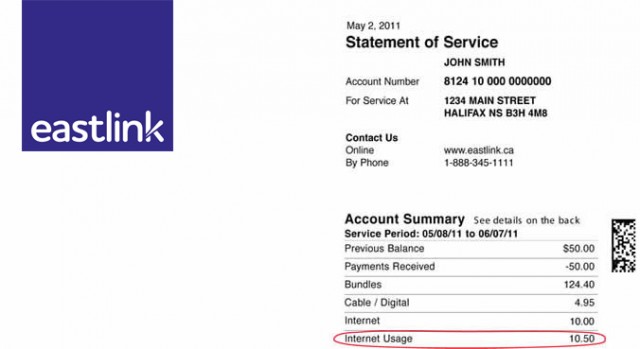
Atlantic Canada provider Eastlink still offer unlimited access for speeds of 20Mbps or slower, but the fastest speeds now come with usage caps and overlimit fees, as depicted on this sample invoice.

Atlantic Canada provider Eastlink still offer unlimited access for speeds of 20Mbps or slower, but the fastest speeds now come with usage caps and overlimit fees, as depicted on this sample invoice.

While broadband pricing in the United States depends primarily on whether one lives in a rural or urban area, in Canada, which province you live in makes all the difference.

Canadian broadband pricing varies wildly across different provinces. If you live in northern Canada, particularly in Nunavut or the Yukon, Internet access is slow and prohibitively expensive, assuming you can buy it at any price. Customers in Atlantic provinces including Nova Scotia, Prince Edward Island, Labrador and Newfoundland pay the next highest prices in the country, often exceeding $60 a month. But Atlantic Canadians often find unlimited use, fiber optic-based plans are often part of the deal. In the west, fervent competition between dominant cable operator Shaw and telephone company Telus has given residents in British Columbia and Alberta more generous usage allowances, faster speeds, and lower pricing.

The Canadian Broadcasting Corporation reports the most significant gouging takes place in the Canada’s two largest provinces: Ontario and Québec, where Bell (BCE) competes with three dominant cable operators: Rogers and Cogeco (Ontario) and Vidéotron and Cogeco (Québec). Critics contend that “competition” has been more in name-only over the last several years, as prices have risen and usage allowances have not kept up.

“These disparities are influenced by the competition,” Catherine Middleton, a professor at the University of Ryerson’s Ted Rogers School of Management told CBC News. “For example, Bell competes against Rogers in Ontario, but against Vidéotron in Quebec, with different plans for different markets.”

(Coincidentally, in 2007 the University of Ryerson accepted a gift of $15 million from the late Ted Rogers, founder of Rogers Communications, which won him naming rights for the Ted Rogers School of Management.)

Rogers and Cogeco charge Ontario residents more money for less access. Vidéotron treats their customers in Québec somewhat better, so Bell has plans to match.

more money“Ontario gets the worst when it comes to competitiveness,” Michael Geist, a law professor at the University of Ottawa and Canada Research Chair in Internet and e-commerce law told CBC News. “It tends to be the least competitive when it comes to getting bang for your buck.”

Prices start to moderate in the prairie regions. SaskTel and MTS Allstream are the largest providers in Saskatchewan and Manitoba. Both offer customers unlimited service plans, something of a shock to those further east. But unless you live in a larger city where the two companies are upgrading to faster fiber-based networks, DSL at speeds averaging 5Mbps is the most widely available service.

Nearing the Canadian Rockies, usage-restricted plans are a reality once again. In Alberta and British Columbia, Telus and Shaw competition means more generous usage allowances, and Telus does not currently enforce their usage limits. Shaw raised its own usage limits significantly beyond what a customer would find from Rogers back east. Prices are often lower as well.

The CBC notes unlimited broadband from cable operators has become a rarity. Eastlink, which provides service in Atlantic Canada, has phased out unlimited access on plans above 20Mbps. Rogers has a temporary “unlimited use” offer for customers paying for its premium-priced 150Mbps plan, and only until March 31.

The most significant recent change for eastern Canada was Bell’s decision to offer an unlimited-use “add-on” for $10 extra a month for Bell customers in Québec and Ontario who choose at least three Bell services (broadband, television, phone, satellite, or wireless service). Rogers has matched that offer for its own triple-play customers. Those who only want broadband service from either provider will pay three times more for unlimited access — an extra $30 a month.

The mainstream Canadian press often ignores third party alternative providers that offer an escape from usage-capped Internet access.

The mainstream Canadian press often ignores third party alternative providers that offer an escape from usage-capped Internet access.

But there are other alternatives, often ignored by the mainstream media.

A growing number of third-party independent providers buy wholesale access from large Canadian networks and sell their own Internet plans, often with no usage limits. TekSavvy, Distributel, Acanac, among many others, provide Canadians with DSL and cable broadband at prices typically lower than one would find dealing with Bell, Rogers, Shaw, or other providers directly. Some discount plans still include usage caps, but those limits are often far more generous than what the phone or cable company provides, and unlimited access is also available in most cases.

One website allows consumers to comparison-shop 350 different providers across Canada. Despite the growing number of options, the majority of Canadians still buy Internet access from their phone or cable company and live under a regime of usage caps and high prices, if only because they do not realize there are alternatives.

Usage caps have cost Canadian broadband consumers both time watching usage meters and money paying overlimit penalties. But the cost to innovation is now only being measured. While online video has become so popular in the United States it now constitutes the largest percentage of traffic on broadband networks during prime time, usage limits have kept the online video revolution from fully taking hold in Canada. That is a useful competition-busting fringe benefit for large telecom companies in Canada, which own cable networks, cable systems, broadcast networks, and even satellite providers.

Netflix’s chief content officer called Canadian broadband pricing “almost a human rights violation.” The online video provider was forced to introduce tools to let Canadians degrade the quality of their online video experience to avoid blowing past monthly usage allowances.


A Look Inside Time Warner Cable’s Quarterly Results and Forthcoming Plans

Phillip Dampier February 12, 2013 Broadband Speed, Data Caps, Online Video 12 Comments

timewarner twcIt’s time to take a look inside Time Warner Cable’s latest quarterly financial report and pick out some interesting developments that will impact customers during the first quarter of 2013.


Time Warner Cable managed 9 percent revenue growth in 2012, primarily from its broadband service, its strongest product. The company added another 500,000 broadband customers over the last year, primarily poached from telephone company DSL service. This growth in subscribers continues despite rate increases and the introduction of a $3.95 monthly modem rental fee introduced last fall.

CEO Glenn Britt noted that Time Warner Cable customers use and love their broadband service.

“The average customer used roughly 40% more capacity last year,” Britt noted.

But Time Warner Cable has plenty of capacity to handle that traffic growth.

Britt plans to leave as CEO of Time Warner Cable by the end of this year.

Britt plans to leave as CEO of Time Warner Cable by the end of this year.

Irene Esteves, Time Warner’s chief financial officer noted Time Warner Cable continues to decrease its capital spending. Overall, Time Warner spent $3.1 billion on capital expenditures in 2012, or just 14.5% of its revenue. That represents a 40-basis point decrease from 2011. The bulk of that spending was on business services, primarily from the costs of wiring business office parks and buildings for cable. Less than 12% of Time Warner Cable’s spending targeted residential services.

“Overall, we expect capital intensity will continue to decline modestly, with full year capital spending around $3.2 billion in 2013,” Esteves told investors.

Time Warner’s new modem fee is earning the company a major boost in Average Revenue Per User (ARPU). The average Time Warner customer now spends $103.79 a month for service, an increase of 6.3%. Three-quarters of that increase is attributable to the modem fee alone.

Customers are clamoring for higher broadband speeds. At the end of 2012, Turbo, Extreme and Ultimate subscribers comprised over 23% of the company’s residential broadband customer base, up from 19% a year ago and 11% three years ago.

Britt, expected to retire by the end of this year, noted the company’s biggest challenge during his tenure continues to be programming costs. But the company is contributing to that problem itself, spending $110 million in 2012 on its new regional sports networks in southern California, which feature the Los Angeles Lakers and the Los Angeles Dodgers.

“Our programming costs per subscriber has grown 32% in the last four years,” Britt complained. “Over that same period, the Consumer Price Index has risen by 9%. So the math is pretty simple, programming costs have been rising at more than three times the rate of inflation. Our residential video ARPU increased 16% over that same period, so we’ve effectively raised pricing a little faster than inflation but only half as fast as programming costs have risen.”

The rising price of cable service has caused Time Warner to lose a larger number of customers, particularly when promotional pricing deals expire. The company has retrained its retention agents to avoid losing customers to the competition as new customer promotions expire. Time Warner noted some of its strongest competition is coming from AT&T U-verse promotional pricing for double-play offers in Texas and the midwest. In Kansas City, Time Warner continues to dismiss competition from Google Fiber as largely irrelevant, although the company has boosted its maximum broadband speeds to 100Mbps in that city.

Time Warner's TV Everywhere app.

Time Warner’s TV Everywhere app.

Other highlights:

♦ TWC completed its DOCSIS 3.0 broadband enhancement rollout in 2012 and began a process of reclaiming bandwidth previously dedicated to the delivery of analog video. These steps will allow the company to continue to devote more network resources to enhancing broadband service, including handling more traffic and selling faster service.

♦ Optional usage-based tiers are available from most Time Warner Cable regions. The offer of a $5 monthly discount for customers keeping their usage under 5GB each month has received almost no interest from subscribers. Sources inside Time Warner tell Stop the Cap! the company never expected much customer interest, but the offer allowed Time Warner to introduce the concept of usage-based pricing without alienating current customers.

♦ Time Warner Cable’s “TV Everywhere” platform continues to expand. Various TWC TV apps now offer as many as 300 streamed video channels on both smartphones and streaming set-top boxes. In December the company expanded its offering to include video on demand, and last week those on-demand programs became available on the desktop. Time Warner expects to grow its on-demand library and introduce local television channels to its streaming apps in 2013.

♦ Time Warner is trying to improve the standing of its residential telephone service with the introduction of a Global Penny plan, which offers international calling to over 40 countries for one cent per minute. This helps the company market its phone service to subscribers choosing its various ethnic and foreign language television packages.

One-hour service windows are now available in most Time Warner Cable areas. In New York City, a 30-minute window is available for the first appointment of the day. The company is also expanding its self-install packages, letting customers do simple equipment installations themselves. The equipment is delivered free of charge by package delivery services and can be returned by mail as well.

♦ Although Time Warner is earning more from its broadband customers, the introduction of a modem rental fee did cause a significant number of customers to disconnect service, presumably in favor of a competitor. But the extra money in the cable company’s pockets more than makes up for the loss.

♦ Time Warner Cable’s forthcoming “hosted navigation product” represents a major change for the company’s set-top boxes. The “gateway” device will include 1TB of storage, can record up to six shows at once, and will automatically transcode video for an IP platform, letting customers view recorded and live programming on set-top boxes or wireless devices like smartphones and tablets inside the home. Expect to see the new device arrive in the second half of this year in many Time Warner cities.

Netflix January ISP Ratings: Google Fiber Tops, Verizon/AT&T DSL At Bottom

Phillip Dampier February 11, 2013 Broadband Speed, Consumer News, Online Video Comments Off on Netflix January ISP Ratings: Google Fiber Tops, Verizon/AT&T DSL At Bottom

Netflix has released figures for January ranking Internet Service Providers delivering the best viewing experience for viewing Netflix’s catalog of online video titles.

At the top is Google Fiber, which comes as little surprise considering Google provides 1,000/1,000Mbps service to its limited number of customers in Kansas City.

Suddenlink saw the greatest improvement. The mostly-rural and small city cable provider jumped five points in January’s ratings, scoring 3rd. Cablevision’s Optimum broadband service jumped ahead of three rivals to score second place.

Time Warner Cable and Cox remained in the middle, while AT&T U-verse demonstrated that the benefits of a fiber network end when the remaining copper wire to the customer’s home comes into play. U-verse performed only marginally better than the DSL services of independent phone companies like Windstream and CenturyLink. Frontier managed some minor improvement, now scoring 14th place out of 17.

The worst performers: DSL services from both Verizon and AT&T and Clearwire’s 4G WiMAX network, which scored dead last.

NetflixLeaderboard_MajorISP_US_01-2013_UPDATED USA

Search This Site:

Contributions:

Recent Comments:

Your Account:

Stop the Cap!