Home » Online Video » Recent Articles:

Second TV Network Threatening to Sign Off Free Airwaves if Aereo Lives

univisionUnivision is joining Fox Television warning that if an upstart online video streaming service is allowed to stay in business, it will seriously consider turning off its free to watch over-the-air programming and go pay cable only.

Univision chairman Haim Saban says if Aereo continues to sell online streaming of its over the air stations, it could be forced to turn off more than 50 local broadcast affiliates, forcing viewers to cable, satellite, or telco pay television to keep watching.

Univision is no longer a small player in American broadcasting. The Spanish language network is now more popular than NBC in the ratings.

Saban says its local affiliates could find themselves off the air if the network abandons them — Univision’s network programming occupies most of the broadcast day, with most local stations airing only local news and a small selection of syndicated programming and program length commercials.

“To serve our community, we need to protect our product and revenue streams and therefore we too are considering all of our options — including converting to pay TV,” Saban said. “With Hispanics watching over-the-air news and entertainment at twice the rate of non-Hispanics, being forced to convert to cable would significantly impact this community.”

FOX-TV-logoThe real threat, according to industry analysts, is Aereo’s business model could offer an end run around lucrative retransmission consent fees now demanded by broadcast networks and local television stations. If the cable, satellite, and telco TV industry were to license Aereo’s technology, it could carry broadcast stations for free without paying broadcasters for permission to put their stations on the lineup.

The collateral damage could be felt by more than 13 million American households that have either abandoned pay television, can’t afford the asking price, or don’t have access for other reasons. If the networks make good on their threats, viewers would no longer have access to network programming for free.

Industry observers suggest Fox and Univision are engaged in saber-rattling for the benefit of Washington lawmakers that might be asked to choose sides in the dispute.

Aereo has responded to the industry’s line in the sand by reminding the networks they are violating a long-standing deal they made with Congress in return for access to the public airwaves.

“It’s disappointing to hear that Fox believes that consumers should not be permitted to use an antenna to access free-to-air broadcast television [after promising] that they would broadcast in the public interest and convenience, and that they would remain free-to-air.”

[flv width=”360″ height=”290″]http://www.phillipdampier.com/video/Bloomberg RBCs Bank on Aereo Fox Broadcast Dispute 4-8-13.mp4[/flv]

Bloomberg News reports on the conflict between Aereo and over the air broadcasters and how far both sides are really willing to go.  (5 minutes)

[flv]http://www.phillipdampier.com/video/CNBC Aereo Broadcaster Battle 4-8-13.mp4[/flv]

CNBC’s Julia Boorstein reports on Fox’s assertion Aereo is “pirating their signal” and notes the network may be preparing to convert its over the air free service into a pay channel.  (2 minutes)

[flv]http://www.phillipdampier.com/video/CNBC Why News Corp Is Trying to Outfox a Start-Up 4-13.mp4[/flv]

CNBC talks with Aereo founder Chet Kanojia about the court decision to allow Aereo to keep operating. Kanojia also explains how Aereo works for consumers who don’t want to pay for a big cable TV package.  (6 minutes)
HissyFitWatch: Fox TV Threatens Nuclear Option: “Subscription TV” if Aereo Decision Stands

Phillip Dampier April 8, 2013 Consumer News, HissyFitWatch, Online Video, Video 13 Comments

aereo_logoFox Television’s over the air signal may be scrambled and available “only by subscription” if the courts do not reverse their decision to allow an upstart television streaming service to continue operations while a broadcaster-backed lawsuit works through the legal system.

Aereo has been streaming New York City local stations to area residents that lease a tiny dime-sized antenna and receive the stations via the Internet. Broadcasters consider Aereo an end run around copyright law and retransmission consent fees paid by cable, satellite, and telco-TV operators. With millions in licensing fees at stake, several networks immediately filed suit to force the service to suspend operations.

But the 2nd Circuit Court of Appeals ruled in a 2-1 decision last month that Aereo’s streaming service did not represent a “public performance,” meaning the company was not infringing on the copyrights of broadcasters. Until a final court ruling is made, Aereo can continue operating, the judges ruled.

That decision prompted a hissy fit by News Corporation’s president and chief operating officer, who declared he is considering turning the Fox television network into a subscription-only service, potentially meaning the service would be scrambled and unavailable for free over-the-air in the future.

“Aereo is stealing our signal,” Chase Carey said at the opening of the National Association of Broadcasters’ convention is Las Vegas last night. “If we can’t have our rights properly protected through legal and governmental solutions, we will pursue business solution. One solution would be to take the network and make it a subscription service. We’re not going to sit idly by and let people steal our content.”

[flv width=”640″ height=”380”]http://www.phillipdampier.com/video/Bloomberg News Corp to Take Fox Off Air If Courts Back Aereo 4-8-13.flv[/flv]

Bloomberg Television explores Fox’s “nuclear option” of scrambling its broadcast outlets and forcing all Americans to pay for its content. (2 minutes)

[flv width=”384″ height=”236″]http://www.phillipdampier.com/video/CNN Money Aereo TV 3-13.flv[/flv]

CNN Money explains Aereo and its threat to the traditional broadcast retransmission consent fee system that has made over-the-air networks highly profitable with subscriber fees paid by your cable, satellite, or telco-TV provider and passed on to you in the form of higher cable or satellite bills.  (2 minutes)

PBS Explores The Growing Impact of Broadband

[flv width=”512″ height=”308″]http://www.phillipdampier.com/video/PBS Streaming Video Major Player 3-20-13.flv[/flv]

Traditional Hollywood studios now compete with streaming content providers like Netflix and Amazon to capture viewers’ attention. Hari Sreenivasan looks at the growing impact of broadband and its effect on our viewing habits and entertainment industry with Brian Stelter of the New York Times and Lisa Donovan of Maker Studios. (8 minutes)

Some portions of the video were not cleared for online viewing. The missing section of the segment:

Traditional Hollywood studios have long produced the movies and television programs we love to watch, but in the era of high-speed broadband, companies like Netflix, Amazon, YouTube, and Hulu are some of the new power players.

All of them stream movies, TV and video. Increasingly, they’re creating their own unique content as well. For the moment, Netflix has raised the stakes most prominently. Last month, it debuted all at once 13 episodes of its original $100 million dollar series “House of Cards” all at once. It stars Kevin Spacey as a cynical U.S. House majority whip. Its success turned up the heat on its competitor, Amazon Prime, which is spending millions on new content.

Amazon in turn announced an exclusive deal with PBS to stream its hit show “Downton Abbey.” Cable providers like Xfinity and Time Warner are making more of their content available for their online customers, an audience that is growing.

According to comScore, a company that tracks digital media, every day, 75 million people in America watch videos online.

[flv width=”512″ height=”308″]http://www.phillipdampier.com/video/PBS Tennessee Internet 3-21-13.flv[/flv]

Chattanooga, Tenn., is home to American’s fastest Internet connection — up to 200 times faster than the national average. Hari Sreenivasan talks with Sheldon Grizzle of The Company Lab and Richard Bennett from the Information Technology and Innovation Foundation about whether Chattanooga offers a model for the rest of the U.S. (9 minutes)

[flv width=”640″ height=”380″]http://www.phillipdampier.com/video/PBS Equal Access to the Internet 3-22-13.flv[/flv]

Internet use is now so ubiquitous in the U.S. that not having access or online literacy can create major hurdles. As part of the NewsHour’s series on broadband technology and its effect on society, Hari Sreenivasan explores the so-called digital divide with Vicky Rideout of VJR Consulting and former FCC official Karen Kornbluh. (9 minutes)

AT&T Savings: 30GB Wireless Data – Old Price $30, New Price $300 (A 900% Increase)

walletAT&T has new wireless data plans you can’t afford.

Saving money takes a back seat to AT&T’s newest supersized Mobile Share data packages reported by The Verge. AT&T’s goal of monetizing data usage for their most ravenous wireless data users means a 900 percent price hike from the days of the company’s $30 unlimited data plan. Here are the newest plans:

  • 30GB data usage = $300 a month
  • 40GB data usage = $400 a month
  • 50GB data usage = $500 a month

Unlimited texting and talking are included in these prices, but the individual device fees for each smartphone, tablet, or wireless modem are not.

AT&T’s pricing is relevant to rural customers who face an imminent threat of losing landline phone and broadband service should the phone company win the right to abandon its copper wire network in favor of wireless-only service. A family watching Netflix consuming 45GB of usage on AT&T’s DSL service pay as little as $15 a month for broadband. With AT&T’s wireless Internet service, that same family will spend a prohibitive $500 a month.

Rogers: Monetizing Your Data Usage Key to Future Revenue Growth

Phillip Dampier March 13, 2013 Broadband Speed, Canada, Competition, Data Caps, Online Video, Rogers, Wireless Broadband Comments Off on Rogers: Monetizing Your Data Usage Key to Future Revenue Growth

rogers logoRogers Communications, Canada’s largest cable operator, told investors at an investment bank conference it intends to accelerate plans to monetize wireless and broadband data usage this year.

Anthony Staffieri, chief financial officer of Rogers Communications told attendees at Morgan Stanley’s Technology, Media & Telecom Conference that Rogers’ future revenue outlook was going to be data-centric.

“We think data, monetizing data, is going to be a key aspect of that, both on the wireless side, as well as on the cable side of things,” Staffieri said.

Staffieri

Staffieri

Key to Rogers is the development of data plans that maximize revenue potential by exploiting the customer’s discomfort with overlimit fees. Staffieri admits the company has plans that can cost the company revenue if customers downgrade to a usage bucket that brings them very close to their usage limit.

But most customers do not choose those “exact fit” data plans. They typically select more expensive, larger-bucket plans so they can rest easy knowing they will not get slapped with a overlimit fee.

“And so they’re coming into data plans that are probably more than they need,” Staffieri said. “But for most users, what they’re looking for is comfort in usage. And so what we found is there’s a preponderance to buy more than what you need. So there’s no surprise at the end of the month in terms of billing. And so it’s all about that comfort in usage that we’re focused on in the price plans.”

In wireless, Rogers is also counting on the explosive growth of usage that comes after introducing 4G LTE coverage.

“Simply on 3G to LTE, you see an immediate growth in data usage,” Staffieri said. “Same users, but if you were to look at the data set, it’s just within a defined period of time, they can just access more. And so for whatever reason, whatever they’re doing with it, it’s just driving more usage, more efficiency and they’re using it in the business context.”

Staffieri says Rogers is experiencing 30-50% increases in data usage year over year. Rogers introduced new wireless plans in the fall of 2012 that refocus customers on their anticipated data usage, with gradually more expensive wireless plans to match.

“That really gets the customer focused on choosing something that continues to drive data growth,” Staffieri noted.

Rogers Cable broadband customers have also faced data caps and consumption-oriented billing for years. Although Rogers competitively responded to a Bell offer introduced in January that includes unlimited use service for customers who want it, that option comes at an added cost — one that can be priced up or down according to marketplace conditions.

Rogers primary focus is on encouraging its cable broadband customers to move towards higher-speed, more expensive data plans.

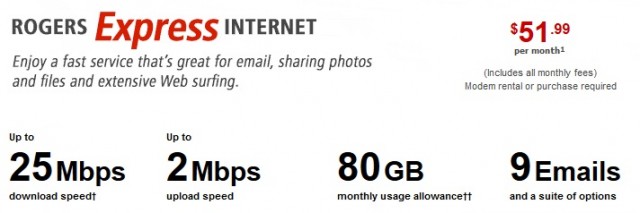
Rogers sells a 25/3Mbps broadband plan for $52 a month that includes only an 80GB monthly usage allowance.

MONETIZED: Rogers sells a 25/2Mbps broadband plan for $52 a month that includes only an 80GB monthly usage allowance. A $2/GB overlimit fee applies, up to a maximum of $100 per month. Taxes, a modem rental fee or purchase, a one-time activation fee of $14.95 and up to a $99.99 installation fee also apply.

“On the cable side, making sure we have the best Internet experience was the other piece of it,” Staffieri said. “We ended the year with 90% of our footprint able to get 150Mbps data speed ($122.99/mo with 250GB usage allowance). And so to the extent that we continue to lead on Internet, we think that’s going to be important ingredient for the top line [revenue] growth.”

On the wireless side, Rogers is following the lead of big providers in the United States and gradually shifting the cost of new smartphones away from itself and onto its customers by adjusting its subsidy program.

“As we see data [usage] pulling [revenue] growth, overall, that bodes well for a continuation of the subsidization,” Staffieri said. “For us, it’s really been about making sure that we give the customer choice. And so when we combine that with the introduction of the Flex Plan, which we did in 2012, what we’re seeing is more and more customers opting into new handsets. But more and more, it’s on the customer’s nickel as opposed to our nickel on the Flex Plan programs.”

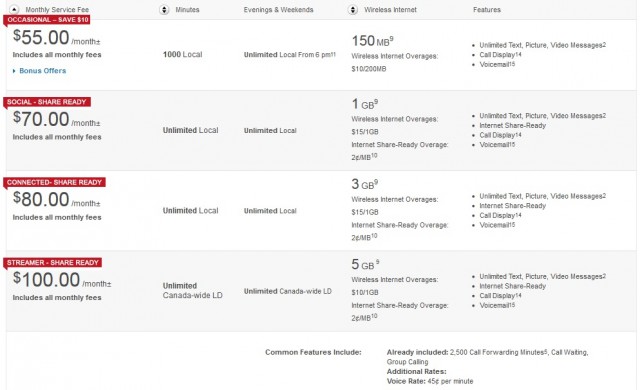
Rogers Wireless' Individual wireless plans. Rogers' customers have to pay extra for long distance cell phone calling -- most plans only cover local calling. Data plans are stingier and more expensive than what most Americans pay, and steep overlimit fees up to $0.02 per megabyte apply.

Rogers Wireless’ Individual plans. Rogers’ customers have to pay extra for long distance calling — most plans only cover local calls. Data plans are stingier and more expensive than what most Americans pay, and steep overlimit fees up to $0.02 per megabyte ($20/GB) apply. Like in the United States, Rogers is moving to bundle unlimited calling and texting into more of their plans. What differentiates more plans today is how much data usage is included.

Staffieri admitted Bell is giving Rogers the most competitive headaches in Ontario because of their aggressively priced promotions.

“Certainly, [Bell’s Fibe IPTV] has been competitive for us. In the short-term, we continue to deal with what I would consider to be aggressive pricing in terms of acquisition and retention offers by our IPTV competitor,” said Staffieri. “We’ve always been competing with their satellite product and so that competition has always been there. But I would describe it as certainly having picked up and continuing to pick up. And it’s largely been through pricing offers as opposed to product.”

Staffieri says Rogers is competing with improved set-top equipment like the NextBox 2.0 — a whole-home DVR with an improved user interface. It also offers customers Anyplace TV, a TV Everywhere service that allows customers to watch the Rogers’ TV lineup on tablets inside the home.

The Toronto Maple Leafs, the National Hockey League's most valuable sports franchise, is 75% co-owned by Bell Canada and Rogers Communications.

The Toronto Maple Leafs, the National Hockey League’s most valuable sports franchise, is today 75% co-owned by Bell Canada Enterprises (BCE) and Rogers Communications.

As is the case in the United States, Canadian cable companies are also facing dramatically increasing programming costs, particularly for sports programming.

But to a greater degree than in the U.S., Canadian media conglomerates own and control a larger share of cable and broadcast networks, programming producers, would-be competitors like satellite television, and even sports teams and the networks that show their games.

That positions them to negotiate with themselves over content costs, because they own or control the sports franchise, the cable or broadcast network that televises their games, and the cable, satellite, or telephone provider through which most Canadians watch.

“We’ve tried to be disciplined on the extent that content price increases are there because consumers want it, then we want to make sure we’re disciplined in passing on that cost to the customer,” Staffieri said. “And so we strive to make sure that in the TV and video business our gross margins are consistent.”

“So if you were to look at how that’s played out over the last several quarters and several years, it’s been fairly consistent. And so that’s what we strive to do is to make sure that those programming costs ultimately are passed on to the consumer, which is ultimately driving up the cost through their demand.”

Search This Site:

Contributions:

Recent Comments:

Your Account:

Stop the Cap!