Home » Online Video » Recent Articles:

Netflix Monthly Performance Ratings: Fiber on Top, Cable Second, DSL and Wireless Stink

Phillip Dampier July 10, 2013 Broadband Speed, Competition, Consumer News, Online Video, Wireless Broadband Comments Off on Netflix Monthly Performance Ratings: Fiber on Top, Cable Second, DSL and Wireless Stink

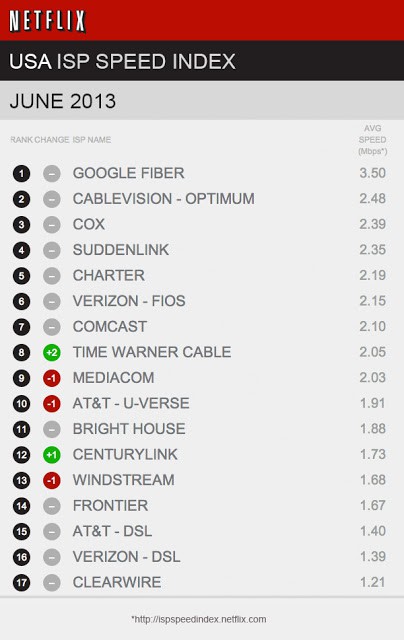
usa-ispspeedindex-netflix-jun-13Netflix kicks off the summer rating the streaming video performance of some of America’s largest ISPs, and the results deliver only a few surprises.

Google Fiber is the runaway leader, but Verizon FiOS — also a fiber-based network — is lagging behind several cable operators, notably Charter Cable and Suddenlink.

In mid-June, GigaOM reported Verizon was engaged in a battle with Cogent — a bandwidth provider Netflix depends on to help it reach Verizon customers.

Cogent promptly blamed Verizon for the slowdown:

Cogent and Verizon peer to each other at about ten locations and they exchange traffic through several ports. These ports typically send and receive data at speeds of around 10 gigabit per second. When the ports start to fill up (usually at 50 percent of their capacity), the internet companies add more ports. In this case, through, Verizon is allowing the ports that connect to Cogent to get crammed. ”They are allowing the peer connections to degrade,” said Dave Schaeffer, chief executive officer of Cogent said in an interview. “Today some of the ports are at 100 percent capacity.”

“Think of it as the on-ramp to the freeway being log-jammed,” Schaeffer said. And that means your Netflix content, especially content sent by Netflix’s content delivery network, slows down, and you get pixelated pictures and buffering.

Verizon just as quickly shot back at GigaOm and Cogent:

Cogent is not compliant with one of the basic and long-standing requirements for most settlement-free peering arrangements: that traffic between the providers be roughly in balance. When the traffic loads are not symmetric, the provider with the heavier load typically pays the other for transit (see our ex parte filing [PDF] from the 2010 Comcast/Level 3 spat for more info on peering and transit agreements). This isn’t a story about Netflix, or about Verizon “letting” anybody’s traffic deteriorate. This is a fairly boring story about a bandwidth provider that is unhappy that they are out of balance and will have to make alternative arrangements for capacity enhancements, just like any other interconnecting ISP.

Customers don’t care. They just know their efforts to watch Arrested Development are being stymied, and Netflix’s June ISP results illustrate the degraded performance customers are getting.

Cablevision, the top performing cable operator, can likely thank its recent investments in network upgrades for improved performance, not its participation in Netflix’s OpenConnect Content Delivery Network, designed to improve streaming performance for participating ISPs. Cablevision is a member, but so are Frontier Communications (#14) and Clearwire (#17 and dead last).

OpenConnect couldn’t help Frontier DSL or Clearwire wireless customers achieve good results — the technology in use and the upstream connections both companies maintain with the Internet backbone mattered much more.

In general, fiber performs best when everyone is getting along, cable comes in second, DSL third, and wireless last.

But if you want the best performance possible, and Google Fiber is not in your neighborhood, your best bet is to move to Sweden, where the top-six providers all outperformed every American cable, DSL, and wireless provider. In Finland, the top-four beat everyone but Google Fiber. The nine best-rated ISPs in Denmark also outclassed their American counterparts, while in Norway a half-dozen providers did better.

But many ISPs in the United States can still be proud: the top eight beat Mexico. Mediacom, AT&T U-verse & DSL, Bright House, CenturyLink, Windstream, Frontier, Verizon DSL and Clearwire have some work to do… if they want to keep up with those speed mavens in Guadalajara.

DirecTV, Time Warner Cable Moving in On Hulu; Online Video Rights & Internet Cable TV

Phillip Dampier July 9, 2013 AT&T, Competition, DirecTV, Online Video, Video 2 Comments

twc logoTime Warner Cable won’t engage in an expensive bidding war for ownership of Hulu so it is trying to convince the online video venture’s current owners not to sell.
Sources tell Bloomberg News the cable company has offered to buy a minority stake in the online video streaming service alongside its current owners, which include Comcast-NBC, Fox Broadcasting, and Walt Disney-ABC.

If Hulu accepted the offer, the other bidders’ offers may not even be entertained.

Among those filing binding bids/proposals with Hulu as of the July 5 deadline:

  • DirecTV, which reportedly wants to convert Hulu into an online companion to its satellite dish service for the benefit of its satellite subscribers;
  • AT&T and investment firm Chernin Group, which submitted a  joint bid, presumably to beef up online video options for U-verse customers.

[flv width=”640″ height=”380″]http://www.phillipdampier.com/video/Bloomberg Plot Thickens in Bidding War for Hulu 7-9-13.flv[/flv]

Bloomberg News discusses how the various bidders for Hulu would adapt the service for their own purposes. It’s all about bulking up online video offerings.  (4 minutes)

huluTM_355Hulu’s new owners could continue to offer the service much the same way it is provided today, with a free and pay version. But most expect the new owners will throw up a programming “pay wall,” requiring users to authenticate themselves as a pay television customer before they can watch Hulu programming. If Time Warner Cable acquired a minority interest and the current owners stayed in place, Time Warner Cable TV customers could benefit from free access to certain premium Hulu content, now sold to others for $8 a month. That premium content would presumably be available to U-verse customers if AT&T emerges the top bidder, or DirecTV could offer Hulu to satellite subscribers to better compete with cable companies’ on-demand offerings.
Hulu’s influence will be shifted away from broadcast networks and more towards pay television platforms regardless of who wins the bidding. That could end up harming the major television networks that provide Hulu’s most popular content. Many of Hulu’s viewers are cord-cutters who do not subscribe to cable or satellite television. Placing Hulu’s programming off-limits to non-paying customers could force a return to pirating shows from peer-to-peer networks or third-party, unauthorized website viewing.

Online video rights are so important to cable operators and upstarts like Intel, which wants to launch its own online cable-TV like service, providers are willing to pay a premium for streaming rights.

[flv width=”640″ height=”380″]http://www.phillipdampier.com/video/Bloomberg Why Hulu Is Attracting Billion Dollar Bids 7-8-13.flv[/flv]

Richard Greenfield, analyst at BTIG, and Scott Galloway, chairman and founder of Firebrand Partners, discuss Hulu and the ability to stream on multiple platforms. They speak on Bloomberg Television’s “Bloomberg Surveillance.” (4 minutes)

directvThe Los Angeles Times reports that pay TV distributors are in a rush to make deals, not only to offer more viewing options for customers, but to potentially get rid of expensive and cumbersome set-top boxes.
Interlopers like Intel, Apple, and Google who want to break into the business have not had an easy time dealing with programmers afraid of alienating their biggest customers. Even DirecTV, which has done business with some of the largest cable networks in the country for well over a decade still meets some resistance.

Acquiring Hulu could be an important part of DirecTV’s strategy to develop the types of services satellite TV has yet to manage well. On-demand programming is no easy task for satellite providers. But if DirecTV acquired Hulu, satellite customers could find DirecTV-branded on-demand viewing through the Internet. The Times speculates DirecTV could even build an online subscription service for subscribers who don’t want a satellite dish, receiving the same lineup of programming satellite customers now watch.

Distributors that acquire enough online streaming rights could even launch virtual cable systems in other companies’ territories, potentially pitting Comcast against Time Warner Cable, but few expect cable operators to compete against each other.

The Government Accountability Office warned head-on competition between cable operators was an unlikely prospect, especially because those cable operators also own the broadband delivery pipes used to deliver programming.

“[Cable companies] may have an incentive to charge for bandwidth in such a way as to raise the costs to consumers for using [online video] services.”

[flv width=”640″ height=”380″]http://www.phillipdampier.com/video/Bloomberg Hulu Buyers Haggle as Final Deadline Looms 7-5-13.flv[/flv]

Bloomberg News explains why Hulu is worth a billion dollars in a changing world of television. (3 minutes)

ABC Network Putting Video Behind Paywall: Only Paying Cable/U-verse Subscribers Can Watch

WATCH_ABCFree TV? Not quite.

Despite offering free over-the-air television, ABC is putting its programming and stations behind a new paywall that can only be breached by “authenticated” cable and AT&T U-verse subscribers able to prove they already pay to watch.

Watch ABC is the television network’s contribution to the cable industry’s “TV Everywhere” project that offers online viewing options for current cable television subscribers.

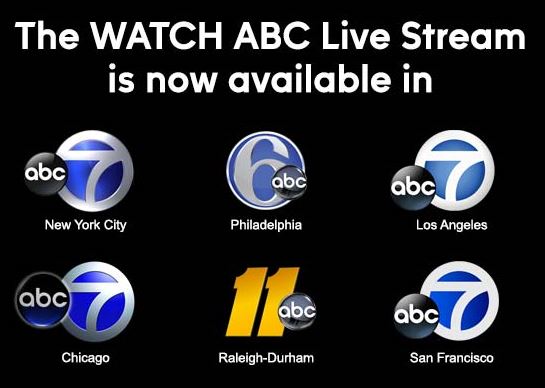
Watch ABC now offers on-demand and live viewing of programming aired by the network and six network-owned television stations both at the desktop and through apps for iOS, Android, and the Kindle: New York City’s WABC-TV, Philadelphia’s WPVI, Los Angeles’ KABC, Chicago’s WLS, San Francisco’s KGO, and Raleigh-Durham’s WTVD. (Coming soon: Houston’s KTRK and Fresno’s KFSN.)

During the “online preview,” ABC permitted online viewers within confirmed coverage areas to watch the station nearest them for free. Now, viewers will also have to confirm they are paying cable or AT&T U-verse customers to watch online.

But even then, not everyone will qualify. ABC only has streaming authentication agreements with AT&T U-verse, Cablevision, Charter, Comcast, Cox Communications, and Midcontinent Communications. Watch ABC is currently off-limits to everyone else, including customers of Verizon FiOS, Time Warner Cable, and both satellite services.

ABC has also banned IP addresses known to be associated with anonymous proxy servers. This measure is designed to enforce geographic restrictions to be sure only local viewers can get access to the station in their area.

By this fall, ABC affiliates owned by Hearst are expected to also join Watch ABC’s paywall system.

ABCNews.com announced an experiment with a paywall in the summer of 2010. It never came to fruition.

[flv width=”640″ height=”380″]http://www.phillipdampier.com/video/WPVI Philadelphia Watch ABC in Philadelphia 5-14-13.mp4[/flv]

WPVI in Philadelphia turned over airtime during its evening newscast to self-promote the new ‘Watch ABC’ app and explain how it works. Effective now, it only works with preferred partner cable companies and AT&T U-verse. (Aired: May 14, 2013) (2 minutes)

Cox Testing TV Over Broadband, But It Eats Your Monthly Internet Usage Allowance

flare-logoCox Communications has found a new way to target cord-cutters and sell television service to its broadband-only customers reluctant to sign up for traditional cable television.
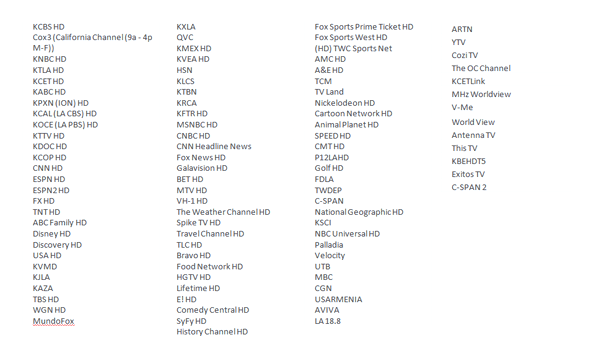


flareWatch is a new IPTV service delivered over Cox’s broadband service. For $34.99 a month, customers participating in a market trial in Orange County, Calif. receive 97 channels.  About one-third are local over the air stations from the Los Angeles area, one-third top cable networks, and the rest a mixture of ethnic, home shopping, and public service networks. Expensive sports channels like ESPN are included, but most secondary cable networks typically found only on digital tiers are not. Premium movie channels like HBO are also not available.

The service is powered by Fanhattan’s IPTV set-top box. Cox offers up to three “Fan TV” devices to customers for $99.99 each.

xopop

flareWatch’s channel lineup in Orange County, Calif.

The service is only sold to customers with Preferred tier (or higher) broadband service and is being marketed to customers who have already turned down Cox cable television.

What Cox reserves for the fine print is an admission the use of the service counts against your monthly broadband usage allowance. Preferred customers are now capped at 250GB of usage per month. While occasional viewing may not put many customers over Cox’s usage caps, forgetting to switch off the Fan TV set-top box(es) when done watching certainly might. flareWatch also includes another usage eater — a cloud-based DVR service. Cox does not strictly enforce its usage caps and does not currently impose any overlimit fees, but could do so in the future.

[flv width=”480″ height=”292″]http://www.phillipdampier.com/video/Cox FlareWatch 7-13.mp4[/flv]

Cox’s brief promotional video introducing flareWatch. (1 minute)

Cool... usage capped.

Cool… usage capped.

Cox spokesman Todd Smith described the introduction of flareWatch as a “small trial,” and that “customer feedback will determine if we proceed with future plans.”

The service is clearly intended to target young adults that are turning down traditional cable television packages. Most of those are avid broadband subscribers, so introducing a “lite” cable television package could be a way Cox can boost the average revenue received from this type of customer. It may also serve as a retention tool when customers call to disconnect cable television service.

The MSO is selling flareWatch at five Cox Solutions stores in Irvine, Lake Forest, Rancho Santa Margarita, and Laguna Niguel.

Customers (and those who might be) can share their thoughts with Cox about flareWatch by e-mailing [email protected] and/or [email protected]. Stop the Cap! encourages readers to tell Cox to ditch its usage cap, and point out the current cap on your Cox broadband usage is a great reason not to even consider the service.

[flv width=”640″ height=”380″]http://www.phillipdampier.com/video/The Verge Fan TV revealed is this the set-top box weve been waiting for 5-30-13.flv[/flv]

The Verge got a closer look at the technology powering flareWatch back in May. Fan TV could be among the first set-top boxes to achieve “cool” status. Unfortunately, technical innovation collides with old school cable company usage caps, which might deter a lot of Cox’s broadband customers from using the service.  (4 minutes)

What You Knew Already: Fiber Broadband Rules, Says New Report; We Need More

buddecomAttention broadband planners: Although broadband deployment strategies differ around the world, a new report decisively concludes there is only one network technology proven to meet the demands of broadband users both today and tomorrow: a national fiber optic network.
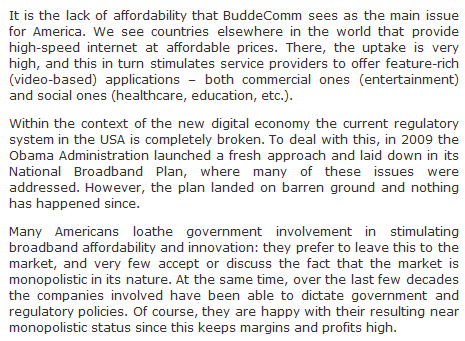

BuddeComm’s new report, “Global Broadband – Fibre is the Infrastructure Required for the Future,” looked at every technology from variations of DSL, cable broadband, satellite, and wireless and found only fiber optics capable of handling the capacity of data and applications that will be required to run cities and countries from today onwards.

The report found that fiber optic deployment faced a range of challenges, despite its obvious technological advantages. Political obstacles are among the biggest roadblocks facing fiber networks. A combination of concerns about the cost of wiring service to procrastination has held back many national broadband improvement projects, including those in Australia and New Zealand. Incumbent commercial providers in North America have also actively attempted to block public fiber networks to protect their own commercial interests.

buddecomm concl

BuddeComm concludes America’s biggest broadband problems come as a result of incumbent providers exercising undue market power and influence over elected officials to protect their commercial interests at the price of the public good.

The report concludes that decisive political leadership is essential to overcome many of the artificial obstacles which slow down or stop fiber broadband deployments.

“One can argue endlessly about what technologies should be applied and at what cost, but we believe that all signs point to Fiber-to-the-Home (FTTH) networks as the best future-proof solution,” the report concludes. “One can debate about whether it is needed in five, ten or fifteen years – and again that depends on some of the differences between countries – but in the end FTTH is the best final solution for all urban and many regional premises.”

The 21st century digital economy is powered by robust broadband, and growing demands for faster speeds are coming from the healthcare, energy, media and retail sectors. Healthcare uses include file transfers of high-definition medical imagery and teleconferencing. Smart Grid technology is being deployed by many power companies to develop more efficient means of distributing and conserving energy. Media and mass entertainment providers are moving to high bandwidth online video, and the retail economy markets products and services over modern broadband networks.

The implications for the global economy are enormous. More than 120 countries have formal broadband policies and many consider high-speed Internet access a national priority. In the last century, North America and western Europe were considered the dominant economic players, in part because they established and maintained infrastructure to support their manufacturing and service economies. But many of these countries are falling far behind in the 21st century digital economy, where countries like Japan and Korea, parts of eastern Europe, the Baltic States, and Scandinavia are taking the lead in infrastructure deployment.

“Broadband infrastructure is perceived by all to be critical for the development of the digital economy, healthcare, education, e-government and so on,” the report notes. “From a financial and investment point of view broadband infrastructure should be treated as utility infrastructure.”

The interests of the private sector are not always aligned with the public interest, particularly when it comes to spending capital on upgrading network infrastructure. The report recommends that governments step in and build a public fiber highway system on which all providers can offer services.

“A National Broadband Network (NBN) should be based upon an open network as this makes it possible to offer the basic infrastructure on a utility basis to content and service providers,” the report concludes.

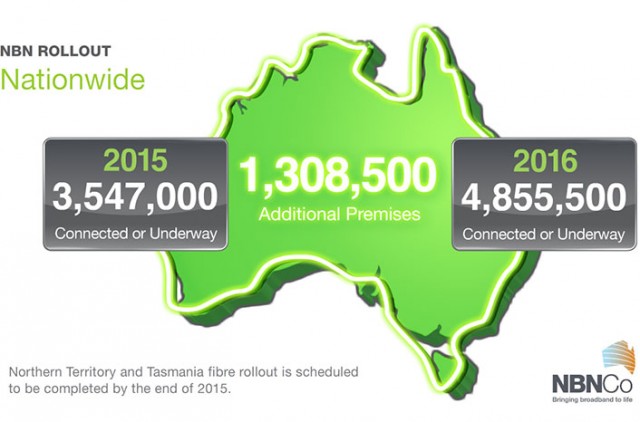
The governments of Australia, New Zealand, Israel, and others are already moving in that direction, setting up broadband authorities to build fiber infrastructure dismissed as too expensive or unnecessary by commercial providers who answer first to financial markets, shareholders, and private banks.

Under most NBN plans, providers get access to the fiber network at wholesale rates and help recoup its cost.

Australia's National Broadband Network is on the way.

Australia’s National Broadband Network is on the way.

Where politicians answer to the whims of the private sector before considering the public good, the report finds:

  • Private cable companies, particularly in North America, will continue to support and incrementally upgrade their HFC networks, but new cable operators are more likely to deploy fiber at the outset, not coaxial copper cable. Network costs, efficiencies, and reliability are all in fiber’s favor. In Europe, cable broadband is regularly losing market share to faster fiber technology. The share of all broadband subscribers held by HFC networks across Europe fell from 26% in 2002 to about 11% by mid-2013;
  • Private telephone companies that do not face robust competition will continue to rely on their existing DSL networks. In cities and larger towns, expect phone companies to eventually upgrade to VDSL fiber-to-the-neighborhood (and its variants) in the largest markets with the most competition. Rural areas will continue to receive less robust DSL service, particularly where no cable competitor provides service;
  • Rural areas may receive fixed wireless or satellite broadband service, but this is not a solution for more populated areas.

Although the global economic downturn stalled many fiber network deployments and suppressed demand, the report finds broadband usage and demand for faster speeds are quickly accelerating. Some other highlights:

  • Asia continues to be the leader in fiber optic deployment;
  • Sufficient customer demand to make the investment in fiber worthwhile is increasingly likely once fiber service becomes widely available in countries like the Netherlands, China, France, Israel, Switzerland, Norway and Sweden;
  • International connectivity in Africa remains a challenge, but fiber bandwidth is expected to more than double by 2014;
  • The Middle East will see rapid growth in fiber broadband once international capacity constraints are eased.

Obtaining a copy of the full BuddeComm report is prohibitively expensive for consumers, priced at $995.

Search This Site:

Contributions:

Recent Comments:

Your Account:

Stop the Cap!