Home » Online Video » Recent Articles:

Sony Has Preliminary Agreement With Viacom to Offer Online Cable TV Alternative

Phillip Dampier August 15, 2013 Competition, Consumer News, Data Caps, Online Video, Sony 1 Comment

sony_logoSony’s bid to enter the “over-the-top” online video business has gotten a shot in the arm with news it has reached a preliminary agreement with Viacom, Inc., to carry its popular cable networks on the Japanese electronics giant’s planned online subscription TV service.

Sony wants to build its own virtual cable television service, offering live and on-demand programming delivered over broadband lines in direct competition with cable and phone companies Comcast, Time Warner Cable, AT&T and Verizon.

Getting agreements with traditional must-have cable networks like Comedy Central, ESPN, and USA have been difficult because the networks fear alienating their traditional customers — large cable, telco and satellite TV companies.

viacomThe Wall Street Journal reports Viacom’s agreement remains preliminary at the moment and the final details have yet to be worked out. If a final agreement is reached, it will be a breakthrough for so-called online cable systems which have gotten nowhere with other cable network owners, including Comcast-NBC, Walt Disney, Time Warner, and CBS.

Cable executives have repeatedly warned that a wider distribution of cable network programming would make them more reluctant to pay higher prices for the cable networks because of the loss of relative exclusivity. Many cable programming contracts restrict the ability of network owners to sell to would-be online competitors.

Viacom has had contentious relationships with cable and satellite companies in the past, so observers suggest it is no surprise Viacom would be among the first to break with tradition. Viacom’s CEO, Sumner Redstone, also controls CBS which is currently off Time Warner Cable systems in three major cities and has had its pay movie channels Showtime and The Movie Channel blacked out on Time Warner systems nationwide. If Sony’s service gets off the ground, CBS could ask Time Warner customers to sign up with Sony instead to get those networks back.
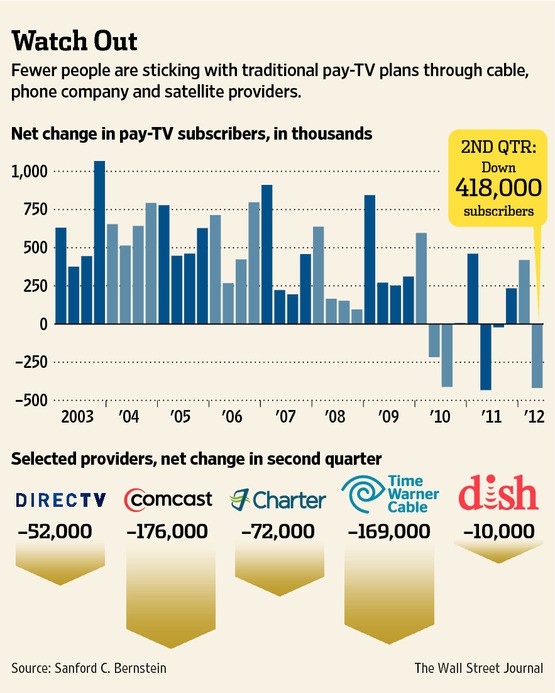
Cord Cutting is Real (Graphics: The Wall Street Journal)

Cord Cutting is Real (Graphics: The Wall Street Journal)

Competing online video services from Intel and Google have largely gone nowhere because of stalled programming negotiations. How Sony managed a breakthrough remains a mystery. To secure rights, Sony may have been asked to sign a lengthy contract with favorable financial terms for Viacom, or Sony might have agreed to carry the full roster of Viacom-owned cable networks, which include:

The next generation of the Sony PlayStation may be your next cable box.

The next generation of the Sony PlayStation may be your next cable box.

  • BET
  • CMT
  • Comedy Central
  • Logo
  • MTV
  • MTV2
  • Nick at Nite
  • Nick Jr.
  • Nickelodeon
  • Nicktoons
  • Palladia
  • Spike
  • TeenNick
  • Tr3s
  • TV Land
  • VH1

A source told the Journal Sony hopes to launch its new venture by the end of the year, perhaps on the next generation of Sony’s PlayStation gaming console due soon. Sony also could offer the service on its line of Bravia high-definition televisions, as well as tablets and smartphones.

The Journal:

People who have seen demonstrations of Sony’s system say it has some features that are appealing in comparison to traditional pay TV distributors, including one that recommends shows for users based on what they’ve previously watched. Content providers are allowed to supply some of those recommendations, so they can steer users to other episodes on their channels, according to the people familiar with the matter. Sony provides other content suggestions for viewers based on an algorithm.

The development of online cable television in direct competition with large cable and phone companies could spark a new wave of broadband usage restrictions including usage caps and metered billing. The same telecom companies that earn a substantial part of their revenue selling cable television service are likely to find it unsettling to discover Sony undercutting them on price and using “their” broadband lines to do it. Placing restrictions on the amount of broadband traffic a customer can use each month would deliver a significant deterrent to would-be cord cutters.

Time Warner Surrenders to CBS’ Money Demands; Digital Rights Still in Contention

Phillip Dampier August 8, 2013 Consumer News, Data Caps, Editorial & Site News, Net Neutrality, Online Video, Public Policy & Gov't, Video Comments Off on Time Warner Surrenders to CBS’ Money Demands; Digital Rights Still in Contention

surrenderIf Time Warner Cable is concerned about the rising cost of cable television, it sure didn’t show it after sources revealed the cable company quickly accepted CBS’ demands for more compensation but is refusing to budge until it wins rights to show CBS programming on mobile platforms.



Sources tell the Daily News Time Warner quickly agreed to a major increase from 50 cents a month per subscriber to $2 a month for CBS content, but is keeping CBS-owned stations and cable networks off the dial until the network agrees to let the cable company distribute on-demand and live programming on cell phones, tablets, and personal computers.

Earlier this week, Time Warner Cable CEO Glenn Britt made an offer CBS couldn’t wait to refuse: the cable company would put CBS programming back on the lineup if it could be sold to customers a-la-carte instead of bundling it with other channels.

That would “allow customers to decide for themselves how much value they ascribe to CBS programming,” Britt said in a letter to CBS CEO Leslie Moonves that was promptly posted online.

CBS called the idea a sham, noting a-la-carte runs contrary to the economic model the cable industry itself regularly and loudly defends. Try telling ESPN, which costs every cable subscriber more than $5 a month, it will now be offered only to customers that want to pay for it.

Phillip "Capitulation Corner" Dampier

Phillip “Capitulation Corner” Dampier

In fact, for most cable operators, the concept of selling customers only the channels they want is the nightmare scenario. Average revenue per subscriber would tumble as consumers rid themselves of networks with three digit channel numbers they didn’t even know they had. Goodbye ‘Yarn Creations’ on Generic Home Shopping Channel 694, Bosnian music videos, reruns of Simon and Simon, mysterious networks showing episodes of Law & Order that USA Network already burned into your permanent memory, and that “fine arts” network that shows endless hours of Antiques Roadshow dating back to 1998.

Digital rights is an important issue for both cable companies and programmers. Although both sides deny “cord cutting” is real, the intensity of the fight allowing online viewing says otherwise. If CBS gives away rights to Time Warner Cable to show live and on-demand programming to subscribers, CBS can’t make as much money offering shows on its own website (with its own ads), much less sell programming to customers. Time Warner fears if CBS only offers online programming through its own website, customers might decide they don’t need the cable company to watch those shows any longer.

“At the moment the cable operators have the leverage because the more that CBS is off the cable, the more that they realize the viewers don’t need it,” said media expert Michael Wolf, former Yahoo! board member and president of Viacom-owned MTV Networks.

For now, many viewers are turning to pirate video sites to catch the CBS shows they are missing. TorrentFreak reports huge spikes in illicit download traffic of CBS content over the weekend. Under the Dome was the source of much of the spike, although customers are also downloading pirated copies of Showtime programming. The evidence is clear: take away popular programming and customers will simply download it illegally from third-party websites.

As summer wanes and the fall football season approaches, just about everyone expects the war will quickly end, because football fans are more than willing to drop a provider if they can’t spend several hours in front of the television Sunday afternoon. Considering Time Warner has reportedly already caved in on CBS’ money demands, it is likely CBS will be able to eventually extract even more money from the cable company to secure digital distribution rights. Subscribers will pick up the tab for both during the next round of rate increases beginning this fall in the south and by January in the northeast.

Time Warner Cable’s latest regulatory notice admits current deals with more than 50 networks are due to expire soon, and the company may cease the carriage of one or more of the networks. They include: Lifetime, E!, Style, Turner Classic Movies, and the NHL Network. So just like Law & Order reruns, we will see this episode again in the near future.

The PGA is offering a way for golf fans to watch the PGA Championship online, bypassing the CBS-TWC dispute.

The PGA is offering a way for golf fans to watch some of the PGA Championship online, bypassing the CBS-TWC dispute.

[flv]http://www.phillipdampier.com/video/CNBC PGA Time Warner 8-8-13.mp4[/flv]

Perhaps the biggest loss viewers without CBS will experience this weekend is the PGA Championship. CNBC talks with tournament officials in Rochester, N.Y., about the possibility of viewing alternatives. But golf fans can watch parts of the tournament for free from the PGA’s website. (3 minutes)

[flv width=”640″ height=”380″]http://www.phillipdampier.com/video/Bloomberg The Future of Cable Post CBS-TWC Battle 8-6-13.flv[/flv]

Bloomberg News reports that while many cable viewers could care less about the loss of CBS and Showtime, broadband customers may care very much when cable operators start charging extra for Netflix or add punitive usage caps to make sure customers don’t cut cable TV’s cord. (3 minutes)

Sen. Schumer Warns Your Internet Enabled Smart TV May Be Spying on You

Sen. Schumer

Sen. Schumer

That new Internet-enabled television in your living room may be allowing virtual Peeping Toms to watch and listen to you because manufacturers never bothered with adequate security measures to keep unwanted guests out.

Sen. Charles Schumer (D-N.Y.) is calling on major television manufacturers to create a uniform security standard to stop the hacking before it becomes widespread.

A security research group recently highlighted security flaws in so-called “smart” TVs that make it simple for anyone to hack the television’s internal microphone and embedded camera originally designed for video chatting. The security group warned that almost anyone could begin eavesdropping within minutes of identifying a vulnerable television — most lacking any significant security measures to prevent unauthorized video spying.

“You expect to watch TV, but you don’t want the TV watching you,” said Schumer. “Many of these smart televisions are vulnerable to hackers who can spy on you while you’re watching television in your living room. Our computers have access to firewalls and other security blocks but these televisions do not and that’s why manufacturers should do everything possible to create a standard of security in their internet-connected products.”

The security vulnerability exists because many modern “smart” TVs are now connected to the Internet. To enhance the social experience, many of these televisions are equipped with microphones and unobtrusive video cameras similar to those found in a laptop. But many consumers do not realize these devices could allow anyone on the outside to activate the camera and microphone unbeknownst to the owner and quietly watch and listen in on what is happening inside a home.

Particularly vulnerable

Particularly vulnerable

Samsung televisions starting with the 2012 model year were called particularly vulnerable to hacking. Researchers found they could not only access cameras and microphones, they could also tap into the television’s web browser, steal user accounts and passwords, and redirect consumers to hacked websites designed to capture personal information including credit card numbers and bank account information.

Some manufacturers have not taken responsibility for the security flaws, suggesting worried consumers put black electrical tape over the camera or unplug the TV when not in use. Samsung has issued patches for many of the affected devices and promises more changes in future models.

Schumer called current measures inadequate and too often leave the burden solely on consumers. He wants an industry security standard implemented that includes a firewall and other security measures that keep unwanted visitors out without forcing consumers to disable features they paid to have on their television.

[flv width=”368″ height=”228″]http://www.phillipdampier.com/video/WTEN Albany Schumer Says TV Could Be Watching You 8-4-13.mp4[/flv]

Your Internet enabled television set may be vulnerable to hacking. WTEN in Albany reports Sen. Schumer wants manufacturers to create a uniform security standard to keep unwelcome visitors out of your living room. (2 minutes)

Comcast Has ‘Plenty of Broadband Capacity,’ Reserves the Right to Acquire Others

Phillip Dampier August 1, 2013 Broadband "Shortage", Broadband Speed, Comcast/Xfinity, Competition, Consumer News, Online Video, Public Policy & Gov't, Video, Wireless Broadband Comments Off on Comcast Has ‘Plenty of Broadband Capacity,’ Reserves the Right to Acquire Others
Big, Bigger, Biggest, Still Bigger

Big, Bigger, Biggest… Bigger Still

Comcast has plenty of available bandwidth to indefinitely expand its High Speed Internet services at speeds up to 3Gbps and believes it has won the legal right to grow its cable business as large as it likes.

Comcast executives admitted Wednesday they have more than enough network capacity to meet the demands of customers, both now and well into the future.

“With regard to usage and capacity, we feel the network is flexible and has plenty of opportunity to grow in capacity,” said Neil Smit, president and CEO of Comcast Cable Communications. Smit was responding to a Wall Street analyst asking about future capacity during a quarterly financial results conference call.

Smit noted that some of the biggest bandwidth users served by Comcast are businesses, and the cable operator was well-positioned to service them by extending fiber or deploying its Metro Ethernet product. Residential customers get increased bandwidth through neighborhood node splitting or DOCSIS 3 channel bonding that combines several channels together to increase speed and capacity.

Brian Roberts, CEO of Comcast Corporation, agreed with Smit, adding, “the more the consumer desires speed, the better that is for our company.”

Roberts noted DOCSIS 3.1 — the next generation of cable broadband — was “promising technology.”

“At the cable convention, we demonstrated 3Gbps” over Comcast’s existing cable infrastructure, said Roberts.

Smit

Smit

Comcast is easily the country’s largest cable operator, but many believe it is restrained from growing larger through mergers and acquisitions because of antitrust concerns. But thanks to a number of lawsuits initiated by Comcast, the company believes it can now grow as large as it likes.

Roberts admits the question of cable industry consolidation remains a gray area, particularly for Comcast. But he told investors he does not believe there are any remaining legal hurdles preventing Comcast from buying out other cable operators, despite earlier FCC rulemakings limiting the maximum size a cable company can grow through buyouts.

Comcast yesterday announced its last buyout — NBCUniversal — helped fuel a 29% increase in net income in the second quarter, thanks in part to strong results from film and television.

But many of Comcast’s largest gains came from its cable business.

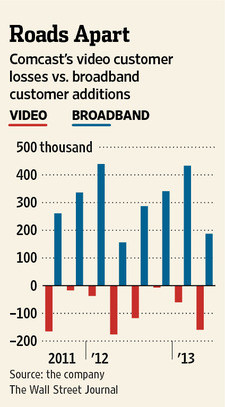
Despite continued losses of video subscribers (159,000 in the second quarter), Comcast’s cable revenue increased 5.8% to $10.47 billion, and operating cash flow grew 5.7% to $4.3 billion. Comcast, which also owns several NBC broadcast affiliates, is playing for both sides of the retransmission consent wars. Its owned and operated television stations have demanded higher fees to be carried on cable systems, many owned by Comcast itself. The increased programming costs fuel subscriber rate increases, which also boost revenue.

Broadband way up, although the company keeps losing video customers to cord-cutting.

Broadband is way up, although the company keeps losing video customers to cord-cutting.

Comcast’s broadband revenue has continued to grow dramatically. Customer additions for High Speed Internet access were up more than 20% in the quarter — the best second-quarter growth in five years — even as subscribers paid more for the service because of rate increases. Customer growth and price hikes delivered 8% growth in broadband revenue. In the last quarter alone, Comcast earned $2.6 billion from its broadband business.

Comcast is not spending a significant percentage of that revenue on enhanced broadband network upgrades. Instead, the company has increased investments to wire office parks and businesses to entice commercial customers, which account for a substantial amount of new customer growth. Comcast is also investing in research and development of new products and services, such as set-top boxes. The company also expects to pay 10% more in programming costs than it did a year earlier.

Year-to-date cable communications capital expenditures have increased 7.1% to $2.3 billion representing 11.3% of cable revenue. Comcast expects that for the full-year of 2013, cable capital expenditures will increase by about 10% over 2012.

Some other highlights from the quarter:

  • In the last six months, Comcast completed broadband speed increases for 70 percent of its customers;
  • High Speed Internet revenue was again the largest contributor to Comcast’s cable revenue growth;
  • At the end of the quarter, 33% of Comcast’s residential high-speed customers take a higher speed tier above its primary service;
  • Comcast has pushed Wi-Fi hard, installing more than four million wireless gateways and boosted Wi-Fi coverage to 250,000 hotspots through both cable partnerships and its home hotspot initiative;
  • Comcast’s new X1 cloud-based set-top platform has been introduced to more than half of its national service area and will be available everywhere by the end of 2013. By the end of the year, Comcast also expects to push a firmware update to installed boxes to upgrade them to its new X2 platform;
  • The average Comcast subscriber now pays the company $160 per month, up 7.4% from last year. Rate hikes, speed upgrades and growing programming packages account for the higher price;
  • 77% of Comcast video customers took at least two products and among those, 42% took phone, broadband and television service.

[flv width=”640″ height=”380″]http://www.phillipdampier.com/video/Bloomberg Comcasts Cable and Media Units Grow 7-31-13.flv[/flv]

Bloomberg reports Comcast is still having trouble holding on to its video-only customers, but broadband customer growth continues to explode. Comcast also does well because it owns a number of cable networks and entertainment properties. Expect Comcast to continue evolving its products to bring them closer to the things people do online.  (3 minutes)

Aereo Survives Third Court Challenge: Appeal to Re-Hear Case in Appellate Court Denied

Phillip Dampier July 16, 2013 Competition, Online Video, Public Policy & Gov't, Video 1 Comment

aereo_logoFor the third time, legal action from the four largest commercial television networks to shut online streaming service Aereo has been denied.

In a 10-2 decision, with one recusal, the 2nd Circuit Court of Appeals denied an attempt to re-hear the case by the full appellate court.

Following disposition of this appeal on April 1, 2013, Plaintiffs-Appellants filed petitions for rehearing in banc. An active judge of the Court requested a poll on whether to rehear the cases in banc. A poll having been conducted and there being no majority favoring in banc review, rehearing in banc is hereby denied.

Circuit Judge Denny Chin strongly dissented from the majority’s decision, joined by Circuit Judge Richard C. Wesley. Chin firmly took the side of the broadcasters, fearing if Aereo was permitted to continue operating, it could quickly mean the end of free over-the-air television. He believes the service exists only because of a precarious loophole:

“The majority’s decision elevates form over substance. It holds that a commercial enterprise that sells subscriptions to paying strangers for a broadcast television retransmission service is not performing those works publicly. It reaches that conclusion by accepting Aereo’s argument that its system of thousands of tiny antennas and unique copies somehow renders these transmissions “private.” In my view, however, the system is a sham, as it was designed solely to avoid the reach of the Copyright Act and to take advantage of a perceived loophole in the law….”

Just about every over-the-air network and major station in the New York City area is opposed to Aereo. Among those filing suit against its continued operation:

  • Networks: ABC, CBS, NBC, FOX, PBS, Univision, and Telemundo
  • Stations: WNET, WPIX, WNJU

[flv width=”640″ height=”380″]http://www.phillipdampier.com/video/Bloomberg IACs Diller Says Aereo Is Not a Threat to Anyone 7-10-13.flv[/flv]

Barry Diller, the force behind Aereo, tells Bloomberg News he expected to get sued when he provided viewers with an alternate way to watch television. Diller says networks and stations are simply uncomfortable with change and that Aereo poses no threat to them. (3 minutes)

[flv width=”640″ height=”380″]http://www.phillipdampier.com/video/Bloomberg Aereo Not a Blip on Broadcasters Radar 6-27-13.flv[/flv]

Bloomberg Industries director of North American research Paul Sweeney looks at Aereo’s impact on television broadcasters and how it could eventually threaten their revenue streams. He speaks on Bloomberg Television’s “In The Loop.” (2 minutes)

Search This Site:

Contributions:

Recent Comments:

Your Account:

Stop the Cap!