Home » Online Video » Recent Articles:

HissyFitWatch: Canadian Telecom Companies Annoyed Consumers Getting The Upper Hand

Phillip Dampier February 12, 2014 Bell (Canada), Canada, Cogeco, Competition, Consumer News, Data Caps, HissyFitWatch, Online Video, Public Policy & Gov't, Rogers, Shaw, Telus, Vidéotron Comments Off on HissyFitWatch: Canadian Telecom Companies Annoyed Consumers Getting The Upper Hand
Canadians are demanding a better deal from their cable and phone companies and they are forced to respond.

Canadians are demanding a better deal from their cable and phone companies and they are forced to respond.

As the United States battles back against the introduction of usage caps and rising prices for broadband service, increased competition and regulated open wholesale access to some of Canada’s largest broadband providers have given Canadians an advantage in forcing providers to cut prices and improve service.

Canadians can now easily get unlimited broadband access from one of several independent ISPs that piggyback service on cable and phone networks. Some large ISPs have even introduced all-you-can eat broadband options for customers long-capped by the handful of big players. As customers consider switching providers, cable and phone companies have been forced to cut prices, especially for their best customers. Even cell service is now up for negotiation.

The more services a customer bundles with their provider, the bigger the discount they can negotiate, say analysts who track customer retention. Bell, Rogers, Telus, and others have a major interest keeping your business, even if it means reducing your price.

“It’s far more lucrative for the telecom company to keep you there for the third or fourth service,” telecom analyst Troy Crandall told AP. It cuts down on marketing, service and installation calls, he added.

Getting the best deal often depends on your services, payment history, and how long you have been a customer. Cellphone discounts are the hardest to win, but customers are getting them if they have been loyal, carry a large balance and almost never pay late.

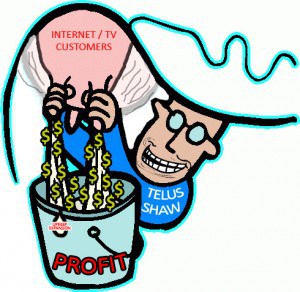
telus shawBigger discounts can be had for television and Internet service — cable television remains immensely profitable in Canada and broadband is cheap to offer, especially in cities. Americans often pay $80 or more for digital cable television packages, Canadians pay an average of $60.

Internet service in Canada now averages $45 a month, but many plans include usage caps. It costs more to take to the cap off.

Because of Canada’s past usage cap pervasiveness, online video is not as plentiful in Canada as it is in the United States. There has been considerably less cord-cutting in the north. Despite that, Canadians are ravenous online viewers of what they can find to watch (either legally or otherwise). As usage allowances disappear or become more generous, online video and the Internet will continue to grow in importance for service providers.

Customers should negotiate with their provider for a better deal, particularly if Bell’s Fibe TV is in town. Bell has been among the most aggressive in price cutting its fiber to the neighborhood television service for new customers ready to say goodbye to Rogers or Vidéotron.

Shaw and Telus battle for market share in the west and also have room to cut customer bills and still make a handsome profit.

More Hackery on Broadband Regulation from the AT&T-Funded Progressive Policy Institute

Phillip "Follow the Money" Dampier

Phillip “Follow the Money” Dampier

“In the 1990s, U.S. policymakers faced critical choices about who should build the Internet, how it should be governed, and to what extent it should be regulated and taxed. For the most part, they chose wisely to open a regulated telecommunications market to competition, stimulate private investment in broadband and digital technologies, and democratize access.” — Will Marshall, guest columnist

Is competition in Internet access robust enough for you? Has your provider been sufficiently stimulated to invest in the latest broadband technologies to keep America at the top of broadband speed and availability rankings? Is Net Neutrality the law of the land or the latest victim of a Verizon lawsuit to overturn the concept of democratizing access to online content?

I’m not certain what country Will Marshall lives in, but for most Americans, Internet access is provided by a duopoly of providers that must be dragged kicking and screaming to upgrade their networks without jacking up prices and limiting usage.

Marshall is president and founder of the Progressive Policy Institute, a so-called “third way” group inspired by centrist Democrats led by President Bill Clinton in the 1990s. Unlike traditional liberals suspicious of corporate agendas, these Democrats were friendly to big business and welcomed the largess of corporate cash to keep them competitive in election races. It was under this atmosphere that Clinton signed the bought-and-paid-for 1996 Telecom Act, ghostwritten by lobbyists for big broadcasters, phone and cable companies, and other big media interests. Long on rhetoric about self-governing, free market competition but short on specifics, the ’96 law transformed the media landscape in ways that still impact us today.

ppiMedia ownership laws were relaxed, allowing massive buyouts of radio stations under a handful of giant corporations like Clear Channel, which promptly dispensed with large numbers of employees that provided locally produced programming. In their place, we now get cookie-cutter radio that sounds the same from Maine to Oregon. Television stations eagerly began lobbying for a similar framework for relaxing ownership limits in their business. Phone companies won their own freedoms from regulation, including largely toothless broadband regulations that allowed Internet providers to declare victory regardless of how good or bad broadband has gotten in the United States.

Marshall’s views appeared in a guest column this week in The Orlando Sentinel, which is open to publishing opinion pieces from writers hailing from Washington, D.C., without bothering to offer readers with some full disclosure.

Marshall

Marshall

While Marshall’s opinions may be his own, readers should be aware that PPI would likely not exist without its corporate sponsors — among them AT&T, hardly a disinterested player in the telecommunications policy debate.

Marshall’s column suggests competition is doing a great job at keeping prices low and allows you – the consumer – to decide which technologies and services thrive. There must be another reason my Time Warner Cable bill keeps increasing and my choice for broadband technology — fiber optics — is nowhere in sight. I don’t have a choice of Verizon FiOS, in part because phone and cable companies maintain fiefdoms where other phone and cable companies don’t dare to tread. That leaves me with one other option: Frontier Communications, which is still encouraging me to sign up for their 3.1Mbps DSL.

“The broadband Internet also is a powerful magnet for private investment,” Marshall writes. “In 2013, telecom and tech companies topped PPI’s ranking of the companies investing the most in the U.S. economy. And America is moving at warp speed toward the ‘Internet of Everything,’ which promises to spread the productivity-raising potential of digital technology across the entire economy.”

Nothing about AT&T or the cable companies is about “warp speed.” In reality, AT&T and Verizon plan to pour their enormous profits into corporate set-asides to repurchase their own stock, pay dividends to shareholders, and continue to richly compensate their executives. It’s good to know that PPI offers rankings that place telecom companies on top. Unfortunately, those without a financial connection to AT&T are less optimistic. The U.S. continues its long slide away from broadband leadership as even developing countries in the former Eastern Bloc race ahead of us. Verizon’s biggest single investment of 2013 wasn’t in the U.S. economy — it was to spend $130 billion to buyout U.K.-based Vodafone’s 45% ownership interest in Verizon Wireless. Verizon’s customers get stalled FiOS expansion, Cadillac-priced wireless service, and a plan to ditch rural landlines and push those customers to cell service instead.
AT&T financially supports the Progressive Policy Institute

AT&T financially supports the Progressive Policy Institute

“A recent federal court decision regarding the FCC’s Open Internet Order has prompted pro-regulatory advocates from the ’90s to demand a rewrite of the legal framework that allowed today’s Internet to flourish,” Marshall writes in a section that also includes insidious NSA wiretapping and Internet censorship in Russia and China.

Marshall’s AT&T public policy agenda is showing.

Net Neutrality proponents don’t advocate an open Internet for no reason. It was AT&T’s former CEO Ed Whitacre that threw down the gauntlet declaring Google and other content providers would not be allowed to use AT&T’s pipes for free. AT&T has since patented technology that will allow it to discriminate in favor of preferred web traffic while artificially slowing down content it doesn’t like on its network.

“Pro-regulatory advocates” are not the ones advocating change — it is AT&T, Verizon, and Comcast, among others, that want to monetize Internet usage and web traffic for even higher profits. Net Neutrality as law protects the Internet experience Marshall celebrates. He just can’t see past AT&T’s money to realize that.


Is Verizon Purposely Slowing Down Netflix for FiOS Customers? Stop the Cap! Investigates

David Raphael ran into trouble using his Verizon Internet connection last month, discovering major slowdowns when accessing Amazon’s cloud-server ‘AWS,’ which in addition to serving his employer also feeds Netflix video content to customers.

“One evening I also noticed a slowdown while using our service from my house,” Raphael writes on his blog. “I realized that the one thing in common between me and [my employer] was that we both had FiOS internet service from Verizon. Since we host all of our infrastructure on Amazon’s AWS – I decided to do a little test – I grabbed a URL from AWS S3 and loaded it. 40kB/s.”

Internet slowdowns while accessing different websites is nothing new. Just ask anyone trying to watch YouTube in the early evening.

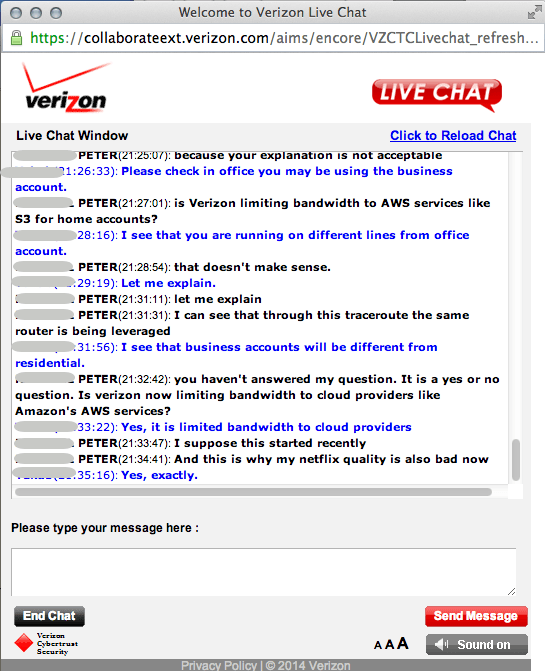
But what was different this time is that a Verizon representative seemed to openly admit the company is purposefully throttling certain web traffic, as this chat screen capture suggests:

verizon_fail
“Frankly, I was surprised he admitted to this,” Raphael writes. “I’ve since tested this almost every day for the last couple of weeks. During the day – the bandwidth is normal to AWS. However, after 4pm or so – things get slow. In my personal opinion, this is Verizon waging war against Netflix. Unfortunately, a lot of infrastructure is hosted on AWS. That means a lot of services are going to be impacted by this.”

That would certainly be the case as many large content distributors increasingly rely on cloud-based delivery services to reach subscribers over the shortest and fastest possible route. But broad-based interference with web traffic would also throw a major wrench in Verizon’s core marketing message for FiOS — its fiber-fast speed when compared against the cable competition. If subscribers notice their Netflix experience degraded to speeds that resemble dial-up, cable companies are going to get a lot of returning customers.

We reached out to Verizon for comment and it turns out the company has not declared war on Netflix after all.

“We treat all traffic equally, and that has not changed,” says Verizon spokesman Jarryd Gonzales. “Many factors can affect the speed a customer’s experiences for a specific site, including, that site’s servers, the way the traffic is routed over the Internet, and other considerations.  We are looking into this specific matter, but the company representative was mistaken. We we’re going to redouble our representative education efforts on this topic.”

HBO’s New Subscriber Growth is Mostly From Non-Paying Customers

Phillip Dampier February 5, 2014 Consumer News, Online Video Comments Off on HBO’s New Subscriber Growth is Mostly From Non-Paying Customers

While cable companies continue to point to growing subscriber numbers for premium movie channels as evidence cable cord-cutting is not taking its toll, the owner of the country’s largest pay movie channel has undercut their argument.

Time Warner (Entertainment), owner of HBO, disclosed to investors recently that although the network picked up nearly two million new subscriber in the United States, most of those were watching the network for free through temporary promotional offers.

hbo free

Free or discounted offers for premium movie networks are not uncommon. Time Warner Cable frequently bundles a one-year subscription to Showtime/The Movie Channel in its promotions. HBO and Cinemax are often offered for 3-6 months at no charge by other pay television providers.

Many viewers drop the network(s) (or negotiate another free viewing promotion) when charges start appearing on their bill. For years, premium movie channels cost around $13 a month, and many cable operators sold extra premium channels at a discounted $7 a month. But prices have risen dramatically over the last five years. Time Warner Cable, for example, now charges $15.95/mo for HBO, Cinemax, Showtime, and/or Starz.

Because of higher prices, HBO’s subscription revenue of $1.3 billion during the fourth quarter was up 8% year over year.

AT&T U-verse Expansion Peaks This Year; Company Raked in $6.9 Billion in Profits Last Quarter

Phillip Dampier January 29, 2014 AT&T, Broadband Speed, Competition, Editorial & Site News, Net Neutrality, Online Video, Rural Broadband, Video, Wireless Broadband Comments Off on AT&T U-verse Expansion Peaks This Year; Company Raked in $6.9 Billion in Profits Last Quarter

att-logo-221x300AT&T’s investment in U-verse expansion is expected to peak this year as part of its “Project VIP” effort to bring the fiber to the neighborhood service to more areas and offer faster broadband speeds to current customers.


AT&T is spending $6 billion over three years to broaden the footprint of U-verse, which now earns AT&T 57% of its total consumer revenues. In 2013, AT&T earned $13 billion in revenue from U-verse, up 28%.

AT&T’s investment in U-verse is dwarfed by the company’s efforts to benefit shareholders. In the last quarter of 2013, AT&T realized $6.9 billion in profits on revenue of $33.2 billion. For 2013, AT&T repurchased 366 million shares of its own stock for around $13 billion and paid out another $10 billion in shareholder dividends. Together, the total return for shareholders for the year was $23 billion and in the last two years AT&T achieved a new record benefiting shareholders with $45 billion in returns. In contrast, AT&T will spend just $6 billion on the current round of U-verse upgrades, with those markets left out likely pushed to wireless-only service if the company succeeds in winning approval to decommission its rural landline network.

Most of AT&T’s revenue growth is coming from its wireless business, particularly wireless data. After AT&T eliminated its flat rate plans, monetizing data usage has become very profitable — $23 billion per year and growing at 17% annually. Because increasing wireless usage forces customers to upgrade to higher cost plans offering more generous usage allowances, AT&T’s average revenue per customer increased by 3.9% — the highest in the wireless industry and the 20th consecutive quarter of customers collectively paying higher cell phone bills.

“The next steps are to make our networks even more powerful and layer on services that will drive new growth in the years ahead,” said AT&T CEO Randall Stephenson.

AT&T is counting on even higher customer bills as the company moves forward on several revenue-enhancing initiatives:

  1. Moving an increasing number of customers away from subsidized handsets. AT&T Next allows wireless customers to get a new handset every year, but in return AT&T no longer subsidizes equipment purchases. Instead, most Next customers finance their current phone and will finance their next one, assuring AT&T of a constant revenue stream for equipment. AT&T expects to gradually move away from phone subsidies altogether;
  2. Data plans for cars are forthcoming, as auto manufacturers install wireless capability in new vehicles. Many are signing agreements with AT&T that will make it easy for current customers to add vehicles to their existing plan, but customers of other carriers may find signing up for a new plan prohibitively expensive;
  3. Internet-connected home security systems are getting a major marketing push in 2014 with advertising blitzes and other promotions. The alarm systems are connected to and use AT&T’s wireless data network;
  4. AT&T customers are being pushed to wireless data plans with much higher data allowances than they need, delivering extra profits for AT&T with no impact on its wireless network;
  5. AT&T wants to begin selling “sponsored data” services to companies willing to foot the bill for accessing preferred websites. AT&T calls it “toll-free data” but Net Neutrality advocates complain it monetizes data usage and establishes a unlevel playing field where deep pocketed companies can help customers avoid AT&T’s usage meter while others have to contend with customers worried about their data allowance.

[flv]http://www.phillipdampier.com/video/ATT Next – Get A New Smartphone Every Year from ATT Wireless 1-2014.flv[/flv]

AT&T explains its Next program, which lets customers upgrade to a new smartphone every 12 or 18 months. AT&T doesn’t tell you the plan is effectively a lease that benefits them by not having to pay a phone subsidy worth hundreds of dollars to discount a phone they will eventually refurbish and resell after you return it. AT&T Next, as intended, is an endless installment payment plan that never stops as long as you keep upgrading your phone. You also can’t leave AT&T until you pay your current phone off. (1:30)

A new way for AT&T to end phone subsidies.

A new way for AT&T to end phone subsidies.

Despite fierce competition from T-Mobile, AT&T so far has seen little impact from T-Mobile’s aggressive marketing. AT&T added 566,000 new contract customers in the last quarter and sold 1.2 million smartphones to its customer base. AT&T’s customer churn rate — the number of customers coming and going — remains very low despite T-Mobile’s latest offer to cover AT&T’s early termination fees to encourage customers to switch.

Stephenson says AT&T’s superior wireless 4G LTE network and its larger coverage area make customers think twice about taking their business to a smaller carrier.

In 2014, AT&T laid out these plans during its quarterly results conference call this week:

  • U-verse will get an expanded TV Everywhere service allowing customers to view programming on smartphones and tablets inside their home and out;
  • U-verse broadband speed enhancements should be available to at least two-thirds of customers, with speeds up to 45Mbps;
  • LTE coverage expansion targets are expected to be ahead of schedule;
  • AT&T will begin a “big effort” on network densification — adding overlapping cell towers and small cell technology in current coverage areas — to handle network congestion;
  • AT&T will focus on improving its wired and wireless networks to prioritize video delivery;
  • If approved by the government, AT&T will use its acquired Leap/Cricket brand for aggressive new no-contract plans marketed to customers with spotty credit without tainting or devaluing the AT&T brand;
  • AT&T will use its agreements with GM, Ford, Nissan, Audi, BMW, and Tesla to offer AT&T wireless connectivity in new 2015 model year vehicles.

[flv]http://www.phillipdampier.com/video/Bloomberg ATT Latest Results Good 1-28-14.flv[/flv]

Bloomberg notes AT&T’s latest financial results are ahead of analyst expectations. Despite competition from T-Mobile, AT&T’s customer defection rate is at a historic low. (2:03)

Search This Site:

Contributions:

Recent Comments:

Your Account:

Stop the Cap!