Home » Online Video » Recent Articles:

Action Alert: Upset With Frontier Communication’s Again-Usage-Limited DSL? Get Involved

If you are a Frontier DSL customer, your unlimited Internet service is at risk of being arbitrarily limited by a company that wants to cut costs and increase revenue… at your expense.

Suburban Sacramento residents deemed to be “using too much” Frontier Internet service are being told they have to ration their Internet usage or pay more — a lot more — for the same speed service.  Even worse, many customers are paying extra for a “Price Protection Agreement” from Frontier that protects Frontier’s profits while your Internet bill doubles.  That’s a price protection racket only the Sopranos could love.

Frontier’s own representatives are literally at a loss for words when told it’s easy to exceed their “5GB” limit just by web browsing and checking e-mail.  But they are even quieter when customers report Frontier’s own video website – my fitv, a “free online video service” heavily promoted by Frontier, is ultimately responsible for their looming $99.99 monthly Internet bill.

Frontier wants to get tough with some of their best customers.  As a result, many are exploring disconnecting service for a cable competitor.  The best way to fight these Internet Overcharging schemes is to make it clear to Frontier you will not submit to them.  The first step is to bring wider media attention to the issue.

Sacramento-Elk Grove Customers

  • Contact the Sacramento Bee, the Elk Grove Citizen and other local newspapers and ask them to write a story about this;
  • Contact KOVR-TV’s consumer reporter and ask him to do a story;
  • Contact other stations and local call-in shows and draw attention to Frontier’s abuse of its customers;
  • If you are on a “price protection agreement” contact the California Public Utilities Commission and file a complaint.

Points to consider raising:

  • Frontier’s usage caps are easily broken using the company’s own video website, my fitv;
  • What the company suggests most people will not exceed today is not reasonable tomorrow.  Besides, how much customers actually use is considered proprietary and we have to take their word on it;
  • Customers on price protection agreements are being asked to pay more than double for the exact same quality of service they used to receive for less.  Where is the price protection?;
  • Frontier is generous with their shareholders, paying outrageously high dividends out of step with their earnings, but are notoriously stingy with the customers that deliver them that revenue;
  • Where’s the fire?  This is the same company that said it had more than enough capacity to take on millions of ex-Verizon broadband customers, but now suddenly can’t deliver the same level of service to existing customers in Elk Grove without doubling the monthly price?;
  • Customers are being asked to pay $1 a gigabyte for a service that costs Frontier far less to actually provide;
  • At a time when Frontier continues to lose landline customers, can they afford to alienate more, who take all of their business elsewhere?

Frontier alienating its own customers who pay for their landline and broadband DSL service does not sound like a winning business strategy.  Let Frontier know you will not do business with a company that abuses its big-spending customers.  Let them know in clear terms you will cancel all of your services if the company maintains its Internet Overcharging practices and you will encourage your friends and family to take their business elsewhere as well.

Verizon Downplays Industry Calls for Internet Overcharging: ‘Unlimited’ Part of the Value Proposition

Phillip Dampier December 8, 2010 Broadband Speed, Competition, Data Caps, Online Video, Verizon, Video Comments Off on Verizon Downplays Industry Calls for Internet Overcharging: ‘Unlimited’ Part of the Value Proposition

Verizon’s chief operating officer thinks industry calls for Internet Overcharging schemes like metered billing and usage capped-broadband will harm providers trying to convince customers their multi-service packages represent the best value.

Bob Mudge told Bloomberg News Verizon has little interest heading down the road to charge customers based on what they use, particularly on its FiOS fiber to the home network.  Although Verizon does limit usage on its wireless network, to enforce limits on its fiber network could harm the company’s “value proposition” to consumers.

“The way we’ve structured our pricing is we have a great value proposition with the best speeds in the industry,” Mudge said.  “What we’re thinking about here is to make sure that if you are an Internet user, the total triple or quad play will have so much value and flexibility to you it will prevent you from becoming a niche buyer or seeking to cut the cord.”

Mudge believes customers want to be able to access content across several different device platforms, from home-based televisions, to computers around the home, to wireless devices while out on the go.

Despite Verizon’s enthusiasm for FiOS, the company has continued to put further expansion to new areas on hold.  Only communities already holding signed franchise agreements from Verizon will see fiber to the home from the company anytime soon.

[flv width=”640″ height=”500″]http://www.phillipdampier.com/video/Bloomberg Mudge Says Verizon Is Expanding Its Fios Service 12-7-10.flv[/flv]

Bloomberg News interviews Bob Mudge from Verizon about FiOS and Verizon’s future plans.  (5 minutes)

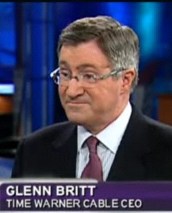
Glenn Britt’s Fireside Chat: Time Warner Cable Wants to “Remain Focused on the Customer” in 2011

Phillip Dampier December 6, 2010 Competition, Consumer News, Data Caps, Online Video, Video 2 Comments

Glenn Britt, Time Warner Cable’s CEO, says the cable company’s biggest challenge in 2011 is remaining “completely focused on the customer.”

Britt told Michael Grebb, writing for CableFAX, that America’s second largest cable company cannot succeed if it dictates terms to customers.

“We have to deliver a differentiated customer experience that’s linked to our brand—a brand that says ‘we give you more control in ways that are simple and easy for you, the customer,'” Britt said. “We’ve heard loud and clear from customers that they want flexibility in packaging, including the ability to buy smaller packages. We’re working hard to deliver what they’re asking for.”

Britt is referring to Time Warner’s new pared-down cable-TV tier, TV Essentials.  Currently undergoing a market trial in northeast Ohio and New York City, it deletes more expensive basic cable networks from the cable package to provide a discounted, smaller lineup to customers.

Britt’s remarks come more than a year after the cable company experimented with an Internet Overcharging scheme that would have restricted consumers’ use of Road Runner unless they were willing to pay triple the price — $150 a month — for unlimited use.  The company shelved the test after an outpouring of customer complaints and threatened congressional action.

Britt’s remarks would seem to indicate Time Warner is not going to antagonize its customers in the coming year, especially considering the economic challenges many face.  Time Warner lost more than 100,000 subscribers in the last quarter alone.

“Even if we weren’t in a bad economy, we’d still want to deliver customized products and experiences to specific customer segments, which is smart business in any environment,” Britt said. “And it just so happens our lower [revenue] customer segments are most affected by the economy and are the same customers who are really shouting about smaller packages. With respect to ‘higher-end fare,’ I would add that, even with the tough economy, we’re still seeing good demand from higher [revenue] customer segments.”

Britt added Time Warner plans to be more aggressive about its own TV Everywhere project in the coming year.  TV Everywhere delivers on-demand programming online for “authenticated” customers who also subscribe to a corresponding cable-TV package.  No cable-TV package means no access to that programming online.

“Our firm belief is that consumers want access to any content, anywhere, any time and from any device,” Britt said.

Britt signaled the cable company feels on-demand is only part of the online video equation.  Portability — the ability to access content on-the-go, is also a very high priority for Time Warner.  Britt encouraged cable programmers to get on board and participate in the TV Everywhere project to help grow awareness of the service for existing cable-TV subscribers.

Britt also telegraphed the company was moderating its tone over retransmission consent agreement battles with cable networks and broadcasters.  While previous statements from the cable operator indicated the company was prepared to “get tough” with programmers seeking dramatic price increases, Britt’s latest comments suggest the company recognized consumers do not want to be put in the middle of the disputes and the company was taking the matter to Washington lawmakers to adjudicate instead.

Time Warner faces a major showdown with Sinclair Broadcasting, owner of several network affiliate stations, which will come to a head on New Year’s Eve.

“We will continue to work hard to reach fair agreements, but we believe existing retransmission consent rules – set by the government almost 20 years ago – have not kept up with a changing marketplace,” Britt noted. “The rules are outdated, and they’re in urgent need of reform in order to avoid more public battles.”

[flv width=”640″ height=”500″]http://www.phillipdampier.com/video/Bloomberg Britt Calls for Cable Content Dispute Resolution Process 11-23-10.flv[/flv]

Time Warner Cable CEO Glenn Britt told Bloomberg News the company wants to reform the retransmission consent dispute process.  (3 minutes)

Cable Stocks Soar, Rationing Broadband With ‘Usage-Based Billing Coming Quickly,” Predicts Analyst

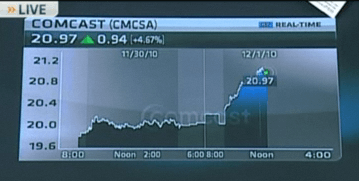
When the FCC delivers for Big Telecom's agenda, stocks soar. Comcast shares exploded on news the company could largely do as it pleases with its broadband service. (CNBC)

Comcast’s stock price soared today as Wall Street was cheered by news America’s largest cable operator would likely face little regulatory restraint from consumer protection policies designed to keep broadband providers from meddling with Internet traffic.  But investors were also excited by the green light signaled by Federal Communications Commission chairman Julius Genachowski that launching Internet Overcharging schemes like “usage-based” billing, speed throttles and hard usage caps on broadband consumers was also acceptable marketplace behavior.

Craig Moffett, a Wall Street analyst with Sanford Bernstein said Genachowski’s remarks left the marketplace with little doubt it can get away with price increases and new limits on broadband consumption.

“The FCC here is expressly acknowledging the need to ration broadband, and that’s a really big deal,” said Moffett, appearing on CNBC this afternoon.  “I think you are going to start to see usage-based pricing plans from the broadband providers pretty quickly.”

Moffett also acknowledged his firm’s own research showing consumers despise such pricing schemes and admits the impact on America’s broadband landscape is likely to include a dramatic shift in how customers use their Internet accounts.

“When customers think they are going to be charged when they click on that link and watch a movie, they are going to be inclined to watch fewer movies,” Moffett said.  “You can’t expect linear progression of online video because there are going to be feedback loops like usage-based pricing that are going to limit usage.”

Moffett says cable operators are benefiting from Chairman Genachowski’s new approach because it opens the door to repricing wired broadband accounts to limit broadband consumption.  Since most analysts guessed regulators would allow usage-based pricing to remain on wireless broadband, the unexpected green light for similar rationing plans on cable broadband, DSL, and other wired services was welcome news, at least for providers and Wall Street.

Consumers that don’t deliver a resounding negative response to elected officials, the FCC, and the White House better start thinking twice about clicking that YouTube video, because that few minutes could cost plenty if providers slap higher prices and limits on broadband service in the coming year.

[flv]http://www.phillipdampier.com/video/CNBC The Fight for Your Right to Surf the Web 12-1-10.flv[/flv]

A Wall Street telecom analyst predicts the end of unlimited home broadband accounts is going to come quickly, now that the FCC has capitulated on Net Neutrality policies.  (3 minutes)

Net Neutered: The Cowardly Lion is Back — FCC Chairman Caves In With Homeopathic Net Reform

The Cowardly Lion is back.

Federal Communications Commission chairman Julius Genachowski believes he has a sound legal basis to implement Net Neutrality policies to protect Internet traffic from provider interference, but has stopped considerably short of implementing his own proposed enforcement mechanisms.

Genachowski outlined his ideas to implement Net Neutrality reform in brief remarks before the Commission this morning.

“Broadband providers have natural business incentives to leverage their position as gatekeepers to the Internet,” the text of the speech says. “The record in the proceeding we’ve run over the past year, as well as history, shows that there are real risks to the Internet’s continued freedom and openness.”

Genachowski praised the progress the Internet has managed to achieve over the past decade, and said his efforts would ensure that progress could continue with a minimum of regulation.  In that spirit, Genachowski announced he would not move that the Commission re-assert its legal authority to oversee broadband by a process to reclassify the service under Title II, which governs telecommunications services.

Comcast successfully sued for repeal of the Commission’s original authority, implemented by Bush FCC chairman Michael Powell, which classified broadband as “an information service.”  A DC Circuit Court discarded the legal basis for Powell’s regulatory authority in a sweeping victory for the cable giant, which was sued for throttling down speeds for broadband customers using peer to peer applications.

Genachowski argued he has “a sound legal basis” to pursue his latest vision of Net Neutrality rules in spite of the earlier court case.  But critics doubt that and charge that the FCC chairman has capitulated to America’s largest broadband providers, including Comcast, AT&T, and Verizon.

Genachowski's view of the Internet does not meet the realities consumers face without Net Neutrality protection assuring a free and open Internet.

“By not restoring the FCC’s authority, Chairman Genachowski is unnecessarily placing his Net Neutrality agenda, and indeed his entire broadband agenda, at risk,” said Free Press executive director Josh Silver.

Boiled down, Genachowski now seeks just two major principles governing provider behavior:

  1. No censorship of content.
  2. Full disclosure of network management techniques so consumers know what providers are doing to their broadband connections.

Consumer groups are furious that the chairman has apparently discarded many of Net Neutrality’s most important consumer protections, and accused him of caving in to lobbyist demands and abdicating his responsibility to oversee critical broadband infrastructure.

Marvin Ammori, a cyber-activist and public interest law professor said the proposal also fell well short of meeting President Barack Obama’s repeated promises to enact strong Net Neutrality policies.

“It’s make-believe Net Neutrality,” said Ammori, who called Genachowski’s proposals “garbage” and “meaningless gestures.”

Now off the table:

A ban on Internet Overcharging schemes that allow providers to limit, throttle, or overcharge consumers who use more than an arbitrary amount of Internet usage per month. This exposes home broadband users to the same kinds of bill shock that wireless customers already experience.

A ban on using “network management” to artificially slow or block traffic the provider — at its sole discretion — determines is “harmful” or “congests” their network. Under Genachowski’s new proposal, the definition of “harmful” could be made by an engineering department on technical grounds or in an executive suite as companies ponder their financial returns. So long as they manage traffic without “unreasonable discrimination,” it’s okay with the Commission.

Built-in loopholes guarantee providers need only set rates high enough to assure only “preferred partners” can afford the asking price, and that only their competitors meet the definition of “harmful” traffic worthy of speed throttling.  The proposal also reportedly only covers video and voice traffic on wireless networks.  It’s open season on everything else if you access the web from a smartphone or wireless broadband service.

Actual legal authority to implement any broadband reform policies. It was Julius Genachowski and the FCC’s General Counsel Austin C. Schlick that argued without asserting legal authority under Title II, nothing the Commission did could be assured of withstanding a court challenge.  Yet today the chairman now claims his legal team has found some legal precedents that somehow will keep his policies in force after inevitable lawsuits are filed.  Former FCC chairman Powell thought much the same thing about his own idea of reclassifying broadband as “an information service.”  The DC Court of Appeals thought otherwise, something Schlick knows personally, having fought the Comcast case before that court.  In the end, Schlick correctly guessed his case was a train wreck, and was reduced to asking the court for legal pointers about how to draft regulations that could survive a court challenge.

[flv width=”640″ height=”380″]http://www.phillipdampier.com/video/The Third Way The Future of Internet Policy in America 5-2010.flv[/flv]

This “other” Julius Genachowski from May of this year delivered remarks that carried a very different tone about the importance of restoring legal authority to oversee broadband.  But that was before AT&T put him on their speed dial, successfully reaching him personally more than a half dozen times in the last few weeks to argue their point of view.  Consumers don’t have Julius Genachowski’s phone number.  (4 minutes)

In short, Genachowski’s proposals represent near-total victory for providers, and any cable or phone company annoyed with the few scraps still on the agenda need only file suit arguing the Commission lacks the authority to stick its nose into their business affairs.  Without Title II authority in place, that lawsuit is probably going to result in a favorable ruling putting us back where we are today — with no Net Neutrality protections.  But by then, the Internet will be a very different place, loaded with toll booths from content providers and your ISP, who may ask for extra money if you want to watch Netflix or download files.  Your speeds may be reduced at any time, to any level, if a provider deems you’ve over-consumed your traffic allowance for that day, week, or month.

Worse, some providers will dispatch bills with overlimit fees that could run into the hundreds of dollars (or more) for those with a family member who left a high bandwidth application running while running out the door to catch the school bus.

Providers and their well-paid lobbyists celebrate their victory over consumers' wallets

So long as providers agree to abuse everyone more or less equally (excepting their own “preferred partners” of course), Julius Genachowski believes the next ten years of America’s online experience can be as great as the last.

In his dreams.  As Public Justice attorney Paul Bland said about dealing with ruthless companies like AT&T, assuming providers will behave favorably towards consumers puts you on the candy bridge into Rainbow Land.

Even with Genachowski’s proposed reforms, diluted to be point of being homeopathic, Republicans were moving in for the kill this morning.

Rep. Marsha Blackburn (R-Tenn.) a member of the House Energy and Commerce Committee, said she would work to topple any FCC-led Net Neutrality order.

“This is a hysterical reaction by the FCC to a hypothetical problem,” she said, adding that Genachowski “has little if any congressional support” for the action.

To overturn any order, Blackburn vowed to reintroduce her bill to prevent the FCC’s policy making process.

Robert McDowell, one of two Republican FCC commissioners, called the move to enact reforms a defiance against Congressional will.

“Minutes before midnight last night, Chairman Genachowski announced his intent to adopt sweeping regulations of Internet network management at the FCC’s open meeting on December 21. I strongly oppose this ill-advised maneuver. Such rules would upend three decades of bipartisan and international consensus that the Internet is best able to thrive in the absence of regulation,” McDowell said in a prepared statement.

All this is taking place at the same time Comcast has foreshadowed America’s future broadband experience: charging backbone provider Level 3 extra for sending Comcast customers online movies and TV shows, censored a blog run by one of its customers trying to get around Comcast’s unresponsive customer service agents, stifled innovation by independent cable modem manufacturer Zoom Modems, has achieved a fever pitch in lobbying Washington to hurry up and approve its colossal merger deal with NBC-Universal, and has a lobbying team convinced it can achieve victory on all fronts from a favorable incoming Congress.

If they and other broadband providers succeed, it’s time to get out your wallet and count your money before handing it over.  A consumer revolt is all that stands between your Internet experience today and an endless series of pay-walls and stifled speeds tomorrow.


Search This Site:

Contributions:

Recent Comments:

Your Account:

Stop the Cap!