Home » Online Video » Recent Articles:

HissyFitWatch: Billionaire Owner of FilmOn Declares War on CBS-Viacom – “CBS You Suck”

Phillip Dampier February 17, 2011 Competition, Consumer News, HissyFitWatch, Online Video, Public Policy & Gov't, Video Comments Off on HissyFitWatch: Billionaire Owner of FilmOn Declares War on CBS-Viacom – “CBS You Suck”

British billionaire Alki David thinks Viacom, owner of CBS, is “an irresponsible hypocrite.”

After being dragged into court in New York and finding himself with an injunction, the founder of FilmOn is looking for revenge.

Claiming Viacom-owned CNET “has ruined the lives of hundreds of thousands of people in the creative community and created copyright infringement damages into the trillions of dollars,” David is considering a lawsuit against the company, which David accuses of dealing in piracy:

Has your song, movie, software or literary work been copied and distributed illegally through the file-sharing software called LimeWire? If so, and if you are interested in joining a lawsuit against CNET for its widespread distribution of LimeWire with the malicious intent to infringe on copyright, then please read on.

We are putting together a committed coalition of artists and rights owners whose movies, music, software and literary works have been pirated by LimeWire users. A U.S. District Court has already shut down LimeWire, but others who participated in its wrongdoing like CNET have not yet been made accountable.

On December 21, 2010, Leslie Moonves issued a statement to the Hollywood Reporter regarding Alki David’s “incendiary video” which was posted on YouTube and which detailed CNET/CBS Interactive’s participation in widespread, “malicious copyright infringement”. Mr. Moonves was quoted as saying that was that “He (Alki David) is hardly an expert on intellectual property rights. CNET respects such rights.”

Mr. David has just released a second video in response. The video is even more fact filled and includes a discussion by a leading copyright attorney, Michael Zeller of Quinn Emanuel.

As demonstrated in the new video and supported by Court documents, CNET.com — also known as download.com — was responsible for distributing 95.5% of all LimeWire downloads. In May 2010, U.S. District Judge Kimba Wood granted a summary judgment in favor of the music industry’s claims that LimeWire’s software maker and its founder Mark Gorton committed copyright infringement, engaged in unfair competition, and induced copyright infringement.

Mr. David said: “We are very pleased to announce that a large coalition of copyright owners, including myself, who have been harmed by CNET’s distribution of LimeWire file sharing software are working with Mr. Zeller’s firm in preparation for a lawsuit.” Mr. David added: “Mike Mozart of YouTube fame originally introduced me to CNET/Limewire connection. Since absorbing all of the evidence, it has now become an impassioned commitment to stop the injustice that still goes on today as a result of CNET’s actions.”

David’s new website, Viaconned, is the home base for his campaign against CBS.  His video, rambling at times, claims that CNET’s website recommended software that can be used to strip copyright protection mechanisms from songs, and also distributed the very file sharing software Viacom railed against for copyright infringement.

FilmOn recently had to yank most of its American network stations from the lineup of its online virtual cable system, and the service is now relegated to showing pornography, documentaries, older movies, and international channels of limited interest to most American viewers.

[flv width=”640″ height=”380″]http://www.phillipdampier.com/video/David Alki Attacks Viacom 12-2010.flv[/flv]

Alki David outlines his case against Viacom, with a little help from his friends.  (10 minutes)

The Problem With the Internet… Slow Speeds Hamper Online Efficiency

Phillip "Swimming Upstream... slowly" Dampier

I spent the better part of today finding, assembling, and finally uploading the audio and video content covering Canada’s ongoing hearings about Internet Overcharging.  Locating and editing the content took about two hours, writing the piece to accompany it took another hour, and then everything  s   l   o   w   e   d  down from there.

Uploading several hundred megabytes of audio and video, included in today’s articles, was by far the most cumbersome part of the operation.  In all, it took nearly four hours to upload a handful of video and audio files, and that saturated our cable modem to the brink of un-usability.

While most providers concentrate upgrades on boosting download speeds, upload speeds have remained remarkably consistent — and painfully slow, for several years now.

Time Warner Cable, which provides our Internet connection, tops out at just 1Mbps for uploads locally, and it is slower during peak usage times.  Contrast that with 2Mbps in more competitive cities (with 5Mbps now common wherever DOCSIS 3 technology has been deployed).  Still, at least it is better than the 384kbps residents in upstate New York contended with for a decade earlier.

Cable modem technology is built on the premise that you will download far more than you will need to upload, and speeds are provided accordingly.  DSL service from some phone companies has managed to keep up with upload speeds… barely, if only because many cable providers have largely ignored the upstream component.

But as the Internet and social media become a more interactive part of our lives, we increasingly need to give as much as we get, and our Internet Service Providers continue to let us down in too many cases.

The one exception is fiber-to-the-home service, which can deliver synchronous (identical upload and download) speeds to their customers.  Community-owned fiber networks continue to be the kindest to their customers, thinking of speed equality as an advantage, not a marketing option that commands a high price.  Many of these networks are owned and operated by local governments — you know, the people we’re told never do anything right.

Yet in many instances they alone have the prescience to recognize broadband speeds have a direct impact on efficiency — at home and at work.  Many are building networks that leverage as many megabits per second they can get.  Why?  Because they can.  Such a response is scoffed at by many cable and phone companies, most of whom claim you don’t need that kind of speed.

For those of us without access to such state-of-the-art networks, we’ll have to continue setting our sights considerably lower.  Time Warner will finally bring 50/5Mbps service to Rochester early this year.  As far as they’re concerned, we should be glad to have it.  It will cost just shy of $100 per month on a standalone basis.  If we lived in Chattanooga, Tenn., home of EPB, the municipal broadband provider would sell us 50/50Mbps service for nearly $20 a month less — $79.99 per month.

EchoStar Buys Hughes Satellite; Acquires Satellite ‘Fraudband’ Service Rural Americans Loathe

Phillip Dampier February 14, 2011 Broadband Speed, Consumer News, Data Caps, HughesNet, Online Video, Rural Broadband, Video, Wireless Broadband Comments Off on EchoStar Buys Hughes Satellite; Acquires Satellite ‘Fraudband’ Service Rural Americans Loathe

EchoStar Corporation, which makes equipment and provides satellites for Dish Network, today announced it has agreed to buy Hughes Communications, Inc., for about $1.32 billion.

The deal means Dish, the second-largest U.S. satellite television provider, could be one step closer to providing a national data service to its customers.  Hughes operates a “broadband” satellite network, which almost entirely serves rural areas.

Much maligned by its customers, who consider the service’s high prices, low speeds and even lower usage caps “fraudband,” Hughes’ satellite service has been up for sale for some time.

The purchase “brings together the two premier providers of satellite communications services and delivers substantial value to our shareholders,” Pradman Kaul, chief executive officer of Hughes said in the statement.

Satellite television companies have increasingly been at a disadvantage because they cannot sell a true “triple-play” package of television, Internet, and phone service to customers who commonly bundle the three services together.  Instead, Dish and its larger competitor DirecTV have been relying on partnerships with telephone companies who provide phone and Internet service with a satellite television package.

The current generation of satellite broadband services are not well-rated by their customers.  Capacity shortages force providers to place strict limits on usage, which makes the service largely useless for high bandwidth applications — especially video.

The deal is expected to close later this year.

[flv width=”640″ height=”500″]http://www.phillipdampier.com/video/Hughesnet.flv[/flv]

Watch HughesNet’s advertisement promising “blazing fast” speeds in contrast to an actual speed test completed by one of their customers, at a non-peak-usage time.  (2 minutes)

Stealing the Broadband Revolution with Internet Overcharging: A Report from CBC Radio

Phillip Dampier February 9, 2011 Audio, Canada, Competition, Consumer News, Data Caps, Online Video, Public Policy & Gov't Comments Off on Stealing the Broadband Revolution with Internet Overcharging: A Report from CBC Radio

CBC Radio One: The Current explores Internet Overcharging in Canada:

It’s hard to believe that just eighteen years ago — back in 1993 — we were only beginning to grasp what the Internet could do for us. Today, the Internet is an integral part of the global economy, a powerful political tool, and something many couldn’t imagine living without. That’s partly why the cost of Internet access has been at the centre of a national debate for the past week.

The debate was sparked by the CRTC’s decision to approve what’s known as “usage-based billing.” Then Federal Industry Minister Tony Clement tweeted that Ottawa wouldn’t accept the ruling. And the CRTC is now reviewing its decision and has put out a call to Canadians asking them to weigh in with their opinions.

Today we look at the implications of the different ways of charging for Internet access and we also ask if the Internet should be treated more like a utility or even a human right.

CBC Radio One’s program, The Current explores Canada’s attitude towards usage-based billing and what implications it hold for an increasingly digital society. Steve Anderson from Openmedia.ca joins the program to debate the notion usage-based billing “saves” light users’ money.  (28 minutes)
You must remain on this page to hear the clip, or you can download the clip and listen later.

CRTC Chairman Raked Over the Coals by MP’s Over Internet Overcharging, But Remains Defiant

Phillip Dampier February 8, 2011 Bell (Canada), Canada, Competition, Consumer News, Data Caps, Online Video, Public Policy & Gov't, Video Comments Off on CRTC Chairman Raked Over the Coals by MP’s Over Internet Overcharging, But Remains Defiant

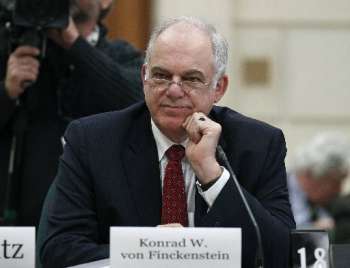
Finckenstein at Thursday's hearing. Turn me over when I'm done on one side.

Canadian Radio-television and Telecommunications Commission chairman Konrad von Finckenstein appeared before a Commons committee last Thursday to answer questions regarding the growing scandal of so-called “usage-based billing (UBB).”  The Commission’s decision to enforce this pricing scheme, ending unlimited broadband service in Canada, has created major headaches for the Conservative government of Prime Minister Stephen Harper.

Seasoned political observers were shocked when Industry Minister Tony Clement earlier tweeted his support for overturning the CRTC decision.  Thursday’s hearing at the Standing Committee on Industry, Science and Technology also suggested the decision was made without any prior consultation with von Finckenstein, who appeared to be learning most of the details of the Clement’s decision at the hearing itself or in the morning newspapers.

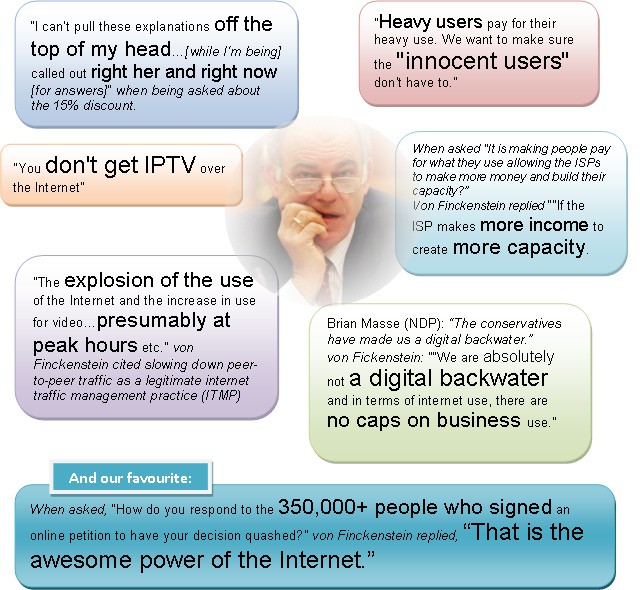
Facing a grilling from members from just about every major political party in Canada, from the Liberals to the Bloc Quebecois, von Finckenstein only managed to add fuel to the fire, blaming “heavy users” for forcing the end of unlimited usage plans, all to protect what he called “innocent users.”  He also blamed online video services like Netflix for forcing new pricing policies on Canadian consumers, who were increasingly using their broadband connections for more than just “e-mail and Facebook.”

At times exasperated, the chairman seemed to rely on industry talking points to address concerns with MP’s in attendance, occasionally without fully understanding their meaning.

At one point, he insisted Internet Protocol TV (IPTV), was never delivered over the Internet.  At another, he claimed that providers would certainly use all of the funds collected from new, higher-priced broadband plans to rebuild their networks, asking rhetorically, “how else would they use that money?”

The head of the agency that is tasked with protecting the interests of Canadian consumers regularly compared the Internet to a power, gas, or water utility, which he said justified usage pricing.  But von Finckenstein ignored landline telephone service, which is most related to broadband — a service moving towards flat rate pricing.  Instead, he relied on cell phone pricing, which caused several reporters to cringe, as they reflected on newly-introduced flat-rate calling plans among new wireless competitors.

At this point a reporter for the Globe & Mail bemused with all of the utility comparisons tweeted: “Main difference is I can’t watch movies on my furnace.”

Watch the entire 90-minute hearing by clicking here and choosing the English version, which provides simultaneous translation as the hearing moves back and forth from French to English.

The CRTC’s decision to ignore hundreds of thousands of petition signers across Canada while quickly acceding to Bell’s request for a 60-day temporary delay in implementing the pricing scheme brought an angry response from Openmedia.ca, a pro-consumer group highly critical of UBB.

“The CRTC’s stubbornness in the face of a mass public outcry demonstrates the strength of the Big Telecom lobby’s influence,” said founder and national coordinator Steve Anderson . “While government officials have recognized the need to protect citizens’ communications interests, the CRTC has made it clear that their priorities lie elsewhere. Now is the time for citizens to demonstrate that they, rather than incumbent ISPs, are the real stakeholders.”

Some media observers and consumer groups are also scoffing at the government’s suggestion the CRTC should be allowed to review its own, earlier decision, claiming it is a virtual certainty the regulator will find their original decision was the correct one.

In fact, von Finckenstein’s relentless defense of usage-based pricing, even in light of recent political realities, suggest the Commission’s authority could be swept aside to keep the matter from becoming an issue in future elections.

“I would like to reiterate the Commission’s view that usage-based billing is a legitimate principle for pricing Internet services,” the chairman told members attending the hearing. “We are convinced that Internet services are no different than other public utilities, and the vast majority of Internet users should not be asked to subsidize a small minority of heavy users. For us, it is a question of fundamental fairness. Let me restate: ordinary users should not be forced to subsidize heavy users.”

The CRTC also claims the UBB policy will only impact residential customers — business accounts are exempt.  But several MPs questioned that statement, suggesting home-based businesses, farmers and other entrepreneurs would face Internet Overcharging schemes.

Canada’s Liberal Party is using the occasion to embarrass the Tories’ handling of what they’ve called an Internet fiasco.  Liberal’s industry critic, Marc Garneau, used some of his seven minutes of question time to ask whether the CRTC first heard of the Harper government’s stance on UBB through social media network Twitter.

Quotes from the CRTC Chairman; Image by Vojtěch Sedlák & Openmedia.ca

Search This Site:

Contributions:

Recent Comments:

Your Account:

Stop the Cap!