Home » Online Video » Recent Articles:

An Open Letter to Content Producers: Netflix, Hulu, Valve, Microsoft, Sony, and Nintendo

Dear Content Producer:

Your money train is leaving the station.

Customers are about to start making some very important choices about what they do on the Internet. AT&T announced this month they are going to start capping their DSL customers at 150GB per month and their fiber-to-the-neighborhood U-verse customers at 250GB per month, with overlimit fees for those who exceed them.

Comcast already has a 250GB per month cap, currently loosely enforced. Time Warner Cable has strongly advocated usage-based billing for years. Other telecommunications companies are all either supporting or considering these Internet Overcharging schemes for one reason, and one reason only:

It makes them absolute boatloads of cash.

Canada already lives with this reality. So does Australia, although they’re backing away from it. South Korea? Japan? Europe? Nope. Flat-rate Internet service is the norm there.  In Europe, mobile customers are demanding the removal of bandwidth caps American providers are still trying to attach to customers’ bills.

So how does this impact you? 250GB a month is a lot, and you’ll be fine? Sure. For now.

But what happens when Sony introduces the Playstation 4, or Microsoft announces the Xbox Next? Games aren’t exactly going to get smaller, and online distribution is far and away the future of games and software in general. Right now a game for the 360 or PS3 can be as large as 20GB. PC game enthusiasts routinely cope with 10-12GB game upgrades, and woe be unto you if you have to reinstall your Steam library and have 20-30 (or more) games to restore.

Internet Overcharging schemes make providers, and the lobbyists who do their bidding, very wealthy.

For the “Massively Multiplayer Online” game universe, incremental software updates and upgrades often come through BitTorrent, which exposes users to peer-to-peer traffic well beyond the size of the update itself.  In fact, as games increasingly turn towards Cloud storage and distribution, the traffic adds up.

For online video companies, your very business model could be at risk.  Netflix? Hulu? People are no longer satisfied with grainy, compressed video.  They want HD content, and you’ve answered the call.  But as consumers increasingly face 8-10GB per movie (at 720p, 15GB+ for 1080p), the usage racked up is going to blow past all of these caps.

Who knows what happens in the next five years, or ten.  Considering Canada, where a similar duopoly of broadband providers have lowered usage allowances, do you really expect anything different down here?  The only thing likely to be raised is the monthly price, which remains higher here than in most places around the world.

Google has the right idea with their experimental 1Gbps fiber-to-the-home network. The problem is, that’s only going to serve one (or perhaps a few) communities in the U.S.  The rest of the country will have to survive with ‘Ultra’ cable broadband packages serving up 10-20Mbps service or DSL that barely manages 6Mbps.  If you don’t live in an urban area, tough luck.  You will be lucky to get 3Mbps service.

Broadband service upgrades come painfully slow in the absence of robust competition.  Time Warner Cable and other providers are slowly starting to roll out DOCSIS 3, which allows speeds up to 100Mbps, assuming the average consumer can afford the Cadillac price that comes with it.  Many phone companies continue to bet the farm on their DSL service, which can also be expensive when it’s the only broadband service in town.

Against this backdrop, the rest of the world marches on, and beyond, North America.

South Korea? They’re promising national speeds of 1Gbps by 2013 — for $27 a month!

How has this happened?  Where have we gone wrong?

For starters, the broadband providers have very powerful lobbyists — quite a few of which are ex-legislators. Together, they wage their public policy battles on both the state and federal level, often writing the bills a compliant legislator is willing to introduce as their own.

Washington regulators take a "see no evil, hear no evil" approach to regulating super-sized corporations who can cause them trouble.

The Federal Communications Commission has adopted a “see no evil, hear no evil” approach to broadband, capitulating when a chairman occasionally strays too far into the industry minefield laid to protect their business agenda.  As a result, the agency is a toothless dog.  It recently adopted a “Net Neutrality” policy all but written by Verizon, who ironically is now spending money to fight the rules they helped write.  As a backup, virtually every Republican and several Democrats have teamed up to pass a Resolution of Disapproval seeking to overturn the weak-kneed Net Neutrality rules the FCC adopted.  Lobbyists are well paid to cover every contingency.

Consumers — your customers — can’t do much about this beyond writing their members of Congress and complaining.  But because they did not enclose a check or money order made payable to the respective politician’s campaign fund, the result will be a form letter response weeks, if not months later… after the corporate agenda is enacted into law.

We just cannot fight this battle all by ourselves.  Recognizing the realities of today’s politics, we need your help to fight money and power with money and power.

The video game industry earns billions yearly. You have already faced battles in Washington, so you know how this works. You can fight for your interests while protecting ours by ensuring broadband service is cheap, plentiful, and unlimited. The same story applies to other content producers, such as online video, software, and any other company that wants to move to online distribution to power their business. You cannot succeed if customers are too afraid of using your service because of a bandwidth cap.

The remarkable thing is that countries many Americans cannot find on a map are now beating the United States with better and cheaper broadband while we hand over our digital economic future to a duopoly. That will not buy us better service, just bigger bills for “fast enough for you” Internet access.

So that’s it. Act now. Act strongly. If you cannot stand up for your customers, you may not have any.

Signed: A gamer. A movie watcher. A music listener. An enjoyer of entertainment. A lover of the Internet.

Broadband consumer and reader Jason Ballew penned this guest editorial, with some editing and additions from Stop the Cap! editor Phillip M. Dampier.


AT&T Data Caps: Gizmodo’s Joe Brown In Over His Head on G4TV’s Attack of the Show

Joe Brown was obviously not the right person for G4TV’s Attack of the Show to talk to about the issue of Internet Overcharging.

As AT&T begins notifying their DSL and U-verse customers they are about to face usage limits on their broadband service, G4TV sought out reaction from the features editor of Gizmodo.com, who was wholly unprepared to inform viewers about the facts behind AT&T’s usage caps and their implications for customers.

While Brown and G4TV were joking about users having to curtail game downloads, for millions of AT&T customers, it’s no laughing matter.

AT&T’s announced 150-250GB limits will eventually cost customers $10 or more for each extra 50GB allotment, on top of their already-expensive broadband service package.

“It really had to happen eventually I think,” Brown told viewers.  “People are using a lot of bandwidth.”

Gizmodo's Joe Brown talks with G4TV's Attack of the Show

But Brown’s observation conflicts with AT&T’s own claim “only a tiny minority of customers” will use more than the company wants to allow, with the average AT&T customer consuming 18GB per month.  AT&T isn’t telling the full story about that either.

For those “heavy users” AT&T wants to restrict first, the implications go well beyond curtailing Netflix and playing online games.

“As a software developer who works under a Linux environment and is forced to telecommute from home one week per month, these caps would absolutely kill me,” writes Joe Stein from Sparks, Nev.  “If you are a retired person using your computer to check e-mail and browse the headlines, you will obviously never exceed AT&T’s caps, but for technology innovators and those like me in the software development field, 150GB is nothing.”

Stein downloads regular updates for Linux, exchanges software back and forth with the office several times a day, and uses video conferencing regularly when he works from home.

“Not all online video is about adult entertainment or downloading movies,” Stein says.  “Usage caps hurt anyone who has to work with large files or business-related video, and after the events this week, AT&T can afford to leave off the caps.”

Brown claims AT&T conducted “a study” in two cities which found that 98 percent of their customers used far less than the usage caps would allow.  What Brown does not know is that those two cities are Beaumont, Texas and Reno, Nevada — hardly superstars in the tech revolution.

“Nobody moves to greater Reno to be a software superstar, which is why I am in San Jose, Calif., all the time,” Stein says.  “But there is more to this area than casinos.”

Stop the Cap! has been helping consumers in both cities avoid AT&T because the company’s “study” came at the same time it was experimenting with an Internet Overcharging scheme that limited customers to as little as 20GB of usage per month — a strong incentive for customers to avoid high bandwidth services,  or better yet AT&T.  So it’s no surprise broadband users who know better chose an alternative provider, including Stein.

“I first became aware of the usage cap debacle a few years ago when AT&T tested usage caps in the Reno area, which covers Sparks,” Stein says.  “I saw the impact first hand when customers started getting notified they would have to pay substantially more for basic Internet service.”

Lvtalon

AT&T first limited their broadband customers to as little as 20GB of usage per month, then claimed the average customer only uses 18GB, making their 150GB DSL cap "generous."

Stein left for the cable company — Charter Communications, and they have usage caps too, but they are rarely enforced and much higher than what AT&T offers DSL customers, Stein says.

Brown claims AT&T is trying to “get out ahead of people using too much,” a point in conflict with the fact AT&T is willing to sell consumers additional bandwidth on its “overcongested” network.

Brown’s suggestion that “bandwidth costs money” is partially true, but not in the context of AT&T’s usage limits.  The company that can afford fiber optic upgrades to deliver limitless television and telephone service apparently cannot afford the pennies in bandwidth costs customers consume as part of their broadband service, which can run $50 a month or more.

Pondering broadband usage “fairness” is a losing proposition for consumers… and reporters, too.

Once someone blindly accepts the premise AT&T needs data caps, with no evidence usage presents a technical or financial challenge for the company, the debate is quickly reduced into a numbers game about “how much usage is fair.”

Clearly for Brown and his friends, who admit they are dangerously close to reaching or exceeding AT&T’s limits, the answer to Brown wondering aloud if the caps would “do it for him” should be no.

Stop the Cap! believes no cap is worth living with, especially on AT&T’s enormous-sized broadband network, now increasingly designed to handle the multimedia rich Internet and their U-verse platform.

It is doubtful many will be assuaged by Brown’s comments that “AT&T sounded pretty cool” about how they will deal with those who exceed their arbitrary usage limits.  Why?  Because after the “fair warnings” AT&T will provide customers on its artificially limited network, they will drop the sledgehammer of higher bills on top of customers’ heads.

Brown should know better, especially after finding AT&T unwilling to discuss how often it intends to revisit its usage cap levels.  AT&T’s counterparts in Canada have already foreshadowed the answer.  Once the cap regime is in place, several companies lowered them, sometimes repeatedly, to further monetize broadband usage.  They also raised the prices of overlimit fees, often substantially.

AT&T depends on uninformed consumers and reporters not understanding the true facts about Internet Overcharging schemes.  It’s not too late for reporters like Joe Brown to undo the damage, however.

Stop the Cap! strongly encourages everyone to examine the evidence we have compiled here over the past two and a half years.  It’s not hard to discover AT&T’s usage caps have nothing to do with fairness, are arbitrary and unnecessary, and come as a result of providers seeking higher profits in an undercompetitive marketplace.

If we do not uniformly and loudly oppose usage limits, America’s broadband rankings, digital economy innovation, and high technology jobs are all at risk, just to satisfy AT&T’s insatiable appetite for higher profits.

(P.S. – Joe: How did you miss Comcast has been capping their customers at 250GB for two years now.  Say it ain’t so, Joe!)

[flv width=”480″ height=”380″]http://www.phillipdampier.com/video/G4TV Attack of the Show ATT Caps Their Data Usage 3-15-11.flv[/flv]

G4TV’s ‘Attack of the Show’ misses the boat on AT&T’s Internet Overcharging scheme.  They did better covering Time Warner Cable’s attempt at Internet Overcharging in 2009.  It’s time to revisit this issue and get involved in the fight that could hurt the very audience watching this show.  (6 minutes)

Same Story, Different Countries: Whether It’s Bell or AT&T, Usage Billing & Caps Are Nonsense

[flv width=”640″ height=”380″]http://www.phillipdampier.com/video/UBB is Nonsense.flv[/flv]

François Caron produced this video succinctly smashing the myth that “usage-based billing” and “usage caps” are about fairness or fight congestion.  In this case, Caron refers to Canadian providers, but the story is much the same south of the border.  These Internet Overcharging schemes are nothing more than an effort to control what you can do with your broadband connection.  AT&T wants a 150-250GB usage cap on broadband, but has limitless capacity for television and telephone service.  They also have $39 billion to buy T-Mobile, but need to overcharge you for broadband service.  Bell in Canada wants -every- broadband user in Canada to pay this ripoff pricing.  Share with anyone who thinks paying for usage is anything like paying for water, gas, or electricity.  It’s not!  (6 minutes)

Debunking Dollar-A-Holler Group’s Claim: Usage Caps Help Resolve Piracy

In a stretch even the most accomplished Yoga master would never attempt, an industry-funded dollar-a-holler group has told Congress that Internet Overcharging is a useful tool to combat online piracy.

On Tuesday, Daniel Castro, an analyst at the Information Technology and Innovation Foundation (ITIF), testified before the House Judiciary Committee on the issue of combating “rogue sites [that] operate in a low risk, high reward environment.”

In December 2009, ITIF proposed a number of policies to help reduce online copyright infringement, especially in countries that turn a blind eye to copyright enforcement. The purpose of these policies is to establish a robust enforcement mechanism to combat IP theft online. These recommendations include the following:

  • Create a process by which the federal government, with the help of third parties, can identify websites around the world that are systemically engaged in piracy;
  • Enlist ISPs to combat piracy by blocking websites that offer pirated content, allowing pricing structures and usage caps that discourage online piracy, and implementing notice and response systems;
  • Enlist search engines to combat piracy by removing websites that link to infringing content from their search results;
  • Require ad networks and financial service providers to stop doing business with websites providing access to pirated content;
  • Create a process so that the private sector can consult with government regulators on proposed uses of anti-piracy technology;
  • Fund anti-piracy technology research, such as content identification technology;
  • Pursue international frameworks to protect intellectual property and impose significant pressure and penalties on countries that flout copyright law.

Castro’s idea of allowing providers to establish “pricing structures and usage caps” stands out like a sore thumb in the context of battling piracy because it is the only recommendation on the list that targets every broadband user with the same broad brush, punishing every customer whether they are engaged in piracy or not.

It would be like setting up roadblocks and searching every vehicle in a city to search for a shoplifter.  Every individual is found guilty before being proved innocent, and will be forced to pay higher prices regardless of the outcome.

The ITIF proposal runs contrary to years of efforts by Internet Service Providers to avoid being involved in the personal business of their customers.  In 2009, major ISPs wanted no part of enforcing a proposal from the record industry for a “three strikes, you’re out” plan.  Verizon, among others, made clear copyright enforcement was not their responsibility to police, although many ISPs are willing to forward copyright infringement notices to individual customers.

Castro’s testimony goes over the top when he blames his own suggested pricing antidote for “hurting law-abiding consumers who must […] pay higher prices for Internet access to compensate for the costs of piracy.”

Of course, no ISP has ever suggested they would use the extra revenue earned from Internet Overcharging to combat another industry’s piracy problem.

His sweeping indictment against consumers extends beyond nipping at their bank accounts on behalf of telecommunications companies who help fund the group he represents.  He also suggests those who oppose his piracy prescriptions are either in league with, or defenders of piracy — or other offenders ranging from criminal enterprises to kiddie porn peddlers.

Castro’s support for usage caps to control illicit online activities leaves collateral damage as far as the eye can see.  It also simply won’t work for many forms of piracy Castro complains about.  ISPs with usage caps go out of their way to note even the most draconian limits still allow thousands (if not hundreds of thousands) of songs to be downloaded — legal or otherwise.  Castro testified e-published books are now increasingly vulnerable to piracy, content compact and easy to obtain even with usage limits.  Combating websites dealing in counterfeit goods with usage limits isn’t even worth trying.

What Castro’s proposal will do is limit access to the growing amount of legitimate online video traffic.  While the author cites statistics that “one in four bits of traffic traveling on the Internet today is infringing content,” (taken from a report commissioned by NBC-Universal, who has a major interest in this battle) he ignores other facts.  Namely, more than three-quarters of all broadband traffic is legal and legitimate.  Nearly 20 percent of primetime broadband traffic is coming from companies like Netflix who are in the business of providing a legal alternative to video piracy.

Castro’s argument on usage caps simply falls apart: ISPs, who have never been particularly interested in being the enforcement divisions for Hollywood studios, should be given the right to limit broadband usage and raise prices to combat piracy even when most of that traffic heads for legitimate websites?

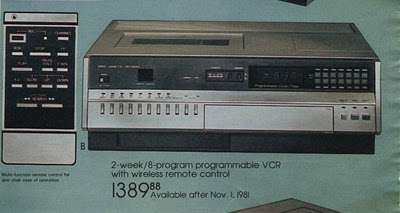
Public Enemy #1 for Content Theft circa 1981: The $1,400 VCR

Online piracy enforcement should not involve Internet Overcharging schemes, and arguments that it should only illustrate why so many consumers and public interest groups get nervous about industry-proposed enforcement mechanisms.  Too often, they ignore presumption of innocence before guilt, browbeat alleged offenders into settlements to avoid costly litigation — guilty or not, and turn over policing to an industry with a long track record of overreach to protect their business interests. The record speaks for itself:

  • Demands to ban videotape recorders in the 1970s and early 1980s for “piracy reasons”;
  • Tax cassettes and video tapes to cover alleged piracy losses in the 1980s;
  • Tax blank digital media in the 1990s because of “rampant piracy”;
  • Impose monthly “piracy recovery surcharges” on broadband users in the 2000s;

Now the industry wants to police the piracy problem on its own terms.  As before, the proposed solutions are worse than the problem.

Back to the future.  In 1981, ABC’s Nightline ran this report on the entertainment industry suing a VCR owner, retailers, and manufacturers for piracy over taping a television station with a videocassette recorder.  The concern in 1981 — technology was moving faster than copyright law could keep up.  Many of the yesterday’s players are part of today’s debate, including Universal, the company that purchased research indicting 20 percent of all Internet traffic as “illegal.” (Part 1 of 3 – 9 minutes – Courtesy WEWS-TV Cleveland, ABC News, and ‘videoholic1980s’)

Today’s piracy debate rehashes the same accusations of content theft, only the technology has changed.  One executive tells the Nightline audience he’s offended at being told the industry already earns enough.  The movie and television industry predicted calamity over the VCR more than 30 years ago, saying it would cost them billions in lost profits.  Hollywood eventually lost the argument against the VCR and their businesses turned out fine, earning billions in revenue selling videotapes of movies and television shows to consumers they were willing to sue just a few years earlier. (Part 2 of 3 – 9 minutes)

Before Washington is asked to join the panic-frenzy over online piracy, perhaps they should recall the same predictions of doom and gloom made by many of the same companies — predictions that were overstated.  Imagine if they had succeeded in banning the VCR?  Indeed, just as before, Hollywood stands to earn billions online when they make their content available for easy, legal viewing at a reasonable price.  Slapping usage limits on broadband consumers is the worst idea ever to promote legal viewing of digital content because it discourages customers from shopping for it.  (Part 3 of 3 – 4 minutes)

Time Warner Cable’s iPad ‘TV Everywhere’ App Crashes Under Heavy Demand

Phillip Dampier March 16, 2011 Online Video, Video, Wireless Broadband 1 Comment

Time Warner Cable’s new free iPad application, giving authenticated cable customers a selection of live cable channels to watch on the portable device, crashed under heavy demand last evening, hours after the company unveiled it in a mass e-mail campaign to customers.

Time Warner Cable TV for iPad is Time Warner’s first serious effort at delivering a cable TV experience to an online audience, initially streaming 31 cable channels in HD to customers who pay for both cable television and broadband from the company.

Several of the featured networks were part of earlier contract battles with the cable company. Scripps-Howard’s Food Network and HGTV are there, as is Fox’s FX and Fox News.  Some smaller “less-connected” networks like Hallmark Channel also made the cut.  Comcast-NBC’s networks also have a prominent place, including Bravo and CNBC.  All four major cable news channels are included.  Time Warner has been making a point to negotiate for on-demand and streaming rights with cable networks as part of contract negotiations.

Channel Lineup

A&E
ABC Family AMC
Animal Planet
BET
Bravo
CMT
CNBC
CNN
Comedy Central
Discovery
Disney Channel
E!
Food Network
Fox News
FX
Galavision
Hallmark Channel
HGTV
History
HLN
Lifetime Movie Network
MSNBC
MTV HD
National Geographic
Nick
Spike
SyFy
TLC
Travel Channel
USA
VH1

Requirements

  • iPad™ with iOS 4.
  • Time Warner Cable video package at the Standard (Expanded Basic) level or higher.
  • Time Warner Cable Internet Service (Road Runner® Standard or higher recommended for best experience. EarthLink® High Speed or EarthLink® Cable Max is also supported).

[flv width=”416″ height=”254″]http://www.phillipdampier.com/video/TV for iPad Time Warner Cable Ad.flv[/flv]

Time Warner Cable advertises its new iPad app for online viewing.  (15 seconds)

Time Warner Cable's new app for the iPad delivers 31 channels of live cable network viewing for free -if- you are a cable subscriber willing to watch from home.

Plenty of channels are missing though, including local broadcasters, Turner Broadcasting-owned networks like TNT and Turner Classic Movies, and sports networks.

But the most obvious limitation is that the service only works from inside of your own home, over a Time Warner Wi-Fi broadband connection.  You cannot take your viewing on-the-go.  This limitation seemed curious, considering other companies provide similar online viewing apps that can be used anywhere a wireless connection exists. 

Despite the limits, AdWeek reports several unnamed cable networks fired off warning shots yesterday to Time Warner Cable executives warning them they were streaming networks without permission.

Network legal reps are issuing a flock of heated missives to the nation’s No. 2 cable operator, calling for an immediate halt to a new service that allows subscribers to stream video content to iPads and other tablet devices. Although Time Warner Cable introduced the free app just 24 hours ago, a number of cable network groups have already made it abundantly clear that they had not signed off on any such distribution arrangement.

[…] “Distribution via any sort of third-party app is not addressed in our carriage deals with Time Warner Cable or any other operator,” said one affiliate chief. “There is going to be a messy dissection of what the rights are, but our position is that [this sort of distribution] is not authorized by our affiliate agreements.”

TWC CEO Glenn Britt has cautiously navigated the syntactic rapids, offering carefully worded assessments about the nature of the service. “Certainly all the business structures with the owners of copyrights are not fully in place, but you can begin to see a very exciting future for this set of industries and for the American consumer,” Britt said last August, after announcing plans to bow the iPad app. “There is great potential in all these devices…But it’s also a complicated process.”

Cable networks are concerned viewers who are not authenticated cable subscribers could get free access to programming from account sharing.  But considering Time Warner Cable has locked down viewing to inside the home for the time being, it is unlikely Time Warner Cable faces the same degree of wrath that could be heaped on Comcast and satellite dish TV providers who deliver apps that permit anywhere-viewing.

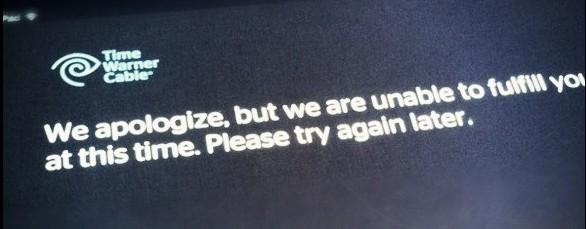
Time Warner Cable's new iPad app crashed under a heavy load last night.

The cable company’s heavy promotion of the newly-available app in mass e-mail announcements was probably a mistake, however.  The online viewing party came to a rapid end last night when the company’s servers, unprepared for the demand, ended up turning away many would-be viewers.

Jeff Simmermon, director of digital communications for the cable company, said they did not anticipate the level of demand they got last night.

“At about 8 o’clock last night the app crashed under a much heavier load than we anticipated. Our engineering team is working as hard as they can to put a fix in place and get everything up and running as soon as they can,” Simmermon wrote on Time Warner’s blog.

“For the time being, the app is running with only 15 channels. We have found that by temporarily reducing the number of available channels, we can ease strain on the authentication process. This will enable us to offer at least some sort of an experience to our customers while we get a fix in place. We’ll add the other 17 channels back in as soon as we can fix the underlying issue, and we’ll be adding more channels in future iterations of the app as well.”

[flv width=”640″ height=”380″]http://www.phillipdampier.com/video/BTIG Time Warner Cable iPad App.flv[/flv]

Rich Greenfield demonstrates Time Warner’s new iPad app.  (3 minutes)


Search This Site:

Contributions:

Recent Comments:

Your Account:

Stop the Cap!