Home » Online Video » Recent Articles:

Time Warner’s iPad App Lawsuitarama: Every Day Brings a Whole New Channel Lineup

Phillip Dampier April 12, 2011 Consumer News, Online Video 1 Comment

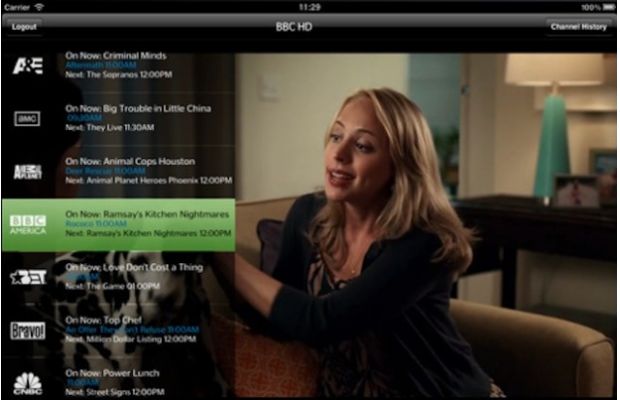
iPad Owners:  Don’t get too comfortable with the channel lineup on Time Warner Cable’s free app for watching streamed HD video of some of your favorite cable networks.  What you see today may be gone tomorrow (or replaced by something else.)

Time Warner Cable’s ongoing effort to implement their TV Everywhere-vision have run headlong into a legal quagmire as some content owners object to the new service.

Back in March when the app first appeared, the cable company was offering a few dozen channels of national cable feeds, with a heavy emphasis on news and mainstream cable networks.  But then Viacom, News Corp., and Discovery Communications protested, claiming the cable operator had not negotiated streaming rights for their networks.  Viacom and Time Warner Cable are currently suing one another over the matter.

Although some programmers use the excuse streamed video could reach “unauthorized viewers who do not have a cable subscription,” viewing restrictions imposed by Time Warner Cable makes that unlikely.  The cable operator requires viewers to watch from a Time Warner Cable Wi-Fi broadband connection.  Wi-Fi hotspots don’t work; neither does access from 3G or 4G mobile broadband networks.  The cable company says that restriction is by design.

“We believe that the location inside the home grants us the rights, provided the method of delivery is over a traditional cable network which is exactly what we’re doing,” Time Warner Cable’s Alex Dudley told NY1, Time Warner’s 24-hour news channel in New York City. “This is not programming delivered over the Internet; this is delivered over our network just like your cable television is delivered, and then to your Wi-Fi router where it reaches your iPad.”

So it is really about money.  Programmers want extra compensation from the cable company for streaming their content, and the cable company doesn’t want to pay extra.

While negotiators and the courts untangle the mess, the cable operator has been adding some channels while deleting others.  The big losers: Animal Planet, Black Entertainment Television, Country Music Television, Comedy Central, Discovery Channel, FX, MTV, National Geographic, Nickelodeon, Spike, TLC and VH1 — are all currently off the lineup.

The winners: C-SPAN, which gets all three of its channels streamed.  A variety of other “enlightened” (Time Warner Cable’s words) cable networks have given the green light to be a part of the project.  Recently added: AMC, Bio, Bloomberg, CNBC World, Chiller, Current, Disney XD, ESPN News, G4, Golf Channel, History International, HSN, IFC, Jewelry TV, Lifetime, NY1, Oxygen, QVC, Reelz, Sleuth, Soap Channel, Style, and Tru TV.  (In New York City, Galavision, History en Español, PBS Kids Sprout, and We are also included.)

For channels like Bio, Chiller, Current, and Reelz — buried in Digital Channel Siberia on the cable dial only to be found by the most ardent channel surfers — getting a prominent place on an app with just a few dozen channels competing for viewers is exposure gold.

We’ve tested the app here at STC HQ and found the picture quality and responsiveness to be excellent.  Channel changing is nearly as fast on the app as it is on our set top box — quite an accomplishment.  But the restrictions imposed by Time Warner really limit the app’s usefulness.  After all, if you want to watch television at home, why reach for an iPad when your television remote control is nearby.  But for those without digital cable boxes, or who want to wander around the house while watching, Time Warner’s app is useful, and better yet — free to those who already subscribe to cable television.


Why Verizon’s LTE/4G Network Will Never Replace Cable/DSL Broadband: Usage Caps

Lynch

Verizon’s ambitions to provide 285 million people with the option of ditching their cable or DSL broadband account for its new LTE/4G wireless network is a dream that will never come true with the company’s wireless Internet Overcharging schemes.  With a usage cap of 5-10GB per month and a premium price, only the most casual user is going to give up their landline cable or DSL service for Verizon’s wireless alternative.

Dick Lynch, executive vice president and chief technology officer at Verizon spoke highly of Verizon’s new next generation wireless network as a perfect platform to deliver broadband service to landline customers, including many of those the company sold off to Hawaiian Telcom, FairPoint Communications, or Frontier.

“[LTE] provides a real opportunity for the first time to give a fixed customer in a home, broadband service — wireless — but broadband service,” Lynch said. “In wireless, I see a great opportunity within the LTE plans we have to begin to service the customers who don’t have broadband today … They will be able to have mobile LTE and also to be able to have fixed broadband.”

Unfortunately, Verizon’s LTE network comes with usage limits and a premium price — $50 a month for 5GB or $80 a month for 10GB.  At those prices, rural America will have two bad choices — super slow 1-3Mbps DSL ($30-60) with allowances ranging from 100GB-unlimited or LTE’s 5-12Mbps (assuming the local cell tower is not overloaded with users) with a usage cap that guarantees online video will come at a per-view cost rivaling a matinee movie ticket.

Still, Verizon is likely to test market the service as a home broadband replacement, particularly in territories they no longer serve.  Verizon has done much the same thing pitching a home phone replacement product that works with their wireless network to residents of Rochester, N.Y., and the state of Connecticut, neither currently served with landlines from Verizon.

Despite the pricing and cap challenges, Deutsche Bank — one of the Wall Street players that follows Verizon — thinks the company’s DSL-replacement has merit, if:

  1. If you are a regular traveler that needs a wireless broadband service anyway;
  2. You use broadband exclusively for web browsing, e-mail, and very occasional multimedia access;
  3. You are wealthy enough not to care about the overlimit penalty.

For everyone else, sticking with traditional DSL service will continue to be the most affordable option, assuming usage caps are kept at bay.  Where available, cable broadband service from companies that serve smaller communities, including Comcast Cable, Time Warner Cable, and Cablevision, among others, will probably continue to deliver the most bang for the buck in rural America.


Netflix Canada Turns Down the Bandwidth So You Don’t Turn Down Being a Customer

Phillip Dampier March 29, 2011 Canada, Data Caps, Editorial & Site News, Online Video 3 Comments

Netflix continues to get a lesson on broadband economics from the Internet Service Providers out to scare their customers away from spending too much time watching the company’s online streaming service.  As some Canadian ISPs lowered usage caps in response to Netflix’s imminent arrival, the video streaming service just announced it was letting customers turn down the bit rate of online videos to conserve their monthly usage allowance.

Neil Hunt, Netflix Chief Product Officer, told customers about the bit rate reduction in a company blog post:

Starting today, watching movies and TV shows streaming from Netflix will use 2/3 less data on average, with minimal impact to video quality.

Now Canadians can watch 30 hours of streaming from Netflix in a month that will consume only 9 GBytes of data, well below most data caps.

We made these changes because many Canadian Internet service providers unfortunately enforce monthly caps on the total amount of data consumed.

In the past, viewing 30 hours of Netflix could consume as much as 70 GBytes, if it was all in HD, and typically about 30 GBytes. While there is some lessening of picture quality with these new settings, the experience continues to be great.

Video compression reduces data consumption, but also sacrifices video quality and enjoyment. An example of high video compression on the left can be more than noticeable.

Unfortunately for Hunt, providers can continue to lower data caps to the point where Netflix would have to present their video library as a slideshow to keep customers under their limits.

Stop the Cap! responded directly to Hunt imploring Netflix to get involved in the battle that consumers have thus far fought alone:

While some customers appreciate Netflix for turning down the video bitrates, I am here to tell you it’s not nearly enough.

For nearly three years, our consumer group — Stop the Cap! has fought Internet Overcharging schemes in both Canada and the United States.

Whether it’s Bell’s proposal to eliminate flat rate broadband across all of Canada, Time Warner’s 2009 pricing experiment to limit broadband users to just 40GB of usage per month, or AT&T’s 150-250GB cap taking effect this spring, your competitors are on a mission to scare customers away from using your online video streaming service.

[…] The fact is, Netflix MUST engage in this fight. Consumers cannot do it alone, especially when up against billion dollar companies spending millions on lobbyists trying to convince lawmakers usage caps are about “fairness” when they are really about monetizing broadband traffic and scaring off cord-cutting.

BitTorrent CEO Willing to Appease Providers for Unproven ‘Bandwidth Congestion’

Phillip Dampier March 24, 2011 Broadband "Shortage", Broadband Speed, Consumer News, Data Caps, Editorial & Site News, Online Video Comments Off on BitTorrent CEO Willing to Appease Providers for Unproven ‘Bandwidth Congestion’

BitTorrent, the company behind the popular file sharing protocol routinely blamed by providers for overburdening broadband networks and by Hollywood for distributing pirated content, took a tentative step today to oppose Internet Overcharging schemes.

Eric Klinker, CEO wrote a guest piece for GigaOM calling out AT&T for its announced 150-250GB usage caps:

While the trend toward metered bandwidth is not inherently pro-consumer, ISPs have staked out a singular public rationale: data caps are necessary to limit the consumption of “bandwidth hogs” in order to protect the network experience for everyone else. Such concepts are simplistic and easy to imagine. They are also completely wrong.

And with that, Klinker stumbled into a public relations and marketing effort defending the company’s culpability for increasing broadband traffic, and proposing a resolution for their ‘part of the problem’:

Since any data traffic that doesn’t induce congestion on a fixed cost network is essentially free; applications can voluntarily play a role in traffic prioritization. And since BitTorrent is a high percentage of global Internet traffic, we have a responsibility to be a part of the solution.

This was the primary motivator around our release of a new protocol a year ago, called µTP. The protocol essentially senses congestion and self-regulates to avoid contributing to Internet traffic jams.

Because µTP can never induce network congestion, it doesn’t contribute to an ISP’s cost. An ISP still has regular network maintenance expenses, but remember, with a fixed-cost network, traffic only becomes an economic burden if it contributes to congestion and forces the need for expansion.

As a result, µTP is exceedingly friendly to ISPs and their business model. µTP is open-source, and we invite application and cloud services providers to work with us directly or in the IETF’s LEDBAT working group in the ongoing innovation and usage.

Klinker

Some providers and their allied interest groups have disputed the diminished impact Klinker cites as a benefit of µTP, but in provider-world, the BitTorrent “problem” is rapidly becoming yesterday’s news anyway — online video is the new boogeyman.  NPD Research just released numbers showing peer-to-peer use has dropped from 16 percent of all U.S. Internet users to 9 percent over the last three years.

After making a spirited sales pitch for what he hopes will represent peer-to-peer 2.0, Klinker surrenders on behalf of everyone else, arguing the solution to America’s ‘broadband crisis’ is speed throttles during peak usage periods, and time of day pricing.  Klinker suggests broadband users might need to plan their “on-demand” viewing well ahead, or face the kind of “congestion pricing” Londoners face if they attempt a journey by car into the city center at high noon.  Klinker suggests Netflix customers should pre-schedule downloads of their movies the night before watching them, or else pay a fee for instant gratification.

That assumes, of course, you know what you want to watch the day before you do, that you can download Netflix content (you cannot), and that you didn’t remember you could accomplish the same thing if Netflix shipped the DVD out to you by U.S. Mail.

Are broadband rationing coupons far behind?

Klinker’s willingness to submit his own company’s peer to peer technology to provider speed throttles is likely to earn him a dressing down by investors wondering what the future holds for a protocol that can be dosed with Xanax at provider will.  Handing over the power to make your file sharing technology painfully slow and frustrating is likely not going to win new converts, either.

Before willing to subject everyone to solutions for broadband providers’ scary predictions of a broadband exaflood, would it not be better to actually obtain verifiable evidence there is a congestion issue in the first place?

Bell CEO: Bandwidth Usage Charges Are About Monetizing Video Traffic for Shareholders

Cope

In another example of providers telling the public (and lawmakers) one thing, while saying something very different to their own shareholders, Bell Canada’s CEO made a remarkable admission about why the company imposes Internet Overcharging schemes on its customers:

“As we see a growth in video usage on the Internet, making sure we’re monetizing that for our shareholders through the bandwidth usage charges,” CEO George Cope told listeners in a financial conference call last autumn.

That is a far cry from the story Mirko Bibic, Bell’s government affairs representative tells to anyone who will listen. Michael Geist, a Canadian syndicated columnist on technology law issues notes Bibic has told a different tale while appearing before Parliament’s Standing Committee on Industry to answer questions on usage based billing held in February.

For Bibic, usage-based billing is about “fairness” and solving alleged congestion issues.

“As for small businesses, which are generally on the same network as residential users, what you have is really a case where the congestion during peak periods is largely a residential phenomenon. It’s in that area that we’ve addressed the usage-based billing issue, and all we’re asking the CRTC for is to follow a fundamental principle of fairness,” Bibic told MPs. “If we asked 97% or 98% of Canadians if they would be prepared to pay more so that the 2% of heaviest users pay less, I’m pretty sure of what the answer would be.”

Bibic

Bibic’s argument has been repeatedly undercut by his own bosses, Geist notes.

In August, Cope told shareholders “our data revenue growth was 3.8% for our Residential Services business, particularly driven through an increase in Internet ARPU of 3.3%. And interesting, almost all that increase now coming from usage based billing as the demand for Internet use explodes through the use of video services, and we’re continuing to see an increase in the revenue per customer.”

By November, Cope was turning Bibic’s bandwidth “fairness and congestion” lemons into lemonade, celebrating data revenue growth of 5 percent, “driven principally by the bandwidth usage revenue being up 83% year-over-year.”

Cope not only decapitates his company’s arguments for usage-based billing, he also shines the light on who they will impact: if providers are to be believed that usage caps will only affect a tiny percentage of customers, how can data revenue be up a whopping 83 percent year-over-year. Are a handful of Canada’s “heavy” broadband users responsible for this growth, or are an increasing number of Canadian consumers finding themselves over the “generous” limits Bell has established because they used their broadband connections to stream movies and television shows.

As Geist notes, “no one should be under the illusion that UBB is anything other than a revenue maximization strategy in a market with limited competition, not one premised on fairness or network congestion.”

Search This Site:

Contributions:

Recent Comments:

Your Account:

Stop the Cap!