Home » Online Video » Recent Articles:

New Tenn. Law: Spend a Year In Jail If You Share a Netflix/Rhapsody Account With Friends & Family

Phillip Dampier June 2, 2011 Consumer News, Online Video, Public Policy & Gov't Comments Off on New Tenn. Law: Spend a Year In Jail If You Share a Netflix/Rhapsody Account With Friends & Family

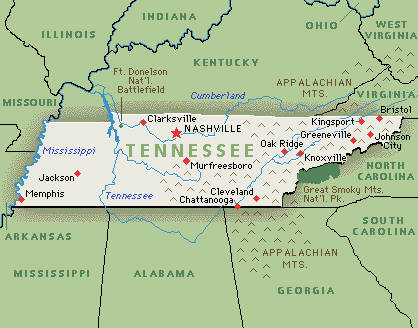
Sharing your Netflix account with your spouse or your son at college? Under a new Tennessee law, both you and the other party could spend up to a year in jail for “theft of entertainment services” if Netflix, or any other entertainment service says that is not okay.

Eyebrows were raised in Tennessee this week as Republican Gov. Bill Haslam admitted he signed the new copyright protection bill into law while telling reporters “he wasn’t familiar with the details of the legislation.”

Rep. Gerald McCormick (R-Chattanooga), who worked last summer to completely deregulate AT&T’s phone service in Tennessee spent this spring pushing for adoption of a bill sponsored by Nashville record labels to up-end state copyright law in favor of content producers.

The entertainment industry, having failed to win wholesale support of its copyright protection agenda in Congress has now taken to lobbying individual statehouses for new state copyright laws.  Tennessee is the first among 50 states to extend its long-standing cable-TV theft statute to include content over the Internet.

Under the law, anyone other than the account owner who uses their account name and password, even with permission, is a violator and subject to a criminal misdemeanor charge punishable by up to a year in jail and a fine of $2,500. If the username and password opens access to content collectively worth more than $500, the charge becomes a felony with correspondingly harsher penalites and fines.

Some reporters questioned whether the law could mean sharing your Netflix, iTunes or Rhapsody account with an immediate family member meant you were breaking the law.  The answer is, you might, although bill supporters doubt it would be prosecuted.

“What becomes not legal is if you send your user name and password to all your friends so they can get free subscriptions,” McCormick told the Associated Press.

Currently, most online content providers don’t have a problem with immediate family members sharing accounts.  Netflix allows at least two concurrent video streams of its online content.  Music services often recognize three or more “authorized devices” on which content can be shared and accessed.

But if attitudes change, content providers can file complaints when they realize their service is being accessed by multiple parties at the same time or in multiple places.

"Gerald McCormick will support anything if you staple a big check to your cover letter."

The music industry in Nashville openly admits it strongly advocated for passage of the bill, claiming the music business loses millions from account sharing.  But critics of the new law attack it as overly broad.  One defense lawyer suggested it is so broad, it could be used to prosecute people who share magazines.

Proving a case to hard-working law enforcement officials could also present a problem says Jeff Polock, a Knoxville-based law enforcement and consumer advocate.

“We have enough trouble fighting crime on the streets,” Polock tells Stop the Cap! “While law enforcement officials appreciate the dilemma of copyright theft, many officers are not going to be technically skilled in building a case over who shared what password in the dorms at the University of Tennessee.”

Polock suspects the new law will be wielded against larger wholesale copyright offenses, if only to avoid the threat of negative publicity.

“Can you imagine what the local evening news would do if they arrested some father in Chattanooga for sharing his iTunes account with his daughter at school here in Knoxville?,” Polock wonders.  “It’s not like these people are downloading stolen copies of content they are not paying for — they are running a single iTunes account so the parents can monitor what their kids are buying, watching, or listening to while away from home.”

As for McCormick, Polock has choice words.

“Gerald McCormick will support anything if you staple a big check to your cover letter,” Polock says. “The man is never too far away from corporate interests trying to win favorable legislation in the state legislature.”

MetroPCS’ Nasty Terms of Use: ‘We May Not Provide You a Meaningful Data Experience’

Phillip Dampier May 25, 2011 Consumer News, Data Caps, MetroPCS, Net Neutrality, Online Video, Wireless Broadband Comments Off on MetroPCS’ Nasty Terms of Use: ‘We May Not Provide You a Meaningful Data Experience’

Unlimiting the ways a cell phone company can limit your service.

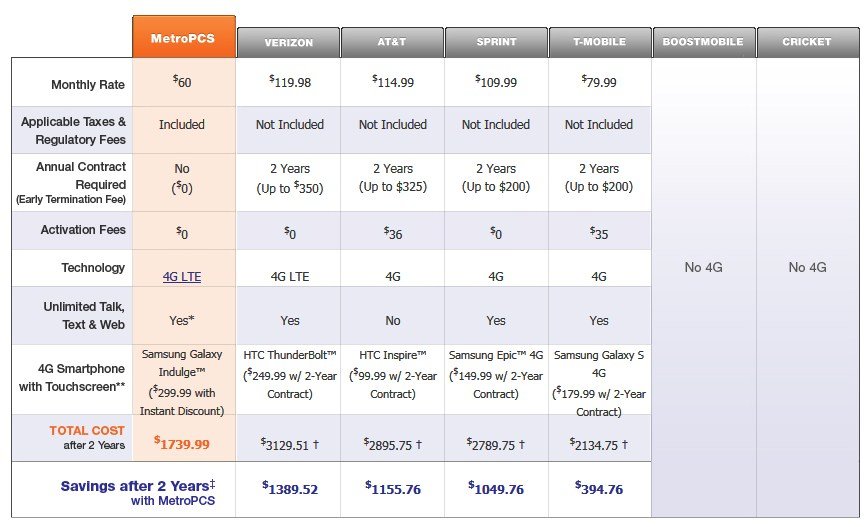
MetroPCS pitches its 4G/LTE plans to customers looking to save money over the bigger players in the marketplace.  The upstart provider, based in Richardson, Texas, serves just over a dozen major metropolitan areas with no-contract plans that deliver lower prices in return for smaller coverage areas.  As larger providers heavily sell their “next generation 4G” networks, MetroPCS has also been promoting their own “unlimited talk, text, and web” 4G/LTE plan that offers an “unlimited” experience for $60 a month.  But there is a catch, only revealed when customers click the fine print link that opens the Terms of Use.  The document is a poster child for Net Neutrality, because it allows the company to block, throttle, prioritize, alter, or inspect any web content.

Here is what MetroPCS advertises:

Here is a selection of the Terms and Conditions which tarnish a great sounding deal (underlining ours):

You acknowledge and agree that the Internet contains Data Content which, without alteration, will or may not be available, or may not be providable to you in a way to allow a meaningful experience, on a wireless handset.

You acknowledge and agree that such alteration that MetroPCS may or will perform on your behalf as your agent may include our use of Data Content traffic management or shaping techniques such as, but not limited to delaying or controlling the speeds at which Data Content is delivered, reformatting the Data Content, compressing the Data Content, prioritizing traffic on MetroPCS’ network, and placing restrictions on the amount of Data Content made available based on the Agreement. You further acknowledge that MetroPCS may not be able to alter such Data Content for you merely by reference to the Internet address and therefore acknowledge and agree that MetroPCS may examine, including, but not limited to Shallow (or Stateful) Packet Inspection and Deep Packet Inspection, the Data Content requested by you while using the MetroWEB Service to determine how best to alter such Data Content prior to providing it to you.

If we notice excessive data traffic coming from your phone, we reserve the right to suspend, reduce the speed of, or terminate your MetroWEB Service. In addition, to provide a good experience for the majority of our customers and minimize capacity issues and degradation in network performance, we may take measures including temporarily reducing data throughput for a subset of customers who use a disproportionate amount of bandwidth; if your web and data Service Plan usage is predominantly off-portal or otherwise not provided by MetroPCS during a billing cycle, we may reduce your data speed, without notice, for the remainder of that billing cycle. We may also suspend, terminate, or restrict your data session, or MetroWEB Service if you use MetroWEB Service in a manner that interferes with other customers’ service, our ability to allocate network capacity among customers, or that otherwise may degrade service quality for other customers.

MetroPCS also wants customers to know their service is not intended as a home broadband replacement, and states it is only to be used for basic web services, including e-mail and web browsing and downloading of legitimate audio content.  Video streaming is naughty.

AT&T Action Plan: Strategies to Avoid Being Overcharged by AT&T’s Overlimit Fees

Stop the Cap! reader Cal believes AT&T cannot be reasoned with about Internet Overcharging until you threaten to cancel.

While a significant number of customers have already pulled the plug on AT&T DSL and U-verse service over their recently-introduced Internet Overcharging schemes, some are telling Stop the Cap! they have no plans to actually disconnect service until AT&T threatens to charge them overlimit fees.

For some AT&T customers, there is no suitable alternative to the phone company.  Rural customers without a cable provider, or those who are faced with two bad choices — AT&T or Charter Communications — say they are going to test AT&T’s resolve to actually overbill them.

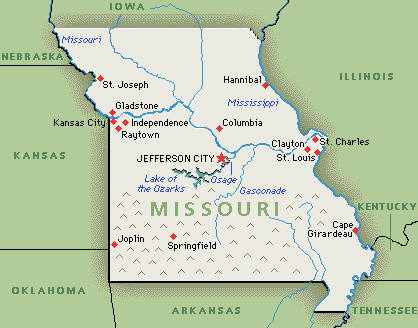
Cal is an AT&T customer is Missouri.  His alternative?  Charter Cable, which has an Internet Overcharging scheme of its own and delivers what he calls “third world service” in his community.  Given a choice, he intends to stay with AT&T as long as possible, pulling the plug only after his third warning of exceeding the phone company’s new broadband usage limits.  He thinks AT&T’s customer service won’t ultimately let it come to that.

“My sister works for an AT&T call center where she lives, and there was some training on the subject of handling the company’s usage caps,” Cal reports. “Get the right representative or supervisor and they can make virtually anything go away with a few keystrokes, especially if you are prepared to cancel your service over the issue.  While they may not cancel the caps, they very well may credit back any overcharges.”

Cal says his family does not intend to change their usage habits one bit.  He’ll change providers before he rations his Internet usage.

“I maintain control over our Internet access here, they don’t and sure as hell won’t,” he said.  “We do not do illegal downloads and we don’t allow torrenting or anything else that can get my kids into trouble, but we do use a Roku box and watch Netflix instead of buying pay movie channels with programming not suitable for my family to watch.”

Cal says his five children are home-schooled, which makes daily Internet access an essential part of the education process.  Many companies that provide home-schooling materials increasingly require a broadband connection.  While not as bandwidth hungry as Netflix video streaming, with five children in the home, usage adds up fast.

“It is not hard to do 260GB of usage a month, which puts us just over their U-verse limit, and I’ll be damned if I am going to pay AT&T another $10 for 10GB over,” Cal says.  “This is another reason why the Obama Administration is no better than the last one — they are all masters of big corporations who will rob us blind and use the money to pay off Congress to look the other way.”

Cal used to be a Charter Cable customer, but left when that company implemented its own Internet Overcharging scheme.

“I told Charter with their lousy service they were lucky I was a customer, but after putting usage limits on, I left,” he reports.

Cal’s neighbor thinks he has an even better way to battle AT&T.

“My neighbor will cancel service under his name and sign up under his wife’s and bounce between them whenever AT&T threatens to send him a bigger bill; he has already been doing that for years back and forth between AT&T and Charter on new customer deals,” Cal says.

Cal, and many other readers touching base with us, believe AT&T is not very responsive to customer complaints unless customers threaten to cancel service, and they believe AT&T will only change its mind when shareholders see the usage limits as counterproductive.

“AT&T can buy enough people in Washington to make street protests irrelevant, but their shareholders sure won’t like it when they see customers and revenue dropping,” Cal notes.  “If you can’t get cable, you are stuck with AT&T, so you have to keep the pressure on — file complaints with the Better Business Bureau, the FCC, and Congress.  Make them spend more money defending their policy than they earn from its proceeds.”

Understanding Customer Defections: The Value Perception of Cable Television

Phillip Dampier May 5, 2011 Competition, Consumer News, Data Caps, Online Video 2 Comments

Click to enlarge

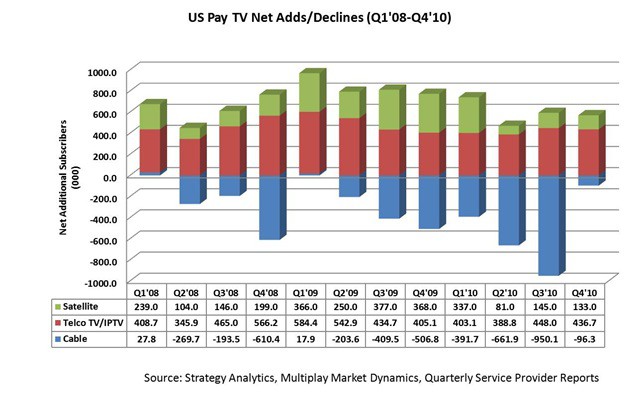
Your cable company has a problem.  Collectively, the cable industry has lost more than 2 million video customers over the past year, and the problem may be getting worse.  Some of the largest cable companies in the United States are making excuses for the historic losses:

  • The bad economy
  • Housing and foreclosure crisis
  • High unemployment
  • Family budget-cutting

But cable companies should be rethinking their excuses, according to a new report from Strategy Analytics.

“Throughout the past seven consecutive quarters of subscriber losses, the inclination of cable has been to point the finger at various external factors,” said Ben Piper, Director of the Strategy Analytics Multiplay Market Dynamics service. “Our analysis shows that neither the economy nor the housing market is to blame for these subscriber defections. The problem is one of value perception.”

Value perception.  That’s a measurement of whether or not one feels they are getting good value for the money they pay for a product or service.  Value comes in several different forms, starting with emotional — do I feel good, safe, secure, or nostalgic using the service?  Can I imagine life without it?  What about my friends and family — will I stand out if I am not buying this product?  It’s also practical — Can I afford this?  Can I find a cheaper or better alternative?  Do I really need this service anymore?

Tied into value perception is customer goodwill.  If you have an excellent experience with a company, letting go of their products comes much harder.  If you feel forced to deal with a company that has delivered poor and expensive service for years, pent up frustration will make it much easier (and satisfying) to cut them loose at the first opportunity.

Embarq used to be Sprint's pathway to prosperity in the local landline business, until cord cutting put landlines into a death spiral.

In the telecommunications industry, value perception is a proven fact of life.  It began with phone companies.  Formerly a monopoly, landline providers have been forced to try and reinvent themselves and become more customer-friendly.  First long distance companies like Sprint and MCI moved in to deliver cheaper (and often better quality) long distance service.  Sprint even got into the landline business themselves, forming EMBARQ, which at its peak was the largest independent phone company in the United States.  When Voice Over IP providers like Vonage and the cable industry’s “digital phone” products arrived, they promised phone bills cut in half, and introduced the concept of unlimited long distance calling.

The value perception among consumers became clear as they began disconnecting their landlines.  The alternative providers offered cheaper, unlimited calling services, often bundled with phone features the local phone company charged considerably more to receive.  Even though VOIP is technically inferior in call quality in many instances, the value the services provided made the decision to cut the phone cord easier.

But local phone company landline losses would only accelerate with the ubiquity of the cell phone, but for different reasons.  What began with high per-minute charges for wireless calls evolved into larger packages of calling allowances, with plenty of free minutes during nights and weekends, and often free calling to those called the most.  Most Americans end the month with unused calling minutes.  As smartphones gradually take a larger share of the cell phone market, the accompanying higher bills have forced a value perception of a different kind — ‘I can’t afford to keep my landline –and– my cell phone, so I’ll disconnect the landline.’

The cable industry has traditionally faced fewer competitive threats and regularly alienates a considerable number of customers, but still keep their business despite annual rate increases and unwanted channels shoveled into ever-growing packages few people want.

This pent up frustration with the cable company has led to perennial calls for additional competition.  That originally came from satellite television, which involved hardware customers didn’t necessarily like, and no option for a triple play package of phone and broadband service.  The cable industry offers both, and by effectively repricing their products to discourage defections from bundled packages, customers soon discovered the resulting savings from satellite TV were often less than toughing it out with the cable company.

As a result, satellite television has never achieved a share of more than 1/3rd of the video market.  Many satellite customers are in non-cable areas, signed up because of a deeply discounted price promotion, were annoyed with the cable company, or didn’t care about the availability of broadband or phone service.  When the price promotion ends or technical issues arise, many customers switch back to cable.

More recently, researchers like Strategy Analytics have discovered some potential game-changers in the paid video marketplace:

  • The impact of broadband-delivered video content
  • The Redbox phenomena
  • Competition from Telco TV
  • The digital television conversion

Strategy Analytics studied consumer perceptions and found customers braver than ever before about their plans to cut cable’s cord.  According to the consumers surveyed, nobody scores lower in value perception than cable companies.  Citing “low value for money,” over half of the cable subscribers surveyed told the research firm they intended to disconnect their cable TV package in the near future.

While other researchers dismiss those high numbers as bravado, there are clear warnings for the industry.

“Much ink has been spilled on the topic of cord cutting and even skeptics are now admitting that it can’t be ignored,” said Piper.

Indeed, Craig Moffett, an analyst with Sanford Bernstein who almost never says a discouraging word about his beloved cable industry, told Ad Age Mediaworks the issue of cord-cutting was real.

“It’s hard to pretend that cord cutting simply isn’t happening,” Moffett said.

Craig E. Moffett, perennial cable stock booster, even admits cord-cutting is real.

The most dramatic impact on the cable industry has been in the ongoing erosion of the number of premium channel subscribers, those willing to pay up to $14 a month for HBO, Cinemax, Showtime, or Starz!.  The reason?  Low value for money.  As HBO loses subscribers, Netflix and Redbox gain many of them.  Netflix still delivers a considerable number of movies by mail, but has an increasingly large library of instant viewing options over broadband connections.  Strategically placed Redbox kiosks deliver a convenient, and budget-minded alternative.

The loss of real wage growth, the housing collapse, and the down-turned economy do put pricing pressures on the industry, but some cable executives hope the time-honored tradition of customers howling about rate increases without ever actually dropping cable service continues.

But as new platforms emerge, some delivering actual pricing competition to the cable TV package, increasing numbers of customers are willing to take their video business somewhere else.  Some are stopped at the last minute with a heavily discounted customer retention pricing package, but that doesn’t keep them from sampling alternative online video options.  Among those who actually do leave, some are satisfied with the increased number of channels they get for free over-the-air after America’s digital television conversion.

Many others are switching to new offerings from telephone companies.  Both AT&T and Verizon deliver video packages to many of their customers, often at introductory prices dramatically lower than their current cable TV bill.  When considering a bill for $160 for phone, video, and broadband from the cable company or $99 for the same services from the phone company, $60 a month in savings for the first year or two is quite a value perception, and the inevitable disconnect order is placed with the cable company.

Ad Age‘s own survey, more skeptical about cord-cutting, confirmed that many former cable TV customers left for budgetary reasons, but many also kept their triple play packages.  They just bought them from someone else.

Also confirmed: a dramatic upswing in online viewing, sometimes paid but often ad-supported or free.

Strategy Analysts concludes in its report, available for $1,999, that the ongoing erosion of cable TV subscribers isn’t irreversible, but it requires urgency among providers to become more customer-friendly and increase the all-important value perception.

In other words: respecting the needs and wishes of your customers.

Thankfully, the cable industry is dealing with competitors like AT&T, who are willing to assassinate their current lead in value perception by slapping Internet Overcharging pricing schemes on their broadband service.  That will certainly raise the ire of their DSL and U-verse customers, many who are treating the customer unfriendly usage limits as an invitation to leave.  Their former cable companies are waiting to welcome them back.  The real question remains, will cable customers now be treated better?

Shaw Increases Broadband Speeds You Can’t Use For Long Because of Data Caps

Phillip Dampier April 20, 2011 Broadband Speed, Canada, Data Caps, Online Video, Public Policy & Gov't, Shaw Comments Off on Shaw Increases Broadband Speeds You Can’t Use For Long Because of Data Caps

Shaw Communications today announced they are boosting speeds on one of their popular broadband tiers — Shaw Extreme, from 15/1Mbps to 25/2.5Mbps.  The current price for the Extreme plan remains the same.  So does the monthly usage limit of 100GB.

Customers appreciate the faster speed, but are not impressed Shaw has continued to limit customers to how much service they can use.

“Now I can hit my 100GB usage cap that much faster,” shares Shaw customer Dan Peek, who lives in Calgary.  “Shaw just completed dozens of listening tours, but they are obviously not listening at all.  What good are the faster speeds when you are effectively limited from using your broadband account to full advantage?”

Shaw claims the new broadband speeds are part of an effort to unveil new Internet packaging anticipated for early summer.

“It’s an exciting time at Shaw as we begin to create a world-class Internet product, giving our customers the ultimate experience in connectivity and entertainment,” said Peter Bissonnette, President, Shaw Communications Inc. “The Shaw Extreme speed upgrade is just the first spark of a whole new world of entertainment and offerings to come. We’re building the network of the future and our customers are at the very heart of it.”

Shaw also plans to introduce new equipment options, including a new box that will allow customers to access files stored on personal computers on their television set.  Shaw’s efforts suggest the company recognizes customers are increasingly interested in accessing multimedia content with their broadband connections.  Unfortunately, the company’s usage caps preclude customers from doing more than dabbling.

“It’s a PR effort made for the Canadian government and the Canadian Radio-television and Telecommunications Commission,” offers Peek.  “This summer they will be in Ottawa promoting their new broadband speeds as evidence the Canadian ISPs are not the backwater players they’ve always been, all while hoping their usage-based billing schemes will get a pass.”

Peek suggests broadband speed is not Canada’s biggest broadband challenge — the usage caps are.

“If you asked most Canadians if they would prefer 10Mbps service with no cap or 20Mbps service with caps starting at 40GB per month, people will take the slower speed,” Peek says.  “Shaw doesn’t seem to understand that basic message.”

Shaw's usage billing shark is still circling western Canada. The company may have increased speeds, but their 100GB usage cap on the Extreme tier remains.

Shaw’s listening tour across western Canada brought “summaries” from company officials that are being criticized by several Shaw customers who were at the meetings.

“I was at one of the Calgary meetings and the “summary” that showed up after the fact was the work of one of Shaw’s marketing hacks,” says Steve, a Stop the Cap! reader.  “The one thing they left out of the summary is the fact we do not want these caps and that they are not justified by the facts.”

Steve claims Shaw left customer demands for the end of usage caps out of their summaries, even though many customers brought up how much they hated usage-based billing and caps.  But there was plenty of room for customers who asked, “why should low usage customers pay for usage,” something Shaw’s customers in fact don’t do.  Another frequent meme from Shaw — “[customers] rejected the idea of subsidizing high bandwidth consumers.”

“That’s Shaw propaganda designed to fix a pre-determined conclusion around their distorted facts,” Steve says.  “The company presented charts and graphs with their world view and asked customers to comment on them in a focus group-like setting.  If you didn’t know those ‘facts’ were actually company ‘positions,’ you end up debating their numbers on their terms.”

Steve thinks Shaw’s version of “fair” is unique to Canada and would never be accepted in the United States.

“When you have media types parroting Shaw’s claim that practically nobody exceeds their usage limits, it quickly allows the cable company to claim heavy users are abusing the system, necessitating the caps,” Steve says.  “Now that Netflix is here, we’re all going to be heavy users now.”

Marie from Burnaby, B.C. confirmed Shaw’s new Extreme speeds were active as of this evening, noting speed test results of 20Mbps downstream and just over 2Mbps upstream once she reset her cable modem.  But she considers it of little value because of the usage cap.

“This will help our family when we’re all sharing the connection after school and at night, but since the 100GB cap remains unchanged, those faster speeds invite more usage, which will also eventually bring a higher bill,” she writes.

Search This Site:

Contributions:

Recent Comments:

Your Account:

Stop the Cap!