Hulu has received an unsolicited, and still private offer to buy the company lock, stock, and barrel — disengaging some of America’s largest television networks from the online streaming business Hulu represents.
With an offer in hand, Hulu’s owners News Corp., Walt Disney, and Comcast/NBC have decided to hire investment bankers to solicit any competing offers for the service. Yahoo! may be one of the companies interested.
Hulu has always represented an irritation for program buyers — notably cable networks and television stations — that purchase programming to rerun on cable networks and television stations. Because Hulu gives away most of its content for free, these buyers argue it devalues the programming they are buying.
In short, if everyone has already been able to watch 30 Rock several times online, for free, why pay top dollar to buy the series to show on a local television station?
The problem is even worse from the perspective of cable, phone, and satellite companies in the business of selling video packages to customers. As soon as viewers discover they can watch all of their favorite shows online, again for free, why buy the cable TV or satellite package?
The Los Angeles Timesreports Hulu may have some bad news in store for cord cutters: it may implement its own “authentication” system that would only allow instant access to those with a verified subscription to a pay television package. All others would need to wait just over a week before they can watch popular shows during a limited viewing window.
For many analysts, that will slash the service’s net worth to a would-be buyer. So would the inability of the new owners to win long-term contracts for the rights to keep popular series and shows on Hulu for the indefinite future. In the case of Comcast/NBC, it’s a classic case of being torn between bringing your programming to more viewers and eroding away your company’s own cable subscriber base.
[flv width=”360″ height=”290″]http://www.phillipdampier.com/video/Bloomberg Olson Says Yahoo Google Amazon Potential Hulu Buyers 6-22-11.mp4[/flv]
Bloomberg News reports on rumors Yahoo!, Google, and Amazon may be interested in acquiring Hulu. (5 minutes)
Unless Canada deregulates the media industry further, a “technological storm” by “audiovisual Wal-Marts” will harm or destroy Canada’s media companies. No doubt looking directly at Netflix, those were the views of Quebecor CEO Pierre Karl Peladeau at the outset of hearings held this week by the Canadian Radio-television and Telecommunications Commission on media ownership and vertical integration issues.
Canada’s media landscape is rapidly consolidating at a rate that will allow even ordinary Canadians with a passing interest in the issue to recognize the handful of remaining media moguls and identify them by name. Phone companies that own major Canadian television networks, cable operators that own cell phone companies, and mergers among the dwindling pack have left consumers soaking in Shaw, Rogers, Bell, and Quebecor — whether they flip on their televisions, make a cell phone call, read a newspaper, or download something from the Internet. Talk about vertical integration! Now the supersized are back for more deregulation so they can trade programming rights between themselves, fend off the devil — Netflix, and of course continue to buy each other out.
There is one exception, of course. Allowing party crashers. While all of the incumbent players want the rules loosened up on their respective media and telecommunications operations, they are hellbent on keeping foreign competition out of Canada — the only real deep pockets sufficient to break up a convenient cartel of phone and cable companies. Rogers and Shaw stay on their respective sides of a line dividing eastern Canada’s turf for Rogers and western Canada’s territory for Shaw. Bell and Telus do much the same. Quebecor provides cable for Quebec, and a handful of much smaller players fight for any remaining crumbs.
For Americans, it would be the equivalent of turning over your telephone, broadband, cable, television, newspapers, magazines, and radio stations to Rupert Murdoch or ex-media baron Ted Turner.
For Canadians, these hearings come just a tad too late. Shaw Communications is absorbing their latest buyout — Canwest Media’s TV assets, which are hardly meager. Shaw will run more than two dozen local broadcast TV outlets, 30 cable and satellite networks, and Global — a major broadcast network. Bell is still popping Rolaids over its digestion of the enormous CTV and smaller upstart A-Channel network. When it’s finished, “A” will become “CTV Two.”
The Globe and Mailnotes between them, Bell, Shaw, Rogers and Quebecor control:
86 per cent of cable and satellite distribution;
70 per cent of wireless revenues;
63 per cent of the wired telephone market;
49 per cent of Internet Service Provider revenues;
42 per cent of radio;
40 per cent of the television universe;
19 per cent of the newspaper and magazine markets;
60 per cent of total revenues from all of the above media sectors combined.
As far as growth goes, as Alan Keyes used to proclaim, “that’s geometric!”
But it’s still not enough now that Netflix has arrived in Canada. Despite the fact the operation has been challenged by punitive usage caps restricting viewing (or lowering its video quality), Netflix and new technology companies like it are the 21st century boogeymen for these multi-billion dollar media corporations. The only way to defend against it? Deregulate to allow them to trade viewing rights, grow larger, and charge whatever they like. Somehow that seems to miss the point: Netflix is popular because it costs less, allows people to stream the shows they actually want to watch at a time of their choosing, and let’s families drop some overpriced premium channels and video rental fees along the way.
Bell’s dollar-a-holler researcher expanded on why large media conglomerates miss the point, even if he did so unintentionally.
According to University of Alberta economics professor, Jeffrey Church, “vertical integration is beneficial for consumers.” Sit down as you read why:
it reflects efficiencies, spurs competitive innovation and is a global trend;
telecom, media and Internet markets in Canada are “highly competitive;”
our ‘small media economy’ needs a few deep-pocketed national champions to compete globally and invest heavily in innovation at home;
instances of harm are mostly imaginary and few and far between;
it helps keep “consumers . . . within the regulated system” (Shaw’s submission, p. 4).
This week, the tech community has been buzzing over new entrants in the world of cloud computing. Apple’s iCloud in particular has sparked enormous media coverage as the company plans to encourage customers to access all of their favorite content over their broadband connection. Apple is also moving towards online distribution of many of its software products, including the forthcoming OS X Lion operating system, suggesting consumers can pass up traditional physical media like CD-ROMs or DVDs.
Cloud storage theoretically allows you to store your entire music, video and photo collection online for easy access from any device. Watching the 20-somethings buzz about 100GB+ secure file lockers and the end of traditional file storage as we know it has been amusing, but these people need to get their heads out of the clouds. Unless they become politically involved in America’s broadband debate, it is not going to happen the way they hope it will.
Tech entrepreneur? Meet broadband provider reality check: the Internet Overcharging usage cap and “excessive use” pricing scheme.
While Steve Jobs was introducing iCloud, broadband providers and their industry friends have been ruminating over the impact all of this new traffic will have on their broadband networks. In an homage to former AT&T CEO Ed Whitacre’s “you can’t use my pipes for free,” the drumbeat for implementing “control measures” for cloud computing and video traffic has been amplified several times over by certain providers, Wall Street analysts, and their trade press and equipment supplier lackeys.
One alarmed provider pondered the impact of iCloud in terms of their past experience with iTunes, which also spiked traffic when it was first released. Others balk at the notion of consumers using broadband platforms to move entire libraries of content back and forth, especially on wireless networks. The only sigh of relief detected? Apple won’t start iCloud with video content — just music, at least at first.
The enemies list
The biggest targets — the companies that get a lot of pushback from providers for using “their networks” to earn millions for themselves are Google, Netflix, Amazon and Apple. Each of them are rapidly moving into the online entertainment business, threatening to provoke more cable TV cord-cutting. Netflix is now responsible for 30 percent of online traffic during primetime hours, a fact that some use as an accusation — as if Netflix should be held to account for its own success. Amazon has opened its own cloud based music storage and is also increasingly getting into online video content streaming. Apple has a novel approach at handling its forthcoming iCloud music feature which should save hours in uploading, but the company is also moving towards online distribution of a growing proportion of its software, including the huge bug fixes and upgrades that will easily exceed a gigabyte if you own several Apple products.
Google is a frequent Washington target and honestly delivers the only truly effective corporate pushback to anti-consumer broadband pricing some providers have contemplated. In fact, Google is putting its money where its mouth is building a gigabit network larger providers repeatedly scoff at as unnecessary, too costly, and too complicated.
While millions in venture capital funds new online innovations, only a miniscule amount of money is being spent to counter the lobbying major providers are doing in Washington to redefine the broadband revolution in their terms, complete with usage pricing that bears no relation to cost, arbitrary usage limits, and ongoing lack of true competition.
Online innovation is grand, but allowing providers to strangle it with Internet Overcharging schemes guarantees to end the party real fast.
Individually, none of the new cloud services are likely to blow out usage caps in excess of 100GB, but in combination they certainly could. Anyone using online file backup, cloud storage of video and large music collections, uses Netflix or other online streaming services, and spends lots of time on the web will easily approach the limits some providers have established. That doesn’t even include large software updates. Unless you have an unlimited usage plan on the wireless side, don’t even think about using most of these services with AT&T’s 2GB monthly wireless usage cap.
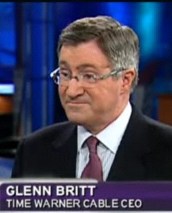
Glenn Britt: The Internet is a utility which is why we can keep raising the price.
In the handful of countries with ubiquitous Internet Overcharging, little of this will pose a problem — companies won’t launch cloud computing services in markets where usage caps will effectively keep customers from using them.
That is why it is critical for some of America’s largest technology companies to get on board the fight against Internet Overcharging, and demand Washington recognize broadband as a utility service that should be wide open and usage cap free. The evidence is right in front of you. Time Warner Cable CEO Glenn Britt recognizes the fact broadband is an essential part of our lives today, which is why he is confident enough to keep raising the price and charging even more in the future. It’s not about “network congestion,” “building the next generation of broadband,” or “pricing fairness.” Stop the Cap! started at ground zero for Time Warner Cable’s 2009 version of “pricing fairness” — $150 a month for an unlimited use broadband account that likely cost major providers less than $10 a month to provide. It’s about pure, naked profiteering, unchecked by free market competition in today’s broadband duopoly.
Unless a company like Google can vastly expand its own broadband rollouts, it is increasingly apparent to me (and many others), we may have to move towards an entirely different model for broadband in the United States — one built on the premise of the Interstate Highway System. One advanced, publicly-owned fiber network open to all providers on which telecommunications services can travel to homes and businesses from coast to coast.
Nobody says private companies shouldn’t be able to compete, but every day more evidence arrives they will never be inclined to deliver the next generation of service that other countries around the world are starting to take for granted. They will instead protect their current business models at all costs, even if that means throwing America’s broadband innovation revolution under the bus.
[flv width=”640″ height=”380″]http://www.phillipdampier.com/video/CNN Will iCloud Measure Up 6-7-11.flv[/flv]
CNN takes a look at what makes Apple’s iCloud service different from competitors from Google and Amazon. (5 minutes)
More than halfway into Glenn Britt’s appearance last week at a Wall Street-sponsored investor event, the head of the nation’s second largest cable company candidly admitted years of price hiking is finally driving a growing segment of America’s hard-pressed middle class out of the market:
“There is a segment of our economy that should be of concern. We have a bifurcating economy where people who are college educated and like everybody in this room are doing okay. For that segment, pay TV [pricing] is fine. There is another group of people who are sort of falling out of the middle class. For some of those people, pay TV is too expensive.”
That’s a remarkable admission from a cable company that has consistently raised prices for its products well in excess of inflation for at least a decade, and judging from the rest of his comments, there is plenty more of the same on the way.
Britt is nearing his 10th anniversary as CEO of what is now Time Warner Cable, formerly a division of AOL/Time-Warner. In the past decade, the company he oversees has undergone a transformation in its business model. In 2001, digital cable was all the rage, delivering the 500-channel television universe at the cost of rapidly increasing cable bills. Cable broadband was just coming back from the dot.com crash, with many Americans still mystified by the concept of “www” and whether a web address had a “/” or a “\” in it.
Time Warner Cable CEO Glenn Britt tells Wall Street investors at the Sanford Bernstein conference the company is using their customers’ addiction to high speed broadband as leverage for rate increases — three in the last three years. Britt’s world view for Internet Overcharging schemes like consumption billing are reinforced in a room where ordinary customers aren’t invited and the Wall Street types in attendance dream about the enormous profits such pricing would bring. June 1, 2011. (6 minutes)
You must remain on this page to hear the clip, or you can download the clip and listen later.
Today, broadband is threatening to become the cable industry’s most important product — one that Americans will crawl through broken glass to buy. In larger cities, the competitive war between DSL and cable broadband has been settled and DSL lost. That has brought Time Warner a steady stream of customers departing their local phone company and bringing their telecommunications business with them. Even during the economic downturn, Britt notes, one of the last products people will agree to give up is their broadband Internet access.
“Broadband is becoming more and more central to people’s lives,” Britt said. “It is becoming our primary product. People are telling us that if they were down to their last dollar, they’d drop broadband last.”
Britt openly tells investors Time Warner Cable will take that last dollar, and many more.
“We are able to raise prices,” Britt notes. “As broadband becomes a utility, you can charge more. So after a dozen years of not raising prices for broadband service, for the last three years we have been raising prices.”
Britt notes the company is also enjoying increased average revenue per customer as many upgrade their broadband service to higher speed tiers which deliver higher revenue to the cable operator.
But as the market for broadband matures, the next level of profits could come from so-called “consumption pricing,” which could make yesterday’s rate increases look like a miniscule price adjustment. In 2009, Time Warner Cable sought to test new broadband pricing that would have tripled the cost of unlimited broadband from $50 a month to an astonishing $150 a month. A firestorm of protests for this level of Internet Overcharging temporarily killed the prospect of OPEC-like profits, unsettling some Wall Street investors and analysts, many who refuse to let the dream die.
Among the biggest proponents of this kind of metered pricing is, in fact, Sanford Bernstein — the sponsor of the conference. So it came as no surprise Britt faced additional browbeating in the hour-long interview to reintroduce these pricing schemes. After all, Britt is told, AT&T has implemented a usage cap and Cable One has (what the interviewer calls) a “quite interesting” pricing model — delivering the smallest usage caps to customers with the highest speed tiers. So when will Time Warner follow suit?
Once again, Britt said he’s a true believer in consumption billing and thinks the industry will move in that direction, but refused to give an exact timetable. “Consumption billing” goes beyond traditional usage caps by establishing a combination of a flat monthly service fee, and additional charges for the amount of data you use. Time Warner’s original proposal limited consumption to 40GB per month at today’s broadband prices, but added an overlimit fee of $1-2 for each additional gigabyte.
The strangest part of the hour was Britt’s defense of usage pricing with an impromptu discussion with his wife the evening before about the pricing models of public transit in European capitals (they’ve no doubt visited), and metropolitan New York City.
Britt shared that in the finest cities of Old Europe, bus and train travelers paid different rates based on how far they traveled within the city. In New York, his wife noted, one price gets you access to any point in the city on the subway.
How fair is that?
Aside from the hilariously unlikely scenario either Britt or his wife have stepped foot on a New York City public bus or subway train in the last decade, his rendition of “consumption billing is fairer”-reasoning fell flat because it argues a false equivalence between the cost to move data and the expenses of a public transit system. Remember, Time Warner is the cable company that pitches unlimited long distance calling on the one platform that most closely resembles broadband — telephone service.
“People want us to invest more to keep up with the traffic,” Britt argued. “People who use it should pay less — people who want to spend eight hours a day watching video online is fine with me, but they should pay more than somebody who reads e-mail once a week.”
This is the same Glenn Britt who just minutes earlier confessed the cable company has been raising prices on all of its broadband customers for three years in a row because they can. Earlier attempts at consumption billing saved nobody a penny. Light users were given a paltry usage allowance that could be largely consumed by downloads of security patches and software updates, after which a very punitive overlimit fee kicked in. Besides, Time Warner Cable already sells a “lite” usage plan today that has few takers. Most consumers want, and are willing to pay for a standard, flat rate broadband account. That’s the account Britt and his Wall Street cheerleaders want to get rid of come hell or high water.
Britt is asked whether pay television is getting too expensive for the hard-pressed middle class. For many consumers, it is, which is why the company is developing its “welfare” tier called TV Essentials — a sampling of cable networks with plenty of holes in the lineup to remind subscribers what they are missing if they make do with this less expensive package. June 1, 2011. (3 minutes)
You must remain on this page to hear the clip, or you can download the clip and listen later.
Throughout the hour long interview, Britt’s read of the hard-pressed common American family comes across as more than a little hollow — more like hopelessly out of touch. One part Marie “Let Them Eat Cake” Antoinette and one-part “we’ll throw a bone to some and raise prices on the rest,” Britt is content lecturing consumers — discouraging them from crazy ideas like “a-la-carte” cable pricing and reasonably priced broadband.
The Wall Street crowd loved every minute, and the friendly echo chamber atmosphere made Britt feel more than welcome at the conference. While Time Warner Cable’s CEO spent more than a hour talking to Wall Street, he has no time to actually sit down and talk with his customers — the ones that want nothing to do with his Internet pricing schemes. Indeed, at one point Sanford Bernstein’s host dismisses customers as “people who want everything for free,” a contention Britt partly agreed with.
Have another piece of cake.
If you are still wealthy enough to buy an iPad and are enjoying Time Warner Cable’s free streaming app, watch out. It may not be free for long. As Britt partially admits, Time Warner Cable is using the online video service as a “Trojan Horse” to get subscribers hooked on their online video, before they attach a price tag to the service. June 1, 2011. (3 minutes)
You must remain on this page to hear the clip, or you can download the clip and listen later.
And what about all of this much-ballyhooed “investment” in tomorrow’s broadband networks?
Britt confesses the cable company is spending less than ever on system upgrades and capital construction projects. Why? The company forecasts its demand and growth five years out and budgets accordingly. The current target is to spend just 15 percent of revenue on such projects, and based on budget planning, there is no urgent need to upgrade Time Warner’s broadband networks to keep up with demand. In fact, it was all smiles when Britt revealed one of the company’s biggest expenses — the costly set top box — may not be a permanent part of America’s cable future after all. Britt offered there was a good chance capital spending might even decline further in the future.
Britt suggests the next generation of television sets will deliver the same functionality as today’s set top box at a cost paid by the consumer. Time Warner’s slow march to all digital cable means the need for wholesale upgrades of cable systems is over for perhaps a generation. And with an IP-based cable delivery platform, software upgrades and improvements can be made without paying the high asking price charged by today’s handful of set top manufacturers.
In fact, outside of programming costs, Britt doesn’t see any long term challenges to years of good times for investors. Even minor competition from the telephone companies, who generally charge prices very similar to what Time Warner Cable charges, pose no big threat.
His biggest nightmare? A check on the industry’s near-unfettered power by Washington regulators. Despite Britt’s claims the cable industry is already well-regulated, in fact it is not. Since 1996, cable companies can charge whatever they choose for standard cable, phone and Internet service. Consumption billing, which will almost certainly be seen as gouging by consumers, may trigger an unwelcome intrusion by Congress, especially if the industry continues to cause a drag on America’s broadband ranking, already waning.
For investors, the glory days of huge rate hikes for cable television are likely behind us, Britt warns. But have no fear: for the generally well-heeled and barely-hanging-on there is plenty of room for more rate increases on broadband — and meters, too.
Once again, Britt unintentionally admits the truth: Time Warner Cable does not have a broadband congestion problem that requires an Internet Overcharging scheme to solve. In fact, he admits the cable company is spending less than ever on network upgrades for residential subscribers, and expects that trend to continue. He’s also avoiding overpaying for merger and acquisition opportunities. June 1, 2011. (6 minutes)
You must remain on this page to hear the clip, or you can download the clip and listen later.
[flv width=”360″ height=”290″]http://www.phillipdampier.com/video/Bloomberg Swinburne Sees Most TV Revenue from Subs by 2015 6-2-11.mp4[/flv]
With the advent of high speed broadband and streamed online video, an analyst at Morgan Stanley is predicting that by 2015, more than half of all television revenue will come from subscription fees charged to access it. Ben Swinburne says the entire television model is being turned on its head by broadband video, with cable, phone and satellite companies scrambling to protect the average $85 Americans spend every month for broadband Internet and television service.
Among Swinburne’s predictions:
Cable and telephone broadband will increasingly be the delivery platform for television programming with at least 50% of all televisions connected directly to the Internet by 2015;
Advertising revenue will continue to lose prominence, with networks and programmers seeking direct payments from consumers in the form of monthly subscriptions or pay-per-view to access even traditional over-the-air programming;
Satellite television is at a distinct disadvantage not offering broadband Internet access, something satellite companies are trying to change;
Cable companies will face the potential of “online cable” competitors delivering multichannel video packages over broadband connections;
Content producers, networks, and the cable industry will continue to maintain a united front against a-la-carte television, which could dramatically reduce the revenue the entertainment industry earns from selling multi-hundred channel cable and satellite video packages.
Swinburne speaks with Carol Massar and Matt Miller on Bloomberg Television’s “Street Smart.” (4 minutes)
Be Sure to Read Part One: Astroturf Overload — Broadband for America = One Giant Industry Front Group for an important introduction to what this super-sized industry front group is all about. Members of Broadband for America Red: A company or group actively engaging in anti-consumer lobbying, opposes Net Neutrality, supports Internet Overcharging, belongs to […]
Astroturf: One of the underhanded tactics increasingly being used by telecom companies is “Astroturf lobbying” – creating front groups that try to mimic true grassroots, but that are all about corporate money, not citizen power. Astroturf lobbying is hardly a new approach. Senator Lloyd Bentsen is credited with coining the term in the 1980s to […]
Hong Kong remains bullish on broadband. Despite the economic downturn, City Telecom continues to invest millions in constructing one of Hong Kong’s largest fiber optic broadband networks, providing fiber to the home connections to residents. City Telecom’s HK Broadband service relies on an all-fiber optic network, and has been dubbed “the Verizon FiOS of Hong […]
BendBroadband, a small provider serving central Oregon, breathlessly announced the imminent launch of new higher speed broadband service for its customers after completing an upgrade to DOCSIS 3. Along with the launch announcement came a new logo of a sprinting dog the company attaches its new tagline to: “We’re the local dog. We better be […]
Stop the Cap! reader Rick has been educating me about some of the new-found aggression by Shaw Communications, one of western Canada’s largest telecommunications companies, in expanding its business reach across Canada. Woe to those who get in the way. Novus Entertainment is already familiar with this story. As Stop the Cap! reported previously, Shaw […]
The Canadian Radio-television Telecommunications Commission, the Canadian equivalent of the Federal Communications Commission in Washington, may be forced to consider American broadband policy before defining Net Neutrality and its role in Canadian broadband, according to an article published today in The Globe & Mail. [FCC Chairman Julius Genachowski’s] proposal – to codify and enforce some […]
In March 2000, two cable magnates sat down for the cable industry equivalent of My Dinner With Andre. Fine wine, beautiful table linens, an exquisite meal, and a Monopoly board with pieces swapped back and forth representing hundreds of thousands of Canadian consumers. Ted Rogers and Jim Shaw drew a line on the western Ontario […]
Just like FairPoint Communications, the Towering Inferno of phone companies haunting New England, Frontier Communications is making a whole lot of promises to state regulators and consumers, if they’ll only support the deal to transfer ownership of phone service from Verizon to them. This time, Frontier is issuing a self-serving press release touting their investment […]
I see it took all of five minutes for George Ou and his friends at Digital Society to be swayed by the tunnel vision myopia of last week’s latest effort to justify Internet Overcharging schemes. Until recently, I’ve always rationalized my distain for smaller usage caps by ignoring the fact that I’m being subsidized by […]
In 2007, we took our first major trip away from western New York in 20 years and spent two weeks an hour away from Calgary, Alberta. After two weeks in Kananaskis Country, Banff, Calgary, and other spots all over southern Alberta, we came away with the Good, the Bad, and the Ugly: The Good Alberta […]
A federal appeals court in Washington has struck down, for a second time, a rulemaking by the Federal Communications Commission to limit the size of the nation’s largest cable operators to 30% of the nation’s pay television marketplace, calling the rule “arbitrary and capricious.” The 30% rule, designed to keep no single company from controlling […]
Less than half of Americans surveyed by PC Magazine report they are very satisfied with the broadband speed delivered by their Internet service provider. PC Magazine released a comprehensive study this month on speed, provider satisfaction, and consumer opinions about the state of broadband in their community. The publisher sampled more than 17,000 participants, checking […]


 Subscribe
 Hulu has received an unsolicited, and still private offer to buy the company lock, stock, and barrel — disengaging some of America’s largest television networks from the online streaming business Hulu represents.