Home » Online Video » Recent Articles:

Houston TV Station Tells the Story of Internet Overcharging in 2 Minutes

Phillip Dampier July 4, 2011 AT&T, Comcast/Xfinity, Data Caps, Online Video, Video Comments Off on Houston TV Station Tells the Story of Internet Overcharging in 2 Minutes

[flv width=”360″ height=”290″]http://www.phillipdampier.com/video/KRIV Houston Know Your Homes Internet Limit 6-29-11.mp4[/flv]

So you’re ready to switch from cable or satellite TV to Internet-only video? Beware: many Internet providers limit how much you can download from websites like Netflix or Hulu.  Isn’t that exactly the point?  KRIV-TV in Houston investigates.  (2 minutes)

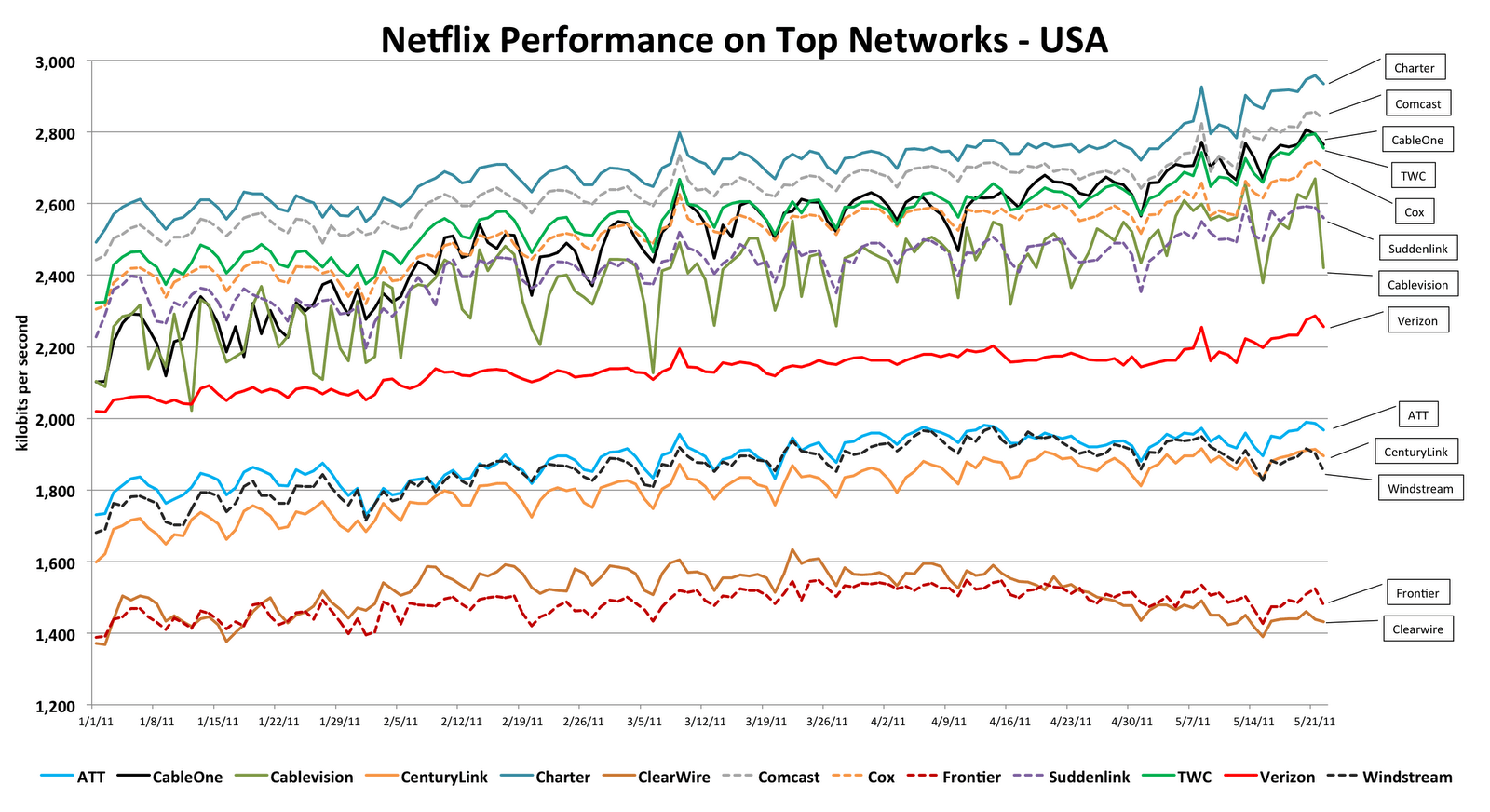
Frontier: America’s Worst Wired ISP for Netflix Viewing (Second Time Winner!)

Click to Enlarge

Frontier Communications’ DSL service delivers abysmal results for customers looking for quality time with Netflix.  For the second quarter running, the independent phone company’s ability to keep up with Netflix’s high quality video is about on par with a garden slug in a triathlon — yes, it may eventually reach the finish line, but you’ll be dead before it happens.  Even more embarrassing for Frontier, their service is occasionally beaten by Clearwire, a wireless ISP with a bandwidth throttler that can reduce your online experience to the painful days of dial-up if deemed to be using “too much.”

“Frontier sucks,” writes Stop the Cap! reader Doug in Charleston, W.V. “After they took over where Verizon fled, my ability to watch Netflix online became a source of endless frustration, so now I limit myself to mailing DVD’s back and forth.”

Remarkably, Charter Cable, which does poorly in customer satisfaction surveys, is again the runaway winner, followed by Comcast, the heavily usage-capped Cable One, Time Warner Cable, and Cox.  Verizon and AT&T only deliver middling performance.

Bright House Says No to Internet Overcharging: No Caps – Not Even Under Consideration

Phillip Dampier June 23, 2011 AT&T, Broadband Speed, Data Caps, Online Video, Verizon 1 Comment

Bright House Networks, a cable company primarily serving Florida and other southeastern states says it has no plans to implement Internet Overcharging schemes like usage caps or consumption billing.  But a company spokesperson went even farther, telling Tampa Bay Online the cable company was not even considering them.

Bright House, which relies on Time Warner Cable’s programming negotiators and sells broadband under the Road Runner brand, was among the only companies in Florida that was willing to go on record stating they were not considering limiting broadband customers.

Other providers were unwilling to follow Bright House’s lead:

  • AT&T: “2 percent of our customers were using 20 percent of our bandwidth,” said an AT&T spokesman, so the company slapped 150GB usage limits on DSL customers, 250GB on U-verse customers.  The overlimit fee is $10 for every 50GB extra.
  • Verizon Florida: “At this point, we’ve not implemented any usage controls or broadband caps.  We’ll continue to evaluate what’s best to ensure our customers get the highest quality broadband service for the best value,” the company said.  But it also added: “We’re continuing to evaluate usage-based pricing for our wireline broadband customers.”

“Bandwidth caps stifle consumer choice,” said Parul Desai, public policy counsel for Consumer’s Union.  Desai notes customers do not sign up for pricey high-speed FiOS broadband service from companies like Verizon just to read e-mail.  Customers who are willing to pay premium prices for super high speeds certainly don’t want a usage cap devaluing their broadband package.
Comcast, for example, uniformly limits consumption to 250GB per month, even on high speed plans delivering over 50Mbps service.

“It’s like building a rocket that you blow up after it reaches 250 feet into the air,” says Stop the Cap! reader Will in Tampa, who shared the article with us.  “What is the point of having 50 or 100Mbps service from any provider if they slap a limit on it like that.”

Will thinks customers will abandon higher speed packages in droves once they realize they really can’t use them.

“With some of these companies talking about caps around 40GB per month, you can’t even take your connection for a test drive,” he says.  “You might as well stick with basic speeds, just to remind and discourage you from putting yourself over their stupid limits.”

Desai suspects broadband companies will try limiting their customers, if only because they face few competitors consumers can use instead and they have video services to protect.  But she suspects some consumers will either abandon or seriously downgrade their broadband service and find other ways to trade large files and content.

“It’s not inevitable they’re going to succeed,” she told TBO. “People only find value in broadband because of what they can access with it. If more people feel constrained, they’ll start looking for another way.”


Bipolar Cable Industry Loves<->Hates Netflix; Britt Says It’s About Giving Customers What They Want

Phillip Dampier June 23, 2011 Competition, Consumer News, Data Caps, Editorial & Site News, Online Video, Video Comments Off on Bipolar Cable Industry Loves<->Hates Netflix; Britt Says It’s About Giving Customers What They Want

[flv width=”512″ height=”298″]http://www.phillipdampier.com/video/WSJ Studios disarming cable in battle with Netflix Media Report 6-20-11.flv[/flv]

Wall Street Journal: Top execs of some media behemoths are shifting their public stances toward Netflix Inc. of late. They’re now trying to persuade investors that the video streaming service will expand their business rather than destroy it. (4 minutes)

You are forgiven if you are confused about the love-hate relationship the cable industry has with online video streamers like Netflix — one that the Wall Street Journal likens to manic bipolar episodes.  Weeks after blaming Netflix for getting video programming too cheaply and threatening cable subscriptions, cable industry executives were hugs and kisses about online video at the recent Cable Show in Chicago.

“The reason why there’s interest in these Internet video providers that is that they’re deploying technology that’s making the experience better for consumers,” Time Warner Cable CEO Glenn Britt said in an interview with MarketWatch during the National Cable & Telecommunications Association’s annual Cable Show last week.

“There’s nothing about [cable companies] that stops us from doing that. So I would say … we as an industry just need to pay attention and give consumers what they want. Then there’s no room for these other guys. I don’t mean to say that in a negative way, but it’s true.”

Britt

Of course, this is the same man that has earplugs firmly implanted to help resist another rejection of his Internet pricing schemes that Time Warner Cable customers loathed in 2009.  Britt’s desire to give “consumers what they want” just doesn’t play in this part of town while the cable company is installing software to measure and potentially meter broadband usage.

What is different in the online video spectrum is consumers have choices.  They can adopt Time Warner Cable’s glacially-slow rollout of its TV Everywhere concept, watch Hulu, use Netflix, or simply steal content providers don’t want them to watch.  For customers of Time Warner Cable facing competition from AT&T, there is potentially nowhere to run to avoid an Internet Overcharging scheme which could bring the online viewing party to a rapid conclusion when your viewing allowance is used up.

Britt says he is struggling with rights holders to provide more accessibility to online video streaming of popular shows.  He’s also thinking about how many restrictions to slap on subscribers.

MarketWatch talked with Britt and found him dealing with nagging questions about how many devices each user account should be authorized to use for viewing. “Should it be three, should it be 10? If I make [that number] too small, you’re not going to be happy as a customer,” Britt philosophized. “If I make it too big, you’re going to give the password to all of your friends, and they won’t have to buy a subscription to begin with.”

Is Netflix Driving Cord Cutting? New Evidence Suggests ‘Not Really’

Phillip Dampier June 23, 2011 Online Video Comments Off on Is Netflix Driving Cord Cutting? New Evidence Suggests ‘Not Really’

As Netflix traffic continues to grow, analysts are pondering whether Netflix is a primary driver behind consumers cord-cutting their pay television packages in favor of watching video content online.

A recent article in The New York Times claims that Netflix may be behind the recent decrease in cable television households, citing a report from the Diffusion Group, a media analyst.  The group’s study claims 32% of satellite, telephone, or cable-delivered pay television customers were planning to downgrade or cancel their packages in 2011, a giant increase from the 16% measured in 2010.

[trefis_forecast ticker=”NFLX” driver=”0532″]

Trefis, another research firm, is challenging those assertions, noting an in-depth review of the study finds only around 7% of those planning to pull the plug cited Netflix as the chief reason.

What is causing a rush to downgrade or cancel service?  Rate increases, particularly for add-on services like premium channels or extra tiers including sports and movies.  Time Warner Cable recently boosted prices for HBO to as high as $15 a month for many subscribers.  Netflix may have an impact on these consumers, deciding to drop premium services like HBO, Showtime, and Starz!  For several dollars less than what these premium channels charge, Netflix customers have unlimited access to the company’s streaming video library.

Relentless annual rate hikes have often triggered subscribers to review their packages and delete services to keep the bill stable.  Economic distress is also a widely cited factor among those completely canceling pay television.  The report does not measure how many consumers, especially younger ones, don’t ever start a pay television subscription.  These subscribers never had a cord to cut.

Search This Site:

Contributions:

Recent Comments:

Your Account:

Stop the Cap!