Home » Online Video » Recent Articles:

Netflix: We Actually Thought More Of You Would Be Mad At Us, But We Know You Still Won’t Cancel

Phillip Dampier July 26, 2011 Consumer News, Online Video, Video 6 Comments

Netflix knows many customers are upset over the company’s recent decision to raise prices up to 60 percent, but company officials are shrugging their shoulders, suspecting the vast majority won’t actually follow through on their threats to cancel service. But Netflix is preparing investors for a possible third quarter decline in revenue, just in case.

CEO Reed Hastings downplayed the vocal protests with shareholders on an investor conference call.

“Believe it or not, the noise level was actually less than we expected,” Hastings said. “Given a 60% increase, we knew what we were getting into.”

Netflix expects revenue will decline temporarily in the third quarter as customers drop either the streaming or mailed DVD component from their rental plans.  The company effectively separated the two options into individual plans, and suspects many customers won’t retain both under the new pricing that takes effect next month.

Company officials also sent letters to major investors defending the new pricing as still reasonable when compared with the alternatives.

“We expect most to stay with us. We hate making our subscribers upset with us, but we feel like we provide a fantastic service,” the letter read.

Dan Rayburn, an analyst at Frost & Sullivan, believes the price changes are part of a master plan for Netflix to get out of DVD rental business altogether to save costs.

Many analysts predict Netflix will eventually adopt streaming video exclusively, but some are asking at what cost.  Predictions are widespread that Netflix will be forced to raise prices on streaming, perhaps by double, just to remain profitable in light of growing rights fees.  Sacrificing the labor-intensive DVD rental business, with associated warehousing and postage costs, could provide a savings cushion to protect subscribers from sticker shock should streaming rights fees get out of hand.

[flv width=”360″ height=”290″]http://www.phillipdampier.com/video/Bloomberg Williams Says Netflix Future Is Streaming Based 7-26-11.mp4[/flv]

Netflix stock is falling fast after consumer dissatisfaction over Netflix’s new pricing plans.  Bloomberg covers who wins and who loses after the price changes.  (2 minutes)

Time Warner Cable Acnowledges Its iPad App Has ‘Aggravating Issues’

Phillip Dampier July 25, 2011 Editorial & Site News, Online Video 1 Comment

Time Warner Cable’s newest version of its iPad app — TWCable TV — has more issues than the New York Times.

Stop the Cap! previously judged the latest version of the app ‘garbage,’ and after several weeks of periodic testing, we’ve found nothing to change our mind.

Now the cable company itself is acknowledging what hundreds of reviewers have bottom-rated: it simply doesn’t work right.

We’ve identified a number of frankly aggravating issues that have presented themselves only in a live environment. Comment threads on Engadget, DSLReports, this very blog and others support our internal findings, too. If you’re experiencing the following issues, please be reassured that they should be fixed in an upcoming patch releasing by the end of this month at the latest:

  • The app crashes after iPad awakes from sleep or lock
  • HD filter returns incomplete results
  • Intermittently, guide listings will overlay other guide listings (text appears overwritten and jumbled).
  • The device selector slides off-screen or disappears altogether
  • In-guide recording indicators do not appear

We’ve also discovered an intermittent quality issue with our live streaming that we are working to fix right now. This problem is independent of the release 2.0 code bugs, and will be fixed very, very soon.

The end of the month is a week away, and nothing appears to have been fixed just yet.  For Stop the Cap!‘s tests, the most obvious and aggravating problem continues to be streamed video that simply does not work for more than 30 seconds.  That such a core function of the product would remain hopelessly broken and unusable for almost a month is a profound embarrassment, tempered only by the fact the app and service is offered for free at the present time.

Time Warner Cable’s Jeff Simmermon tries to offer helpful, but very limited advice to the large contingent of users who find the app bug-laden:

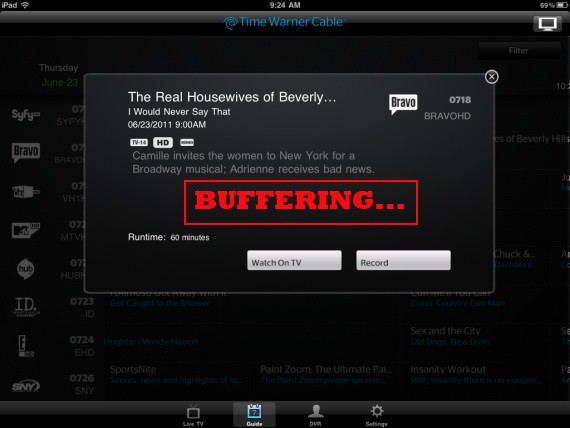
Live TV playback – video buffers (displays “loading” message)

(Note, we are currently working to resolve an intermittent video quality issue that could result in excessive buffering of the live feed.)

Did you experience any video quality issues prior to the 2.0 upgrade? If not, has anything changed on the home network recently?

Simmermon

Download a speed measurement tool or visit an iPad compatible speed measure web site to measure speed on the device at the point in the home where live video is being viewed. TWCable TV’s high definition video streams require a sustained 1.5mbps to avoid buffering. Fringe WiFi areas (e.g., a far corner of the house, backyard, etc) may not achieve these speeds.

Contact customer care with a detailed report of which channels are impacted and the frequency of the buffering (e.g., every few minutes, every 5 sec, etc).

We reported this particular issue and note it is hardly intermittent — it’s a constant for us in the Rochester, N.Y., area.  What is particularly odd is the prior version never experienced any of these issues.  We’ve only received guidance that our home network — the one Time Warner Cable technicians installed themselves when we upgraded to DOCSIS 3 technology — might be responsible.  We think not.

Many Time Warner Cable customers have used the company’s blog postings on the app as an opportunity to vent frustration over the cable company’s foot-dragging on online video.  While other cable companies’ TV Everywhere projects are unveiling a second generation of online playback tools, Time Warner is still withholding HBO Go and CNN Networks’ new live streaming of their cable networks’ digital online productions.

One satellite television customer responded bemused with Time Warner’s technical problems: “My DirecTV iPad app just works.”

Run Around and Sue: Movie Studios Want Zediva Remote DVD Rental Service Shut Down

Phillip Dampier July 21, 2011 Cablevision (see Altice USA), Consumer News, Online Video, Video Comments Off on Run Around and Sue: Movie Studios Want Zediva Remote DVD Rental Service Shut Down

A California company with a novel approach for renting DVDs faces the prospect of a preliminary injunction against the service if a judge agrees the service is skirting copyright law.

Zediva promotes itself as a remote DVD rental service that avoids lengthy delays often imposed on online streaming and pay-per-view services.  The company allows customers to “rent” DVD titles the same they are released, remotely streaming the contents over a broadband connection.  Zediva says it literally has a bank of DVD players which customers can access and remotely control.  When a customer “rents” a DVD, a Zediva employee inserts the disc into a DVD player and gives each customer up to two weeks to watch the movie.  Because Zediva says only one customer can rent the physical DVD at a time, it is not skirting copyright or streaming laws. The service will even mail the DVD to a customer if they don’t want to watch it over their Internet connection.

Zediva argues it is using the Internet as a way to connect the DVD player to a renter’s television.  The company says it should not matter where the player is physically located, and because a customer can exclusively control the actual player during the rental period, it is not violating any laws.

Hollywood disagrees, and the Motion Picture Association of America promptly filed suit in April, claiming Zediva’s business model undermines its licensing agreements with online movie services.  The lawsuit claims Zediva is not paying movie streaming rights like other online movie services, and is not comparable to a traditional movie rental store because the company makes individual titles available for viewing by other parties as soon as four hours after a customer stops watching, even though they can return and watch the movie again for no additional charge for up to two weeks.

This week, the MPAA touted a potential new friend of the lawsuit — Cablevision, which filed its own amicus brief in the case drawing distinctions between its Remote DVR service and Zediva.  Cablevision is in trouble with some rights holders over its new Remote DVR, which records shows on equipment at the cable company’s offices and then streams the programming on-demand to subscribers’ TV sets.  Some contend Cablevision owes “per performance” license payments for every show watched over the service.  Cablevision has consistently argued to the contrary, suggesting the actual location of the storage system should not matter, so long as the recordings are made and watched by only a single customer.

But Cablevision’s brief shows the company has no interest in being connected to Zediva, arguing its Remote DVR service is not comparable to the pay-per-view business Zediva is running.

A judge is expected to hear the case early next week.

[flv]http://www.phillipdampier.com/video/CNBC Zediva Video Streaming Service 3-17-11.flv[/flv]

CNBC and the New York Times’ David Pogue tried out Zediva back when it was introduced in March of this year.  (3 minutes)


AT&T’s Phoney Baloney Video About Broadband Usage Belied By Actual Facts And A Broken Meter

AT&T warns DSL customers they can watch 10 High Definition movies per month... and use their Internet connection for absolutely nothing else, unless they want to incur an overlimit fee of $10.

AT&T has released a phoney baloney video for their customers purporting to “explain” broadband usage and the company’s completely arbitrary usage limits on DSL and U-verse customers: “A single high-traffic user can utilize the same amount of data capacity as 19 typical households. Lopsided usage patterns can cause congestion at certain points in the network, which can slow Internet speeds and interfere with other customers’ access to and use of the network.”

Too bad these claims are not verified with actual facts.

Meaningless statistics

AT&T’s claim that less than two percent of their customers use 20 percent of available bandwidth is frankly meaningless to the company’s DSL and U-verse hybrid fiber-copper networks.  For years, phone companies made a marketing point that unlike cable broadband’s shared network, their DSL service was never shared with anyone else in a neighborhood.  Therefore, running it at a trickle or full speed ahead should have no impact on any other customer.  The only exception to this rule comes from phone companies that under-invest in their middle mile and backbone networks.  For AT&T, that means trying to serve too many customers on inadequate equipment ranging from a poorly planned network of D-SLAMs, which connect individual customers with a fatter pipeline back to the central office, or an inadequate network between the central office and AT&T’s regional backbones.  Fiber, such as that used by AT&T’s more modern U-verse system, completely solves any capacity issues.  Broadband traffic is only a tiny percentage of the bandwidth consumed by AT&T’s IPTV video service — the one that delivers U-verse TV to your home.  AT&T imposes no viewing limits on customers, of course.

Any actual capacity crunch would only show up during peak usage periods — when AT&T customers of all kinds pile on their broadband connection at the same time. AT&T’s usage cap regime does next to nothing to mitigate that kind of congestion.  Here’s why:

Since AT&T and other broadband companies routinely claim the average use per customer is well under 20GB per month, and only 2 percent of customers are currently deemed “heavy users” by AT&T, that tiny percentage of customers cannot create sufficient drag on AT&T’s DSL network even if they opened up their connections to full speed traffic.  In reality, the 98 percent of “average” users piling on the network during prime time would be the only thing capable of the kind of critical mass needed to create visible congestion.  What uses more capacity?  Two customers using their 7Mbps DSL lines to stream online videos concurrently or 98 customers all using their 7Mbps DSL lines at the same time for virtually any online activity?

The math simply doesn’t add up.

The Congestion Myth
AT&T targets their broadband customers with an unwarranted, arbitrary Internet Overcharging scheme they cannot effectively explain to customers.

As two week’s of hearings this month have demonstrated, Bell Canada’s similar arguments for its usage caps simply come without any evidence of actual congestion.  In fact, company officials modified their position to talk more about peak usage congestion, a problem that cannot be controlled with a usage cap well in excess of the average consumer’s usage.  In fact, only a speed throttle could control network congestion at the times it actually occurred.  AT&T also ignores when its customers are using its network.  Is a heavy user downloading files at 3 in the morning creating a problem for other users?  No.  Are the majority of their average-usage customers all jumping online after school or work creating a problem?  Perhaps, if you believed AT&T even had a congestion problem.

Industry maven Dave Burstein does not, and Burstein talked to two chief technology officers at AT&T who told him wired broadband congestion is a “minimal” problem for the phone company.

Upgrades and Cord-Cutting, Delayed

Two things usage caps can do is help your company delay necessary upgrades to meet customers’ broadband needs, whether they are “heavy users” or not.  AT&T has shown itself historically to be slow to invest, and cheap when it does.  AT&T’s wireless network is bottom-rated by consumers thanks to inadequate network capacity.  The company elected to upgrade on-the-cheap to an IPTV platform that still relies on copper phone lines to deliver service that simply cannot compete in quality and capacity with Verizon’s FiOS fiber to the home network.  But investors love the fact the company counts every penny, even if it means inconveniencing and overcharging customers for their services, usually offered in duopoly or monopoly markets.

AT&T’s usage caps on U-verse are even less credible than those imposed on their DSL service.  U-verse is a fiber to the neighborhood network with near limitless capacity for broadband and video.  In fact, the only “congestion” comes from the copper phone lines that limit how much bandwidth can be supplied to your individual home.  But no matter how much you use, you will not affect your neighbors because your copper phone line is shared with nobody else.  In fact, the biggest chunk of U-verse’s bandwidth is reserved for their video services, which makes arguments about excessive Internet usage on that pipeline un-credible.

What AT&T’s usage cap does assure is that you will not drop that video package from your U-verse service anytime soon.  That lucrative revenue from expensive video packages cannot be forfeit without a fight, and a nice deterrent in the form of an arbitrary usage cap does wonders to keep that cord cutting to a minimum.

Meters That Don’t Measure

One of the worst ongoing problems with Internet Overcharging schemes like AT&T’s is the broken usage meter.  Stop the Cap! has received hundreds of e-mails from AT&T DSL and U-verse customers who report AT&T’s usage meter is either unavailable, broken, or is wildly inaccurate.  With absolutely no independent oversight, and no consistently accurate usage measurement, charging anyone overlimit fees with a broken meter doing the counting is unconscionable.  Yet AT&T may well try.  The company has already been sued by one law firm for what it alleges is an unfair usage meter on the company’s wireless service — a meter that consistently overcounts usage in AT&T’s favor.
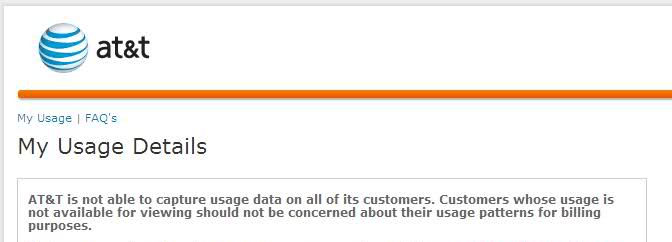
AT&T admits they cannot even accurately measure their own customers' usage.

Once getting over the broken meter, customers are directed to a pointless usage-estimator — the ones that tell you about how many tens of thousands of e-mails you can send and receive under AT&T’s cap regime.  In fact, these statistics are irrelevant for the vast majority of customers who never think of sending 10,000 e-mails or exchanging 2,000 pictures or songs.  That’s because customers do not use the Internet to exclusively do those things.  Even with the guestimator, they are left checking a broken usage meter to ponder whether or not they can watch one more show or download another file without incurring a $10 overlimit penalty (or more).  That “generous” limit AT&T touts suddenly doesn’t look so ample when the company gets to the wildly popular activity of streamed video.  AT&T’s own video warns you can only watch 10HD movies a month over your broadband connection — and absolutely nothing else.  No web browsing, e-mail, or photos or music.  Ten movies a month.  Still thinking of dropping your U-verse video subscription now?

Yet AT&T has the nerve to claim, “Our goal is to provide you with the best Internet service possible.”  Really?

Thankfully, not every member of the investor class is thrilled with nickle-and-diming broadband consumers for usage that costs the providing company next to nothing.

The Economist excoriated AT&T for its unwarranted usage limits on its blog earlier this year:

The use of caps allows providers to dish out bandwidth with one hand and take it away with the other. The companies have vastly increased the capacity of various copper, coaxial and fibre lines, but artificially separate out a portion—at least half and often much more—for video which a set-top box or a broadband modem spits out as an apparently distinct service. Cable firms simultaneously push out hundreds of digital channels, while telecoms firms rely on multiple digital streams from live broadcast or cable TV or on-demand pay-per-view. It is as though the water main were divided as it entered the home and a steady, modest stream was made available for showers and at the tap, while most of it was always at the ready for a coin-operated washing machine.

Increasing speed on the internet portion, which would allow consumers to give up on TV subscriptions, is balanced by capping volume. If a consumer does not monitor usage, his internet access can be withdrawn or, in AT&T’s case, overage fees of $10 charged for every additional 50 GB of usage. […] [That] $10 charge applies whether the limit was breached by 1 MB or a smidgen under 50 GB.

[flv width=”640″ height=”380″]http://www.phillipdampier.com/video/ATT Usage.flv[/flv]

AT&T’s new video on broadband usage is based on facts not in evidence and only adds to consumer confusion about arbitrary Internet Overcharging schemes.  (4 minutes)

Netflix Customers Erupt in Firestorm Over Plan Changes: More Than 35,000 Negative Comments Logged

Phillip Dampier July 13, 2011 Consumer News, Online Video 4 Comments

fire - courtesy Dan HammontreeMore than 35,000 Netflix subscribers flooded the company’s blog and Facebook page with negative comments less than 24 hours after the company announced major pricing changes for its DVD-by-mail and streaming services.

News that Netflix would unbundle discounts for customers who enjoy online streaming and still need to rent an occasional DVD-by-mail went over like a lead balloon for the overwhelming majority, who hit the 5,000 comment limit on Netflix’s own blog by 5:30pm Tuesday, and continue to pound the company’s Facebook page by the tens of thousands this morning.

One of the most “liked” comments came from longtime Netflix customer Scotty Fagaly:

“The only way that this is terrific for the customer is if you plan to offer your entire collection available for streaming,” Fagaly lamented. “Otherwise, this is just yet another way to choke more change out of your customers.”

Only about 20 percent of Netflix’s library is available for streaming at any time, with some titles and studios coming and going.  Several television series are available online, but certain episodes are often missing from the streaming library, requiring customers to rent the DVD to see everything.

Are these discs made of gold now?

The biggest negative response came from the loss of the popular $9.99 plan, which allowed unlimited streaming and an unlimited number of DVD’s — sent one at a time — to customers.  With the unbundling of discounts, that same plan now costs $15.99 — a 60% increase.

Netflix officials have yet to respond to the firestorm of criticism, in part laid at the feet of Jessie Becker, who tried to make lemonade out of the price increase most customers describe as a lemon.

“It’s insulting that Netflix think we’re stupid enough to believe this change is either ‘exciting’ or ‘good news,'” one hostile commenter noted.  “Stop couching this as anything other than what it is — a price hike.”

“So far you have 32,446 people on your Facebook page planning to or already have canceled, and 6,857 on this blog [over an] announcement yesterday. If nothing else there might be an award in it for you guys for most Internet hits for pissing off customers in the shortest amount of time,” said Christine Perry.  “I can go to Redbox and rent a new release for a dollar, watch it and return it the same day and get a new one. Why would I pay $7.99 to wait 3 days to get a DVD, and the another 3 days after I watch it for you to get it back, and then another 3 days to get another one?”

Daniel Indiviglio, a former investment banker who works today as an associate editor at The Atlantic, called Netflix’s price changes “boneheaded,” particularly for investors if it backfires:

“How much could Netflix lose? Let’s do a quick analysis. According to one estimate, about 80% of Netflix subscribers currently have by-mail service that includes free streaming. Of that portion, let’s say half cancel streaming but keep by-mail service. Remember, many people don’t use streaming at all. In particular, if you don’t have an Internet-ready device connected to your television with a Netflix widget, then streaming is far less attractive. Through Netflix’s new pricing, by-mail only service will be about 20% cheaper than the current rate that includes free streaming.

[…] “Netflix has been a darling of investors for some time now. In just the past year, its stock price has increased by an amazing 144%. But Wall Street might begin to question its strategy. The company has said that streaming is the future. It’s right. But the future isn’t here yet. If its streaming subscriber base suddenly plummets by 50% or even by a smaller margin like 30%, then investors might worry about whether consumers are really ready to embrace the service on which Netflix has been investing a huge portion of its revenue. And if its profits dive as a result of the rate hike, then investors will be even more concerned with Netflix’s vision.

“So what should Netflix have done? It should have increased its rates slightly, maybe by a dollar or two, and broke out streaming and by-mail service. For example, the company could have increased the cost of its basic plan from $9.99 to $11.98 for streaming plus by-mail service. If you wanted the two a la carte, it could have charged $4.99 for streaming and $6.99 for one DVD-by-mail. Although customers wouldn’t love the rate increase, they’d be better able to stomach it. It would also give Netflix the ability to up its fees in future years gradually, to hit the target that it believes is appropriate. But putting the hike in place immediately may do the company more harm than good.”

Your Alternatives

Bankrupt Blockbuster wasted no time taking advantage, pelting many of their former rental members with e-mail reminding them they can rent Blockbuster DVD’s by mail without a monthly subscription.  Unfortunately, it’s not cheap.  A seven day rental of a single disc will cost $4.99.  Subscription plans offer a better value for frequent renters.  Blockbuster also benefits from not being perceived these days as a “bad boy” by Hollywood studios, who have been penalizing Netflix with longer rental embargo windows.  Many new releases reach Blockbuster a month before showing up in Redbox or on Netflix’s roster.  Customers can also swap out up for five DVD’s a month at BlockBuster retail outlets, and video game rentals are also available.

Prices:

  • One DVD out at a time: $12 per month
  • Two DVDs out at a time: $17 per month
  • Three DVDs out at a time: $20 per month

Hulu Plus has not been a runaway success for its owners, charging $8 a month to paying customers who win the right to watch additional content, but with the same commercial load the free alternative service provides.  People don’t think of Hulu for movies because the service is heavily focused on television series, but Hulu Plus does deliver a small selection.  Amazon Instant Video is another alternative, for those paying Amazon.com $79 a year for the privilege of getting their orders shipped to arrive in 48 hours for no additional shipping charges.  Amazon added unlimited access to their Instant Video streaming library at no additional charge for Amazon Prime members.  Just about anyone signing up with a new account at Amazon can get a 30-day free trial of Amazon Prime, with the movie service.  But you will make due with watching around 6,000 titles, many of which are obscure or a distant memory.

Many of Netflix’s upset customers report they are headed for the Movie Tardis — the 27,000+ giant red boxes erected in front of grocery and drug stores.  Redbox pitches $1 movie rentals, but you need to return them by 9pm the following day.  Blu-ray movies cost 50 cents more.  Redbox carries a healthy selection of current titles, and you only interact with a machine, so you won’t deal with the eye-rolling you might get renting at area video stores.  This option works best if you are within a very short distance from the nearest kiosk.  Otherwise, you may find returning discs a hassle.

[flv width=”360″ height=”290″]http://www.phillipdampier.com/video/WNAC Providence Netflix raising prices 60pct 7-13-11.mp4[/flv]

Netflix is raising prices and subscribers are not happy, shares WNAC-TV in Providence.  Their advice? “Stick to Redbox.”  (1 minute)

Search This Site:

Contributions:

Recent Comments:

Your Account:

Stop the Cap!