Home » Online Video » Recent Articles:

AT&T’s New Speed Throttle Being Used as Talking Point for Merger With T-Mobile

AT&T's new choke collar for "unlimited use" data plan customers, ready for wearing Oct. 1

Now that Verizon Wireless has stopped signing up new customers for its unlimited usage data plan, AT&T plans to start targeting its grandfathered unlimited-data customers with speed throttles that will effectively limit the company’s “unlimited use” plan.  And the company is trying to suggest approval of its merger with T-Mobile might prevent its growing use.

AT&T says effective Oct. 1, the top 5 percent of its wireless users will receive a warning message before their speeds are cut to near-dial up for the remainder of the billing cycle.

“We’re taking steps to manage exploding demand for mobile data,” said the company in a statement.  AT&T added that “nothing short of completing the T-Mobile merger” will effectively solve the company’s network capacity issues.

“The planned combination of AT&T and T-Mobile is the fastest and surest way to handle the challenge of increasing demand and improving network quality for customers,” said AT&T.

With Verizon Wireless’ exit as a competitive alternative for unlimited data, AT&T’s newly announced speed throttle may not pose much of a risk for business when implemented, as infuriated customers have just one remaining provider offering unlimited data – Sprint.

While AT&T has not specified an exact amount of data usage that will put users in the penalty corner, they did say most of those facing throttling are “streaming video or playing some online games.”

Some AT&T customers use their unlimited wireless plans as a home broadband replacement — an action that could easily bring back a dial-up experience when the speed throttle kicks in.

Only customers on “unlimited use” plans will face AT&T’s special speed treatment.  Those paying for usage-limited packages are exempt.

AT&T’s ongoing hard-sell for the merger has not been well-received by some on Capitol Hill.

Sen. Al Franken (D-Minn.) blamed AT&T for its lack of willingness to spend money on improving its own network infrastructure for self-inflicted network capacity problems.  Franken believes the merger would be anti-competitive and anti-consumer.

In letters to the Department of Justice and Federal Communications Commission, Franken spelled out in great detail why approving the merger does not make sense:

Franken

“The competitive effects of a merger of this size and scope will reverberate throughout the telecommunications sector for decades to come and will affect consumer prices, customer service, innovation, competition in handsets and the quality and quantity of network coverage. These threats are too large and too irrevocable to be prevented or alleviated by conditions,” wrote Franken.

The International Business Times summarized many of Franken’s larger points:

  • AT&T owns more spectrum than any other company, yet AT&T has been plagued with delays in rolling out infrastructure to support spectrum it has been allocated.  The quality of the service it provides is consistently ranked last amongst the national carriers, and it continues to use spectrum in an inefficient manner;
  • Many of [AT&T’s] spectrum licenses remain undeveloped, including $9 billion worth of some of the most valuable “beachfront” spectrum;
  • Other national wireless carriers have been aggressively preparing for this crunch. However, unlike the other wireless providers, AT&T has not visibly taken decisive steps to prepare for the coming crunch, despite the fact that AT&T should have recognized the need for additional investment shortly after introducing the iPhone in 2007;
  • AT&T only increased its spending on wireless infrastructure by one percent in 2009. Although AT&T will point out that one percent is still a significant number, Verizon made the decision to increase its capital spending by 10 percent in 2009/9 and Verizon is now in a much better position when it comes to spectrum capacity.

Cable Internet Providers: We Upgraded Speeds and Hate When Customers Use Them

Phillip "Try the Gouda" Dampier

Welcome to the Broadband Usage Whine & Cheese Festival

Midcontinent Communications earlier this month announced a big boost in broadband speeds for more than 250,000 customers in the Dakotas and Minnesota, bringing up to 100/15Mbps service to customers who wanted or needed that speed.

MidcoNet Xstream Wideband, made possible with a DOCSIS 3 upgrade, delivers 1/1Mbps ($30.95), 30/5Mbps ($44.95), 50/10Mbps ($64.95), or 100/15Mbps ($104.95) service.  Those are mighty fast speeds for an upper midwestern cable company, especially in states where 1-3Mbps DSL is much more common.

The cable provider was excited to introduce the speed upgrades earlier this month, telling customers:

At up to 100 Mbps, MidcoNet Xstream® Wideband is fast. But today’s online experience is about more than speed. It’s about the power and capacity to run every streaming, blogging, downloading, surfing, gaming, chatting, working, playing, connected device in the house. All at the same time. MidcoNet Xstream Wideband delivers…it’s everyone in your entire family online at once, doing the most intense online activities, no problem.

But now there is a problem.  Customers spending upwards of $105 a month for the fastest Internet speeds are actually using them to leverage the Internet’s most bandwidth-intensive services, and evidently Midco isn’t too happy about that.  Todd Spangler, a columnist for cable industry trade magazine Multichannel News, was given a usage chart by Midco, and used it to lecture readers about the need for usage caps: “One thing is clear: Broadband service providers will all need to do something to contain the rapidly rising flood of Internet data.”  The implication left with readers is that limiting broadband usage is the only way to stem the tide.
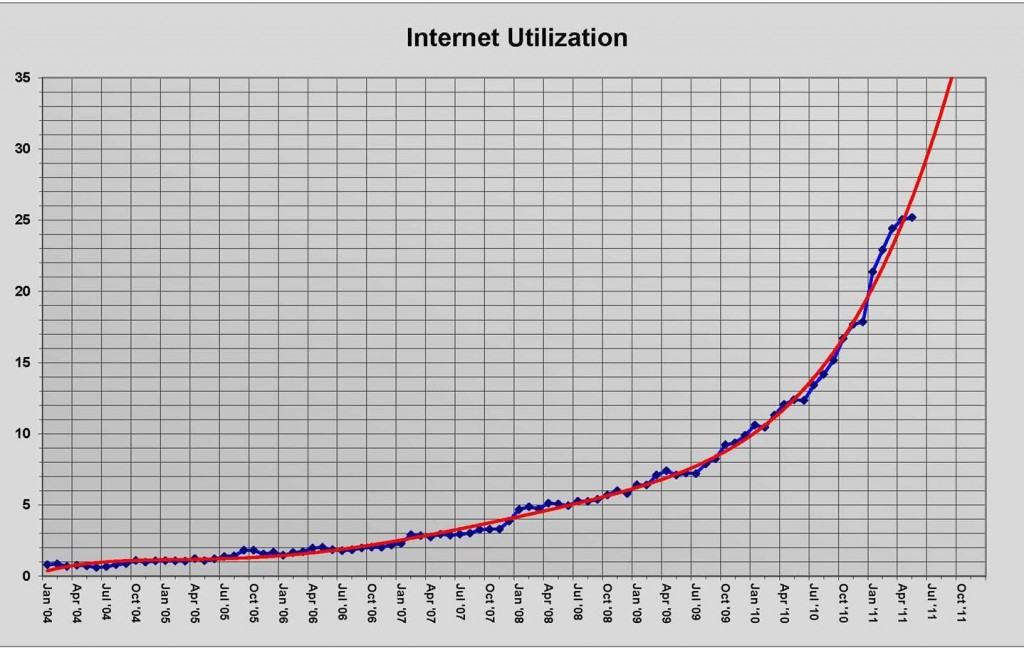
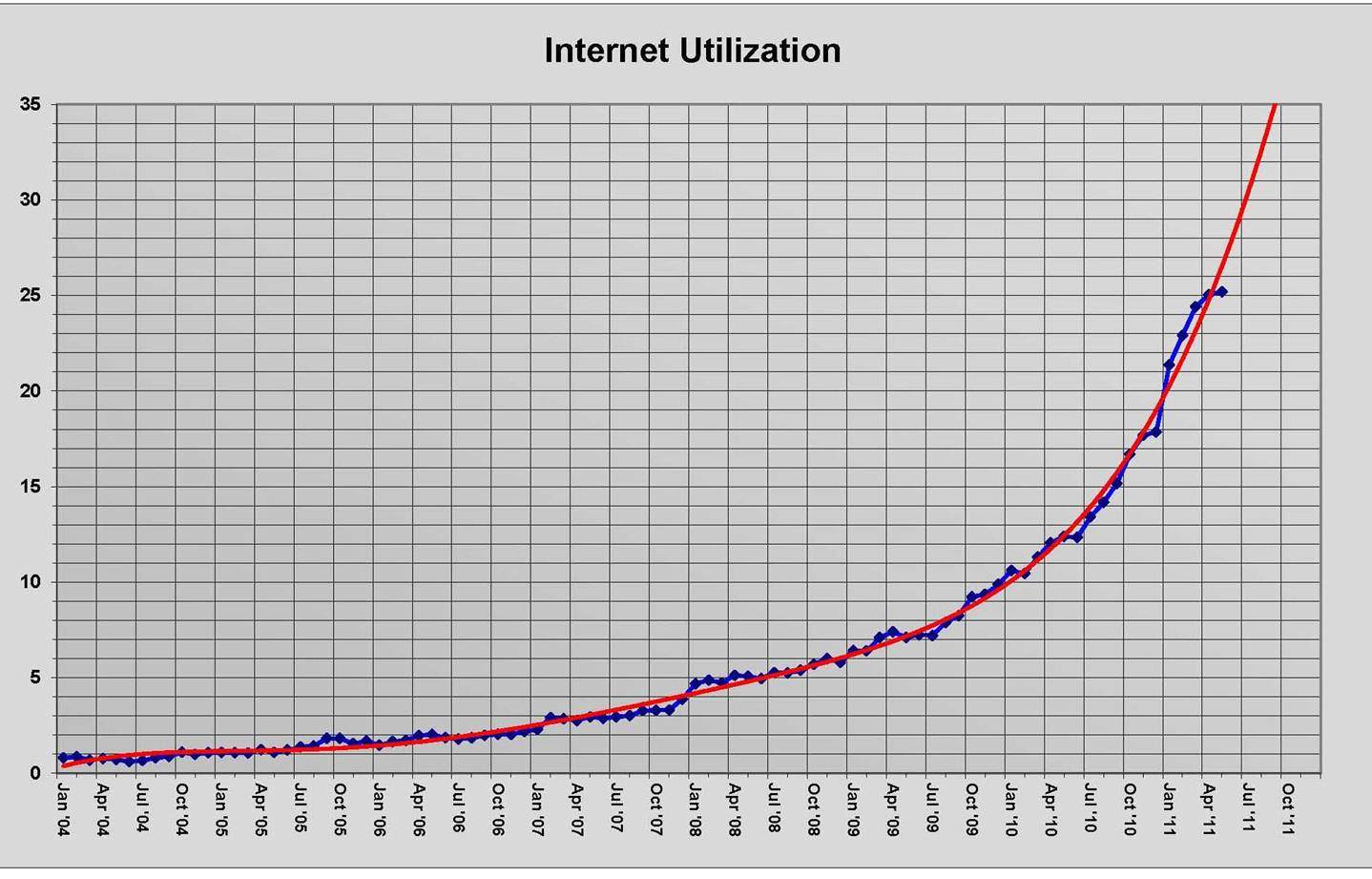
Midco's not-so-useful chart looks mighty scary, showing usage growth on their 100Gbps backbone network, but leaves an enormous amount of information out of the equation. (Source: Midcontinent Communications via Multichannel News)

Spangler quotes Midco’s vice president of technology Jon Pederson: “Like most network providers we have evaluated this possibility, but have no immediate plans to implement bandwidth-usage caps,” he said.

So Midco is more than happy to pocket up to $105 a month from their customers, so long as they don’t actually use the broadband service they are paying top dollar to receive.  It’s an ironic case of a provider desiring to improve service, but then getting upset when customers actually use it.

We say ironic because, from all outward appearances, Midco is well-aware of the transformational usage of broadband service in the United States these days:

If you have ever once said “my Internet is too slow,” then you need MidcoNet Xstream Wideband. With it, you can do all the cool things you’ve heard people are doing online. Explore all the great stuff your online world has to offer. Play the most intense games. Try things you could never do before, from entertainment to finance, video chat or video streaming. Like we said, MidcoNet Xstream Wideband is all about speed, capacity, choice and control.

What this means for you is that you’ll be able to do things like:

  • Download and start enjoying entire HD movies in seconds, not minutes.
  • Stream video and music without a hitch while you simultaneously perform other intense online tasks.
  • Choose from three different pipelines, from 3.0 to 1.0, for the capacity and price your family needs.
  • Monitor your bandwidth use to determine if you need more capacity or can do what you want with less.
  • Upload files or signals, such as webcam footage, faster than ever before possible for a better online experience.
  • Watch ESPN3.com. Your Favorite Sports. Live. Online.

Just don’t do any of these things too much.  Indeed, when providers start toying with usage caps, it’s clear they want you to use your service the same way you did in 2004 — reading your e-mail and browsing web pages.  Real Audio stream anyone?

Let’s ponder the facts Mr. Spangler didn’t entertain in his piece.

Midco upgraded their network to DOCSIS 3 technology to deliver faster speeds and provide more broadband capacity to customers who are using the Internet much differently than a decade ago, when cable modems first became common.  Some providers and their trade press friends seem to think it’s perfectly reasonable to collect the proceeds of premium-priced broadband service while claiming shock over the reality that someone prepared to spend $100 a month for that product will use it far more than the average user.

Part of the price premium charged for faster service is supposed to cover whatever broadband usage growth comes as a result.  That’s why Comcast’s 250GB usage cap never made any sense.  Why would someone pay the company a premium for 50Mbps service that has precisely the same limit someone paying for standard service has to endure?

Cringely

Midcontinent Communications is a private company so we do not have access to their financial reports, but among larger providers the trend is quite clear: revenues from premium speed accounts are being pocketed without a corresponding increase in investment to upgrade their networks to meet demand.  Inevitably that brings the kind of complaining about usage that leads to calls for usage caps or speed throttles to control the growth.

We’re uncertain if Midco is making the case for usage caps, or simply Mr. Spangler.  We’ll explain that in a moment.  But if we are to fully grasp Midco’s broadband challenges, we need much more than a single usage growth chart.  A “shocking” usage graph is no more impressive than those showing an exponential increase in hard drive capacity over the same period.  The only difference is consumers are paying about the same for hard drives today and getting a lot more capacity, while broadband users are paying much more and now being told to use less.  Here is what we’d like to see to assemble a true picture of Midco’s usage “dilemma:”

  1. How much average revenue per customer does Midco collect from broadband customers.  Traditional evidence shows ARPU for broadband is growing at a rapid rate, as consumers upgrade to faster speeds at higher prices.  We’d like to compare numbers over the last five years;
  2. How much does Midco spend on capital improvements to their network, and plot that spending over the last 10 years to see whether it has increased, remained level, or decreased.  The latter is most common for cable operators, as the percentage spent in relation to revenue is dropping fast;
  3. How many subscribers have adopted broadband service over the period their usage chart illustrates, and at what rate of growth?
  4. What does Midco pay for upstream connectivity and has that amount gone up, down, or stayed the same over the past few years.  Traditionally, those costs are plummeting.
  5. If the expenses for broadband upgrades and connectivity have decreased, what has Midco done with the savings and why are they not prepared to spend that money now to improve their network?

While Midco expresses concern about the costs of connectivity and ponders usage caps, there was plenty of money available for their recent purchase of U.S. Cable, a state-of-the-art fiber system serving 33,000 customers — a significant addition for a cable company that serves around 250,000 customers.

A journey through Midco’s own website seems to tell a very different story from the one Mr. Spangler is promoting.  The aforementioned Mr. Pederson is all over the website with YouTube videos which cast doubt on all of Spangler’s arguments.  Midco has plentiful bandwidth, Mr. Pederson declares — both to neighborhoods and to the Internet backbone.  Their network upgrades were designed precisely to handle today’s realistic use of the Internet.  They are marketing content add-ons that include bandwidth-heavy multimedia.  Why would a provider sell customers on using their broadband service for high-bandwidth applications and then ponder limiting their use?  Mr. Pederson seems well-aware of the implications of an increasingly connected world, and higher usage comes along with that.

That’s why we’d prefer to attack Mr. Spangler’s “evidence” used to favor usage caps instead of simply vilifying Midco — they have so far rejected usage limits for their customers, and should be applauded for that.

Robert X. Cringely approached Midco’s usage chart from a different angle on his blog, delivering facts our readers already know: Americans are overpaying for their broadband service, and the threat of usage caps simply disguises a big fat rate hike.  He found Midco’s chart the same place we did — on Multichannel News’ website.  He dismisses its relevance in the usage cap debate.  Cringley’s article explores the costs of broadband connectivity, which we have repeatedly documented are dropping, and he has several charts to illustrate that fact.

You’ll notice for example that backbone costs in Tokyo, where broadband connections typically run at 100 megabits-per-second, are about four times higher than they are in New York or London. Yet broadband connections in Tokyo cost halfwhat they do in New York, and that’s for a connection at least four times a fast!

So Softbank BB in Tokyo pays four times as much per megabit for backbone capacity and offers four times the speed for half the price of Verizon in New York. Yet Softbank BB is profitable.

No matter what your ISP says, their backbone costs are inconsequential and to argue otherwise is probably a lie.

Cue up Time Warner Cable CEO Glenn Britt, who said precisely as much Thursday morning when he admitted bandwidth costs are not terribly relevant to broadband pricing.

We knew that, but it’s great to hear him say it.

Cringely’s excellent analysis puts a price tag on what ISP’s want to cap for their own benefit — their maximum cost to deliver the service:

That 250 gigabytes-per-month works out to about one megabit-per-second, which costs $8 in New York. So your American ISP, who has been spending $0.40 per month to buy the bandwidth they’ve been selling to you for $30, wants to cap their maximum backbone cost per-subscriber at $8.

[…] IP Transit costs will continue to drop. That $8 price will most likely continue to fall at the historical annual rate of 22 percent. So what’s presented as an ISP insurance policy is really a guaranteed profit increase of 22 percent that will be compounded over time because consumption will continue to rise and customers will be for the first time charged for that increased consumption.

This isn’t about capping ISP losses, but are about increasing ISP profits. The caps are a built-in revenue bump that will kick-in 2-3 years from now, circumventing any existing regulatory structure for setting rates. The regulators just haven’t realized it yet. By the time they do it may be too late.

Unfortunately, even if they knew, we have legislators in Washington who are well-paid in campaign money to look the other way unless consumers launch a revolution against duopoly broadband pricing.

Cringely believes usage caps will be the form of your provider’s next rate increase for broadband, but he need not wait that long.  As the aforementioned CEO of Time Warner Cable has already admitted, the pricing power of broadband is such that the cable and phone companies are already increasing rates — repeatedly — for a service many still want to cap.  Why?  Because they can.

Consumers who have educated themselves with actual facts instead of succumbing to ISP “re-education” efforts designed to sell usage limits under the guise of “fairness” are well-equipped to answer Mr. Spangler’s question about whether bandwidth caps are necessary.

The answer was no, is no, and will always be no.

[flv width=”640″ height=”500″]http://www.phillipdampier.com/video/Midco D3 Upgrade Promo 7-11.flv[/flv]

Jon Pederson’s comments on Midcontinent’s own website promoting its new faster broadband speeds can’t be missed.  He counts the number of devices in his own home that connect to the Internet, explains how our use of the Internet has been transformed in the past several years, and declares Midco well-prepared to deliver customers the capacity they need.  Perhaps Mr. Spangler used the wrong company to promote his desire for Internet usage caps.  Pederson handily, albeit indirectly, obliterates Spangler’s own talking points, which makes us wonder why this company even pondered Internet Overcharging schemes like usage caps in the first place.  (10 minutes)

Shaw’s Online Movie Club: Bargain or Bust?

While Netflix has grown like wildfire across Canada, providing unlimited streamed video entertainment for $8 a month, a few cable operators at risk of premium channel cord-cutting have responded with their own movie streaming services, at least one that temporarily found itself the subject of controversy when it was introduced a few weeks ago.

Shaw Communications’ Movie Club is that cable company’s answer to Netflix — offering a flat rate streaming service available over broadband or through your Shaw set top cable box for $17 a month ($12 if you forgo HD movies).  For that, Shaw promises unlimited viewing, without any usage caps so long as you stream movies from your cable box and not from your home computer.

But is it worth it?

With the assistance of one of our readers in Calgary, we were able to give Shaw’s Movie Club a trial run.

Availability

Evidently, Shaw Movie Club works best if you live in Calgary or Edmonton, where Shaw has been testing their new “Gateway” system, which is a combination home video terminal/DVR designed to compete with phone company DVR boxes which can record 4-6 shows simultaneously and deliver recordings to multiple sets in the home.  A number of Shaw customers on less-advanced, older cable systems may find the service a lot less convenient to use.  Outside of urban Alberta and in British Columbia, we found instances where customers could request to view Shaw Movie Club titles, but they had to be watched on your cable set top box.  For now, the most aggressive marketing for the service seems to be in Calgary and Edmonton, perhaps for this reason.

The Selection

When we sampled the service, we found about 150 titles available for viewing — hardly a wide selection.  Although many popular, semi-recent movies were available for viewing, the selection was comparable to what one would find from one or two premium movie channels.  Existing premium subscribers may find more than enough to watch from Super Channel or Movie Central On Demand, which are included with your subscription to one or both networks.  In the States, HBO, Cinemax, and Showtime all offer their own virtual “on-demand” channels that let viewers select most of the titles shown on each respective network for instant, on-demand viewing.  Shaw Movie Club felt very much like one of these channels, based on the limited selection.

In comparison, Netflix does not make it easy to count the actual number of streamed movies they have on offer at any one time, but the selection was clearly more substantial on Netflix, with a much deeper catalog.  But Canadians are also punished by Netflix because the service does not yet have agreements in place with studios to stream the same titles to both American and Canadian audiences.  Americans have a much larger selection of titles to stream.  Shaw’s agreements with studios clearly emphasize more current titles, and there are titles available on Shaw’s service that are not available from Netflix.

Winner: Netflix – You have a better chance of finding something to watch on Netflix.

Loser: Shaw Movie Club – But the service may have access to movies you wish Netflix provided.

Shaw's biggest competitor

The Value

At up to $17 a month, Shaw Movie Club is expensive.  In fact, it’s a lot more expensive if you do not subscribe to Shaw’s cable television.  It’s required to sign up for the streaming service.  That seems counter-intuitive to provide video streaming but deny broadband-only customers the opportunity to buy, but not when you consider such services are designed to prevent cable-TV cord cutting, not enable it.  Shaw charges nearly $40 in Alberta for basic cable service, so that’s a steep entry fee to pay before handing over another $12-17 just to stream movies.

For those uncomfortable video streaming on home computers, Shaw’s set top box solution lets you watch shows on-demand directly on your television.

Shaw initially found itself mired in controversy when it appeared they would exempt their video streaming service from their own usage caps — a clear anti-competitive move against Netflix, which does count against your cap.  But Shaw quickly clarified their position to state only set top box viewing was exempt from their caps.  We’re not certain exactly what distinction Shaw is trying to make beyond the political, because data is data — it all arrives on the same cable.  Shaw would argue their video may travel over their “television” bandwidth when delivered to set top boxes and their broadband network when delivered over the Internet.  But Time Warner Cable has shown it can deliver video over its Apple iPad app to cable subscribers over Time Warner’s internal network, which means it costs next to nothing to provide.  We suspect there is nothing technically precluding Shaw from exempting all of its Movie Club viewing from usage caps, beyond the political implications of doing so.

Winner: Netflix – $7.99 a month is an afterthought when you consider how much you can watch.

Loser: Shaw Movie Club – Up to $17 a month is a very steep price to pay for fewer than 200 movie titles to watch.

Video Quality

Both services delivered high quality video, even over a remote connection we used to sample Shaw Movie Club.  Shaw’s HD streaming performed with absolutely no technical flaws, evidence they are paying careful attention to deliver video from networks as close to their customers as possible.  Shaw’s HD streaming was often better than Netflix’s online streaming, but Netflix’s network consumes a lot less bandwidth, an important distinction if you have a large family piling on your broadband connection at the same time.  Shaw’s video is a bandwidth piggy, and will eat into your usage allowance fast if you use it over the Internet.

We recommend watching Shaw’s service over your existing set top box whenever possible.  It’s convenient and won’t count against your usage allowance.

A Tie: Netflix and Shaw Movie Club both deliver excellent quality video with no technical flaws experienced.  Shaw Movie Club has a larger selection of HD movies, but that is tempered by the fact watching them will rapidly erode your usage allowance if watching online.

Fox: You’ll Have to Wait 8-Days to Watch Our Shows Online, Unless You Are a Pay TV Subscriber

Phillip Dampier July 27, 2011 Consumer News, Online Video 9 Comments

News Corp.’s Fox television network has announced it will erect a pay wall that will delay access to popular Fox shows for eight days after airing… unless you are an authenticated cable-TV or other pay television subscriber.

The announcement is the first among the major broadcast networks to keep cord-cutters and those who don’t pay for their television entertainment from conveniently watching shows online.  With most Fox shows formerly available for free on Hulu one day after airing, many viewers simply watch programs online, enjoying a reduced number of commercials along the way.

Now, viewers will have to wait a week before those shows become accessible.  Or, they can pay Hulu $7.99 a month for a Hulu+ subscription and watch right away.  Or sign up for cable television.

The pay wall will be introduced Aug. 15 and was constructed at the behest of the nation’s largest cable, phone, and satellite companies to stop consumers from watching shows online for free.  Local Fox stations don’t mind the change either, if it means you will watch your favorite shows on local stations instead of a national website.

Michael Hopkins, Fox’s president of affiliate sales released a statement explaining the change was designed to “enhance the value” of cable, satellite, and telco-TV subscriptions.  Cable companies have been upset about paying retransmission rights fees for Fox’s local affiliate stations, only to see the network give away programming, for free, online.

Hopkins

“We’re concerned that cord-cutting is going to be a problem,” Mike Hopkins, Fox’s president of affiliate sales, said in an interview with the Wall Street Journal. “The more you enable it by putting content out there for free without any tether to a pay-TV subscription, the bigger that danger becomes.”

If Fox is the first broadcast network to erect a pay wall, it likely won’t be the last.  Disney’s ABC is exploring adopting a similar strategy, and CBS had withheld much of its programming from online ventures precisely because it believes it dilutes the value of its shows.  It will likely favor a similar pay television approach.

For consumers, the details of how the pay wall will work could become problematic depending on their pay television provider.  DirecTV is quickly working to keep free access to Fox shows for its subscribers after the pay wall takes effect.  But some cable companies like Time Warner Cable have dragged their feet on TV Everywhere online projects, and subscribers, even with cable TV packages, could still find themselves locked out behind the wall, unless they also have a Hulu+ subscription.

The risk of annoying viewers by keeping them away from their favorite shows could easily spark a renewed interest in piracy.  With a commercial newsgroup account, access to peer-to-peer software or file storage sites like Rapidshare or Megavideo, bypassing the industry’s pay-walls is as easy as finding the shows viewers want to watch, legally or otherwise.

Vudu Goes Live on Wal-Mart Website

Phillip Dampier July 26, 2011 Consumer News, Online Video Comments Off on Vudu Goes Live on Wal-Mart Website

Harry Potter: The Chamber of Commerce

Several years ago, Wal-Mart tried its hand in the DVD-by-mail rental service that Netflix ruled.  Netflix won and juggernaut Wal-Mart lost, eventually selling off their rental DVDs at fire-sale prices and quietly exiting the business in 2010.

This morning it’s Round Two.

Earlier today, Wal-Mart began leveraging its earlier purchase of video-streaming service Vudu.com on its own website, giving plenty of new exposure to the online service that offers rentals of movies and television shows, often on the same day they are released to the DVD retail market.

Vudu has continued under its own banner ever since Wal-Mart acquired the company 18 months ago, but few Wal-Mart customers have heard of the service.

By integrating Vudu into Wal-Mart’s own website, browse-by traffic should bring plenty of new customers to the venture.  At least 20,000 titles are available from the outset, playable on a variety of devices.

Rental prices range from a $1-6, but customers can also purchase digital copies for $4.99 and up.  Regular discount offers and promotional codes often deliver substantial discounts, and new customers can enjoy a free trial.

The service’s obvious challenger is, once again, Netflix.  While Vudu doesn’t offer a flat rate viewing plan, they do deliver a substantially larger selection of 1080p HD movies than Netflix offers for streaming.  But they come at a higher price.

For example, Harry Potter and the Deathly Hallows: Part 1 is available on Vudu in standard definition for a rental fee of $3.99.  HD runs a dollar more; HDX a dollar more still.  Customers can buy a copy of the film for $14.99.

Redbox in comparison will rent the same film to you for $1-1.50, depending on the version, per day.  Amazon.com charges $3.99 for online rentals, or buy the DVD from them for $13.99.

Search This Site:

Contributions:

Recent Comments:

Your Account:

Stop the Cap!