Home » Online Video » Recent Articles:

Canada Moves to Digital TV: Canadian Pay TV Providers Move to Cash In

Two years after Americans dumped analog television in favor of digital over the air broadcasting, in just over two weeks many Canadians will discover their favorite free-TV signals gone from the analog airwaves forever.

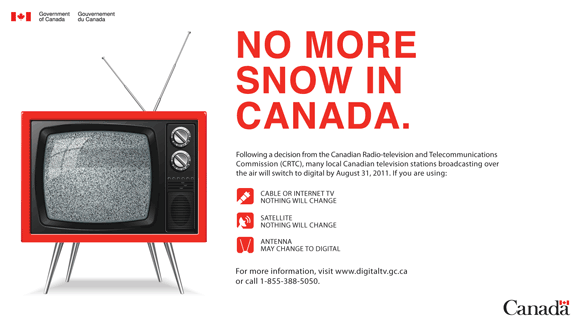
Canada’s transition to digital TV will take a substantial step forward on Aug. 31st when many Canadian local television stations cease broadcasting in analog.  Canada’s pay television providers are taking full advantage of the transition, trying to persuade Canadians who watch their television signals over-the-air for free they will be better off paying for those signals going forward.

Part of the problem is that digital television signals, while “snow-free,” are not pixel-free in many areas distant from the transmitter.  As Americans in suburban locations discovered, those trusty indoor rabbit ears may be insufficient to receive an annoyance-free picture.

Digital television signals are not the nirvana some suggest.  The same passing vehicles and aircraft that caused wavy analog pictures or other interference can turn a digital picture into a frightfest of frozen picture blocks, digital raining pixels, and other effects that can make watching a difficult signal near impossible.

For Americans who thought the days of the external rooftop antenna were behind them, digital television changed all that, especially in more rural areas that could live with a slightly snowy analog picture, but found sub-optimal digital signals unwatchable.

Canada’s vast expanse, and its accompanying large network of low powered television repeater stations rebroadcasting signals from major stations in provincial capitals and large Canadian cities may prove to be an even greater reception challenge, especially in the Canadian Rockies and hilly terrain in eastern Canada.

Some Canadians experimenting with digital-to-analog converter boxes have found reception less practical than they originally thought.

Peter, a Stop the Cap! reader who lives near Oshawa, Ontario delivers some difficult news:

“Reception of digital signals from Toronto’s CN Tower has proved to be a lot more difficult in Oshawa than the existing analog signals,” Peter writes.  “We have no trouble getting truly local signals like CHEX-TV, which has a transmitter in analog serving Oshawa, but watching digital signals from Toronto really requires an outside antenna for good reception.”

Snow may be a thing of the past, but bad digital reception like this may be here to stay for many Canadian viewers.

Peter’s decision to erect a rooftop antenna opened the door to reception of analog and digital signals from Toronto and across Lake Ontario, where he can receive digital signals from some stations in Buffalo and Rochester, N.Y.  But it was an expense of several hundred dollars to get the work done.

“Cable and satellite companies are taking full advantage of the digital switch to try and get free-TV viewers to ‘upgrade’ to pay television, and they don’t hesitate to mention the expense and hassle of erecting rooftop antennas to guarantee good digital reception,” Peter says.

Peter can only imagine what digital reception will be like in the Canadian Rockies, where large networks of analog, mostly low-powered UHF transmitters deliver basic reception to important networks, especially CBC, outside of major cities.

“If you visit western Alberta or eastern B.C., good luck to you — we could barely watch over the air signals in most of the mountain towns,” Peter says. “Most people either have cable or satellite already.”

Not every television transmitter is scheduled to switch off analog service at the end of August.  Many rural areas are expected to retain analog signals for some time, in part because of the expense of digital conversion and concerns about reception quality.  But some areas, particularly near the U.S. border, are scheduled to drop analog signals regardless, potentially causing disruptions for plenty of free-TV viewers.  Ottawa is anxious to auction off the vacated frequencies for cell phone, Wi-Fi and wireless broadband use for an estimated $4 billion, and the demand is highest in cities along the U.S. border.

“As many as 1.4 million English-language viewers and 700,000 Francophone viewers may be left without a CBC signal,” Ian Morrison, spokesman for the non-profit Friends of Public Broadcasting, which monitors the CBC and promotes Canadian content on TV and radio told the Toronto Star. “For the most part, these are poorer and older people on fixed incomes who are of no interest to advertisers, but who rely for their news and connection to the community on the CBC, the nearest thing we have in this country to a public broadcaster.”

The Canadian Radio-television and Telecommunications Commission runs a website regarding the transition and includes a list of impacted television stations.  Canadian consumers who elect to purchase converter boxes for their analog televisions will pay full price for them — Ottawa has not followed Washington’s lead subsidizing their purchase with a coupon program.

Meanwhile, many pay television providers are running “digital TV upgrade” specials trying to get Canadians to walk away from free TV in favor of paid video packages:

Shaw Direct: Shaw’s direct to home satellite service has developed the best offer around for qualifying residents in 20 Canadian cities set to lose analog television: free service.

“The Local Television Satellite Solution is [for] households in 20 designated cities that have been receiving their television services over-the-air, and will lose over-the-air access to their local broadcaster because the analog transmitter is being shut down and will not be replaced by a digital transmitter,” a Shaw spokesperson told the Toronto Star. “Shaw will provide a household in a qualifying area with a free satellite receiver and dish that is authorized to receive a package of local and regionally relevant signals from Shaw Direct. There are no monthly programming fees provided that a household qualifies to participate in the program.”

The qualifying cities:

Barrie Fredericton Moncton Sherbrooke
Burmis Halifax Québec St John’s
Calgary Kitchener Saguenay Thunder Bay
Charlottetown Lethbridge Saint John Trois-Rivières
Edmonton London Saskatoon Windsor

For everyone else, Shaw Direct’s least expensive package is their Bronze – English Essentials tier which runs $41.99 a month.
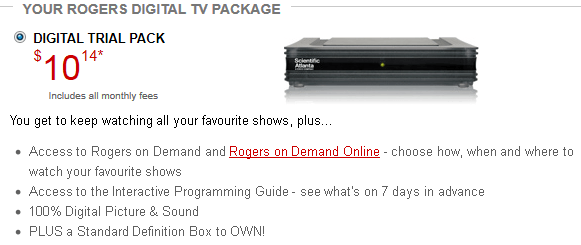
Rogers Cable: Rogers is marketing a special package called Rogers Digital TV which offers up to 85 channels for $10.14 a month, which includes all fees.  Many of the channels are included for the first year as a teaser.  After that, customers are left with mostly local stations and filler (including — we’re not kidding — the Aquarium Channel, which shows exactly what you think it does.  Remember, this is the same cable company that brought you the Swiss Chalet Rotisserie Channel.)

“It’s a fine way to get people used to paying for television, and Rogers introductory price is sure to increase at some point,” suspects Peter.  “Maybe you can save a few dollars using those Swiss Chalet meal coupons, though.”

Telus: Western Canada’s largest phone company doesn’t offer much, in comparison.  A basic package of Telus IPTV over your phone line — Optik TV — starts at $41 a month for the first six months.  Telus Satellite TV starts at $38.27 a month, for the first half of a year.  Prices run higher after that.  The most Telus will toss in is a $50 credit for a customer referral from a friend or family member.

Look on the bright side: When you pay for Rogers Cable, you can finally get to watch The Rotisserie Channel. The spinning chickens are waiting for you, in digital clarity, 24 hours a day on Ch. 208.

Bell: Another phone company with not a whole lot on offer.  Bell’s basic service, which includes TV stations from the U.S. and Canada, starts at $33.50 a month.

Videotron: Quebec’s largest cable company is pitching a combo mini-pack with basic service for $21.29 a month and a required extra channel package starting at $11.17 a month.  That’s around $33 a month.

Can you watch online?  The CRTC says you may find many of your favorite shows available online for free viewing, but includes the important caveat: most Canadian ISP’s engage in classic Internet Overcharging schemes that include a monthly usage allowance that will curtail substantial online viewing.  It should come as little surprise most of the providers in the pay television business in Canada also happen to be the largest Internet Service Providers as well.

About 93 percent of Canadians currently receive television from some form of pay television provider — cable, telco TV, or satellite, according to the CBC.  But some of the 7 percent who do not are at risk of losing Canada’s public broadcaster after the conversion.  While CBC owns most of the stations and transmitters it broadcasts from, it also affiliates with private stations in certain cities where it does have its own presence.

Come Sept. 1, no over-the-air CBC signals of any kind will be transmitted from London and Kitchener-Waterloo in Ontario; Sherbrooke, Chicoutimi, Quebec City and Trois-Rivières in Quebec; Saint John and Moncton in New Brunswick; Saskatoon, Sask., and Lethbridge, Alta.  These are all cities where private stations provided CBC service.  Viewers in these areas will need a pay television subscription, or simply go without.

For some of those already subscribing to cable, Sept. 1 also signals the end of some of their favorite stations, as CRTC requires cable providers to prioritize local stations over more distant ones.  In southeastern Ontario, for example, a number of viewers will lose access to CBLT, Toronto’s CBC station, and CFTO, Toronto’s CTV affiliate, in favor of “more local” stations in Kingston, Ottawa, and Peterborough.


Fox’s TV Everywhere Embargo Starts Today: Pay for Hulu, Subscribe to Dish Network, or Wait

Phillip Dampier August 15, 2011 Consumer News, Dish Network, Online Video Comments Off on Fox’s TV Everywhere Embargo Starts Today: Pay for Hulu, Subscribe to Dish Network, or Wait

Fox has turned off instant access to its network shows effective this afternoon for all but “authenticated” pay television customers.  But with only one partnered provider thus far — Dish Network — that leaves millions on an eight day waiting list.

Fox Network programming on its own website and Hulu is impacted by the new embargo, which means the vast majority will have to wait at least a week for access to new episodes.  Customers paying for Hulu + are not affected by the delay, and the network promises forthcoming partnerships with other cable and satellite providers shortly.

Fox says it’s all a part of “retransmission consent” agreements with pay providers.  Major cable operators don’t want to pay for Fox affiliates and cable networks if the network is willing to give away free access to programs online.  In return for blocking access to “cord-cutters,” cable companies hope to stop consumers from switching off cable television packages.

Viewers who try and access shows are brought to a new authentication page to “unlock” access to programming.  If they can’t because their provider isn’t listed, they can fill out an online form requesting their provider participate in the TV Everywhere project.

Most Fox viewers probably will not encounter the new FoxBlock until late fall.  That’s when new seasons of Glee, House, and The Simpsons get started.

Windstream’s 2nd Quarter: “Broadband For Us Is About Revenue Growth”

Phillip Dampier August 8, 2011 Broadband Speed, Competition, Online Video, Public Policy & Gov't, Rural Broadband, Video, Windstream Comments Off on Windstream’s 2nd Quarter: “Broadband For Us Is About Revenue Growth”

“We’ve been talking for some time that broadband for us is not just about customer growth… it’s about revenue growth.” — Anthony Thomas, Windstream’s Chief Financial Officer

For the first time in some time, Windstream reported revenue growth during the second quarter of 2011.  The independent landline telephone company that last week acquired Rochester-based PAETEC Corporation managed to win new revenue from its business services unit and equipment sales, even as it continues to lose core landline customers, who are disconnecting service in favor of cell phones or cable telephone products.

It added up to a measurable, but meager growth of 0.1 percent for the company year-over-year during the second quarter.

Like many traditional wireline phone companies, Windstream is betting the farm in their largely rural and suburban service areas on selling broadband and maintaining the allegiance of their business customers, challenged in larger cities by increasingly aggressive “Business Class” products from competing cable companies.

Windstream executives responded to questions from Wall Street bankers during their second quarter conference call held last Friday.

While several investment firms were happy to see Windstream manage some revenue growth, several zeroed in on the company’s increased capital expenditures.  Windstream reports the company will continue major investments in fiber and broadband services, but not primarily for their residential retail customers.  Instead, Windstream hopes to capitalize on the “high margin” business of selling fiber-based cell tower services, primarily to support forthcoming 4G deployments.

Windstream officials faced some hesitancy from Wall Street about the company’s spending during Friday’s conference call, particularly from Bank of America and Goldman Sachs.

Anthony Thomas, chief financial officer for Windstream, defended the investments.

“The most important part of fiber-to-the-tower projects are the initial investments. Those are very high-margin businesses,” Thomas said. “But you have be comfortable with the upfront capital and be patient at recognizing those are 6-to 12-month investment time horizons. But once you start bringing those revenues in, the actual cost of operating a tower is low.”

Wall Street also expressed concerns about consumer broadband traffic growth, but did not broach the subject of usage control measures like usage caps or metered billing.  Windstream acknowledged the growth, primarily from online video, and said it had well-equipped data centers to handle the traffic.

Windsteam’s Consumer Strategy: Bundle Customers & Keep Them Away from Cable TV

It's all about the bundle.

Online video may be an asset for Windstream, which is facing increasing challenges retaining landline customers and up-selling them other products like broadband.  That competition comes primarily from cable companies, who are targeting Windstream customers with invitations to cut their landline service and bring all of their telecommunications business to cable.

Traditional phone companies have a major weakness in their product bundle: video.  Independent phone companies, in particular, are usually reliant on satellite TV partners to support the television component of a traditional “triple play” bundle.  Windstream’s network is capable of telephone and slow speed broadband in most areas, but the company’s involvement in video is largely left to a third party satellite-TV provider.

Customers who do not want satellite TV service may be easily attracted to a local cable provider.  But as an increasing amount of video viewing is moving online, Windstream may find customers increasingly tolerant of doing their viewing online, reducing the importance of a video package.

Windstream’s strategies to keep customers:

  • Sell customers on product bundles, now enhanced with online security/antivirus options and on-call technical support for computer-related technical issues;
  • Pitch Windstream’s Lifetime Price Guarantee, which locks in a single price for basic services, good as long as you remain a customer;
  • Challenge cable competitors head-on with its “Quitter Campaign,” which tries to convince cable customers to “quit cable” in favor of Windstream;
  • Offer faster broadband speeds in limited areas to satisfy premium customer demand.

Windstream Tries to Convince Customers the Broadband Speeds It Doesn’t Offer Do Not Matter for Most

Windstream’s efforts at winning over new broadband customers have been waning as of late.  One of the primary issues Windstream faces is the cable industry’s effective portrayal of DSL as “yesterday’s” technology, incapable of delivering the broadband speeds consumers crave.

Instead of investing in improved broadband speeds for everyone, Windstream spends its time and efforts trying to convince most customers they don’t need the faster speeds being pitched by most cable companies in the first place.


Windstream tries to convince customers they can make do with less speed (as low as 1.5Mbps), and there is no difference in speed between different providers — both questionable assertions.  (4 minutes)

The COO says 3Mbps is Windstream's biggest seller -- their website says something else.

Windstream chief operating officer Brent Whittington says his customers “don’t want to pay for incremental speed,” but is expanding their capacity to offer somewhat faster speeds.

“We still see that long term as [an increased revenue opportunity] because we know the demand is going to be there,” Whittington told investors.  “As we’ve rolled it out currently, it’s largely to — from a marketing benefits standpoint to talk about our competitiveness relative to our cable competition, but [consumers] are largely buying at 3Mbps.”

Either Whittington is mistaken, or Windstream’s website is, because it promotes the company’s 6Mbps $44.99 option as its “top seller.”  Many of Windstream’s cable competitors charge less for almost twice the speed, which may be another reason why Windstream’s broadband signup numbers are lagging behind.

Finding More Revenue: Universal Service Fund Reform & Business Services

Among the most important components of Windstream’s strategy for future growth are reform efforts underway in Washington to overhaul the Universal Service Fund.  Rural, independent phone companies like Windstream have reaped the rewards of this subsidy for years in its rural service areas.  But now Washington wants to transform the program away from simply underwriting rural landline phone service and redirect revenues to enhancing broadband access in areas too unprofitable to service today.

Windstream sees the reform as a positive development.

“It focuses USF on high-cost areas,” said Windstream CEO Jeff Gardner. “If you were a customer in a rural area of Windstream versus a customer in a rural area of a small carrier, your subsidy would much be higher, and we would get very little USF for that going forward. In this proposal, USF is really targeted towards those high-cost areas, so we kind of deal with this issue that we refer to as the rural-rural divide.”

Gardner says USF reform will end disparity of access.

“All rural customers are going to have the opportunity to get broadband out to them under this plan,” he said. The more customers paying monthly service fees, the higher the company’s revenues, assuming nothing else changes.

While redirected subsidies may help rural broadband customers, Windstream’s capital investments in expanding their network are going primarily to benefit their business clients, not consumers.

“On the small business side, our service there is very superior to our cable competitors,” said Windstream’s chief financial officer Anthony Thomas. “We’ve made investments in our network to offer VDSL and higher-speed data services. That’s going to be directed predominately toward those small business customers.”

Whittington added most of the company’s efforts at deploying VDSL technology are focused on the company’s small business segment to bring faster speeds to commercial customers.  For consumers, Windstream’s efforts are targeted primarily at keeping up with usage demands.

“Like a lot of folks in the industry, we’ve definitely seen increases in network traffic really due to video consumption,” Whittington said. “No question Netflix and other related type services are driving some of that demand. We continue to invest in broadband transport like we have in years past. And the good thing with a lot of things we’ve been doing from just a network perspective like rolling out as I mentioned before, VDSL technology in our larger markets. That’s really all about fiber deployment, which helps solve some of those transport issues. So we feel like we’ve been in good shape there, but it’s certainly something we’ve been very focused on operationally so our broadband customers don’t see a degradation in the quality of their experience.”

AT&T Math: A ‘Heavy User’ Subject to Throttling Uses 4GB and Up

Loyal AT&T customers grandfathered on unlimited data plans are being paid back for their loyalty to the company with the threat of a speed throttle hanging over their heads if they don’t limit the use of their unlimited use plan.

The Washington Post reports, by AT&T’s calculations, anyone using 4GB of usage and up during the month is likely to find their smartphone neutered to near dial-up speed for the rest of the month:

The company said that it will throttle back data use for the top 5 percent of data consumers, who use “twelve times” what its average smartphone data customers use.

A recent Consumer Reports survey found that the average smartphone user on AT&T’s network uses 360 megabytes per month — meaning that only power users will feel the pinch. Using AT&T’s formula, the company’s likely scaling back its network for users who exceed 4 gigabytes per month.

Four gigabytes of usage on a smartphone is a considerable amount, if all you do is browse web pages, read e-mail, and access a handful of apps.  But consumers who increasingly rely on GPS navigation and streaming multimedia content, particularly videos, will find they don’t have to live on their smartphones to put themselves on AT&T’s bad side.  Even devoted attention to video streams from a home security system could consume a considerable amount of data on a usage plan that was supposed to be unlimited.

“It’s a slap in the face to loyal customers who have been with AT&T for a decade or longer,” says Stop the Cap! reader Paul.  “Wireless providers used to operate on rewarding loyalty by letting customers keep their plans intact unless and until they change plans or depart for another provider.  Now AT&T is literally cattle-prodding their most loyal customers who pay $30 a month for an unlimited plan that will now have limits.”

Paul wonders why anyone would want to keep an unlimited plan that will be throttled to punish customers with unusable speeds.

“Clearly, Verizon moving away from unlimited data allowed AT&T to stick it to customers who know they have few places to run,” Paul writes. “This is probably only the beginning.  Why again would we want AT&T to get any bigger than it already is?”

‘Measuring Broadband America’ Report Released Today: How Your Provider Measured Up

Phillip Dampier August 2, 2011 AT&T, Broadband Speed, Cablevision (see Altice USA), CenturyLink, Charter Spectrum, Comcast/Xfinity, Consumer News, Cox, Frontier, Mediacom, Online Video, Public Policy & Gov't, Rural Broadband, Verizon Comments Off on ‘Measuring Broadband America’ Report Released Today: How Your Provider Measured Up

The Federal Communications Commission today released MEASURING BROADBAND AMERICA, the first nationwide performance study of residential wireline broadband service in the United States.  The study examined service offerings from 13 of the largest wireline broadband providers using automated, direct measurements of broadband performance delivered to the homes of thousands of volunteers during March 2011.

Among the key findings:

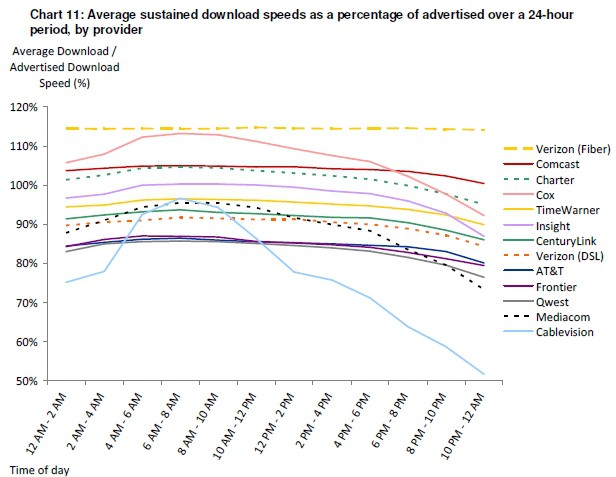
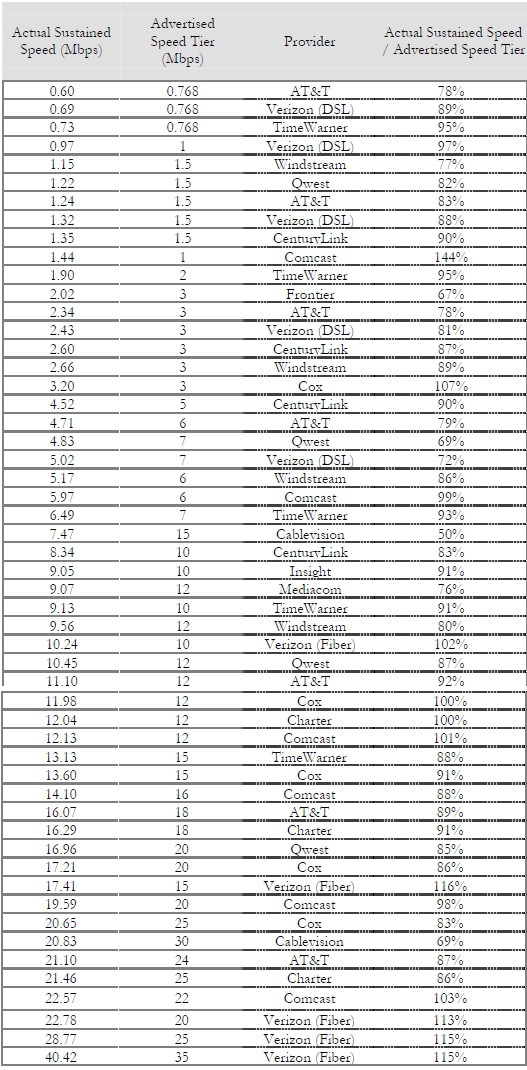
Providers are being more honest about their advertised speeds: Actual speeds are moving closer to the speeds promised by those providers.  Back in 2009, the FCC found a greater disparity between advertised and delivered speeds.  But the Commission also found that certain providers are more likely to deliver than others, and certain broadband technologies are simply more reliable and consistent.

Fiber-to-the-Home service was the runaway winner, consistently delivering even better speeds than advertised (114%).  Cable broadband delivered 93% of advertised speeds, while DSL only managed to deliver 82 percent of what providers promise.  Fiber broadband speeds are consistent, with just a 0.4 percent decline in speeds during peak usage periods.

Cable companies are still overselling their networks.  The FCC found during peak usage periods (7-11pm), 7.3 percent of cable-based services suffered from speed decreases — generally a sign a provider has piled too many customers onto an overburdened network.  One clear clue of overselling: the FCC found upload speeds largely unaffected.

DSL has capacity and speed issues.  DSL also experienced speed drops, with 5.5 percent of customers witnessing significant speed deterioration, which could come from an overshared D-SLAM, where multiple DSL customers connect with equipment that relays their traffic back to the central office, or from insufficient connectivity to the Internet backbone.

Some providers are much better than others.  The FCC found some remarkable variability in the performance of different ISPs.  Let’s break several down:

  • Verizon’s FiOS was the clear winner among the major providers tested, winning top performance marks across the board.  Few providers came close;
  • Comcast had the most consistently reliable speeds among cable broadband providers.  Cox beat them at times, but only during hours when few customers were using their network;
  • AT&T U-verse was competitive with most cable broadband packages, but is already being outclassed by cable companies offering DOCSIS 3-based premium speed tiers;
  • Cablevision has a seriously oversold broadband network.  Their results were disastrous, scoring the worst of all providers for consistent service during peak usage periods.  Their performance was simply unacceptable, incapable of delivering barely more than half of promised speeds during the 10pm-12am window.
  • It was strictly middle-of-the-road performance for Time Warner Cable, Insight, and CenturyLink.  They aren’t bad, but they could be better.
  • Mediacom continued its tradition of being a mediocre cable provider, delivering consistently below-average results for their customers during peak usage periods.  They are not performing necessary upgrades to keep up with user demand.
  • Most major DSL providers — AT&T, Frontier, and Qwest — promise little and deliver as much.  Their ho-hum advertised speeds combined with unimpressive scores for time of day performance variability should make all of these the consumers’ last choice for broadband service if other options are available.

Some conclusions the FCC wants consumers to ponder:

  1. For basic web-browsing and Voice-Over-IP, any provider should be adequate.  Shop on price. Consumers should not overspend for faster tiers of service they will simply not benefit from all that much.  Web pages loaded at similar speeds regardless of the speed tier chosen.
  2. Video streaming benefits from consistent speeds and network reliability.  Fiber and cable broadband usually deliver faster speeds that can ensure reliable high quality video streaming.  DSL may or may not be able to keep up with our HD video future.
  3. Temporary speed-boost technology provided by some cable operators is a useful gimmick.  It can help render web pages and complete small file downloads faster.  It can’t beat fiber’s consistently faster speeds, but can deliver a noticeable improvement over DSL.

More than 78,000 consumers volunteered to participate in the study and a total of approximately 9,000 consumers were selected as potential participants and were supplied with specially configured routers. The data in the report is based on a statistically selected subset of those consumers—approximately 6,800 individuals—and the measurements taken in their homes during March 2011. The participants in the volunteer consumer panel were recruited with the goal of covering ISPs within the U.S. across all broadband technologies, although only results from three major technologies—DSL, cable, and fiber-to-the-home—are reflected in the report.

Search This Site:

Contributions:

Recent Comments:

Your Account:

Stop the Cap!