Home » Online Video » Recent Articles:

Bailing Out the CW Network: Now Profitable Thanks to Netflix

Phillip Dampier October 20, 2011 Online Video Comments Off on Bailing Out the CW Network: Now Profitable Thanks to Netflix

The CW Television Network

First it was the United Paramount Network (UPN) and The WB Television Network (WB), two mini-networks run by their respective studios that simply refused to become profit centers and established challengers to more traditional broadcast networks.  In 1996, both networks combined to create The CW Television Network, and the result has been less than the two original networks had hoped.  Youth-oriented programming targeted to an audience that increasingly doesn’t watch traditional television and a challenging advertising market that has considerably declined since 2009 haven’t helped.

Now the folks in charge of the CW are resting a lot easier, all thanks to Netflix.  The movie streaming and rental service is reported to be signing an agreement worth upwards of $1 billion to access CW programming for its streaming service.

Les Moonves, chief executive of CBS Corp., which now co-owns the network with Warner Bros., couldn’t be happier.

“It essentially makes the CW a profitable enterprise,” Moonves said.

The Los Angeles Times reports:

Netflix is buying rights to repeats of current and future series on the network, and the longer the shows stay on the air and performs well, the more the subscription video company will pay for streaming rights.

For example, Netflix is paying in the neighborhood of $600,000 an episode for “Gossip Girl,” an established show, but will initially pay much less for newer or lower-rated CW programs, people familiar with the pact said. The window between when a new episode of a CW show appears on the network and then ends up on Netflix could be as long as a year.

Netflix has exclusive online subscription rerun rights to all episodes of all CW shows. However, CBS and Warner Bros. can still sell reruns to other outlets, including local television stations and cable networks.
Netflix is hurrying to sign new programming deals as it prepares to lose access to an important component of its streaming library — current movie titles that come courtesy of an expiring agreement with Starz.  Netflix said without renewing that agreement, it would spend heavily to try and find new programming to make up the difference.  The deal with the CW may be an example.

Cord Cutters Can Now Buy Package of Streaming News Channels

Phillip Dampier October 20, 2011 Competition, Editorial & Site News, Online Video 1 Comment

Besides sports, the biggest challenge for cord-cutters is to find access to 24-hour news channels they give up when they cancel pay television service.  While cable news often doesn’t actually spend much time on “news” when breaking stories are few and far-between, when something serious does happen, cord-cutters looking for live coverage can and do miss access to news networks.

But now a New York startup, RadixTV, has a solution for news junkies: Rtv.

Yesterday, the company launched a package of four cable news networks — Bloomberg, CNBC, CNBC World, and MSNBC streamed live 24 hours a day for $14.99 a month.

That’s a steep price for four channels, of which MSNBC is arguably the most important.  The company plans to expand to 10 channels in the future, including CNN, Fox News, and international news networks like BBC World, France 24 and Al Jazeera English that American cable companies routinely ignore.

Kaul

Rtv is pitched primarily to Wall Street — financial firms, brokerages, and investment businesses that want access to continuous business news but don’t need a traditional cable package.  In fact, the package is technically only supposed to be sold to business customers, but anyone can sign up if they say they are stock traders, accountants, investors, etc.

Stop the Cap! sampled Rtv this morning and found the service to work well with our broadband connection, although at times crawling news and stock prices found at the bottom of the screen on some channels seemed less smooth than they could be.  It occasionally was distracting.  MSNBC was the most compelling channel in the lineup, although we’d love to see international news channels even more.  But $15 a month is still a high price to pay.

The company’s CEO, Bhupender Kaul, worked for Time Warner Cable for nearly two decades, and believes the future of cable TV is likely to be Internet-based, with programming sold in niche packages like his.  True a-la-carte may be too unwieldy for providers to pull off, but selling groups of channels together might not.  Still, Kaul seems intent on not aggravating the industry as much as earlier cord-cutting online viewing services, which have all since been sued out of existence.  Local broadcast and general interest programming does not come with Rtv.  While a six figure-salaried Wall Street banker won’t mind $15 a month, you might.

Further reading: In New Web TV Service, A Glimpse of the Future

1 Down, 1 to Go: Bell Plans to Suspend Speed Throttling for Wholesale Customers

After nearly a half-million Canadians expressed outrage about Bell’s Internet Overcharging practices, the company is responding.  This week, Bell sent a letter to their wholesale customers announcing it plans to end the practice of speed throttling peer-to-peer file traffic (at least for them):

Effective November 2011, new links implemented by Bell to augment our DSL network may not be subject to Technical Internet Traffic Management Practices (ITMP).  ITMPs were introduced in March, 2008 to address congestion on the network due to the increased use of Peer-to-Peer file sharing applications during peak periods. While congestion still exists, the impact of Peer-to-Peer file sharing applications on congestion has reduced. Furthermore, as we continue to groom and build out our network, customers may be migrated to network facilities where Technical Internet Traffic Management Practices (ITMPs) will not be applied.

Peer-to-peer traffic, once all the rage for swapping music, movies, and software (legally or otherwise), has been declining as a percentage of Internet traffic and legal online entertainment services (Netflix, et al.) have become available.  Copyright crackdowns and usage caps manage to further restrict customers from leaving P2P software running continuously as it can rapidly eat into usage allowances.

With increased capacity of Bell’s networks and decreased interest in file swapping software among customers, the practice of throttling such traffic (along with the unintended collateral damage to online gaming), means such network management practices have outlived their usefulness.

Providers these days are far more likely to blame online video for congested networks.  But once providers attach a speed throttle to an application, it can be difficult to remove.  Even as Bell announced it would no longer throttle their wholesale clients, retail customers will still suffer with reduced speeds during “peak usage times” — 4:30pm-2am local time.

Michael Geist, who covers Canadian broadband issues, wonders if Bell’s throttles are actually in violation of the Canadian Radio-television and Telecommunications Commission’s traffic management guidelines:

While Bell says its congestion has been reduced, its retail throttling practices have remained unchanged, throttling P2P applications from 4:30 pm to 2:00 am.  Given the decline in congestion, a CRTC complaint might ask whether the current throttling policy “results in discrimination or preference as little as reasonably possible” and ask for explanation why its data cap policies “would not reasonably address the need and effectively achieve the same purpose as the ITMP.”  In fact, the same can now be said for many other ISPs who deploy broad based throttling practices (Rogers, Cogeco), which may not be reasonable under the CRTC policy.

Time Warner Cable Forfeits NFL Network, Again

Phillip Dampier October 17, 2011 Consumer News, Online Video 3 Comments

Time Warner Cable has ended the latest round of talks with the National Football League to bring the NFL Network and NFL RedZone to Time Warner cable customers.

Sports Business Daily reports the talks ended with a contentious meeting held last Friday at the cable company’s New York office.  Sources say the talks didn’t end with a dispute over the cost of the network, noted to be among the most expensive sports networks available.  That likely leaves streaming and other ancillary rights issues to be the latest reasons for the talks to end.  Time Warner has gotten aggressive in negotiations for the right to stream cable programming, and also time shift it for subscribers with its “start over” feature.

The NFL has been negotiating with the cable operator more more than seven years without success.


Oceanic/Time Warner Cable Subscribers Finally Get TWCable TV for iPad

Phillip Dampier October 11, 2011 Consumer News, Online Video Comments Off on Oceanic/Time Warner Cable Subscribers Finally Get TWCable TV for iPad

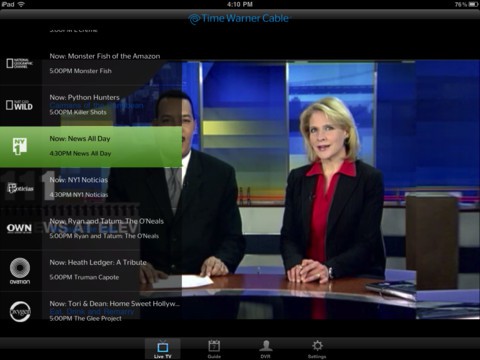
Hawaiian customers of Oceanic Time Warner Cable can now obtain the cable company’s free viewing app for iPad — TWCable TV.

Although the cable operator has offered the free online viewing app for months, it has not worked in Hawaii until this week.

“We are tremendously excited about this app, which is the first of many that will allow our customers to harness the power of their tablet-type devices,” said Bob Barlow, president of Oceanic Time Warner Cable.

Time Warner customers can use the app only within range of their home wireless router connected to Time Warner’s Road Runner Internet service.  Restrictions imposed by the cable company and programmers mean customers cannot access the service from other broadband providers or outside of their own home.

Time Warner also requires TWCable TV app users to maintain a cable television subscription and register for access on the company’s website.

Search This Site:

Contributions:

Recent Comments:

Your Account:

Stop the Cap!