Home » Online Video » Recent Articles:

If You Can’t Beat ‘Em, Join ‘Em: Telco Abandons IPTV in Favor of Online Video, Satellite

Phillip Dampier November 2, 2011 Broadband Speed, Competition, Online Video, Ringgold Telephone Comments Off on If You Can’t Beat ‘Em, Join ‘Em: Telco Abandons IPTV in Favor of Online Video, Satellite

Tiny Ringgold Telephone, which serves 122 square miles of northwestern Georgia, has pulled the plug on the company’s own video IPTV package and is encouraging customers to watch all of their television shows online or through a satellite TV package offered by DISH Network.

Ringgold was in the IPTV business long before AT&T began offering U-verse, having launched video over phone lines back in 2003.  The phone company invested heavily in producing local programming for their customers, including local sports, issues in the news, health and fitness, and educational shows for and about the region.  The hope was that the phone company would give cable subscribers enough reasons to cut the cable cord for good.  They’ve invested heavily to remain on the cutting edge, something uncommon for traditional wireline phone companies.
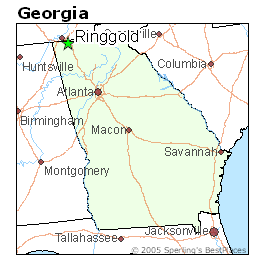
In 2000, Ringgold announced they would deliver a High Speed Internet connection to every single customer who wanted it throughout their entire service area.  The company has continuously upgraded their facilities, offering traditional copper wire customers bonded DSL service up to 25Mbps and their growing number of fiber customers speeds up to 50/50Mbps.  That’s an enormous difference over other nearby providers, including AT&T, Frontier Communications, and CenturyLink which deliver customers 1-3Mbps DSL with no fiber in sight.  The other alternative is service from Charter Cable, among the worst-rated cable companies in the country.

But that level of innovation isn’t unusual for Ringgold, which has outpaced traditional Bell System phone companies since it was first founded in 1912 with just eight telephone lines.

In 1950, Ringgold was among the first independent companies in Georgia to switch from manual to dial telephones.  By the 1990s, Ringgold realized the future was in fiber optics, and planned to replace a significant amount of copper wiring that had been on phone poles for decades.  The phone company thought it had mastered the ultimate triple-play fiber-optics package of voice, broadband, and television, until their small size got in the way.

Ringgold discovered that “bigger is better” in the pay television business.  The largest cable operators enjoy the best bargaining power for just about everything.  Companies like Comcast and Time Warner Cable can use their enormous customer base to negotiate cut rate pricing on programming and equipment and stand-up to greedy programmers that demand excessive payments for programming.  Ringgold discovered they can’t.

Light Reading highlighted the challenges Phil Erli, executive vice president of Ringgold, spoke about recently:

  • Ringgold could not cut a deal with equipment vendors that would deliver DVR and HD functionality at a level above that of the local cable company.  Large set top box manufacturers deal in volume, and smaller players like Ringgold are often left with inferior technology at prices higher than large cable companies pay for the most advanced equipment available.  Erli tried to innovate a new approach using Microsoft’s Mediaroom, but discovered that required a large number of servers too costly for a small phone company to consider;
  • Programming costs were completely out of line.  Volume discounting delivers enormous savings, if you are a large-sized national provider.  Large cable companies pay a fraction of the prices independent providers pay for programming, and local broadcast stations held the company hostage on retransmission consent agreements.  Erli noted the local NBC station, presumably in nearby Chattanooga, demanded an incredible $5.25 a month per subscriber.  That rate was so high, it would turn the company’s video venture unprofitable.  Even worse, Erli relates, “these weren’t negotiations, they told me what we would pay.”  Erli realized that just one programmer could make or break Ringgold’s video service profits;
  • The company’s video lineup, due to wholesale costs, was inferior to that offered by the local cable company.
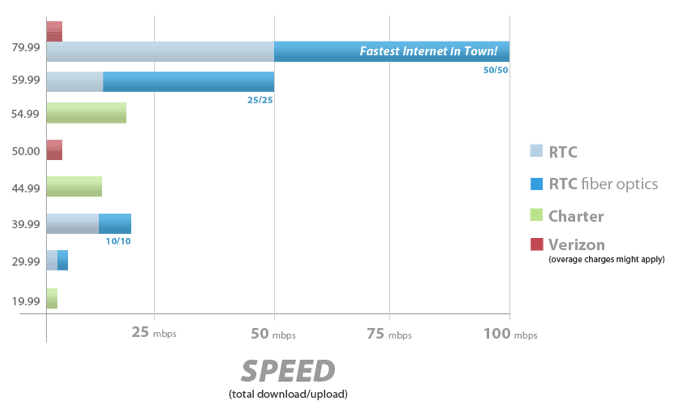
Ringgold's broadband network is superior to anything the competition offers in northwestern Georgia.

With these challenges, the phone company decided enough was enough and dropped its video package, redirecting customers to DISH Network for satellite-TV, and more recently to online Internet video as an alternative to pay television.

Something you won't likely see from your cable company.

While most broadband providers treat online video as a parasite, Ringgold sees it as the ultimate business opportunity to reinvent themselves through their broadband service — selling super high speed access to content that someone else provides and has to worry about.

They’re considering a new customer promotion that includes a Roku, Apple TV, or Clearleap-powered set-top box to integrate broadband connections with television sets.  The company is even educating customers about the growing number of programs available for free (or with a low cost subscription) online with an interactive web tool.

Ringgold’s new solution for online video also includes some small revenge on high programming costs, giving subscribers an integrated over-the-air antenna system that can pick up nearly a dozen HD channels, including that NBC station, for free.

[flv width=”640″ height=”380″]http://www.phillipdampier.com/video/Internet TV.flv[/flv]

Here is something you don’t see every day: Ringgold Telephone encourages its customers to get online and watch TV shows for free.  (1 minute)

Cablevision Struggles With Recession, Self-Inflicted TV Wounds, and Verizon’s FiOS

Cablevision executives reported dismal financial numbers for the third quarter of this year, as the cable company lost 19,000 cable television customers while profits plummeted some 65% at the Bethpage, N.Y.-based company.

Not even 17,000 new broadband customers could erase the damaging losses incurred by Cablevision cord-cutting, some of it as a result of the cable operator’s damaging retransmission consent disputes that deprived viewers of popular local broadcast outlets and cable channels.  The company lost so much subscriber goodwill, company executives admitted they pared back an anticipated rate increase just to protect themselves from further customer defections.

Programming disputes like this one with WABC-TV and their parent company Disney caused more than a few Cablevision customers to head for the competition.

Cablevision, like Time Warner Cable before it, won’t admit that cable cord-cutting is responsible for what one investment bank fears could be the start of an “ex-growth” era in cable television.  Instead, Cablevision executives continue to blame the poor economy for subscription losses, as well as aggressive pricing competition from their biggest rival — Verizon FiOS.  Adding pressure is the relentless demand for higher programming fees, which directly translates into relentless annual rate increases for cable television service.

“With regard to programming [costs, they are] an issue and it is an expensive part of our business.  It is the single biggest cost item we have,” said Gregg G. Seibert, Cablevision’s chief financial officer and executive vice-president. “And the fact that retransmission consent became necessary from the eyes of broadcasters, particularly after the 2008 recession, has been flowing through our business, and there was a large step up [in fees]. I think that the overall rate of programming [costs] going forward will moderate to some extent naturally.”

Seibert called the aggressive retransmission consent fee disputes between broadcasters and cable operators evidence of the collapse of the traditional “free TV” business model.  Because ad revenues are down, broadcasters are increasingly dependent on fees charged to cable operators for permission to include their stations on the cable dial.  That means cable subscribers are increasingly subsidizing the broadcast television business.

Seibert

Seibert’s revelation came too late to stop some of the nation’s most visible retransmission consent battles between Cablevision and network-owned New York-area television stations and cable networks.  When Cablevision blacked out a local station showing coverage of the World Series during the last dispute, fed up customers decided to take their cable business to Verizon or a satellite TV provider.

Cablevision has been trying to lick their wounds ever since, launching increasingly aggressive pricing promotions and “free gift” offers to keep existing customers while trying to win back old ones.

“We’ve recently introduced an offer that includes a new Apple iPod Touch primarily for win back situations,” said Thomas M. Rutledge, chief operating officer.  “Selling for the Triple Play package of video, data, and voice is now at 74% and roughly half of this selling is for our new Ultimate Triple Play, which includes a new higher-priced Boost Plus [broadband] service and a wireless router.”

Cablevision achieves triple-play signups by heavily discounting the package for new and returning customers.  It also hopes to succeed with a ‘more for less’ pricing strategy, delivering new features and services without necessarily charging extra for all of them.  With discounts, free gifts, and additional services, Cablevision is getting some of their old customers back.

Selling faster broadband is a key component in Cablevision's strategy to attract more broadband customers. Boost Plus delivers 50/8Mbps service for an additional $14.95 a month.

“As of September 30, our win back total is more than 45% of customers who once tried Verizon FiOS,” Rutledge claims.

Rutledge noted Cablevision’s participation in the industry’s TV Everywhere online video initiative has grown even stronger with the recent agreement to provide Cablevision cable-TV customers free access to Turner-owned cable network programming.

Seibert admits the more competitive business environment and high profile programming disputes in suburban New York City are impacting profits.

“We had a few significant items in the quarter affecting our results including higher programing costs and higher sales in marketing as we continue to aggressively promote our products and services while revenue growth was essentially flat,” Seibert said.

Those challenges are creating a sense of unease on Wall Street regarding the cable business’ core product: cable television and the increasingly aggressive pricing promotions necessary to keep customers from disconnecting service.

“There is growing concern among the investor community about [the] whole [cable] industry going to ex-growth,” said Jason Bazinet from Citigroup.

Rutledge

“Programming costs are rising faster than video revenues,” Sanford C. Bernstein, an analyst for Craig Moffett, told the Wall Street Journal. “Unless there’s growth somewhere else in the business model, you’ve got the worst of all worlds: a slow-or no-growing business with lower margins.”

Rutledge outlined Wi-Fi and broadband enhancements as part of Cablevision’s priorities for the upcoming quarter:

“We’ve been building out a Wi-Fi network and we’ve had continuous subscriber utilization increases on that network.  We now have more than one-half-million devices out there that can use Wi-Fi and watch our full cable television service in the home.

“And we’re deploying a new Boost product with higher speed broadband, which includes a more sophisticated wireless router as part of that package.

“We think Wi-Fi is a major strategic part of our business. We think that we can continue to take advantage of that. We think our video product today as a result of Wi-Fi is a superior product to our competitors – all of our competitors, and we think that our data service is enhanced by the Wi-Fi outside the home, and we continue to try to build value for our customers and take market share.”

The cable company is already aggressively marketing its Boost Plus service, which delivers 50/8Mbps broadband for an additional charge of $14.95 a month on top of the standard broadband rate.

Bright House Networks Customers Get Rebranded Time Warner iPad App for Online Viewing

Phillip Dampier October 31, 2011 Consumer News, Online Video Comments Off on Bright House Networks Customers Get Rebranded Time Warner iPad App for Online Viewing

Bright House Networks customers now have access to more than 100 channels of online video entertainment thanks to the cable company’s release of Bright House TV, a new free app for the Apple iPad.

Essentially a rebranded version of Time Warner Cable’s TWCable TV app, Bright House TV comes with the exact same restrictions that have peeved more than a few Time Warner customers trying to use it:

  • You must have a minimum of Bright House Networks’ Digital-Basic Cable TV service to watch;
  • You must use your Bright House-supplied Internet connection to access the service on your home’s Wi-Fi connection;
  • The service will not work outside of your home, over alternative Internet connections, or through your smartphone;
  • You cannot currently access the service on any device other than an iPad.

For customers who do manage to meet all of these conditions, many report they are satisfied with the performance of the app.

“A great 1.0 version, acts as advertises, and HD looks great on the iPad,” says Bright House customer Chris McGonigal. “I would like to see fullscreen option (even though it cuts image), and the ability to hide the Status bar at the top. Also a favorite channels list, which kind of works with channel history.”

One other thing Bright House customers have in common with Time Warner Cable — they are still waiting for HBO Go, too.

“Here’s to seeing HBO Go on BHN next,” he adds.

Analyzing Time Warner Cable’s Latest Quarterly Results: Broadband, Broadband, Broadband

Phillip Dampier October 27, 2011 Broadband Speed, Competition, Consumer News, Data Caps, Online Video, Wireless Broadband Comments Off on Analyzing Time Warner Cable’s Latest Quarterly Results: Broadband, Broadband, Broadband

Time Warner Cable experienced another challenging quarter, continuing to lose cable TV customers who either drop or pare back their television service, often in favor of broadband.

The company reported losses of an additional 128,000 video subscribers during the third quarter, but is partly winning that revenue back with new broadband customers — 89,000 of them in the last three months.

“Broadband is a powerful service for which there appears to be unquestionable consumer thirst,” Time Warner Cable CEO Glenn Britt said on the investor call. “Over time, we will contribute more of our plant’s capacity to broadband.”

The company is also poised to expand its marketing to win new broadband customers away from their primary competition — telephone company DSL service.  Company officials remain confounded by customers who subscribe to Time Warner’s cable TV service and take broadband from “inferior” phone company-delivered DSL.  Time Warner will continue to target these customers with win-over promotions offering a year of Road Runner Standard Service at the $29.95 promotional price point.

For the company as a whole, this is the tenth consecutive quarter of year-over-year residential broadband revenue improvement, coming from a combination of higher-priced, faster speed tiers, price increases, and subscriber additions.  The company’s DOCSIS 3 upgrade has proven itself a winner for customers and the company, with 18 percent of Time Warner subscribers now choosing 30 or 50Mbps broadband services.

Wall Street expressed some concern about statements from CEO Glenn Britt that the company was going to expand capital spending on broadband to handle increasing demand, especially from online video.  That concern comes despite the fact the company’s “capital intensity” (spending) from January-September was the lowest in the history of the company.  The full year’s capital spending is on track to reach up to $3 billion, which is consistent with what the company spent last year.

Glenn Britt

So despite the plans to spend more on broadband, that spending is actually in line with previous years.

In response to an opening question from Deutsche Bank’s Doug Mitchelson, Britt delivered an extended explanation downplaying the company’s spending plans:

In a way, there’s nothing really new here. I think you’ve seen this trend for a while. Our broadband product is very strong.

As most people know, the usage of broadband is skyrocketing, as it has been for some time. And that means that we will need to spend more money on it. We have been already, both in capital and operating expenses.

The great thing about the Internet is lots of third parties dream up lots of new applications that require more speed and more bandwidth. And we anticipate that we’re going to have to devote more capacity to that over time. We will do that by gradually removing our analog signals from our — analog TV signals from our plan. We’ve been doing that over the last several years by migrating to digital using Switched Digital technology. And over the next several years, we’ll be going all digital in the TV space.

I don’t see this driving a dramatic change in our cap spending, I think, to the core of your questions. The spending has been going on for a while, and I think you’re seeing a change in mix. The video spending is going down over time. The business services is going to go up, although it didn’t this quarter. And you’re going to see the spending on broadband going up. But I don’t think the overall trajectory is mutually different.

This quarter, the company’s conference call seemed to embrace greater broadband usage, and pondering Internet Overcharging schemes like usage caps or usage-based billing never came up.  But Richard Greenfield from BTIG alluded to usage in his questions to Rob Marcus, president and chief operating officer at Time Warner Cable.

“I think we’re somewhere in the 7GB a month [range] of downstream bandwidth on a median basis,” Marcus said. “The average is much higher given the disproportionate usage by our high-end users.”

There were plenty of other facts to be gleaned from this morning’s conference call:

TV

  • Whole Home DVR service has been introduced nationwide.  In the coming year, Time Warner will begin deploying “home gateways,” which reduce equipment costs;
  • Time Warner is testing improved cloud-based set top boxes with home networking capabilities in parts of Syracuse, Los Angeles and Dallas.  These boxes will expand across the country in 2012.  They offer better search capability and deliver an improved user experience;
  • 60% of customers reject “triple-play” offers from Time Warner and choose either “single” or “double-play” service instead;
  • Much of Time Warner’s revenue growth is coming from rate increases on programming, services, and equipment;
  • TV Essentials, the smaller, less expensive video package, is now available in New York City and Northeast Ohio, as well as upstate New York. It will launch nationwide by year end.  Unsurprisingly, company officials admit the less-than-attractive channel lineup has resulted in the vast majority of customers calling about the offering taking the traditional video package instead;
  • Customers continue to drop ancillary services to cut their cable bill.  The increasingly expensive DVR box is a new target for cutting, and premium movie channels, adult pay-per-view, and mini-pay services all continue to suffer significant declines in business;
  • The Google-Motorola deal will likely have little impact on Time Warner’s set top boxes, which primarily come from Cisco and Samsung.

Broadband

  • By the end of the year, Time Warner plans to offer an Android-based TV Everywhere application similar to the existing iPad application, which will also continue to be upgraded to include on-demand offerings;
  • Time Warner will make their TV Everywhere service available on game consoles, smart TVs and PCs in the near future;
  • New York City customers will soon be able to select from a range of local broadcast stations on the company’s iPad app.  Other markets will start to see local channels added to this app in 2012;
  • Major parts of Time Warner’s capital investments this year are: building data centers in Charlotte and Denver, conversion to all-digital in Maine to make room for enhanced broadband, and the continued rollout of DOCSIS 3.0. The company is also continuing to spend significantly on wiring commercial buildings to sell services to business customers;
  • TV Essentials customers will soon be offered a “lite user” slower speed discount broadband plan to accompany their video package;
  • In Los Angeles, Wideband 50Mbps customers also get 2 gigabytes of 4G/3G mobile broadband for no additional monthly charge on the company-branded Clearwire service. For Turbo Plus and Wideband 30Mbps customers, they can get the same 4G/3G capability for an additional $10 a month. Standard and Turbo customers can get it for an extra $20.  The company’s mobile broadband add-on product has not enjoyed much success with paying customers, however.  Time Warner hopes the value-added bundling of mobile broadband will attract more interest.

Phone

  • Cord-cutting is now impacting Time Warner “digital phone” service, too.  Customers are increasingly reluctant to purchase phone service from any landline provider.  Now Time Warner’s regular pricing is starting to cost them business.  Executives revealed Time Warner’s “digital phone” service costs the company $9.06 to provide.  They charge consumers $30.  With that kind of profit margin, the company admits it will have to get more aggressive in pricing to attract new customers (and potentially keep existing ones);
  • Time Warner lost 8,000 residential voice line customers last quarter, cushioned by net additions of 13,000 business line customers;
  • The company continues to show little interest in selling cell phone products or services, either owned by themselves or others.  Mobile data remains an exception.

Let Consumers Buy Cable Boxes and Stop Endless Rental Charges

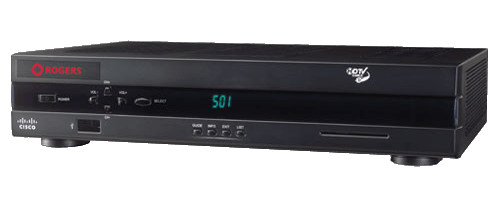
Rogers Cable lets their customers purchase this cable box outright to avoid rental charges.

Stephen Simonin first came to our attention in January 2010 when he proposed charging cable operators room and board for their expensive cable set top boxes they require subscribers to rent.  Now, the chairman of the Litchfield (Conn.) Cable Advisory Council is back with another salvo — demanding an end to mandatory rental charges for cable TV equipment and access to competing providers:

The biggest industry in the US that has money for jobs is the entertainment industry. Federal law requires Cable to carry local broadcast and public channels in the clear for all. If we contact our Federal representatives and ask them to add: “Must carry adjacent competitors programming” We would add a million USA jobs immediately. Paid for by corporate cable and NOT tax dollars!

Cable has forced all of us to RENT cable boxes. We are not allowed to buy them because this is guaranteed free revenue forever for them. A box costs less than $100 and we pay nearly $10 a month for rental and power each month. Cablevision makes over $1,000,000,000 a year on set top box rentals alone. This is only one company! They have compressed TV to less than 20% of the transport. They use the other 80% for business and not covered under TV franchise (Wi-Fi, data, phone business). However, they use the TV franchise for this monopoly access to our front doors.

Adding this must carry clause will allow up to 5 different cable providers at our front doors for lower costs, higher quality and real competition. Cable will not want to give up that fat 80% business revenue they have today and will need to add a new fiber/co-ax transport across the country on their nickel! Think how many local jobs $1,000,000,000 can pay for. Now remember that we have several cable companies here in CT!

These are American jobs! Please help us get this passed! Call our Federal Congressman and Senators today. Remind them of the details I have sent them on behalf of the People.

Simonin’s proposal, sent to Stop the Cap!, enjoys some precedent… in Canada.

Sky Angel, a Christian television distributor, abandoned satellite in favor of IPTV several years ago. Their subscribers watch Sky Angel's channel lineup over a broadband connection.

Consumers there can purchase cable boxes in stores like Best Buy ranging from $80 for a refurbished unit that works with Shaw Cable to $500 for a cable box with DVR designed for Rogers Cable customers.  Buying your own box puts an end to rental fees, often $7+ per month, which never stop, even after the box is effectively paid for in full.  But for those seeking a built-in DVR, the initial price tag is on the steep side.  The practice of buying boxes has also generated some surprising competition between Rogers and itself.  When customers call to inquire about new service, Rogers often includes discounts including free box rentals, making it unnecessary to purchase the box at all (as long as you remember to re-negotiate an extension of the promotion when it ends).  That’s a savings of nearly $100 a year for some customers.  Buying DVR equipment guaranteed to work with your current provider also makes it easy to upgrade the device with larger capacity hard drives that can store more programming.  Since the failure point for most DVR’s is the hard drive, occasional replacements and upgrades can keep a box running for years.  Many pay providers in the United States charge higher rental prices for higher capacity equipment, with no option to buy.

Simonin’s proposal to open up cable networks to other providers is more novel, and probably a lawyer’s dream come true for the endless litigation it offers.  It’s highly unlikely the courts will side with the notion of forcing cable operators to open their infrastructure to competing providers, and considering the amount of informal collusion between companies today, it’s probably not going to deliver much savings.

A bigger hope on the horizon is the ongoing march to IPTV — television programming delivered using Internet technology.  With strong Net Neutrality policies in place (and a strong position against Internet Overcharging with usage caps or usage-based billing), dozens of new virtual “cable companies” could be launched, delivering their lineups over the Internet, direct to computer and television screens.  That could deliver consumers an endless choice of providers, assuming regulatory oversight is in place to make sure programming is available to all at fair and reasonable prices and that broadband providers are not allowed to block or impede access to the offerings that result.

It’s much easier to do an end run around Big Cable than trying to find a way to get them to change their business plans.

Search This Site:

Contributions:

Recent Comments:

Your Account:

Stop the Cap!