Home » Online Video » Recent Articles:

AT&T’s Internet Overcharging Merry-go-Round — Billing App Makers for Your ‘Overusage’

AT&T’s march towards monetizing data usage has just gotten a twist with a new idea from the company to develop “a toll-free wireless Internet” where app makers foot the bill for your data usage.

First appearing in a Wall Street Journal article, John Donovan, AT&T’s executive for network and technology, suggested the new “app maker pays”-option will ease consumers’ fears about using high bandwidth apps that eat into AT&T’s data allowances.

“A feature that we’re hoping to have out sometime next year is the equivalent of 800 numbers that would say, if you take this app, this app will come without any network usage,” Donovan said at the Mobile World Congress in Barcelona, Spain. “It’d be like freight included.”

Critics of the idea pounced immediately, calling AT&T’s latest plan the realization of former CEO Ed Whitacre’s dream that content producers “can’t use [AT&T’s] pipes for free.”

Harold Feld, legal director at consumer group Public Knowledge thinks he’s got AT&T’s number:

Just to be clear, here is what AT&T Wireless is doing:

1. Create an artificial scarcity with an arbitrary bandwidth cap for its wireless services;

2. Charge users who exceed this arbitrary bandwidth cap;

3. Claim to do consumers a favor by letting the ap developer pay for exceeding the arbitrary bandwidth cap.

Which cuts to the heart of the problem in wireless, IMO. The argument in favor of a wireless capacity cap is, in a nutshell, “wireless is different from wireline because the physics imposes bandwidth limitations.” In the presence of these bandwidth limitations, we need a rationing scheme of some kind. Bandwidth caps are a neutral way of rationing and encourage app developers to write more efficient applications — thus improving the system overall.

The problem with this argument is it is impossible at present to determine just how true or false it actually is. I referred above to AT&T’s bandwidth cap as arbitrary. As far as I (or any outside observer) can tell, AT&T just selected a number and said “this is where we impose a cap.” You can buy a higher cap on a monthly basis, or can pay as you go above the cap in the form of overages.
Courtesy: Broadbast Engineering

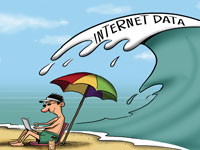
AT&T has no worries about data tsunamis and "exafloods" when app makers or consumers are willing to pay more.

In fact, AT&T’s journey away from unlimited access to their wireless network is well underway.  Just two years ago, customers paid $30 a month for unlimited data on a smartphone.  Then AT&T ended “unlimited” access, imposing a 2GB usage cap on their most popular wireless data plan.  Now AT&T is looking to monetize its wireless traffic even further as customers grow more reticent about using high volume applications that could threaten one’s usage allowance.

Despite AT&T’s ongoing drumbeat America is in the midst of a wireless bandwidth crisis, the ‘national emergency’ is over as soon as someone — anyone other than AT&T — opens their wallet and agrees to pay more for data traffic.  Then the sky is the limit.

The logical inconsistencies of a company crying for more mobile spectrum concurrently envisioning new ways to monetize high volume wireless traffic (eg. large file downloads, online video, etc.) exposes the hollow center of  Internet Overcharging.  The “exaflood”/data tsunami only seems to threaten AT&T’s network when content producers and/or consumers are not paying extra for every kilobyte.

As Stop the Cap! has argued before, AT&T is increasingly  in the bandwidth shortage/rationing business.

The company underspent on its network, balked at the price tag to upgrade capacity (but had no trouble planning to pay substantially more to acquire T-Mobile), and now complains it has to charge higher prices because the federal government blocked its merger and the FCC won’t hand over additional spectrum.

There are two approaches to fat profits in the broadband business these days:

  1. A Proud Member of: Team Rationing for Profit

    Team Innovation: Believe in your product and nurture its growth with upgrades, innovation, and pricing that guarantees an enthusiastic and loyal customer base;

  2. Team Rationing for Profit: Leverage your dominant market power by rationing your product, charging higher prices for less service.  Monetizing usage controls traffic growth, reducing the expense of upgrading your network. With limited competition, even alienated customers face few alternative choices and a steep early termination exit fee.
Based on statements from AT&T’s Donovan, AT&T is a firm believer in the latter.

“There’s a view of an entitlement that says that any impediment to riding over the top of our network is inherently wrong, is un-American,” Donovan said, adding AT&T needed to find creative ways to deal with and profit from surging mobile-data use.

Feld thinks it says something else.

“This new plan is unfortunate because it shows how fraudulent the AT&T data cap is, and calls into question the whole rationale of the data caps,” Feld said. “Apparently it has nothing to do with network management.  It’s a tool to get more revenue from developers and customers.”

In Denial: Nielsen and Cable Industry Still Don’t Believe in Cord-Cutting

ABC’s Daisy Whitney (New Media Minute) went in search for evidence that Americans really are fed up with their cable TV bill and are cutting the cord.  She collided head-on with an industry still in denial that consumers are fed up with high cable bills and relying on their home broadband connection for video entertainment.

Nielsen reports there are 5.1 million homes in the U.S. that have broadband-only service from their provider, and presumably rely on over-the-air TV for live televised events.  That’s up a huge 23 percent over last year.  But some analysts dismiss that as growth that comes from homes that never had broadband in the first place, a conclusion that needs more evidence to back it up.

Providers admit most of their new customers are coming from other broadband providers, especially as Americans dump slow DSL in favor of faster cable or fiber-delivered service.  In most areas, those who want broadband service already have it.  The primary exception: rural residents just accessing newly-available broadband for the first time.

For 20 years, the cable industry has enjoyed a growth in video subscribers.  That is no longer the case.  While the numbers are not staggering, hundreds of thousands of big cable customers are dropping their cable TV subscriptions every quarter, and they don’t seem to be taking their business to the competition.  Granted, many cancellations are income-related, especially among video-only customers, but it is clear a ceiling has been reached on what Americans will tolerate from the cable company.

With programming rate increases continuing unabated, that bill is only going up.

[flv width=”640″ height=”380″]http://www.phillipdampier.com/video/ABC Quitting Cable TV Truth or Lie 2-22-12.m4v[/flv]

Daisy Whitney’s New Media Minute explores cord cutting.  (2 minutes)


Rogers: Bill Shock Warnings Cost Us Money; Subscribers Fearing Fees Stop Using Data

Phillip Dampier February 23, 2012 Broadband Speed, Canada, Consumer News, Data Caps, Online Video, Rogers 1 Comment

Ever wonder why cell phone companies are upset about new regulations that would warn customers when they are about to face mobile usage overlimit or roaming fees?  Rogers Communications explains why in their latest quarterly results:

Nadir Mohamed, CEO:

There was, however, a sequential slowing in the wireless data revenue growth rate, and that’s primarily attributable to new outbound data roaming plans that we put in place. With these new plans, we put in place automated customer notification mechanisms that had a net effect of slowing usage versus stimulating it to the degree that we expected it to. We’re in the process of modifying how these plans and notifications work, which I expect will have a more stimulative effect and help restore the trajectory we had for wireless data growth.

In simpler terms, Rogers began notifying their customers through text messaging when they were about to start data roaming — the most expensive data usage around, incurred when you leave Rogers’ service area and roam on another provider’s network.  With Canadians visiting the United States and elsewhere, using a cell phone while traveling can get expensive fast.  Rogers created new roaming data plans for customers likely to need the service while abroad.  But their roaming data plans come at steep prices:

Unintended consequences: When subscribers know they are about to pay more, they stop using.

U.S. Data Passes

Day Pass: $5 for 2MB
Day Pass: $10 for 10MB
Day Pass: $20 for 40MB
Week Pass: $25 for 15MB
Week Pass: $50 for 60MB
Week Pass: $100 for 250MB

The warnings that customers were about to incur even higher a-la-carte roaming fees or start to consume their day or weekly data pass had the unintended, but highly predictable effect of getting people to think carefully about using data while roaming.

Bruce

While good for consumers, that is bad for Rogers’ bottom line, so the company’s formerly frank warnings to customers are “being modified” to help the company “stimulate” revenue and restore the predicted revenue growth from the high-priced roaming plans.

“We tried to create real transparency about when people and how people could get on data packages as they went overseas,” admits Robert Bruce, president of Rogers Communications Division. “We put in a fair number of reminders to let people know that they were on à la carte pricing, and we think that these dissuaded significantly customers from using it and possibly created some confusion along the way.”

Rogers Cable customers are also finding some of the company’s newest innovations a challenge to their monthly broadband usage allowances, among the lowest in Canada:

  • Rogers Remote TV Manager: Enables cable subscribers to search programming and manage PVR recordings anytime on any device;
  • Rogers Live TV. This service lets cable customers stream live TV channels on their tablets and watch shows anywhere they are in the home;
  • Rogers On Demand TV app on Microsoft’s Xbox 360 LIVE platform, bringing Rogers On Demand TV to the gaming console;
  • A refresh of the digital cable user interface, improving ease of use for the Whole Home PVR and a better program guide and search function.

In the long term, Rogers is moving towards an IP-based delivery system for its video programming, allowing the company to deliver video across different platforms more efficiently.  As Rogers converts the rest of its cable systems to digital cable, it is opening up new broadband capacity — a critical part of the company’s revenues.

Rogers admits it uses data caps to drive revenue.  By moving customers into higher usage, more expensive tiers, Rogers is able to drive revenue upwards as well.

“As customers continue every quarter, in and out, to consume more and more and spend more and more time on the Internet, we think it’s both a great opportunity for us and a welcome addition to the product offering from a customer perspective,” Bruce said.

Updated: Here Come the Streaming Paywalls: Comcast, March Madness Now Charging for Online Access

Phillip Dampier February 22, 2012 Comcast/Xfinity, Consumer News, Online Video, Video 3 Comments

The Great Wall of Pay

Now that the cable industry’s “TV Everywhere” online video platform has been established, some programmers are discovering they can become lucrative revenue streams as well as a deterrent to cable cord-cutting.

Time Warner (no relationship to Time Warner Cable) and CBS have decided giving away live sports programming for free is unacceptable and will now charge for online viewing of certain March Madness basketball games.

Since 2006, the basketball tournament, which may include hoops from https://www.megaslam.com.au/adjustable-basketball-hoops/, has been available for free online viewing, but starting March 7, viewers will need to pay $3.99 for full access to all 67 games [and basic cable viewers will need to verify] they are current cable, satellite, or telco TV subscribers. [See clarification below.]

Online viewing of games televised on CBS will be available for free, but the new paywall will block free access to selected games shown on cable networks TNT, TBS, and TruTV in certain cases.

Time Warner CEO Jeff Bewkes sees charging for online viewing as a substantial new revenue stream.

Monetizing online viewing is a high priority for programmers, even though much of the programming will continue to carry commercial advertising.  Last year, an estimated 2.6 million daily visitors watched March Madness online.  At $3.99 each, that would net the two companies nearly $10.4 million dollars.

The madness will now cost you $3.99

In a separate announcement, Comcast says it will launch a new Netflix-like on-demand streaming service tomorrow for its cable subscribers.

Streampix (free for triple play customers, $4.99/mo for others) will offer on-demand movies and TV series licensed from NBC-Universal, Warner Bros., Sony Pictures, and Disney.

Selected content can be watched while on the go, but a substantial amount of what Streampix is expected to offer is already available through services like Hulu.

Streampix is designed to appeal to customers who currently pay $7-8 a month for Netflix or Hulu+.

The move establishes Comcast’s own “paywall” for a deeper catalog of online video content, supplementing programming it gives away at no charge to “authenticated” cable subscribers.

Comcast will not sell Streampix to non-Comcast customers.

[flv width=”640″ height=”380″]http://www.phillipdampier.com/video/Bloomberg Comcast Streampix 2-21-12.flv[/flv]

Bloomberg reports Comcast’s Streampix service is unlikely to pose a major challenge to services like Netflix.  (4 minutes)

Clarification:  A reader suggested we better clarify the viewing options.  It gets complicated depending on what kind of video/broadband subscription you have, where you want to watch, and what kind of feed you want:

CBS-televised games: Available for free with no restrictions from CBS website.

Basic Cable games: If you want to watch outside of the home, on certain portable devices, or do not have a combined broadband/cable-TV subscription, you will need to purchase a subscription for $3.99 from the NCAA.  Free streaming is only available to authenticated cable/broadband subscribers watching from their home broadband account on devices pre-approved by your pay television provider.

Open/Full Access: If you want full, unrestricted access you need to pay for the NCAA ® March Madness ® Live™ app ($3.99).  Since this app provides the NCAA’s own video and audio feeds, you don’t need a cable subscription.

The TV Antenna is Making a Comeback

Phillip Dampier February 22, 2012 Consumer News, Online Video, Video 1 Comment

Rabbit ears are making a comeback.

After this year’s cable and satellite rate increases, the average American is now spending $550 a year on basic cable television.  With declining middle class incomes and increasing energy and health care costs busting the budget, something had to give.  Increasingly, it is cable and satellite TV.  Now consumers are combining the past with the future to find a cheaper way to watch television — over the air “free TV” with streamed online video entertainment.  Many broadcasters even offer extra channels that are made possible through digital signal compression.

Some marketers are going over the top with the renewed interest in over the air television, pitching “futuristic” television antennas at a steep price to customers who want to cut cable’s cord.  While your parents and grandparents were well-acquainted with antenna technology, today’s younger generations are not, and are overpaying for antennas you can find for a fraction of the price at Wal-Mart.

The concept of cord cutting is simple.  You can watch live sporting events and local news and network shows from over-the-air broadcasters and catch up on favorite movies and TV series streaming shows online.  The days of the snowy picture are over since the country converted to digital TV.  But in many cases, an antenna is essential to getting the best reception.

Satellite and cable companies are trying to compete, offering discounts and, in some cases, pared down packages.  But prices will need to come down further: the average video streamer and over-the-air viewer pays $180 a year on average for a premium streaming package from Netflix, Hulu or other online viewing option.

[flv width=”480″ height=”290″]http://www.phillipdampier.com/video/KIMT Mason City IA TV Antenna Making a Comeback 2-21-12.mp4[/flv]

KIMT in Mason City, Iowa explores the growing interest in the old-fashioned TV antenna.  (3 minutes)


Search This Site:

Contributions:

Recent Comments:

Your Account:

Stop the Cap!