Home » Online Video » Recent Articles:

Time Warner Cable Expands Sports Lineup On Online Streaming App

Phillip Dampier April 25, 2012 Consumer News, Online Video Comments Off on Time Warner Cable Expands Sports Lineup On Online Streaming App

Time Warner Cable has expanded its national and regional sports lineup on its TV Everywhere online streaming app TWC TV in at least three large cities, with more to follow.

Among the national networks most customers can now access: ESPN, ESPN 2, MLB Network, NBA TV, NHL Network, TBS and TNT.

Also added to the lineup: Fox Sports regional cable networks.

  • New York City (except for Hudson Valley) – ESPN, ESPN2, TNT, TBS, YES, SNY, MSG, MSG+, MLB Network, NBA TV, NHL Network
  • Dallas – ESPN, ESPN2, TNT, TBS, Fox Sports Southwest, MLB Network, NBA TV, NHL Network
  • Charlotte – ESPN, ESPN2, TNT, TBS, Fox Sports Carolinas, SportSouth, MLB Network, NBA TV, NHL Network

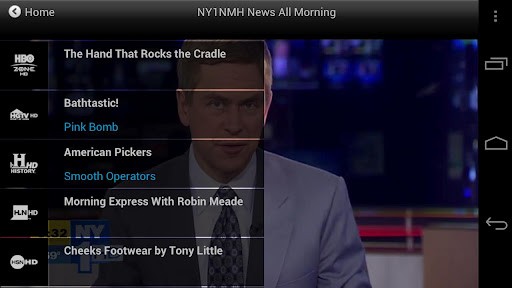
The new channels are available on the iPad, iPhone, Android 4.0 smartphones and tablets, and TWCTV.com to cable customers with at least an expanded basic subscription and the company’s broadband service.


Time Warner Introduces Live Video Streaming Enhancement for Android Devices, With Caveats

Phillip Dampier April 17, 2012 Editorial & Site News, Online Video 1 Comment

Found more new customers than AT&T

If you are among the handful of people with an Android phone or tablet running Android v.4 (also known as ‘Ice Cream Sandwich’), Time Warner Cable’s latest version of its TWC TV for Android app introduces live streaming video.

Available as of 3pm ET this afternoon from the Google Play store, TWC TV for Android finally brings streaming video to an app that used to only allow Android owners to browse an online program guide and remotely manage their DVR boxes.  Time Warner Cable originally introduced its TV Everywhere streamed video service on Apple’s iPad.

But the company’s decision to limit streamed video only to the latest Android devices running Ice Cream Sandwich (ICS) is a major disappointment and will leave a lot of Android owners with a hobbled app.

“It’s currently the only version of the Android OS that allows us the security and stability necessary to distribute video over our private network,” claims Time Warner Cable’s Jeff Simmermon. “But it’s up to the device manufacturer and the sometimes the data carrier when or if ICS will be deployed to a particular device.”

Simmermon suggested the iOS platform developed by Apple was easier to contend with because one company developed the operating system and the devices on which it operates.

If you upgrade to the latest version of TWC TV for Android running on a non-ICS phone, a notification warns that live streamed video remains unavailable to you, leaving the app about as useful as its earlier version, which is to say not very.  Simmermon also warns the upgrade is not available to “rooted” devices.

Smartphones purchased within the last year are likely to receive eventual upgrades to ICS, although exactly when depends on your wireless carrier.  Older phones may or may not receive upgrades.  As a general rule, the older the device, the less likely the manufacturer will be willing to keep upgrading it.

Netflix’s Reed Hastings Discovers Comcast’s Usage Cap: The End Run Around Net Neutrality

Hastings vents on his Facebook page.

As Stop the Cap! has warned Netflix for years, Internet Overcharging schemes like usage caps, usage-based billing, and speed throttles represent an end run around Net Neutrality. If a provider cannot openly discriminate against the competition, slapping usage limits on them (while exempting favored services from that cap) can eventually accomplish the same thing.

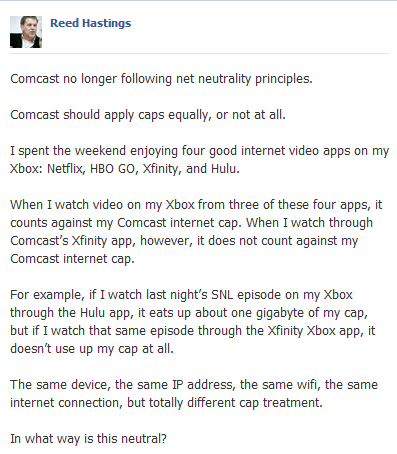
Netflix founder Reed Hastings is finally getting the message after a frustrating weekend watching his Comcast usage allowance bleed away while streaming video.  He shared his views on his Facebook page:

Comcast [is] no longer following net neutrality principles.

Comcast should apply caps equally, or not at all.

I spent the weekend enjoying four good internet video apps on my Xbox: Netflix, HBO GO, Xfinity, and Hulu.

When I watch video on my Xbox from three of these four apps, it counts against my Comcast internet cap. When I watch through Comcast’s Xfinity app, however, it does not count against my Comcast internet cap.

For example, if I watch last night’s SNL episode on my Xbox through the Hulu app, it eats up about one gigabyte of my cap, but if I watch that same episode through the Xfinity Xbox app, it doesn’t use up my cap at all.

The same device, the same IP address, the same wifi, the same internet connection, but totally different cap treatment.

In what way is this neutral?

Comcast says it is “neutral” by framing its own Xbox-streamed video as a “set top box replacement,” even though the video that flows to the Xbox console travels down the same last-mile network Comcast says it needs to “protect” with its 250GB monthly usage cap.

Comcast doesn’t actually need a 250GB usage cap, particularly after the company upgraded its broadband facilities to DOCSIS 3 technology.  That vast improvement in capacity at a comparatively low cost (easily recouped by the company’s latest round of rate increases) should be shared with customers.  Instead of “applying caps equally,” Comcast should abandon them altogether.

[Thanks to Earl, one of our regular readers, for sharing the story.]

Your Cable TV Bill in 2020: $200/Month — Just for Television Shows, Says New Report

Phillip Dampier April 10, 2012 Competition, Consumer News, Online Video Comments Off on Your Cable TV Bill in 2020: $200/Month — Just for Television Shows, Says New Report

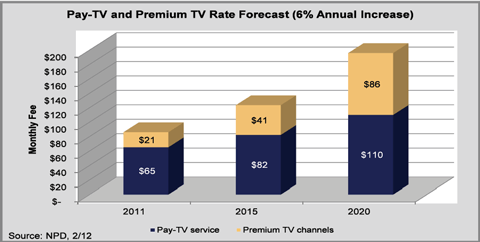
If you thought paying an average of $86 a month for basic pay television and premium movie channels in 2011 was out of line, just wait.  A new report predicts you could pay $123 by the year 2015 and $200 by 2020 — and that only includes the TV portion of your bill.

That is in keeping with typical annual rate increases, typically blamed on “increased programming costs,” which currently run an average of six percent a year.

The NPD Group, who published the findings, predicts consumers may not sit still for that kind of monthly cable television bill, especially as household incomes for the middle class continue to remain stagnant, even as high fuel and health care prices continue to march higher.

The pay television industry isn’t entirely responsible for the annual rate hikes that nearly always outpace the rate of inflation.  The real money is in programming production and distribution, which is why giant companies like Comcast, Bell, Rogers, and Viacom are buying up programming studios, distributors, and networks at a rapid pace.

With new players like Netflix, Amazon, and Redbox joining traditional pay television and broadcast network bidders, auctions for exclusive licensing agreements bring higher and higher bids.  Ultimately, consumers pay the price in the form of higher bills.  Even cable networks, sensing an increase in the value of their programming, are extracting higher monthly fees at contract renewal time.

The last to arrive at the programming money party?  Local over-the-air broadcasters that used to beg cable companies to carry their channels on the local lineup.  Now some are demanding as much as $5 or more per month per subscriber to allow the cable operator to keep carrying the stations.

“As pay-TV costs rise and consumers’ spending power stays flat, the traditional affiliate-fee business model for pay-TV companies appears to be unsustainable in the long term,” said Keith Nissen, research director for The NPD Group. “Much needed structural changes to the pay-TV industry will not happen quickly or easily; however, the emerging competition between video on demand and premium-TV suppliers might be the spark that ignites the necessary business-model transformation of the pay-TV industry.”

In other words, the more consumers cut cable’s cord and go find other ways to watch their favorite shows, the more unsustainable the traditional pay television business model will become.  Some industry watchers believe cord-cutting is not a major issue.  Others believe continued rate increases will drive customers to cancel service, particularly when alternatives are available. But NPD believes economic factors are the biggest reason for cable cord-cutting.  Those ex-customers are switching back to free “over the air” television, which now delivers better picture quality and often includes additional channels that increase the number of viewing options.

NPD Group research shows most consumers don’t want to exert too much effort to hunt down online programming. Most will put up with their current provider as long as they deliver the shows they want at a price they can afford.  What could change that?  Easy-to-access to a-la-carte programming, perhaps available from services that may soon come built-in with the newest television sets.

“Pay-TV providers offer a convenient, one-stop shop for subscribers, and the majority of customers like it that way,” said Russ Crupnick, senior vice president of industry analysis for The NPD Group. “There is an open window for the industry to meet consumer needs and become to television what iTunes is to music; however, there is also a definite risk if pay-TV providers don’t capitalize on the opportunity — and soon.”


Geordi La Forge’s Encounter With Usage Caps Will Temper Google’s New Goggles

Phillip Dampier April 5, 2012 Consumer News, Data Caps, Editorial & Site News, Online Video, Video, Wireless Broadband Comments Off on Geordi La Forge’s Encounter With Usage Caps Will Temper Google’s New Goggles

Google's prototype

Google’s plan to revolutionize eyewear by turning it into a virtual Internet appliance could be tempered considerably by the Internet Overcharging schemes enforced by most of North America’s wireless phone companies that would provide the connectivity.

Google’s Project Glass reportedly will produce the first set of Google glasses, which provide eye-activated online content, before the end of the year.  Without any vision correction, the glasses are anticipated to retail for $250-600, not including your wireless Internet plan.

Chris Green, principal analyst at Davies Murphy Group Europe, told the BBC Google may have bit off more than they can chew, and that other companies have considered similar techwear but abandoned prototypes because technology was insufficient to adequately power the devices.

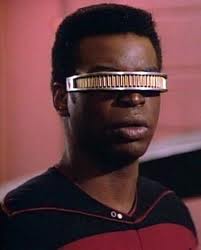
I see a data cap.

“Monetization opportunities would be enormous, but there are still big issues involved with shrinking the technology and making the computer that receives and processes the data truly portable,” Green said.

The glasses project icons and images within the wearer’s field of vision and allow voice-activated control and communication.

The constant connectivity could provide a major new revenue source for usage-capping wireless providers, especially if the wearer decides to pass the time watching something other than what is directly within the field of view. While short messages and updates would have almost no impact on wireless data allowances, streamed content, especially video, could.

That may make the initial price tag for the glasses the least expensive part of owning them.

A two-year contract for wireless data can run more than $720 with companies like AT&T.

[flv width=”640″ height=”380″]http://www.phillipdampier.com/video/Google eyeglasses can surf internet 4-3-12.flv[/flv]

Google’s prototype eyeglasses can surf the Internet in this Google-produced video envisioning potential uses.  (2 minutes)


Search This Site:

Contributions:

Recent Comments:

Your Account:

Stop the Cap!