Home » Online Video » Recent Articles:

Cox Slams DSL in New Ads, But Cox Cable Customers Stuck With Usage Caps

[flv width=”640″ height=”380″]http://www.phillipdampier.com/video/Cox Ads 5-2012.flv[/flv]

Cox Cable has slammed its phone company competition in a series of new TV commercials that call out antiquated and slow DSL. But customers switching to Cox have to endure that company’s unjustified Internet Overcharging schemes.  Cox arbitrarily limits your Internet usage in an effort to maximize profits and reduce costs.  Watching the online video Cox advertises could put you perilously close to your monthly allowance. Exceed it once too often and you may find your account shut off.

Cox executives promise they’ll listen to customers and what they want. Stop the Cap! urges you to participate in our pushback against Cox usage caps. Tell the cable company it does no good selling their broadband service for online video when the company threatens to shut it down if you watch “too much.”  (2 minutes)

Bulldozing Wireless Net Neutrality: Carriers Want “Toll-Free” Data for Their Partners

After intense lobbying, wireless phone companies won a significant reprieve from the watered-down 2010 Net Neutrality policies introduced by Federal Communications Commission chairman Julius Genachowski.

Now some of America’s largest cell phone companies are considering plans that would offer special “toll-free” access to favored partners’ content, while leaving everyone else subject to the companies’ usage capped data plans.

Much of the discussion about exempting certain content from data allowances is taking place at this week’s CTIA Wireless trade show in New Orleans.

Some highlights:

  • T-Mobile USA is planning to expand video streaming services offered to subscribers, but with a twist. Content creators could pay to have their shows streamed to customers, and in turn, T-Mobile would not charge that traffic against the customer’s monthly usage allowance. Whether T-Mobile would maintain an ownership interest in the content is unknown, but “preferred partners” would receive exceptional visibility through aggressive promotional campaigns T-Mobile would launch.  So would T-Mobile, which plans advertising and promotional messages inside that content;
  • Verizon Wireless said it was looking to create “toll-free” data services that would be subsidized by content providers. Video, games, and even apps could be promoted to consumers as “data usage”-free, meaning it won’t count against your monthly usage allowance. But Verizon recognizes the concept would be controversial and run afoul of Net Neutrality concerns.
  • AT&T has already signaled its interest in creating a “content-provider-pays” model where users get free access to content if content providers pay AT&T’s traffic charges.

All three carriers earlier abandoned all-you-can-eat flat rate data plans, and Net Neutrality proponents claim these latest moves are attempts by wireless phone companies to further monetize data traffic.

The Wall Street Journal reports the plans, in some cases, fly in the face of rhetoric about spectrum shortages and a wireless data traffic crisis (underlining ours):

T-Mobile’s Mr. Duea said the goal of new video offerings that don’t count against data plans would be to get customers interested in consuming more data, and set T-Mobile’s plans apart from those of other carriers.

"Data floods" and "spectrum shortages" don't stop T-Mobile.

Current FCC Net Neutrality rules require wireless carriers to not block competing services from companies like Skype and Google, nor censor content. Both Verizon and MetroPCS are challenging those rules in federal court. But wireless carriers are already exempt from giving preferential treatment to certain types of data or traffic, which opens the door to “toll-free” data services.

Net Neutrality supporters believe these practices will uneven the playing field for content creators and innovative new online start-ups, who may not be able to afford the prices carriers charge for first class treatment. It also influences consumer decision-making by encouraging customers to use the “toll-free” services to preserve their monthly data allowance.

Companies like Ericsson and Cisco have plans to market technology that will allow carriers to divide up data traffic into different traffic lanes, some fast and free to use, others subject to a customer’s monthly data allowance, and certain undesirable traffic shunted to low priority slow lanes.

A Verizon Wireless executive ironically blamed the need for “toll-free” pricing partly on the wireless industry itself, which has almost universally abandoned unlimited data plans.

“As we move away from flat rate pricing, there is room for an 1-800-type of service where certain destinations could offset the cost of the network to get customers to those destinations,” said Verizon’s chief technology officer Tony Melone. “There are Net Neutrality issues that have to be addressed, too.”

Melone added the company wasn’t quite ready to launch the “toll-free” traffic lanes just yet, but claimed certain content providers were discussing deals with the company to participate if and when the new toll booths are opened for traffic.

“Harming the Core Business”: The Precarious Future of Video Streaming

Phillip Dampier May 3, 2012 Competition, Consumer News, Online Video, Video 6 Comments

Wall Street analysts are predicting the end of free video streaming in the near-term as media and cable companies regain control over online content for themselves.

Cable companies are partnering with content producers to move a growing amount of streamed video content behind paywalls in an effort to protect their core business profits.

The trend is evolving so rapidly, analysts like Laura Martin with Needham & Co. predict the end of free streaming is imminent.  Either customers will pay upfront or use TV Everywhere “authentication platforms” that require evidence of a pay television subscription before being able to watch.

Craig Moffett, an analyst with Sanford Bernstein, perennially sees cable operators as the most likely winners in the billion-dollar entertainment battle.

“They’re winning the broadband wars,” Moffett says of the cable industry. “Broadband is increasingly the flagship product, not the video distribution business.”

Cable networks and program producers are growing increasingly alarmed at the impact video streaming services like Hulu and Netflix are having on their bottom lines.

Case in point: the fall of Nickelodeon, a popular children’s cable network that used to guarantee high ratings and lucrative ad revenue.  Recently the network has fallen off the ratings cliff.  Some careful analysis found the reason why: Netflix.  Nickelodeon, along with many other cable networks, licensed a number of their series to Netflix for on-demand viewing. In households with young children, parents increasingly choose the on-demand Netflix experience for family viewing over the traditional cable channel.

Moffett

That’s a major problem for content producers and networks, and Moffett quotes industry insiders who predict licensing deals for Netflix streaming will increasingly not be renewed (perhaps at any price) as networks retrench to protect their core business.  What is left will soon be behind paywalls, limited to customers who already subscribe to a pay television service.

That line of thinking is already apparent at Time Warner (Entertainment), Inc., where CEO Jeff Bewkes rarely has a good thing to say about Netflix.  His company refuses to license a significant amount of their content for online streaming because it erodes more profitable viewing elsewhere.

Time Warner only licenses older content and certain “serialized dramas” that have proven difficult to syndicate on traditional broadcast television or cable outlets.  But the company keeps kid shows to itself and its own distribution platforms, like Cartoon Network.

When it does let shows go online, it wants them behind paywalls.

Bewkes applauded Hulu’s recently announced plans to move its service away from free viewing.  Authenticating viewers as pay TV subscribers before they can watch “makes sense” to Bewkes.

“Hulu is moving in the right direction now,” Bewkes said.

Big media companies do not want significant changes to the viewing landscape, where major networks front the costs for the most expensive series, and cable networks commission lower budget programs and repurpose off-network content.  Pay television providers bundle the entire lineup into an enormous package consumers pay to receive. That is the way it will stay if they have their say.

“Just because consumers would rather get individual channels a-la-carte, on-demand, and streamed — only what they want to pay for — [if they think] that is inevitably the way the world if going to evolve, not so fast,” Moffett said. “It may be the way consumers want it and it may be the way technologists want it, but the media companies have a say here.”

“There is no way they are going to voluntarily unbundle themselves,” Moffett said.

[flv width=”360″ height=”290″]http://www.phillipdampier.com/video/Bloomberg Moffett on Cable Operators 4-30-12.mp4[/flv]

Craig Moffett talks about the current state of the media business on Bloomberg News.  He sees trouble ahead for online video streaming, as powerful media and entertainment content distribution companies reposition themselves to better control their content… and the revenue it earns.  The big winners: Cable operators, Hollywood, and major cable networks.  The losers: Consumers, Netflix, Hulu, and free video streaming. (11 minutes)

[flv width=”360″ height=”290″]http://www.phillipdampier.com/video/Bloomberg Martin Sees End of Free Streaming TV Content 5-4-12.mp4[/flv]

Laura Martin with Needham & Co. predicts the imminent demise of free video streaming. Media companies can’t handle the loss of control over their programming, and the erosion of viewers (and ad revenue) it brings.  Martin tells Bloomberg News she sees a future of paywalls blocking access to an increasing amount of online video content.  (5 minutes)

Broadband Money-Maker: Insights from Time Warner Cable’s Latest Financial Results

Phillip Dampier May 2, 2012 Broadband Speed, Competition, Data Caps, Online Video Comments Off on Broadband Money-Maker: Insights from Time Warner Cable’s Latest Financial Results

Highlights:

  • Company still losing video customers, but picking up phone customers (on the cheap), and winning with broadband;
  • Broadband consumption pricing still CEO’s favorite flavor of Internet billing, but only for other people’s content;
  • Broadband speed matters, as Time Warner continues to win over dissatisfied DSL customers;
  • ‘If customers love our broadband, we can charge more for it;’
  • Verizon/Time Warner’s cooperative marketing agreement starts with discounts but ends with “exclusive product enhancements.”
  • The future of Time Warner Cable Wi-Fi.

Time Warner Cable reported unexpectedly strong profits in its first quarter as the company’s broadband services helped stem the losses from departing cable TV customers.

The cable operator told investors it boosted profits 18%, mostly from increasing revenue the company earns selling broadband access to the Internet and convincing customers to add more Time Warner services.

Time Warner Cable said goodbye to 94,000 residential video subscribers last quarter, higher than analysts expected. But that did little damage to earnings because the company picked up an additional 214,000 broadband customers over the same period, most switching from phone company DSL service.

Time Warner Cable’s increasingly aggressive bundled service promotions, particularly on its triple-play offer of cable, broadband, and phone service, even managed to attract 112,000 new landline customers — a significant accomplishment as Americans continue to disconnect traditional phone lines in favor of cell phones.  It also helped increase the average revenue earned per subscriber.  Time Warner Cable pitches double play promotions as low as $79.00 a month. For just $10 a month more, customers can add a third service, and many do.

Most discounts last for one year, but the operator now often sends letters to customers reaching the end of their promotion offering additional, but lower-value discounts going forward. This has limited bill shock for customers surprised by the company’s regular prices. It also might reduce the urge for customers to shop around for a better deal.

Judging from the company’s financial results, most customers hang on to Time Warner Cable’s broadband regardless of price, if the competition happens to be traditional DSL from the phone company. In fact, as phone and cable companies realize they have sold broadband to virtually every home in their service area that wants it, growth in subscriber numbers going forward largely depends on poaching customers from someone else.  Nobody makes that easier than phone companies trying to sell customers DSL with speeds under 10Mbps.  According to CEO Glenn Britt, Time Warner Cable picked up more new broadband customers than Verizon and AT&T combined.
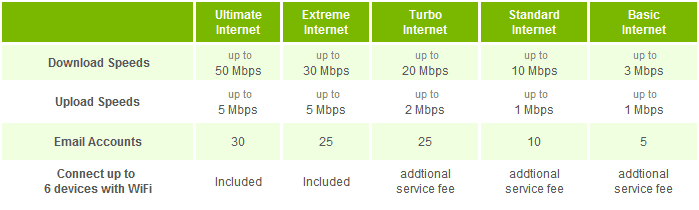
Time Warner Cable broadband speeds give headaches to phone companies trying to sell traditional DSL.

While phone companies continue to argue that speeds don’t matter (at least for their DSL product line), Time Warner believes otherwise and apparently so do their new customers.  The company reports that almost two-thirds of those dumping DSL said their old service was too slow.

Much of the company’s growth in broadband revenue is also coming from the high end, as customers increasingly gravitate towards faster broadband speed tiers.

Britt

Residential DOCSIS 3 (Extreme/Ultimate) customers increased 50% to 218,000, and almost 66% of new broadband customers signed up for either Turbo (20Mbps), Extreme (30Mbps) or Ultimate (50Mbps) service.  Together, these customers now make up 20% of Time Warner’s broadband subscribers, up from less than 16% a year earlier.

Customers are willing to pay higher prices for faster service, a point not lost on Britt, who noted that once customers perceive broadband has more and more value, the company can charge more for it over time.

If Britt’s steadfast belief in Internet Overcharging-consumption billing schemes holds true, some customers might find they are charged substantially more if the company decided to discontinue offering unlimited Internet service.

For now, the company plans to continue its experiments in consumption billing through its Internet Essentials program, now testing in South Texas, which limits customers to 5GB of usage per month before overlimit fees kick in.  But going forward:

“I think we’ve been pretty clear about this, we do think over time, there will be consumption element to the tiers,” Britt said.

But Britt says he wants to keep unlimited access for customers willing to pay for it.
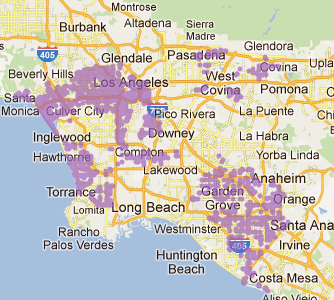
Time Warner's Hotspots in southern California.

“We retained our unlimited tier with no cap (I actually don’t like the term cap),” Britt added. “And I think we should always have that. So that this was not in any way coercive, people who wanted to save money, could. People who wanted to keep what they had have kept it, and they still have unlimited. So our plan is to roll that out further across [the country] as the year goes on.”

Britt noted the company’s own streamed video products would not drain customers’ usage allowances.  But Netflix and other online streamed video would.  Britt adopted the same argument Comcast has used to defend the practice.

“So there’s a set of standards called the IP, Internet Protocol, and those can be used for a wide variety of things in the world,” Britt explains. “There’s also something called the public Internet, which happens to use IP standards. That doesn’t mean those two things are exactly the same. So the application that we have on the iPad is over our closed-circuit network. It’s just a different standard than we’ve used traditionally for our video. But it’s not the public Internet.”

In other developments, the company’s controversial co-marketing agreement with Verizon Wireless has now expanded to four cities: Raleigh, N.C., Cincinnati and Columbus, Ohio, and Kansas City, Mo.

Time Warner Cable executives told investors the early stages of the cooperative marketing agreement will consist of a promotion that includes a $200 gift card when a customer buys both a Verizon Wireless plan and upgrades at least one service on their Time Warner Cable account.  But the company plans to gradually reduce discounts and instead offer unspecified “exclusive product enhancements” that will only be available to customers who subscribe to both services.

Lastly, expect Time Warner Cable to continue aggressive deployment of its Wi-Fi networks in New York and Los Angeles.  The company signaled it intends to construct similar Wi-Fi networks in other cities in serves, but most likely not during 2012.


NY Post: Hulu to Abandon Web Streaming for Non-Cable TV Subscribers

Phillip Dampier April 30, 2012 Comcast/Xfinity, Consumer News, Online Video 12 Comments

The NY Post reports Hulu is on the verge of leaving cord-cutters behind as the video streaming site prepares to switch to a “TV Everywhere” model that requires viewers to prove they subscribe to a pay television provider before they will be able to stream video online.

The decision to abandon viewers who have cut cable’s cord is reportedly behind last week’s decision by Providence Equity Partners to abandon Hulu, the major network-owned video operation.

The Post reports that non-cable TV subscribers are going to find it increasingly difficult to legally stream video content as program producers and networks start switching off access to those getting a “free ride.”

Among the most aggressive to stop the “freeloading” is Fox, which plans on launching talks with Comcast on a TV Everywhere deal that will require all viewers to have a paid video subscription.  Comcast itself is reported to be preparing to switch to an authentication model for online streaming of this year’s Olympics.

Don’t pay for cable, telco, or satellite TV?  No streaming video for you.


Search This Site:

Contributions:

Recent Comments:

Your Account:

Stop the Cap!