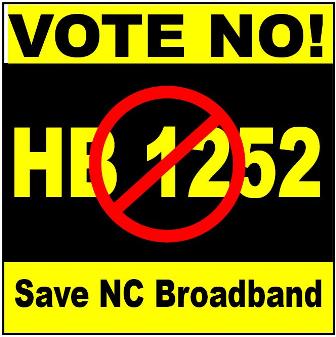
Sneaking in the backdoor - the Senate companion bill scheduled for tomorrow morning!
[12:40am ET Thursday Morning – Added More Contact Information, Expanded Article] I have just been informed big cable and their lobbying friends are going to try to pull a fast one on us in North Carolina. Sometimes you successfully defeat them at the front door while they sneak in the back. That is precisely what they are going to try tomorrow morning.
Brian Bowman, Public Affairs Manager for the city of Wilson, just informed us that Senate Bill 1004, the companion hit-piece on consumers to HB 1252, has been moved up for consideration in a Senate committee tomorrow morning bright and early.
In a sneak attack, the industry hopes to breeze through the approval process on the Senate side after failing in the North Carolina House of Representatives. So unless you get on the phone right now and make those calls, today’s victory could become tomorrow’s defeat. Allowing big cable and telco lobbies to get their foot jammed in the back door is a consumer catastrophe.
It’s clear the industry people have already camped out in several offices and have brought the pizza and coffee. When Bowman called one of the chairperson’s offices to confirm the time, the administrative assistant literally handed the phone to a cable company employee to explain the bill! How nice of them.
This really reminds me of 1990. Back then, a few bad actors in the cable industry were acting so naughty, they created a groundswell of support for legislative action against the cable industry as a whole. At the beginning of the 1990s, it was sky high rate increases, poor service, and trying to deny competitors access to cable programming networks. The level of arrogance among the cable companies reached a high point when, then Senator Al Gore (D-TN), called the industry as a “cable cosa nostra.” We were in the thick of it back then, working to get passage of S.12, a bill to re regulate cable which passed in 1992.
In 2009, some of the same winds are blowing. The industry is attempting to “test” pricing for broadband that either rations Internet usage, or extorts an enormous amount of money for it. Industry leaders promise upgrades in return for rate hikes to customers, and then tell their own investors those upgrades are not immediately necessary. They use inconsistent arguments, bought-and-paid-for research, and clueless legislators who are duped (or bought) to carry their legislative agenda.
It always takes just a few issues, usually coming in sequence, to turn a minor skirmish into a major war, and I think we’re one or two issues away from a full court press to force dramatic changes in the cable and telephone industry. So far, the issues which are coalescing include:
Rep. Ty Harrell, who we’ve been lobbying very hard to get to drop a nasty anti-consumer bill designed to stop municipal broadband, has accepted that the matter requires considerable additional review, and HB 1252 has been buried for the year in a “study committee” to “review” its impact.
In North Carolina politics, that usually means an elected official waded too far out in deep water and needs a lifesaver, and the “bill needs further study” approach is a great way to survive an angry constituent bees nest. The “study committee” will review the legality of the measure and consider the issue before bringing a report back to the House and Senate for consideration, but a number of pieces of legislation that end up going this route are never heard from again.
We’ve received reports the hearing room was packed with people. Among the “pro-HB1252” audience were people supporting the astroturfing “Americans for Prosperity,” a pro-corporate group that pelted North Carolina residents with harassing recorded calls earlier this week. The “anti-HB1252” audience was made up of consumers sent by StoptheCap! and Jay Ovittore’s Facebook group fighting Time Warner Cable on various fronts in his home state, as well as representatives from municipalities, advocates for fiber network development, and supporters who learned about the event from Free Press.
This represents our second pro-consumer victory in less than a month against big cable and telco companies. Thank you to everyone who made calls, sent e-mail, lobbied their elected officials, and attended today’s event. To those that supported this nonsense in the first place, unless we note an acknowledgment of the mistakes made in supporting this anti-consumer nightmare, this will be an issue we’ll be reminding voters of come next election day. This remains a fundamental consumer issue, and who stood with and against consumers will need to be revisited.
Bad weather across the state is leading in the news today across the region, but we’ll have further developments on this story later today.
[Editor’s Note: Our current software does not require users to confirm their e-mail address before submitting comments on this site, although the individual purporting to be Rep. Ty Harrell did use a correct e-mail address for the representative. On the chance that the comments expressed on this site are from the representative, our reply should be taken with that understanding.]
Someone signing their name Rep. Ty Harrell and using his e-mail address left the following general comment on two articles on our site regarding the North Carolina legislation HB 1252, which is essentially a custom written bill by and for the cable and telephone industry in an effort to impede municipal broadband network development inside the state. Today, the legislation will be taken up by the Public Utilities Committee for review. StoptheCap! is calling on all North Carolina citizens to do their best to attend this meeting and be prepared to protest this legislation in the strongest possible terms, and demand that representatives vote “no” on it. At this time, only telephone calls should be made to your elected representatives. It’s too late for e-mail. This is the link for information about the group assembling for today’s Committee meeting in Raleigh. Here is information about the earlier Call to Action.
The same old fundamental misunderstandings about the Internet that got former Sen. Stevens into so much trouble with his pronouncement that the Internet was a “series of tubes” that were being filled up by commercial providers, which is somehow why we cannot be for net neutrality, comes back time and time again with alarmist rhetoric about exafloods, brownouts, global data slowdowns, and the risk of the collapse of the Internet itself.
Just you wait and see.
And folks have been waiting and seeing since 1996:
How can we be saved from the broadband collapse, drowning in exaflood tidal waves and zetaflood cataclysms when the funeral service was held more than a decade ago?
Using fear to advance a corporate or marketing agenda is hardly a new concept. Unless we do “x,” “y” will happen and ruin your life has been used along with alarmist rhetoric to justify virtually everything. For broadband usage capping and metered service, it’s front and center. In fact, wherever service is lousy with limitations and someone has their hand out looking for more of your money, you can be sure the “clogged tubes” argument is going to be a big part of the snowjob.
Snow isn’t a big problem in Australia, but that doesn’t stop the blizzard of nonsense from showing up down under, where the Internet is a particularly lousy experience for Aussies forced to endure draconian caps from monopolistic providers. Exceed your caps there and your connection slows to near-dial-up speeds. Never trust a guy in a ludicrously loud shirt, nor someone who channels Sen. Stevens in calling the whole thing a series of “pipes.” Maybe Pete Blasina got the shirt from Cisco, who he also conveniently notes is supplying switches to save us from impending doom. They also happened to supply him with a lot of his talking points. The bit about YouTube traffic in one month equaling Internet consumption in 2000 came from them.
Duncan Riley (who was the source for the history lesson on exaflood threats) does a fine job debunking the same nonsense we have to endure in North America.
The story is nearly always the same: telcos and infrastructure companies fund research that finds that the latest trend online at the time (audio, video, HD video, P2P, Sykpe and social networking are some previously used) is too much for the Internet to handle. The reasons behind the studies are usually variations on a theme: Government regulation or Government financial support. Which is where we start our story on how Sunrise played a role in the latest outbreak of industry astroturfing.
But how did a primarily American focused astroturfing campaign end up be served to Australians on breakfast television?
The outbreak of “Internet is full” stories this time was remarkably subdued. The last research paper was released in November 2008, which might account for part of the silence, although Sunrise says there’s a new report coming (the contents year to year ultimately deliver nearly the same doom and gloom message.) Given strong coverage of the 2007 outbreak as being an astroturfing campaign, news rooms may have been a little wiser this time round.
Duncan doesn’t realize the Internet is Full Crisis ’09 started last week with the latest Nemertes report we debunked a few days ago as a whole lot of industry-sponsored nonsense. But it’s remarkable the astroturf campaigns have enough industry cash behind them to push this stuff worldwide. Duncan’s piece links some other outbreaks of astroturfing so check it out.
Be Sure to Read Part One: Astroturf Overload — Broadband for America = One Giant Industry Front Group for an important introduction to what this super-sized industry front group is all about. Members of Broadband for America Red: A company or group actively engaging in anti-consumer lobbying, opposes Net Neutrality, supports Internet Overcharging, belongs to […]
Astroturf: One of the underhanded tactics increasingly being used by telecom companies is “Astroturf lobbying” – creating front groups that try to mimic true grassroots, but that are all about corporate money, not citizen power. Astroturf lobbying is hardly a new approach. Senator Lloyd Bentsen is credited with coining the term in the 1980s to […]
Hong Kong remains bullish on broadband. Despite the economic downturn, City Telecom continues to invest millions in constructing one of Hong Kong’s largest fiber optic broadband networks, providing fiber to the home connections to residents. City Telecom’s HK Broadband service relies on an all-fiber optic network, and has been dubbed “the Verizon FiOS of Hong […]
BendBroadband, a small provider serving central Oregon, breathlessly announced the imminent launch of new higher speed broadband service for its customers after completing an upgrade to DOCSIS 3. Along with the launch announcement came a new logo of a sprinting dog the company attaches its new tagline to: “We’re the local dog. We better be […]
Stop the Cap! reader Rick has been educating me about some of the new-found aggression by Shaw Communications, one of western Canada’s largest telecommunications companies, in expanding its business reach across Canada. Woe to those who get in the way. Novus Entertainment is already familiar with this story. As Stop the Cap! reported previously, Shaw […]
The Canadian Radio-television Telecommunications Commission, the Canadian equivalent of the Federal Communications Commission in Washington, may be forced to consider American broadband policy before defining Net Neutrality and its role in Canadian broadband, according to an article published today in The Globe & Mail. [FCC Chairman Julius Genachowski’s] proposal – to codify and enforce some […]
In March 2000, two cable magnates sat down for the cable industry equivalent of My Dinner With Andre. Fine wine, beautiful table linens, an exquisite meal, and a Monopoly board with pieces swapped back and forth representing hundreds of thousands of Canadian consumers. Ted Rogers and Jim Shaw drew a line on the western Ontario […]
Just like FairPoint Communications, the Towering Inferno of phone companies haunting New England, Frontier Communications is making a whole lot of promises to state regulators and consumers, if they’ll only support the deal to transfer ownership of phone service from Verizon to them. This time, Frontier is issuing a self-serving press release touting their investment […]
I see it took all of five minutes for George Ou and his friends at Digital Society to be swayed by the tunnel vision myopia of last week’s latest effort to justify Internet Overcharging schemes. Until recently, I’ve always rationalized my distain for smaller usage caps by ignoring the fact that I’m being subsidized by […]
In 2007, we took our first major trip away from western New York in 20 years and spent two weeks an hour away from Calgary, Alberta. After two weeks in Kananaskis Country, Banff, Calgary, and other spots all over southern Alberta, we came away with the Good, the Bad, and the Ugly: The Good Alberta […]
A federal appeals court in Washington has struck down, for a second time, a rulemaking by the Federal Communications Commission to limit the size of the nation’s largest cable operators to 30% of the nation’s pay television marketplace, calling the rule “arbitrary and capricious.” The 30% rule, designed to keep no single company from controlling […]
Less than half of Americans surveyed by PC Magazine report they are very satisfied with the broadband speed delivered by their Internet service provider. PC Magazine released a comprehensive study this month on speed, provider satisfaction, and consumer opinions about the state of broadband in their community. The publisher sampled more than 17,000 participants, checking […]


 Subscribe