Home » Data Caps » Recent Articles:

Broadband to Enjoy Continued Robust Growth: Five Million New Subscribers in 2009

Phillip Dampier June 15, 2009 Data Caps 1 Comment

Despite the economic downturn, broadband providers continue to achieve healthy growth in the number of new subscribers, with five million new customers signing up for service across the United States in 2009.  Although this does not represent the double digit percent increases operators have achieved in prior years, considering the anemic sales of subscriptions for telephone and television service, broadband’s anticipated seven percent growth this year is a bright spot in an otherwise challenged telecommunications industry.

Healthy profits continue to be reported by most broadband providers, with growing revenue coming at the same time bandwidth costs continue to decline, and some providers decrease the percentage of revenue invested in their networks.

Operators proposing Internet Overcharging schemes don’t have much of a leg to stand on, when consumers learn of the healthy profits earned by the industry and their reluctance to invest in expanding their networks at the same rate year after year to keep up with subscriber growth and demand.

By 2013, fiber to the home will reach an estimated 13% of U.S. households, with more than 80% subscribing to a broadband service package.

VentureBeat Sucked Into Internet Overcharging Propaganda; Readers Revolt

When otherwise intelligent writers get sucked into industry propaganda and advocate against their own readers’ best interests, the blowback can become substantial.

VentureBeat is about to learn that principle firsthand as it bungled a piece about wireless carrier mobile data growth into a confusing article claiming “Net Neutrality” will be used by AT&T and Verizon to “drive Sprint and T-Mobile into the ground.”

What?

Authors Tim Chang and Matt Marshall then journey across the landscape of mobile data networks in the United States, regularly stopping to hammer home the requirement for limits on usage, blaming it mostly on online video.  The factual potholes litter the landscape, unfortunately:

What that means is the country’s major wireless carriers — Verizon, AT&T, Sprint and T-Mobile — are going to have to abort the all-you-can-eat mobile data plans most of us take for granted. It’s just getting too costly for them to give us the service on their networks for the pricing they offer today.

Video 'is the big problem' justifying Internet Overcharging for wireless mobile data, yet one of the nation's largest providers sees no problem providing its own video service on its network.

Video 'is the big problem' justifying Internet Overcharging for wireless mobile data, yet one of the nation's largest providers sees no problem providing its own video service on its network.

Actually, none of these carriers provide unlimited all-you-can-eat mobile data plans.  They either explicitly or implicitly (buried in the fine print) limit consumption, usually to 5GB of usage per month.  What happens beyond that does vary by carrier.  The big four impose overlimit penalties at punishing prices.  Some smaller carriers, like Cricket, simply throttle your connection or suspend service on a case-by-case basis.

The reasons for these limits:

  • Limited spectrum (the frequencies the provider operates on) may not sustain demand using currently available technology and network design. Could additional spectrum, new technology standards, and more localized delivery of data reduce network congestion?
  • Lack of competition.  The two primary carriers, AT&T and Verizon, have essentially provided nearly-equivalent pricing.  Their robust coverage areas make either a natural choice for most users who travel.  Sprint and T-Mobile have larger gaps in coverage.  Spectrum auctions, which is how carriers obtain new blocks of frequencies, raise huge sums for the government, but those costs inevitably do get passed down to customers.
  • Psychological: Consumers accustomed to limited wireless broadband from the outset are less likely to complain if it is taken away later.
  • Economical: Data packages with low limits produce profitable results, with the future possibility of earning even higher profits from subscribers who routinely exceed them and pay penalties and fees, or for carriers to create and market “additional usage packs.”

Jon Metzler, an industry consultant who has conducted research for the CTIA, says he’s heard estimates that a YouTube video of 3-5 minutes costs $1 for a carrier to handle. At this rate, a carrier would be killed when a typical user streams a mere two videos a day. That day is coming soon, because of the race by the smartphones to offer these cool video services.

Of course Metzler works for the CTIA-The Wireless Association, an industry trade and lobbying group.  They have a vested interest in pushing the “bandwidth flood” theory to preserve carrier pricing models.  The factual basis for this YouTube assertion has been challenged as well, once even by a VentureBeat reader.

Verizon doesn’t see wireless mobile video as the harbinger of doom — it sees it as a feature it can rake profits from, charging $13-25 a month extra for access to VCAST Mobile TV, a Verizon Wireless portal filled with video clips and streams.

It’s always ironic when carriers complain about the impact of services like video, while also heavily marketing their own services that, by their nature, impact their network.  YouTube bad, VCAST good.

… Continue Reading

AT&T Refuses to Lower iPhone Data Plan Rates: Company “Happy” With Pricing

Phillip Dampier June 13, 2009 AT&T, Data Caps, Wireless Broadband 10 Comments
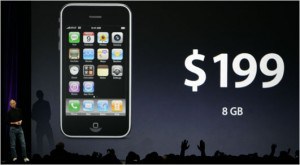
From $199 to much more, Apple & AT&T expect premium prices for iPhone addicts.

From $199 to much more, Apple & AT&T expect premium prices for iPhone addicts.

High demand for a product often carries a premium price to acquire and use it.  The Apple iPhone, one of those few mobile products that can generate lines extending out the door of a retailer, is one such product.  AT&T Mobility, which still holds an exclusive contract with Apple for iPhones in the United States, has made it clear it will not be making any price changes to its wireless data plans with the introduction of the Apple 3G S on June 19.  Speculation about lower pricing started with AT&T Mobility CEO Ralph de le Vega, who spoke at a conference last month indicating he was amenable to “limited data plans for lower fees.”  That message was soon modified into a more generic ‘price cut’ as the story traveled.

“We’ve been very happy with our pricing,” AT&T spokesman Mark Siegel told Dow Jones Newswires.

AT&T already charges a pretty penny for iPhone users on their network.  Customers signing up for service face a minimum voice plan of 450 minutes for $39.99.  An “unlimited” data plan, required for the iPhone, adds $30 per month.  AT&T claims the average iPhone customer spends about $90 per month for voice and data.  The company also reserves the right to crack down on excessive data usage and limits some applications.

Should de le Vega’s tolerance of limited data plans become reality, plans with more specific usage limits may be forthcoming, at a moderately discounted price.

AT&T has had a bad week in the public relations arena, as current iPhone owners continue to object to the full-price upgrade price they may have to pay if they are in a two year contract.  Thousands have signed a Twitter petition and have filled AT&T’s online support forums with complaints about AT&T “price gouging” loyal customers.

AT&T has enjoyed significant revenue from their exclusive arrangement with Apple.  But iPhone users are dedicated to their combination phone and data device, and try to get their money’s worth.  That has put pressure on AT&T’s network, and despite the company’s revenue from its premium priced plans, has been criticized for not keeping up with that demand.

Verizon Wireless, AT&T’s biggest competitor, trashed AT&T’s proposed upgrades as inadequate:

Verizon Wireless CEO Lowell McAdam characterized AT&T’s promises as “too little too late”. He said that AT&T’s “ceiling for their network will be the floor for our network.” McAdam called AT&T’s announcement on its network upgrade old news—about a year old. He also noted AT&T’s promises to upgrade speed are spin.

Audio from Toronto Internet Town Hall Now Available

Phillip Dampier June 12, 2009 Audio, Canada, Data Caps, Events, Net Neutrality, Public Policy & Gov't Comments Off on Audio from Toronto Internet Town Hall Now Available

For those who tried to watch the live stream from this past Monday’s Internet Town Hall from Toronto, it was a process that demonstrated the limitations of broadband service in Canada.  Evidently the hotel broadband connection was inadequate for the task, and the stream suffered ongoing video and audio problems for the duration.

An audio podcast version has now become available and is included below.  Because the event runs nearly two hours, you may wish to download the audio and listen on the go.  If you want to listen here, remember that the audio player will only work as long as you remain on this page.

Internet Town Hall On Canadian Broadband/Net Neutrality Issues – Toronto, June 8, 2009 (1 Hour 50 minutes)
You must remain on this page to hear the clip, or you can download the clip and listen later.

If Profit Margins Decline for Wired Broadband, Wall Street Will Deliver A Spanking

Phillip Dampier June 11, 2009 Data Caps, FairPoint, Frontier 1 Comment

Robert Cyran, writing for BreakingViews, is concerned about the profit capacity of telephone and cable companies in the coming years.

Noting that wired, high speed services often account for more than half the revenue of providers, anything that challenges those margins could provoke hostile reaction from Wall Street, dissatisfied with diminishing returns.

Cyran specifically calls out Frontier Communications, FairPoint Communications, and Qwest for not having wireless (mobile phone) divisions and for their high level of debt.

He’s also been absorbing Sanford Bernstein’s views on the telecommunications industry, which typically guarantees Verizon fiber-to-the-home cost bashing.  And yes, it’s in there:

True, in urban areas where Verizon and AT&T are laying optical fibre, their fixed-line businesses are doing relatively well. Customers like super-fast internet connections, and the companies can pump bundles of services such as voice and television through it. But in rural areas, fibre is prohibitively expensive to lay, and customers without high-speed service options have more reason to rely solely on a mobile phone.

Verizon and AT&T won’t escape unharmed. Verizon is spending about $4,000 per customer to lay fibre.

Verizon is spending money on fiber service that customers like and are generating healthy revenues, but the fiber optics “harms” Verizon.  At least the bashing is consistent.

Cyran claims cable’s biggest problem is that margins for their broadband divisions have been slowly dropping.  Should customers defect en masse to competitors, things could get bad fast:

And when businesses like these with high fixed costs see customers defect, margins can contract quickly and even go negative.

One way to guarantee mass defections is to try to gouge consumers with Internet Overcharging schemes.  In markets where equivalent levels of service are available, customers have the option of leaving the Overcharger behind for a more customer-friendly option.  Unfortunately, not every market has equivalent competitors.

Cyran’s predictions for the future?  Big troubles for Frontier, FairPoint, and Qwest who he predicts will see ongoing declines in their cash flow and increasing difficulty in paying back their debts.  The companies will also struggle with the limitations of aging copper infrastructure to provide advanced class services (high speed broadband, video, and telephone) customers increasingly expect.  In larger communities, many customers will leave for competitors who can provide those services (in these cases that means the cable company).  In rural communities, customers will increasingly rely on cell phones as their only telephone line.

Fairpoint’s stock has fallen about 70% over the last 12 months and Hawaiian Telecom, which Carlyle bought in 2005, filed for bankruptcy at the end of last year. Yet Quest and Frontier’s stocks both still trade at more than 10 times estimated 2010 earnings. Since there’s little chance customer defections from wired telecom businesses such as theirs will stop, their stocks could have much further to fall.


Search This Site:

Contributions:

Recent Comments:

Your Account:

Stop the Cap!