Home » Data Caps » Recent Articles:

Cogeco Wants $2.50/GB in Overlimit Fees – The Gravy Train Rides On North of the Border

Paul-Andre Dechêne June 23, 2009 Canada, Cogeco, Data Caps 6 Comments

canadaflagCogeco, following in the footsteps of Rogers, Canada’s largest cable operator, has mailed letters home to residential subscribers informing them that their new Internet Overcharging scheme and fees are real and will apply to broadband accounts that exceed their arbitrary usage allowances.  Since the spring, Cogeco has been showing the Internet Overcharges on subscriber’s bills, but not actually billing them.  That is set to change, however, and many residents in Ontario and Quebec are quite upset.

“Cogeco can bite me. As soon as I manage to scrounge up a second DSL modem I’m gone.”

“I’m waiting for the Cogeco trolls to come out of the woodwork so they can claim how competitive and affordable that plan is.”

“I am starting to hate Cogeco very much, I am tempted to cancel my internet and my digital TV service for spite.”

“Vote with your wallets guys, I did. And now with the increase I’m going to cancel my HD access and return the receiver — enough is enough. I’ll be down to Basic Digital Cable and if they keep increasing prices, that will go too.”

“Ditto! Price increase is THE LAST STRAW for this 10 year + customer!”

Cogeco’s limits also come with overlimit fees that are particularly harsh on casual and power users.  In Canada, many overlimit fees are currently capped at a maximum amount, and do not continue to increase beyond that maximum.  Lite users face a $2.50/GB overlimit fee (maximum $30), despite representing almost no usage impact on Cogeco’s network, and “Pro” users face a $1/GB overlimit fee, but face a maximum of $50 in overlimit penalties, despite paying a much higher up-front monthly subscription fee.

In a nutshell,

  • Lite – 10GB/mo bitcap – $2.50 per GB over to a maximum of $30
  • Lite Plus – 20GB/mo bitcap – $2.00 per GB over to a maximum of $30
  • Standard – 60GB/mo bitcap – $1.50 per GB over to a maximum of $30
  • Pro – 100GB/mo bitcap – $1.00 per GB over to a maximum of $50

Broadband providers in the United States always promise that if they are permitted to introduce Internet Overcharging schemes, it will be “fairer” for all customers, because “heavy users should pay more for what lighter users don’t do.” Providers also typically allude to network improvements and no widespread price increases.

But as Canadians have already discovered, big telecommunications firms operating with virtual duopolies can have their cake and eat it too.

Cogeco customers now face the prospects of classic Internet Overcharging — usage allowances, overlimit fees and penalties, and “fair pricing,” but after the company implemented these schemes, consumers got a reminder of what cable operators like Cogeco are also capable of — widespread rate hiking.

New Rates: We’re improving our services so you’ll continue the best today and in the future (effective July 17, 2009):

Internet Pricing

Standard – With TV or Phone…..current rate: $44.95……new rate: $45.95

Standard – Standalone……..current rate: $52.95………..new rate: $54.95

Pro – With TV or Phone……..current rate: $69.95………..new rate: $76.95

Pro – Standalone……………..current rate: $74.95………..new rate: $81.95

Internet Overchargers like Cogeco consider “fair share” to mean giving an equal amount of dollars from yourself to them.  That’s fair, right?

It’s simply more evidence to this universal truth, a fact of life every North American should already know:

Cable bills never decrease, they only increase, unless you drop services.

When a cable company tells you they have a plan to guarantee “fairness,” be sure to remember what represents “fairness” to you may mean something entirely different to them.
Cogeco Offers Unlimited WiFi to iPhone/iPod Owners in Toronto for $5 Month

Paul-Andre Dechêne June 23, 2009 Canada, Cogeco, Data Caps, Wireless Broadband Comments Off on Cogeco Offers Unlimited WiFi to iPhone/iPod Owners in Toronto for $5 Month

wifi Canada is a victim of Internet Overcharging, with virtually every major provider limiting access to broadband, throttling speeds, and charging overlimit penalties for exceeding arbitrary limits. Now Cogeco, which itself engages in these schemes for its residential broadband service, has made a breakthrough of sorts.

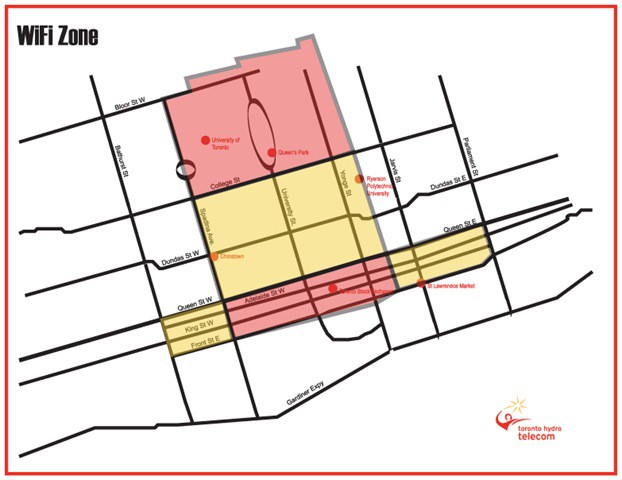
Cogeco One Zone, available only to users of Apple’s iPhone and iPod Touch, provides 802.11g WiFi across the One Zone WiFi network for only $5CAD a month. One Zone, acquired last August from Toronto Hydro Telecom, operates within a six kilometre region in the downtown core of Toronto. Users discovering the service report it can achieve speeds of up to 7Mbps, and there are no data consumption limits or contracts.

Any iPhone/iPod Touch user who accesses the network within range will automatically be taken to a special sign-up page to begin service. Cogeco One Zone’s offer represents a major discount off the pricing being charged to other One Zone WiFi users:

One-Zone_Coverage_Map 1 Hour
60 minutes of continuous access
$4.99 + GST and PST

1 Day
24 hours of continuous access
$9.99 + GST and PST

1 Month
Continuous access to same date in following month
$29.00 + GST and PST

(All prices are in Canadian Dollars)

So why has Cogeco decided to practically give away the service?

“Our expectation is that users won’t be using it for downloading video and huge files … It’s just the nature of the device. It’s not likely they’ll be downloading gigabytes of information standing on the street,” Cogeco Data Services president Ian Collins told itWorldCanada.

One potential use Collins may not realize has been among Toronto residents who live and work within range of the network. For some of them, Cogeco One Zone is being used from work and home, and although it is unlikely to replace residential broadband accounts that connect with home computers, some users will give the network a real workout. Should customers figure out how to tether their iPhone WiFi connection to their home computer, effectively accessing the network from a home PC or laptop, that could become an entirely new challenge.

For Canadian iPhone owners, who already face higher prices for iPhone data plans (no “unlimited” plan exists in Canada as it does in the United States), the biggest savings may come from customers downgrading data plans for “phone-based” data, because they rely on the WiFi network instead. Most iPhone owners currently pay $30 per month for 1GB or $25 for 500MB. With unlimited access through WiFi, there are no worries about exceeding data allowances.

Knowledgeable iPod Touch owners could also turn their players into Voice Over IP telephone lines using Skype or Truphone, and effectively pay just a few dollars per month for unlimited long distance calling.

Coalition of the ‘Willing to Cap’ Complains About Monopolistic Behavior by Big Phone Companies

Phillip Dampier June 22, 2009 AT&T, Data Caps, Editorial & Site News, Public Policy & Gov't, Verizon Comments Off on Coalition of the ‘Willing to Cap’ Complains About Monopolistic Behavior by Big Phone Companies

nochokeThe NoChokePoints Coalition has a point.  They are a coalition of public interest groups and providers like British Telecom and Sprint-Nextel that are upset with monopolistic pricing for high speed broadband lines.  Verizon and AT&T “control the broadband lines of almost every business in the United States” the coalition states, and “generates a profit margin of more than 100% for the controlling phone companies.”


“Releasing the broadband economy from the chokehold these huge phone companies have on the special access market will be a catalyst for innovation and investment in the broadband marketplace, something we desperately need,” said Maura Corbett, spokeswoman for the NoChokePoints coalition.

“Every time you send an email, withdraw money from an ATM, or use your wireless phone, your information travels on these high-capacity lines. Excessive pricing and other market abuses by these companies have long been an issue of concern at the Federal Communications Commission (FCC). Nearly five years ago, after many complaints by broadband customers in several FCC proceedings, the Commission began a review of the high-capacity broadband market to determine the changes needed to ensure reasonable prices. Despite ample evidence of excessive pricing, the Commission inexplicably has yet to take any action.”

“The Obama administration, Congress, and the FCC repeatedly emphasize the importance of broadband to our economic recovery and, frankly, it defies explanation that we are still fighting this market abuse,” Corbett continued. “Huge companies like Verizon and AT&T control the broadband lines of almost every business in the United States. The virtually unchallenged, exclusive control of these lines costs businesses and consumers more than $10 billion annually and generates a profit margin of more than 100 percent for the controlling phone companies, according to their own data provided to the FCC. This hidden broadband tax results in enormous losses for consumers and the economy, and this country cannot afford it; especially now.”

NoChokePoints cited four central principles of its campaign to reform the special access market: (1) the special access market is broken; (2) the outgoing Federal Communications Commission made a bad situation worse by failing to address obvious market abuse by these huge phone companies; (3) this unchecked market control continues to slow broadband deployment, compromise innovation and harm our national information economy; and (4) the resulting market failure must be corrected now.

Yes, when one or two providers get together and establish pricing for a product that is way out of line for what it costs to provide, and uses that control to further squeeze every last penny they can from customers, something should be done.

As consumers, we should agree to join the NoChokePoints coalition struggle.  There are several very credible pro-consumer organizations that support the Coalition and its goals.  And consumers like myself shall, mere seconds after:

Member BT (British Telecom) stops throttling UK customer’s broadband connections, and imposing Internet Overcharging schemes on customers through limits on their data consumption.

Member Sprint-Nextel agrees that consumers should be able to request temporary suspension of their wireless data account, currently limited to 5GB of consumption per month, the moment the limit is reached to avoid the potential of paying overlimit fees, if/when applicable.

TW Telecom gets a pass here as they are entirely independent from Time Warner Cable.

Internet Overcharging schemes, monopolistic control, abuse of market pricing, and other anti-competitive behavior should be confronted.  But companies engaged in problematic behavior themselves should not anticipate a great deal of consumer compassion towards their plight, when those consumers often are on the receiving end of that problematic behavior themselves.

AT&T’s “Grandma” Analogy Upsets Grandmothers – They Don’t Want Overcharges Either

Phillip Dampier June 19, 2009 Data Caps 9 Comments

AT&T’s pushback on Rep. Massa’s consumer protection legislation brought quite a reaction when it invoked the vision of “grandma” overpaying for her broadband account.  The Contact form here got a workout well into this afternoon, from upset grandmothers who attack AT&T for presuming they couldn’t spot a raw deal when they saw one:

Irene from Austin:

AT&T thinks they are so smart about getting us to believe them.  I’ve got five grandkids and raised four daughters and one son.  If they couldn’t pull a fast one on me, AT&T sure can’t. God didn’t put me on this earth to be stupid or He wouldn’t have given me a brain.  I don’t use that much Internet myself, but when the kids come over, the computer is the first thing they head for, and they’re doing everything on it. Heaven help people who don’t know about this hot air meter they want to stick us with, because they’ll be blown over when the bill comes. I’m not buying this one bit.

Dee from Thomasville, North Carolina:

I told Time Warner Cable they could come get their boxes and wires out of my house the minute they wanted to run this plan on us. Who do they think they are fooling. We grandmothers know a ripoff when we see one. I’d tell AT&T the same darn thing. Come and get your things out of my house. I’d rather not have it at all than pay even more than I do now.

“AT&T Granny” from Kernersville, North Carolina:

If Ma Bell were still alive, she’d take these greedy people out to the woodshed and set things right.

Ann from Perinton, New York:

I have their economy plan from Time Warner already.  It works just fine.  I don’t believe a word cable companies say. All they know is “price increase” and we just paid them another rate increase in February. I’m insulted by AT&T [that] thinks grandmothers like myself would be dumb enough to fall for their scams.  Now grandfathers might be something else, which is why I pay the bills in this house. When these cable companies want to let me choose what channels I want then tell me about their “fair” plan.  When cable companies and governments come to you with something called a fair plan, you know what to do. We live in New York and know better! Keep doing the right thing.

Nancy in Oklahoma:

I’m 77 years old. I’ve hated the darn phone company for 50 years. It’s always one lie after another with these people. It’s all about the money. How do they expect people to pay the bills they already get? Now these same companies want to get our tax dollars for Obama’s broadband, and then overbill us for more money? Never trust phone companies. They are almost as bad as those crooks in Washington. Not one of my children or grandchildren would work for AT&T. Where are the honest American companies that used to give you a good service at a fair price? I’ve learned a lot of things since my son gave me a computer and brought the Internet to me. But if they start telling me I have to worry about extra fees and meters to watch, I am getting rid of it. The Internet is not a credit card company.

On Sock Puppets & Industry Hacks: Reactions to Rep. Eric Massa’s Legislation – Predictable & Transparent

"This is not a rate increase, this is about fair pricing for everyone, seriously."

"This is not a rate increase, this is about fair pricing for everyone, seriously."

It’s always awful when you wake up with a bad taste in your mouth.  That’s the flavor of industry hacks and sock puppets who spent a good part of yesterday and last night on the attack against Rep. Eric Massa and your consumer interests.  Part of this battle is about engaging those who claim to represent consumers, but actually turn out to be paid by a lobbyist firm or “think tank,” usually located either in or near Washington, DC.  They are typically unwilling to disclose that involvement.  I’m not.  When called out, the typical response ranges from silence to ‘I would be saying the same things even if I didn’t get paid by them.’

Sure they would.

Consumers need to be particularly vigilant about the Say for Pay crowd of sock puppets that arrive in quotations in articles that attack common sense pro-consumer positions, or in the comments  below an online article.

Now you may be asking what in the world is a “sock puppet.”  Craig Aaron at Free Press explains:

Sock puppets, for those unfamiliar with the creatures commonly found inside the Beltway, are mouthpieces who rent out their academic or political credentials to argue pro-industry positions. These pay-to-sway professionals issue white papers, file comments with key agencies, and present themselves to the press as independent analysts. But their views have a funny way of shifting depending on who’s writing the checks. (To be clear, at Free Press we take no industry money.)

Sock puppets and astroturf groups go hand in hand.  If you remember, we’ve exposed a number of these groups that claim they are standing up for consumers, but in reality are paid to sit down and absorb their industry backer’s talking points.  The snowjob that typically follows claims that if you do the pro-consumer common sense thing, such as not allowing Internet Overcharging schemes to rip people off, you’ll destroy the Internet, America, and maybe even freedom itself.  Besides, just look at the “expert credentials” of our guy telling you that.

Your Money = Their MoneyWhen you boil it all down, sock puppets are people who feel morally fine with taking money for being willing to assume any position you want them to take.  It’s vaguely familiar to another profession that’s been around for a very long time.  One just has better office space than the other, and better business cards, too.

If you want to explore a perfect example of sock puppetry at work, with a group trying to get public taxpayer money to benefit big telephone and cable companies with few strings attached, check out Craig Aaron’s article on the subject this past January.

In Stop the Cap!‘s history, we’ve debated a representative from Nemertes Research who refuses to disclose who pays for their industry research reports that conveniently say exactly what the telecommunications industry’s positions are on the broadband issues of the day.  We’ve questioned a group that claims that “openness” or “neutrality” of the Internet is irrelevant, and called out the American Consumer Institute Center for Citizen Research (you gotta love the name — it’s a delicious consumery-sounding word salad… with special interest croutons sprinkled all over the top), who applauded Internet Overcharging as a great thing for customers, except they were packed with lobbyists to really satisfy big telecom interests.

Readers of this site should be well-qualified to engage industry propaganda and consumer misconceptions about the fairness of Internet Overcharging schemes.  You’ve gotten the information you need to effectively educate consumers and expose the sock puppetry.  The entire reason this group exists is because we realized the fight is not over, and we’d need an army prepared to combat the Re-education campaign we were promised back in April.  The battle is fully engaged now, and I’ve been happy to see many of you joining conversations on other sites where misconceptions and sock puppets prevail, and helping to educate consumers with facts, not focus group-tested propaganda.

We need many more of you to do likewise.  If your local newspaper runs an article on Rep. Massa’s bill, or our issues, take a look at the article online and look at the comments being left by readers.  Encounter misconceptions?  Help educate people.  Discover a sock puppet browbeating consumers for standing up for common sense reform of the broadband industry?  Defend the consumer’s point of view and don’t allow anyone to berate you with smug, fact-free answers.  Most are unprepared to respond with actual evidence to back their views, just a load of industry rhetoric and evidence-free claims they have expertise you don’t.

… Continue Reading

Search This Site:

Contributions:

Recent Comments:

Your Account:

Stop the Cap!